
Quick Answer: Planning Your First Hong Kong Trip
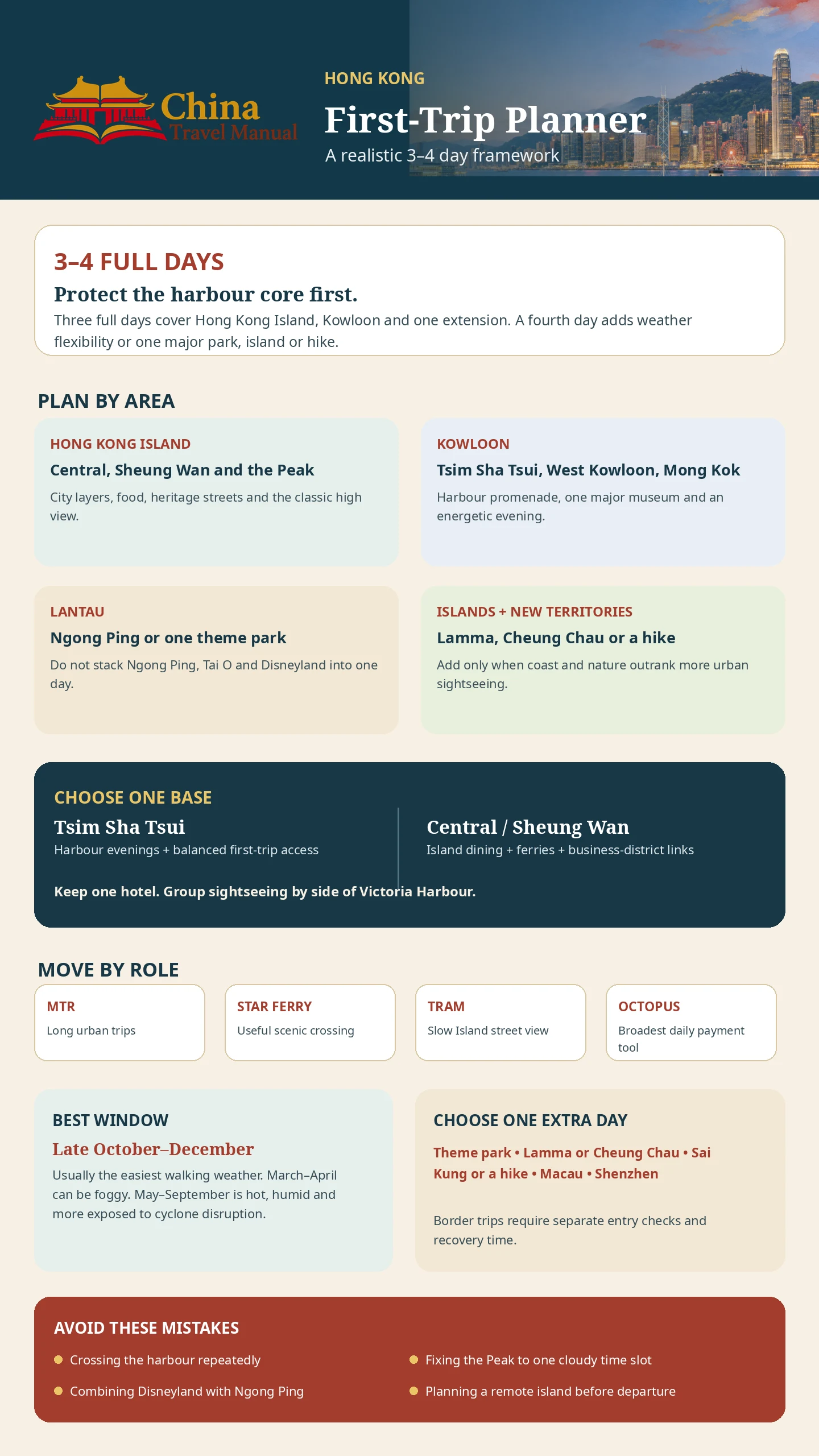
Give Hong Kong three full sightseeing days for the urban and harbour core, or four days if you want one major extension without rushing. Keep one hotel base, group each day by side of Victoria Harbour and treat Lantau, a theme park, an outlying island, Macau or Shenzhen as separate choices rather than automatic add-ons.
- Keep the core: Central and Sheung Wan, the Peak, Victoria Harbour and Tsim Sha Tsui form the strongest first-trip combination.
- Choose one extension: Add Ngong Ping and Tai O, a theme park, an island or a hike only after the harbour core is protected.
- Use one base: Tsim Sha Tsui suits harbour access and Kowloon evenings; Central or Sheung Wan suits Hong Kong Island dining and transport.
- Move by role: Use the MTR for distance, the Star Ferry for a scenic harbour crossing, trams for slow Hong Kong Island trips and buses where rail does not reach.
- Check entry rules: Hong Kong has a separate immigration system from Chinese Mainland, so verify both sides before combining them.
Arrival and departure days are not full sightseeing days unless the flight timing, immigration process and hotel location genuinely leave a usable half day.
Hong Kong is compact on a map but layered in practice. A short trip can include dense neighbourhoods, a harbour crossing, hilltop views, beaches, islands and country-park trails, yet each change of district adds station walks, queues, ferries or steep streets. The best first itinerary is therefore selective: protect the harbour core, choose one outer-area experience and leave room for weather.
This guide is for an independent international visitor planning two to five days. It focuses on day count, hotel base, compatible districts and realistic extensions. It does not replace a visa check or border-crossing tutorial.
Check Entry Rules Before You Book
Hong Kong is a Special Administrative Region with its own immigration control. A visa, visa-free permission or transit rule that applies to Chinese Mainland does not automatically give the same permission in Hong Kong, and Hong Kong admission does not automatically authorize entry to Shenzhen, Guangzhou or another mainland destination.
As of November 13, 2026, Hong Kong’s Immigration Department lists visa-free visit periods that vary by nationality and travel document, commonly from 7 to 180 days. Visitors are generally expected to have adequate funds and an onward or return ticket; Indian nationals who would otherwise visit visa-free must complete the required pre-arrival registration.[1] Check the official table for the exact passport you will carry, including diplomatic or temporary documents, rather than relying on nationality alone.
| Your route | What to verify | Planning consequence |
|---|---|---|
| Hong Kong only | Hong Kong visa or visa-free eligibility and permitted stay | Keep proof of onward travel and accommodation available |
| Hong Kong to Chinese Mainland | Separate mainland entry permission for your passport and purpose | Do not book a nonrefundable Shenzhen day before both sides are confirmed |
| Hong Kong to Macau | Macau entry eligibility plus re-entry to Hong Kong | Treat the trip as two border crossings, not a local ferry ride |
| Transit through Hong Kong | Whether you remain airside, collect bags or change airports or terminals | Self-transfers may require formal entry and much more time |
Entry is assessed on each arrival. If your route exits Hong Kong and returns, confirm that your passport and supporting documents remain acceptable for the return. Policies change, so repeat the check shortly before departure instead of treating an old approval or previous visit as a guarantee.
Where to Go in Hong Kong
Hong Kong Island: Central, Sheung Wan and the Peak
Hong Kong Island gives a first-time visitor the clearest contrast between finance towers, steep historic streets, temples, markets and green hills. Central is the transport and skyline core. Sheung Wan adds dried-seafood streets, traditional shops, Man Mo Temple and a more lived-in scale. They combine well on foot if you accept hills, stairways and escalators.
The Peak is the high-priority viewpoint, but it is not a fixed-time guarantee. Cloud, rain and haze can remove the skyline, while the Peak Tram can develop long queues. Keep the visit on the clearest available morning or late afternoon. A timed tram ticket does not necessarily remove the boarding queue, and weather can interrupt service.[7] If visibility is poor, keep Central and Sheung Wan and move the Peak to another day.
The historic tram is best used for a short east-west ride, not a fast cross-city connection. South-side beaches, Stanley and Aberdeen require slower buses or taxis, so skip them on a two-day visit unless the coast matters more than Kowloon.
Kowloon: Tsim Sha Tsui, West Kowloon and Mong Kok
Tsim Sha Tsui is the easiest place to understand Victoria Harbour. The promenade faces the Hong Kong Island skyline, the Star Ferry provides a useful and scenic crossing, and the district stays active after dark. It is the most efficient Kowloon area for a first evening and the strongest alternative hotel base to Central.
West Kowloon is a separate cultural district. M+ and the Hong Kong Palace Museum can each take several hours, and their closure days and tickets differ. Choose one unless art is the trip goal; both plus Mong Kok creates a rushed day.
Mong Kok is about street energy, markets and dense commercial blocks. Visit in the late afternoon or evening, then eat nearby. It does not need a full day. Temple Street is closer to Jordan and Yau Ma Tei and works as a flexible food-and-night-market stop, but it should not be sold as a perfectly preserved traditional market. Skip repeated shopping streets when your schedule is tight.
Lantau Island: Ngong Ping, Tai O and Theme Parks
Lantau contains several major attractions that look close on a regional map but do not form an easy single-day checklist. Ngong Ping combines the cable car, Big Buddha and Po Lin Monastery. Tai O is a separate bus journey beyond Ngong Ping. Hong Kong Disneyland is another full-day direction, and the airport occupies yet another part of the island.
For a first cultural extension, choose Ngong Ping plus Tai O only if you start early and accept a long transport day. The cable car is weather-sensitive and closes for scheduled maintenance, so check the official operating notice before leaving the city.[8] When it is suspended, buses still reach the plateau but the day becomes slower and less predictable.
Do not combine Disneyland with Ngong Ping or Tai O. Disneyland merits its own day; Ocean Park also deserves a separate day because it sits on southern Hong Kong Island. Travellers with only three full days should choose either a Lantau cultural day or one theme park, not both.
Outlying Islands and the New Territories
Lamma Island is the simplest island add-on for relaxed village lanes, seafood and an easy coastal walk. Cheung Chau has a denser old-town feel, beaches and a longer ferry commitment. Sai Kung and the eastern New Territories open the door to beaches, geopark scenery and demanding hikes, but they require buses, boats or taxis after the MTR.
Choose these areas on a four- or five-day trip, or when hiking and coastlines outrank museums and shopping. Ferry times, sea conditions, heat and trail difficulty shape the day. Never plan a remote island or long hike immediately before an international departure.
| Area | Best for | Suggested time | Main cost in time | Priority |
|---|---|---|---|---|
| Central, Sheung Wan and the Peak | City layers, food, heritage streets and skyline | 1 full day | Hills, Peak queues and weather | Highest |
| Tsim Sha Tsui and Kowloon | Harbour views, museums and night streets | 1 full day | Large station exits and district-to-district walking | Highest |
| Ngong Ping and Tai O | Lantau culture and landscape | 1 full day | Cable-car risk plus bus transfers | Medium |
| Theme park | Families and dedicated park visitors | 1 full day | Consumes an entire core sightseeing day | Preference-based |
| Island or New Territories | Coast, villages and hiking | 1 full day | Ferry, bus and weather dependence | Extension |
How Many Days Do You Need in Hong Kong?
Count full sightseeing days, not hotel nights. A late arrival and an early departure can turn a “four-day trip” into two usable days. Hong Kong’s transport is excellent, but changing sides of the harbour repeatedly and adding outer districts still consumes time.
| Full days | Realistic scope | What to leave out |
|---|---|---|
| 2 days | Hong Kong Island core plus Kowloon and Victoria Harbour | Lantau, theme parks, remote islands, Macau and Shenzhen |
| 3 days | Urban core plus one extension: Ngong Ping, museum focus or a short island day | Multiple theme parks or multiple border trips |
| 4–5 days | Urban core plus two different extensions with weather flexibility | Trying to do every island, park and border destination |
| 6–7 days | Deeper neighbourhoods, hiking or one carefully planned Macau or Shenzhen day | Daily hotel changes and back-to-back long excursions |
Three full days are enough for a strong first visit. Four feel better because the Peak, cable cars, ferries and hikes are weather-sensitive. An extra day protects the core if heavy rain or a cyclone warning disrupts plans.
Suggested Hong Kong Itineraries
2 Days: Harbour and Urban Core
Day 1: Start in Central, walk through Sheung Wan, use a clear-weather window for the Peak, then return to the waterfront. Cross by Star Ferry and finish on the Tsim Sha Tsui promenade. Keep dinner on the side where you end so that you do not add another harbour crossing.
Day 2: Explore Kowloon by choosing either one West Kowloon museum or the neighbourhood sequence from Yau Ma Tei to Mong Kok. Return to Tsim Sha Tsui for the evening skyline if weather spoiled it on Day 1. Delete shopping streets before deleting the harbour crossing or the Peak.
3 Days: Island, Kowloon and One Extension
Use the two-day core, then select one third-day module. Choose Ngong Ping and Tai O for landscape and culture; a theme park for a family trip; Lamma or Cheung Chau for an easier island day; or a museum-heavy West Kowloon day if heat or rain makes outdoor travel unpleasant.
Do not schedule the Peak and Ngong Ping cable car on the same fixed-weather day. Check visibility in the morning, keep the clearer high-view activity and use a neighbourhood or museum backup for the other.
4–5 Days: Add One Theme Park, Island or Hike
A fourth day can support one full theme park, island or New Territories hike. A fifth day can add another category, but pair different experiences: one theme park plus one island, or one museum day plus one hike. Avoid two consecutive long ferry or mountain days if children, older travellers or summer heat are involved.
Macau or Shenzhen can replace an extension day only after immigration permission, border transport and return timing are confirmed. Neither destination is a casual neighbourhood hop.
Where to Stay for Your Hong Kong Route
Most first-time visitors should keep one base. Hong Kong rooms are small, and changing hotels costs more time than the short rail ride saved. Compare the walk from the hotel entrance to the correct MTR exit, not just the station name.
| Base | Best for | Transport advantage | Main trade-off |
|---|---|---|---|
| Tsim Sha Tsui | First visits, harbour evenings and Kowloon dining | Star Ferry, multiple MTR links and easy promenade access | Busy streets, large station passages and tourist pricing |
| Central or Admiralty | Short business-leisure trips and island access | Airport Express connection, ferries and major MTR interchange | High room rates and steep streets nearby |
| Sheung Wan | Food, neighbourhood character and Macau ferry access | Close to Central with a calmer evening feel | Hills and fewer direct links to eastern Kowloon |
| Jordan or Yau Ma Tei | Value, local food and practical rail access | Fast MTR ride to Tsim Sha Tsui and Mong Kok | Less immediate harbour atmosphere |
| Mong Kok | Markets, late-night street energy and shopping | Excellent urban rail connections | Dense crowds and more street noise |
| Tung Chung or airport | Early flight or a Lantau-focused stop | Near the airport, Ngong Ping and Disneyland connections | Poor base for repeated Central and Kowloon sightseeing |
Check the full nightly total, room dimensions and lift access before paying. Some budget guesthouses occupy mixed-use buildings with small lifts and complex entrances. Hong Kong resumed a 3% Hotel Accommodation Tax on accommodation charges on January 1, 2025; service charges are treated separately.[9]
Best Time to Visit Hong Kong
Late October through December is the easiest general window: humidity drops, sunshine is more common and outdoor walking becomes comfortable. The Hong Kong Observatory specifically describes November and December as pleasant, sunny months.[5] This is a climate preference, not a promise of clear Peak views every day.
| Period | Advantages | Risks | Best response |
|---|---|---|---|
| November–December | Comfortable walking and generally clearer conditions | Higher demand around holidays and events | Book core accommodation early |
| January–February | Cooler streets and lower humidity | Cloud, cold fronts and chilly ferries or viewpoints | Carry layers and keep indoor options |
| March–April | Mild temperatures | High humidity, drizzle, fog and reduced visibility | Move the Peak to the clearest window |
| May–September | Long days and lush landscapes | Heat, humidity, thunderstorms and cyclone disruption | Start early, rest midday and follow warnings |
| October | Improving outdoor conditions | Residual cyclone risk and holiday crowds | Avoid rigid ferry and hiking plans |
Tropical cyclones can affect Hong Kong from May through November, most often from July to September. Ferries, cable cars, theme parks and exposed trails can stop, and heavy rain can make country-park routes unsafe.[5] Do not replace a cancelled island trip with another sea journey. Switch to a museum, covered market, shopping district or neighbourhood food day and keep checking official transport notices.
Getting to Hong Kong and Around the City
Choose Your Arrival Gateway
Hong Kong International Airport is the main gateway. Airport Express reaches Hong Kong Station in about 24 minutes and Kowloon Station in about 22 minutes, but the complete hotel journey is longer because neither station is every visitor’s final destination.[6] Add the walk, transfer, taxi queue or hotel shuttle at the city end.
High-speed rail arrives at Hong Kong West Kowloon Station, which is convenient for Kowloon but still requires immigration processing for cross-boundary journeys. Cruise terminals and Macau ferries use separate locations. Save the exact Chinese and English terminal name; “Hong Kong station” can mean an MTR station, Airport Express station or the broader city.
Use the MTR, Ferries, Trams and Buses by Role
The MTR is the default for long urban movements because it is frequent, signed in English and protected from road congestion. Station complexes can be large, so the correct exit matters. Contactless bank cards can cover some rail journeys, but they are not a universal substitute for all buses, ferries, trams and small purchases.
| Mode | Use it for | Do not use it for | Visitor difficulty |
|---|---|---|---|
| MTR | Fast cross-district travel and airport or rail connections | Seeing neighbourhood detail or reaching every coastal area | Low, but exits and interchange walks matter |
| Star Ferry | A useful scenic crossing between Central or Wan Chai and Tsim Sha Tsui | A guaranteed fastest transfer when the pier is far from your route | Low |
| Hong Kong Tramways | Short, slow rides across northern Hong Kong Island | Airport trips or time-critical cross-city travel | Low once boarding direction is understood |
| Bus or minibus | South Island, the Peak, beaches, Sai Kung and rail gaps | A first trip without a saved stop or live navigation | Medium |
| Taxi | Luggage, late nights and last-mile hills | Peak-hour harbour crossings when rail is available | Medium; show the destination address |
An Octopus remains the most practical all-purpose payment tool because it works across public transport and a very wide range of shops and dining outlets. Tourist physical and mobile versions have different purchase, deposit and refund rules; mobile availability also depends on device and account region.[4] Buy it for convenience, not because every traveller must have one. A short visitor using only a few MTR rides can use single tickets or supported contactless payment where accepted.
For route planning, the Tourism Board recommends official tools such as HKeMobility and provides an overview of the MTR, buses, ferries, trams and taxis.[3] Save offline screenshots for piers, bus stops and trailheads where mobile reception or English signs may be weaker.
Hong Kong Food and Neighborhood Experiences
Plan food by neighbourhood instead of crossing the city for one famous shop. Central and Sheung Wan work for dim sum, roast meats and modern restaurants; Jordan and Yau Ma Tei are strong for noodles, claypot rice and late meals; Sham Shui Po rewards travellers who prefer old-school snacks and markets; Sai Kung and outlying islands suit seafood when the route already goes there.
Tea restaurants, known as cha chaan teng, are fast and informal. Dim sum is easiest with two or more people because portions are shared. Roast-goose and roast-meat shops can sell out. Seafood is often priced by weight, so confirm the unit, preparation charge and total before ordering. Dietary restrictions are manageable in international districts, but sauces, broths and shared kitchens may contain seafood, pork or allergens even when the visible dish does not.
Cantonese is the main spoken language. English is official and widely used in transport, hotels and major attractions, but a saved Chinese address still helps with taxis and older restaurants.[2] Queue patiently, do not block narrow shop entrances for photographs and ask before taking close portraits in markets or temples.
Costs, Booking Priorities and Practical Setup
Hong Kong can be economical for transport and street-level food but expensive for rooms, theme parks and premium dining. The ranges below are planning estimates in Hong Kong dollars, excluding international travel and accommodation.
| Daily style | Planning range per person | What it can cover |
|---|---|---|
| Lean | HK$300–500 | MTR and ferries, casual meals and mostly free sights |
| Mid-range | HK$650–1,100 | Restaurants, a few taxis and one paid attraction or museum |
| Experience-heavy | HK$1,300+ | Theme park, premium dining, paid viewpoints and more taxis |
Rooms can exceed the rest of the daily budget, so compare the final rate with taxes and service charges. Keep some cash for small vendors. Hong Kong uses UK-style three-pin plugs and 220-volt electricity.[2]
Book in this order: confirm immigration permission; lock flights and one well-located hotel; reserve any theme park or special exhibition tied to a fixed date; book the Peak Tram or Ngong Ping cable car only after building weather flexibility; then arrange ordinary transport. Free harbour walks and neighbourhoods do not need reservations.
Choose One Extra Day: Theme Park, Island, Hike, Macau or Shenzhen
| Extra day | Choose it when | Skip it when | Key risk |
|---|---|---|---|
| Disneyland | The park is a trip priority, especially for families | You have only two or three days and prefer Hong Kong itself | Consumes a full day and requires date-specific planning |
| Ocean Park | You want rides, marine attractions and a South Island setting | You are already adding Disneyland | Outdoor operations and heat |
| Lamma or Cheung Chau | You want an easy coastal contrast | Ferry weather is poor or departure is the same evening | Schedules and sea conditions |
| Sai Kung or a hike | Outdoor scenery is more important than urban attractions | Heat, storm warnings or limited fitness make the route unsafe | Long last-mile transport and trail exposure |
| Macau | You have at least four or five days and valid entry permission | You want a relaxed Hong Kong first trip | Two immigration processes plus ferry or bridge travel |
| Shenzhen | You have separate mainland permission and a specific purpose | You assume Hong Kong admission covers Mainland China | Border time, different payment setup and return eligibility |
The best extra day is the one that adds a different experience without weakening the urban core. If the choice requires a border, treat it as an international-style excursion with document checks and recovery time.
Crowds, Weather Disruption and Common Planning Mistakes
- Crossing the harbour repeatedly: Group Central, Sheung Wan and the Peak together, then keep Kowloon sights together.
- Stacking Lantau: Ngong Ping, Tai O, Disneyland and the airport are not one convenient sightseeing circuit.
- Fixing the Peak to one cloudy slot: Protect a second clear-weather window.
- Ignoring vertical distance: Hong Kong Island streets, station exits and footbridges add stairs and slopes that a flat map hides.
- Using a remote day before departure: Ferry, cable-car or trail disruption can endanger the flight.
- Assuming every cashless option is universal: Keep a backup card, a small amount of cash and an Octopus or ticket alternative.
- Overloading museums: One major West Kowloon museum plus a neighbourhood is usually enough for a balanced day.
During heavy rain or a cyclone warning, follow official announcements. Do not continue to a closed trail, shoreline or cable car because a map still shows it. Move indoors and protect departure transport.
FAQs About Hong Kong Travel
How Many Days Do You Need in Hong Kong?
Three full sightseeing days cover the Island and Kowloon core plus one extension. Four or five days allow a theme park, island, hike or museum day without turning every day into a long commute.
Should You Stay on Hong Kong Island or in Kowloon?
Choose Central or Sheung Wan for Island dining, ferries and business-district access. Choose Tsim Sha Tsui for harbour evenings and balanced first-trip access. Keep one base unless an airport night solves a very early departure.
Do You Need an Octopus Card?
No, but it is the easiest broad payment option for transport and small purchases. Very short visitors can use supported contactless payment or single tickets for some journeys, but acceptance is not identical across every mode.
Is Hong Kong Entry the Same as Mainland China?
No. Hong Kong and Chinese Mainland have separate immigration controls. Verify permission for each side before booking a Shenzhen, Guangzhou or onward mainland journey.
Can You Visit Hong Kong Without Speaking Cantonese?
Yes. English is common in transport, hotels and major attractions. Save Chinese addresses for taxis and local restaurants, and use a translation app for detailed dietary or medical communication.
Sources
[1] Hong Kong Immigration Department. Visit Visa and Entry Permit Requirements
[2] Hong Kong Tourism Board. Traveller Information
[3] Hong Kong Tourism Board. Getting Around Hong Kong
[4] Octopus Cards Limited. Choice of Octopus for Tourists
[5] Hong Kong Observatory. Climate of Hong Kong
[6] MTR Corporation. Airport Express Timetable and Journey Times
[7] The Peak. Peak Tram Visitor Information
[8] Ngong Ping 360. Tourist Guide
[9] Hong Kong Inland Revenue Department. Hotel Accommodation Tax FAQ





