

Quick Answer: Using Beijing North Railway Station
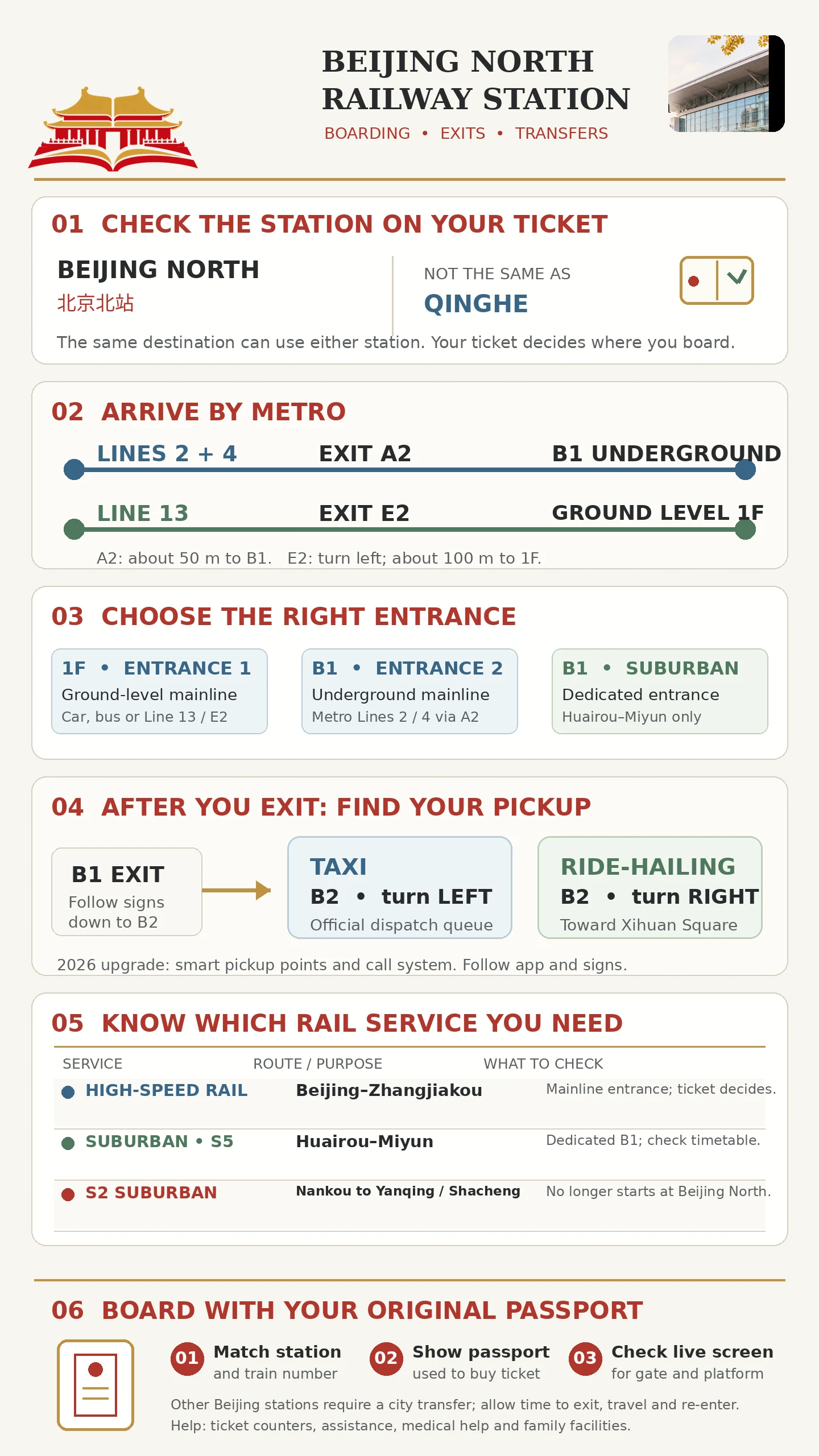
Beijing North Railway Station (北京北站, Beijingbei) is in the Xizhimen transport hub in Xicheng District. [1] Metro Lines 2, 4 and 13 connect to the station, but the best exit depends on your line: use A2 for Lines 2 and 4, or E2 for Line 13. [3] Before leaving for the station, check that your ticket names Beijing North Railway Station, not Qinghe or another Beijing station.
- Location: Use 北京北站 (Beijing North Railway Station) in maps or show the Chinese name to your driver.
- Subway access: Lines 2 and 4 use A2 for the B1 underground entrance; Line 13 uses E2 for the ground-level entrance.
- Pickups: Regular taxis and ride-hailing cars have separate areas on the lower level near Xihuan Square. [2] Follow the signs and your app.
- Train types: Beijing North serves Beijing–Zhangjiakou high-speed trains and the Huairou–Miyun suburban railway. These are different services.
- Passport: Bring the original valid passport used to buy the ticket; a booking screenshot is not a substitute for identity verification. [6]
Do not assume that every train to Badaling or Zhangjiakou leaves from Beijing North. Your ticket’s departure station and the live station displays take priority.
Beijing North Railway Station (北京北站, Beijingbei) is a major railway station in the Xizhimen transport hub in Xicheng District, western central Beijing. It handles trains on the Beijing–Zhangjiakou high-speed railway and the Huairou–Miyun suburban railway. Metro Lines 2, 4 and 13 connect with the station, while buses, taxis and ride-hailing services serve the surrounding transport area.
The most important step is to confirm the exact station printed on your ticket. Beijing North, Qinghe, Beijing Railway Station and Beijing South are separate stations. This guide explains how to reach the correct entrance, board your train, leave the station and find your onward ride. For broader city planning, start with the Beijing Travel Guide.
Where Is Beijing North Railway Station?
Station Location and Chinese Name
The station is at No. 1 Beibinhe Road (北滨河路1号), Xicheng District, beside Xizhimen Bridge. Its Chinese name is 北京北站. Use that exact name in a map or ride-hailing app, or show it to your driver. [1]
Xizhimen Station (西直门站) is the nearby subway interchange, not another name for the railway station. Follow signs for Beijing North as well as your subway line.
Beijing North vs. Qinghe Railway Station
Beijing North and Qinghe (清河站) are separate stations on the Beijing–Zhangjiakou corridor. Trains to the same destination may use different departure stations. A destination such as Badaling or Zhangjiakou does not tell you where to board. [8]
| Check | Beijing North Railway Station | Qinghe Railway Station |
|---|---|---|
| Chinese name | 北京北站 | 清河站 |
| District | Xicheng District | Haidian District |
| Metro connection | Xizhimen: Lines 2, 4 and 13 | Qinghe: Line 13 and the Changping Line |
| What to do | Follow the departure station printed on your ticket | Do not travel here unless your ticket names Qinghe |
If your ticket says Beijing North, do not go to Qinghe. For broader context, see the China railway station guide and the Qinghe Railway Station guide.
How to Get to Beijing North Railway Station
By Subway: Lines 2, 4 and 13
Xizhimen is the subway interchange for Beijing North. Choose your exit by the line you arrive on; the routes lead to different railway entrances. [3]
| Subway line | At Xizhimen, use | Railway access |
|---|---|---|
| Line 2 | A2 (northwest exit) | B1 underground entrance |
| Line 4 | A2 (northwest exit) | B1 underground entrance |
| Line 13 | E2 (north exit) | Ground-level entrance 1 |
From Line 2 or Line 4: Follow signs for Exit A and leave through A2. Walk straight for about 50 meters to reach the B1 underground railway entrance. Follow the signs for Beijing North Railway Station rather than continuing through the subway interchange.
From Line 13: Follow signs for Exit E and leave through E2. After the escalator, turn left and walk about 100 meters to the ground-level railway entrance. The route reaches a different level from the A2 route, so do not follow directions intended for Lines 2 or 4.
These are the recommended routes in current published guidance. If construction or crowd control closes an exit, follow the signs at Xizhimen.
By Bus or Private Car
Buses stop around Beijing North Railway Station and Xizhimen. Published station-area information lists routes 375 and 632 at the Beijing North bus stop, and routes 16, 26, 87, 305, 375, 651 and Special Route 216 at the Xizhimen Subway Station bus stop. Routes and stops can change, so check a current transit app on your travel date. [7]
For a private-car drop-off, use 北京北站临时客区 (Beijing North Railway Station temporary drop-off area) as your map search term. From the designated drop-off point, cross the station plaza and follow signs to Entrance 1 on the ground level. The area is for quick drop-offs, not waiting or parking. [3]
How to Enter and Board at Beijing North Railway Station
Ground-Level Entrance vs. Underground Entrance
Beijing North has three passenger entrance channels: a ground-level entrance, a B1 underground entrance for mainline trains, and a dedicated B1 entrance for suburban railway passengers. Use the entrance that matches your train. [3]
| Entrance | Where it is | Who should use it |
|---|---|---|
| Entrance 1 | Ground-level station plaza, 1F | Passengers arriving by car, bus or Xizhimen Line 13 via E2 |
| Entrance 2 | Underground level B1 | Mainline rail passengers arriving from Xizhimen Lines 2 or 4 via A2 |
| Suburban railway entrance | Dedicated entrance on B1 | Passengers whose ticket is for the Huairou–Miyun suburban railway |
The suburban railway entrance is not a shortcut for high-speed train passengers. For a Beijing–Zhangjiakou train, use the mainline entrance. If unsure, show your ticket to staff before entering.
Security Checks and Ticket Gates
Allow time to reach the waiting area, complete identity verification and pass security. The current station guide describes gates 1–4 in the ground-level waiting area and gates 5–8 in the B1 waiting area. These are not permanent assignments for every train; check the live display for your train-specific waiting area and gate. [3]
- Prepare the original valid identity document used to buy the ticket. For most foreign visitors using the 12306 English service, this is the passport.
- Enter through the correct railway entrance and complete identity verification at an automatic or staffed gate as directed.
- Place your bags and carried items through the security screening process.
- Check the large departure screens for your train number, waiting area and check-in gate. Match the train number and departure time, not only the destination.
- When boarding begins, follow the signs and staff instructions through the ticket gate to the correct platform.
Queues may form at identity checks, security and ticket gates, and check-in closes before departure. Allow extra time if you need manual passport verification, have large luggage or are traveling during a holiday. Follow the station announcements and staff instructions for the exact check-in cut-off. [6]
When Should You Arrive?
There is no single arrival time for every passenger. Include the walk to the correct entrance, identity checks, security, possible queues and the route to the platform. First-time visitors should allow more time than regular users.
- Allow extra time: If you are unfamiliar with Xizhimen, have large bags, need help with passport checks or are traveling during a holiday period.
- Check the train screen: Boarding gates and waiting areas are assigned by train and can change.
- Do not aim for the last minute: Ticket checks stop before departure, even if you already have an electronic booking.
How to Exit Beijing North Railway Station
Finding the B1 Exit Area
After arrival, follow Exit signs from the platform to the B1 exit level. The underground area has east- and west-side passenger flows. Choose the passage marked for your next transport mode; the nearest door may not lead to your pickup area. [1]
Passengers transferring to the subway can follow the metro interchange signs from B1. Passengers going to a bus or the station plaza should follow the relevant ground-level signs. Those meeting a driver should continue toward the lower-level pickup areas and use the signs for the correct service.
Transferring to the Beijing Subway
From B1, follow signs for Metro Lines 2, 4 or 13 and check the line and direction before entering the paid area. If your next train leaves from another railway station, plan a separate city transfer; the stations are not connected by an internal passage.
Taxi, Ride-Hailing and Pickups
Where to Get a Regular Taxi
For a regular taxi, follow the “Taxi” (出租车) signs and take the escalator down. At the lower level, turn left as directed toward the official taxi dispatch area. Join the marked queue and use a licensed taxi. Avoid unsolicited offers. [2]
Where to Meet Your Ride-Hailing Driver
Ride-hailing has a separate pickup area. Follow “E-hailing” (网约车) signs down to B2, turn right and follow the floor markings toward Xihuan Square (西环广场) and the B2 parking area. [2]
The B2 area was upgraded in February 2026 with an additional ride-hailing entry lane, two dedicated pickup points and a smart vehicle-calling and display system. Colored floor markings guide passengers. Follow the pickup bay or call number shown in your app and on station screens; do not rely on an old fixed distance. [4]
- Match the service: Taxi and ride-hailing queues are separate; do not wait in the wrong area.
- Check the app: Confirm the driver, vehicle plate and assigned pickup point before getting in.
- Ignore unsolicited offers: Use the official queue or the pickup point shown in your app.
Train Services and Routes from Beijing North
Beijing–Zhangjiakou High-Speed Railway
Beijing North is one of the Beijing stations serving the Beijing–Zhangjiakou high-speed railway. Depending on the date and train, destinations can include Zhangjiakou, Datong, Hohhot and Baotou. These are route examples, not a promise of a daily direct service. [8][9]
Search 12306 for your exact date, train number, departure station and stops. A ticket for Beijing North cannot be used to board at Qinghe. See Train Travel in China.
Beijing North vs. Qinghe for Badaling Great Wall
High-speed trains to Badaling Great Wall Railway Station (八达岭长城站) may depart from Beijing North or Qinghe. Check your ticket before choosing a subway route or booking a ride. [5]
Badaling Great Wall Railway Station is the high-speed rail station. Badaling Railway Station (八达岭站) is a different station on the S2 suburban railway. They are not interchangeable. See the Badaling Great Wall visitor guide.
High-Speed Rail vs. Suburban Railway
Beijing North handles different rail services. A suburban train is not the same as a high-speed intercity train, even when both use the station area.
| Service | What it does | Key point |
|---|---|---|
| Beijing–Zhangjiakou high-speed railway | Intercity high-speed services, including trains toward Zhangjiakou and Badaling Great Wall | Use the mainline entrance and the train-specific gate shown on the display |
| Huairou–Miyun suburban railway | Suburban service through Beijing North, Qinghe, Changping North, Yanqi Lake, Huairou North, Heishan Temple and Gubeikou | Use the dedicated suburban railway entrance and check the current timetable |
| S2 suburban railway | A separate service on the Nankou–Badaling–Yanqing–Kangzhuang–Shacheng section | It no longer starts at Beijing North; old guides saying to board S2 here are out of date |
The Huairou–Miyun line is about 144.6 km long and has seven stations. The transport department lists eight train pairs per day, but schedules can change. The S2 route was adjusted on October 25, 2025; it now runs from Nankou toward Yanqing and Shacheng, not from Beijing North. [5]
Check the current suburban railway route information before travel.
Transferring Between Beijing Railway Stations
Beijing has several separate railway stations. A change to another station requires a city transfer, not an internal station connection. Allow time to exit, reach a subway or road pickup, cross the city, enter the next station, pass security and find the next gate.
| Station | Typical role in a Beijing rail itinerary |
|---|---|
| Beijing Railway Station (北京站) | Central and eastern Beijing rail connections |
| Beijing South Railway Station (北京南站) | Major high-speed services on the Beijing–Shanghai and southern corridors |
| Beijing West Railway Station (北京西站) | Major services toward central, southern and western China |
| Beijing Fengtai Railway Station (北京丰台站) | Additional high-speed and conventional rail services |
| Qinghe Railway Station (清河站) | Northern Beijing and Beijing–Zhangjiakou corridor |
The station name printed on each ticket is the controlling detail. For station-specific directions, see the Beijing Railway Station guide, Beijing South Railway Station guide, Beijing West Railway Station guide and Beijing Fengtai Railway Station guide.
Facilities and Passenger Services
Listed services include staffed ticket counters, self-service ticket and information machines, waiting areas, a special waiting area, a mother-and-child room, medical assistance, a police station and children’s activity facilities. Ask staff to confirm current access and opening hours. [1]
Elevators and escalators connect the levels, but not every route has the same accessibility features. If you need step-free assistance, contact the railway operator before travel and confirm the accessible route with station staff.
CapitaMall Xizhimen (凯德MALL·西直门) is next to the station area and offers dining and shopping outside the railway paid area.
Practical Tips for Foreign Travelers
- Use the original passport: Bring the same valid passport used to buy the ticket. Keep it accessible until you have exited the destination station.
- Check the name carefully: Confirm the passenger name, passport details, travel date, train number and departure station in your booking.
- Use the original ID: A booking screenshot does not replace the valid identity document used to buy the ticket.
- Ask for manual verification if needed: If an automatic gate cannot read your passport, follow the signs to a staffed/manual ticket-check gate and show the original document.
- Save the Chinese station name: Keep 北京北站 in your phone so you can show it to a driver or station employee.
- Follow live information: The departure screen, station announcements and staff instructions take priority over saved screenshots or old travel posts.
The 12306 English FAQ confirms that foreign passengers can buy real-name tickets with eligible passports and must present the same identity document when checking in and boarding. See How to Use 12306 as a Foreign Visitor. [6]
FAQs About Beijing North Railway Station
Which Subway Exit Is Best for Beijing North Railway Station?
Use A2 at Xizhimen if you arrive on Metro Line 2 or Line 4; it leads toward the B1 underground railway entrance. Use E2 if you arrive on Line 13; after the escalator, turn left and walk toward the ground-level entrance. Check live station signs if an exit is closed.
Is Beijing North Railway Station the Same as Xizhimen Station?
No. Beijing North Railway Station is a railway station. Xizhimen is the nearby subway interchange served by Lines 2, 4 and 13. The two are connected, but the names refer to different transport facilities.
Where Can You Get a Taxi at Beijing North Railway Station?
Follow the Taxi (出租车) signs from the railway exit area and take the escalator to the lower level. Turn left at the B2 level toward the official taxi dispatch area. Ride-hailing uses a separate pickup area, so do not join the taxi queue if you booked a car in an app.
Does Beijing North Railway Station Have High-Speed Trains to Badaling Great Wall?
Yes, some high-speed services to Badaling Great Wall Railway Station depart from Beijing North. Other services may depart from Qinghe. Check the departure station on your ticket; the destination alone does not tell you which Beijing station to use.
Can You Take the S2 Train from Beijing North Railway Station?
No. The S2 suburban railway route was changed in October 2025 and now runs from Nankou toward Yanqing and Shacheng. It no longer starts at Beijing North. Older guides that tell you to board S2 at Beijing North are out of date.
Can Foreigners Board Trains with Their Passports?
Yes. Foreign visitors can use an eligible valid passport for real-name train tickets. Bring the original passport used for the booking. If an automatic gate cannot read it, ask staff to direct you to a manual verification gate.
Sources
[1] Beijing Major Railway Station Areas Administration. Station Guide and Passenger Flow at Beijing North Railway Station
[2] Beijing Municipal Government. Guide to Taxi/E-Hailing Services at Beijing’s Seven Major Railway Stations
[3] Beijing Daily. Latest News! Changes to Entry at Beijing West Railway Station: Construction Schedule (Beijing North section)
[4] Beijing Municipal Government. Smart Ride-Hailing Call System Launched at Beijing North Railway Station
[5] Beijing Municipal Commission of Transport. Suburban Railway Route Information
[6] China Railway 12306. English FAQ
[7] Beijing Major Railway Station Areas Administration. Bus Services at Beijing North Railway Station Area
[8] Beijing Municipal Government. Popular Tourist Destinations from Beijing’s Seven Railway Stations
[9] Beijing Municipal Government. Check Which Beijing Railway Stations Offer High-Speed Rail Service (Korean edition)





