

Quick Answer: Which Ticket or Travel Card Should You Use?
For a few metro rides, buy single tickets or use a supported contactless bank card where available. For frequent rides on buses and the metro, consider a local stored-value card or transport code that covers the services you need.
- Start with the city and service. Activate the correct city and metro or bus code. Check whether airport express, Maglev or suburban lines have separate fares.
- Use the same credential for the trip. Enter and exit with the same ticket, card, phone wallet or transport code where exit validation is required.
- Keep a cash fallback. Carry small yuan denominations as a fallback. If your phone is unavailable at a metro station, check the ticket machine or ask staff which physical ticket you can buy.
Ticket, pass and card policies are set locally. Check the operator’s latest signs for direct bank card acceptance, and ask where you can top up or refund a stored-value card before adding a large amount.
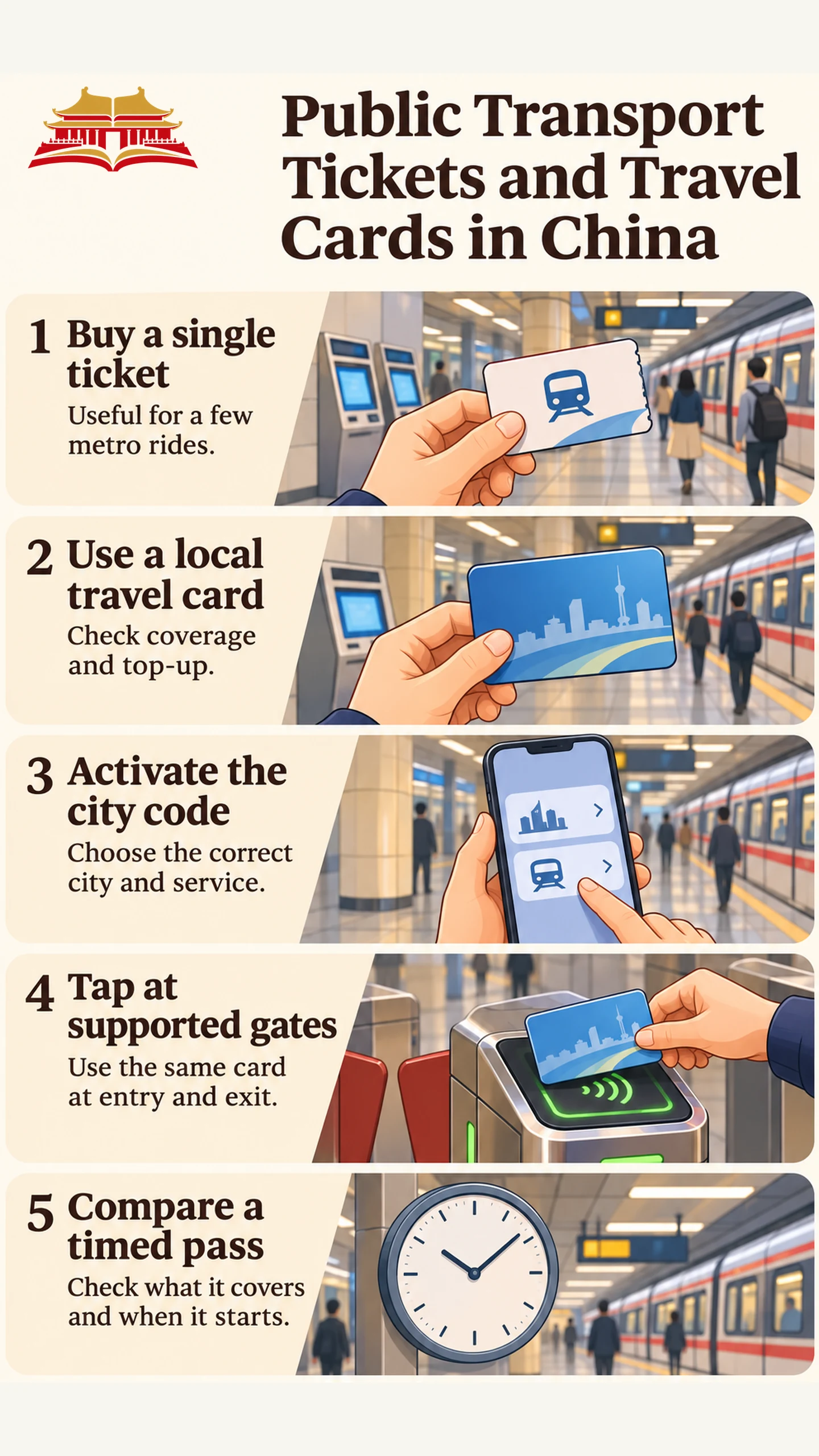
You can buy a single metro ticket, scan a city transport code, use a stored-value card or tap a bank card at a supported gate. The simplest choice depends on the city and whether your trip includes buses or airport rail. Check how you will pay before you reach the gate, and keep the same fare credential handy for the exit.
Compare the Main Fare Options
| Fare method | When it is useful | What to check |
|---|---|---|
| Single metro ticket | You make a few rides or need a fallback | Destination, accepted payment and how to exit |
| Stored-value travel card | You travel repeatedly or prefer a physical card | Purchase fee, covered services, top-up and refunds |
| City transport code | You have a working phone and prefer scanning | City, service, identity verification and payment |
| Contactless bank card | The operator accepts your card directly at the gate | Network, contactless eligibility and same card or device at exit |
| Timed pass | Many rides fit within a defined period | Start time, exclusions and cost against individual fares |
The national visitor guide describes single-journey metro tickets at machines and staffed counters. It also describes local bus and metro QR codes in supported apps. A code for paying a merchant is different from the transport code presented at a gate. See the Alipay guide for getting the app ready.[1]
How to Pay for a Metro or Bus Ride
- Check the local option. Find the names of the metro operator or bus service. For a one-off metro ride, choose your destination at a machine or show its name to a ticket agent. Check whether the machine or counter accepts cash or your card for the purchase.[1]
- Activate a transport code if needed. In a supported app, select the city in the transport section and choose metro or bus where they are listed separately. Complete the verification and payment setup before joining the queue. Open the live code when you need to scan.[1]
- Use one fare credential through the metro. Present the same ticket, travel card, code or bank card at entry and exit. If you entered with a bank card in a phone wallet, use the same device and wallet credential later. See the metro guide for the gate sequence.
- Read the instructions on the bus. Check where to tap, scan or pay cash when boarding and whether there is a second validation when getting off. Keep small change available if you plan to use cash. The city bus guide covers stops and boarding.[1]
- Ask staff to fix a gate error. If the exit reader rejects your credential, go to the service point and show what you used at entry. Keep the time and station name handy. Staff can tell you how to settle a fare or correct an incomplete ride.
When a Local Card or Pass Is Worth It
A stored-value card can be convenient when you take multiple modes. In Beijing, the visitor-oriented Beijing Pass requires a passport at purchase. Its published rules distinguish the card’s nonrefundable purchase fee from the balance that can be refunded under the service’s procedures. Check the listed top-up and refund locations before you leave the city. Beijing also publishes direct tap-to-ride support for eligible cards on five major networks.[2][3]
A timed pass is a different purchase. Shanghai’s metro guide lists an 18 yuan pass valid for eligible rides during operating hours in the 24 hours from first entry, and a 45 yuan pass valid over 72 hours. Both exclude the Maglev and suburban railway lines opened in or after 2024. On a day with four short rides at 3 yuan each, individual fares total 12 yuan. Six such rides total 18 yuan. Use your actual itinerary to compare costs. The Shanghai Metro guide can help you plan those rides.[4]
Check Cross-City Use Before You Top Up
A card with the China T-Union mark can work beyond its issuing city at participating readers. Verify the service and keep enough balance before departing. Shanghai’s transport authority says out-of-town T-Union cards accepted on its public transport cannot be topped up or returned for a refund in Shanghai. Keep your own card issuer’s instructions for those services.[5]
FAQs About China Public Transport Tickets
Can I just tap my foreign bank card at the metro gate?
Only use direct bank card entry when the local operator lists your card as eligible. Beijing and Shanghai publish contactless acceptance for supported bank card networks. Check the gate symbol and use the same contactless card or device for exit.[3][4]
Can I use my city transport code in the next city?
Open the app’s transport section and see whether the next city and service are supported. Some apps offer multiple cities, but you may need to activate a different code. Confirm setup before reaching the gate.[1]
How do I choose between a one-day pass and single tickets?
Add the likely fares for the rides the pass covers. Compare that sum with the pass price and check when the timer starts. Budget any excluded airport or suburban service separately.[4]
Sources
[1] Ministry of Commerce of the People’s Republic of China. 2026 visitor guide to metro and bus payments
[2] Beijing Municipal Government. Beijing Pass purchase, top-up and refund instructions
[3] Beijing Municipal Government. Beijing Subway tap-and-go card acceptance
[4] Shanghai Municipal Government. Shanghai Metro ticket types and fare options
[5] Shanghai Municipal Commission of Transportation. China T-Union card use and servicing in Shanghai





