

Quick Answer
Start with Alipay if you are setting up your first standalone payment app for mainland China. Set up WeChat Pay too if a hotel, restaurant or tour operator uses a WeChat mini program. If you already have a working WeChat account and your card links successfully, you can start there. Both apps support merchant payments with eligible overseas cards. Carry some yuan in cash and another way to pay if your phone or card fails.[1][3]
| What you need | Alipay | WeChat Pay |
|---|---|---|
| Sign up or link a card | Standalone app with an overseas phone number and an eligible card | Wallet within WeChat, using an eligible card |
| Pay in shops and restaurants | Scan the merchant code or show yours | Scan the merchant code or show yours |
| Use transport or order in an app | Check the city or service’s options | Useful when the service already runs in a WeChat mini program |
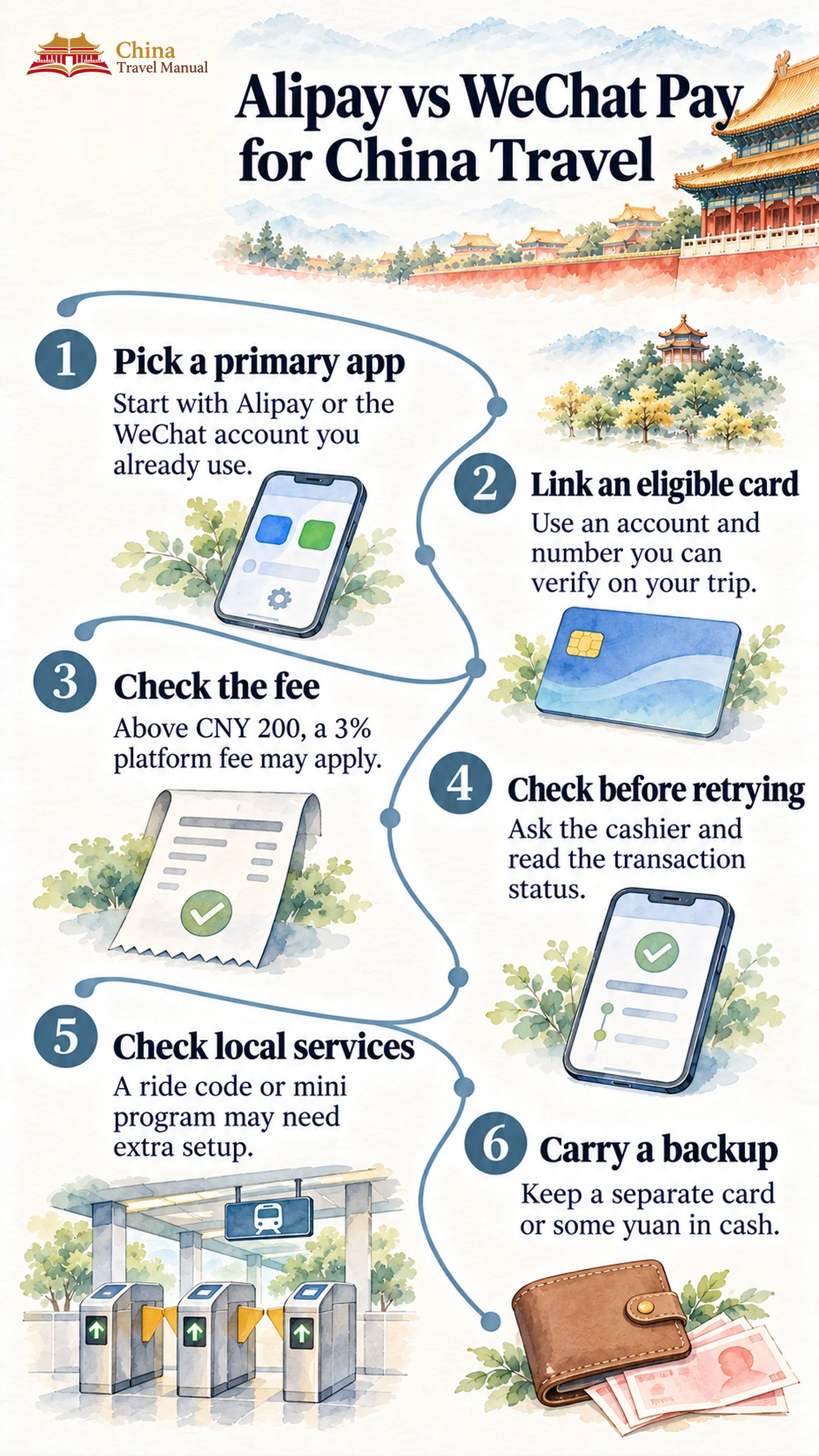
A payment app is ready for travel when you can log in, see the right card in the wallet and complete a real purchase. Linking a card at home is the first check. The next is making a small purchase where you can easily switch payment methods if the transaction fails.
Which App Should You Set Up First?
Alipay is a practical first choice if you want one place to begin with a payment code, bank card and services such as city transport where supported. WeChat Pay, called Weixin Pay in many official guides, fits a trip that already uses WeChat for messages, reaching a guide or opening a restaurant or ticketing mini program. If you can access both apps, start with the one that best fits your first day. The dedicated Alipay guide for tourists and WeChat Pay guide for tourists walk through the individual setups.[1][3][4]
A hotel or family-run shop can give you a useful clue by telling you what payment it expects. Ask whether it will accept a foreign card directly, offer a merchant QR payment, or take cash at the front desk. For a small purchase, the choice may be as simple as using the app the merchant asks for. For a large bill, compare the final quoted amount and how a refund would be handled.
Two apps using the same overseas card have a common point of failure. If the issuer blocks a charge, moving from Alipay to WeChat Pay may leave the problem exactly where it was. Carry another card if you have one and keep small-denomination cash available. The guide to paying in China shows how to combine the options.[1][2]
Set Up Both Before Departure
In Alipay, start under Me and Bank Cards. In WeChat, open Me, Services, Wallet and Bank Cards if that menu is available on your account. Menu labels can vary by app version and region. Follow the in-app card and identity checks. Input the same name as you use on your passport or card where the app asks for those details.[1][5]
Use a number on which you can receive account and issuer codes during the trip. If your China travel eSIM does not receive ordinary text messages, make separate arrangements for verification before changing number settings. Check that the phone and banking app show you how to approve an overseas purchase. Linking a card can fail even when the card network is supported, so confirm any issuer rejection with the bank before relying on the app.[1][2]
In the first shop, ask whether the cashier will scan your payment code or whether you need to scan the merchant’s code. When the app asks you to enter the amount, compare it to the bill and check the merchant name, chosen card and total before confirming. Open the app directly when you need your payment code. Keep your QR code and one-time verification messages private.[1]
Fees and Limits on Overseas Cards
For eligible cards issued outside mainland China and linked to either app, Shanghai’s visitor guidance says a transaction of CNY 200 or less is generally exempt from the app’s service fee. Above CNY 200, a 3% fee can apply to the full transaction. For example, if the fee applies on CNY 400, the platform fee is CNY 12 and the total before any separate issuer charges is CNY 412. Check the screen before authorizing the payment.[2]
Government guidance lists possible ceilings of USD 5,000 per transaction and USD 50,000 annually. Use the limits displayed in your account and any lower limits imposed by your issuer. Fees charged by your issuer, including any foreign transaction charge or conversion cost, are separate from the app’s service fee. Tencent has announced promotions for some newly linked cards. Treat any offer as account-specific and rely on the fee quoted before you pay.[2][6]
For a hotel balance or an expensive reservation, ask what the merchant accepts and compare the mobile-payment total with the direct card quote. The guide to using foreign cards in China explains what to check if you want to pay by card at the terminal.
How to Recover From a Failed QR Payment
- Check the transaction status. Look in the app before you try again. If it is pending, ask the cashier to check their payment record before you make a second attempt.
- Confirm the QR method and chosen card. Ask for a merchant payment code or offer to show your own code. Check the purchase amount and which card the app has selected.[1]
- Try another available payment method. Use the second app when the seller supports it. If you suspect an issuer decline, try a different card or pay in cash while you check with the bank.
- Keep the record if an amount was deducted. Retain the merchant receipt, transaction reference and time. Use the merchant and official app support channels to resolve a missing confirmation.
If you need to trace a reversal or refund later, use the mobile-payment refunds guide to match the transaction with the card statement. The China payment troubleshooting guide has more checks for card linkage, merchant acceptance and network problems.
Transport Codes, Ordering and Larger Bills
A city transit ride code is separate from your shop payment code. For Shanghai, official guidance includes options in both Alipay and a WeChat mini program. Check your city, transit operator and funding method in advance. If you cannot activate the ride code, use the ticket or staffed option at that station when available. A phone that can pay at a convenience store may still need additional setup before you can go through a transit gate.[1][4]
Restaurant table codes can open an ordering service with its own payment flow. If your overseas card works at the till but not inside the mini program, ask staff if they can take the order and accept payment another way. For a tour or room deposit, confirm the owner of the payment account and obtain the terms and a receipt before paying. Use the China cash and ATM guide to plan a backup for transactions you cannot complete on the phone.[1][3]
FAQs About Alipay and WeChat Pay
Do I need a Chinese bank account or phone number?
Both apps allow eligible cards issued overseas, and visitor registration can use an overseas number. Keep access to any text or issuer approval prompt. Requirements can differ by account, card and service.[1][2]
Will every merchant QR code work with a foreign card?
Acceptance depends on the merchant’s setup, the app and your card. If a scan does not give you the option to pay with that card, ask for a merchant payment code or an alternative payment method.[1][2]
Is one app cheaper than the other?
Compare the fees shown for the actual purchase. Both apps commonly use a CNY 200 threshold for the overseas-card service fee, although offers and issuer charges can change the total.[2][6]
Can I send money to a friend from a linked foreign card?
Use the linked card for supported merchant purchases. Direct transfers to a friend and sending red packets have separate eligibility rules, and Shanghai’s guidance warns against expecting those WeChat functions to work with an overseas card.[5]
Sources
[1] Shanghai Municipal Government. How to use mobile payments in Shanghai
[2] Shanghai Municipal Government. Overseas bank card payments, fees and limits
[3] Tencent. Weixin Mini Programs
[4] Shanghai Municipal Government. Public transportation guide for international bank card users
[5] Shanghai Municipal Government. Card linkage and payment functions
[6] Tencent. 2026 inbound payment initiatives and fee promotion





