

Quick Answer
You can use an overseas-issued Visa, Mastercard or other supported bank card at participating merchants in mainland China. Check the logo on the actual terminal or ask the cashier to verify your card’s network before you commit to a purchase. Take the physical card for hotels, a phone payment app for merchants that use QR codes, and some yuan in cash for a backup.[1][2]
| How you want to pay | What to check |
|---|---|
| Directly at a counter | The merchant can process your specific card network. |
| By tapping at a metro gate | The operator supports the network and card or device you present. |
| On a website | The checkout accepts cards from your issuer and you can complete verification. |
| In Alipay or WeChat Pay | You can link the card and the seller supports the payment flow. |
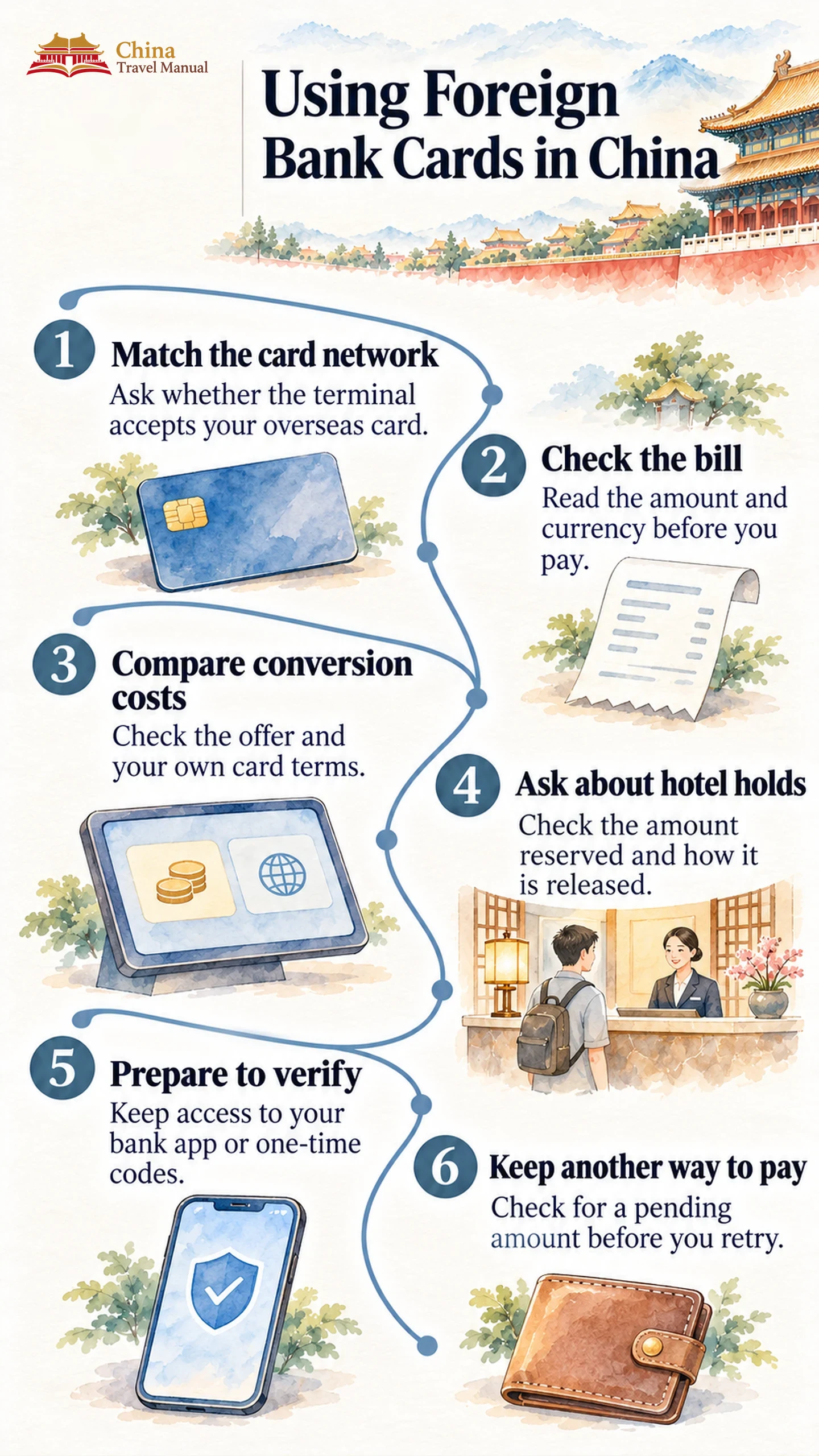
Start by checking three purchases you will probably make as soon as you arrive. Your hotel may be able to take the card directly, your metro may accept a contactless tap, and a food stall may ask for a payment code. A working card in one situation tells you little about the other two.
Where Foreign Cards Are Accepted
China’s visitor payment guidance calls for wider overseas card acceptance at designated tourist hotels, higher-rated attractions and popular tourism areas. At participating terminals, networks can include UnionPay, Visa, Mastercard, American Express, JCB, Diners Club and Discover. The card must still match what that terminal supports. Ask before ordering a large meal or paying for a tour, especially at a small business or in a less-visited area.[1][2]
Direct acceptance is most useful when a merchant can confirm it in advance. Ask the hotel before departure whether your card can cover the room balance and whether it can also be used for the incidental hold. Confirm the network, whether debit cards are accepted for the second purpose, and whether they need the physical card. Even if the deposit is eventually released, it can reduce the money or credit available to you while traveling.[1][6]
Beijing and Shanghai give useful metro examples. Beijing’s urban rail system lists contactless support for five card networks. Shanghai expanded its contactless pilot across the metro network, with eligibility conditions for cards and devices. Check the sign at the gate and use the same card or device for both taps in a paired entry-and-exit system. If a gate rejects your card, ask staff about a single-journey fare or another payment method. Contactless availability varies by operator and city.[3][4]
How to Pay by Card at the Counter
- Check the merchant and card network. Match the card logo to the payment terminal or ask staff if that terminal takes overseas cards. Have the physical card ready if requested.[1]
- Read the amount and currency. Make sure the amount matches your bill and look for any optional conversion to your card’s billing currency.[5]
- Follow the terminal instructions. Tap or insert the card as directed. Use the correct PIN if prompted and cover the keypad while entering it.
- Keep confirmation of the payment. Save the receipt, especially for a large purchase, hotel preauthorization or refund you may need to verify.
If the cashier shows you a QR code instead, ask if it is the merchant’s code or whether you should display your wallet code to be scanned. Follow the instructions for the merchant’s chosen app. See the guide to paying in China for other payment options.[1]
Exchange Rates, Fees and Hotel Holds
Pay Attention to the Currency on the Terminal
At checkout, an offer to pay in your billing currency can include the merchant’s conversion rate and a markup. This is called dynamic currency conversion. The terminal or receipt should show the amount in both currencies, the conversion rate and applicable fees. Review the figures before choosing. If you choose yuan, your card network or issuer handles the conversion under its own terms. Any issuer charge can still apply.[5]
The most useful comparison is the total cost of the purchase in your own currency. Look up the terms of each card before the trip, including its foreign purchase fee. Confirm the displayed currency when you return a product or have a mistaken charge reversed. Keep the original paperwork while you wait to see how it settles.[5]
Ask How the Hotel Handles the Hold
An authorization reserves money or part of your credit limit. Hotels may use it to cover a room balance and expected extra charges. A separate final payment may appear while the authorization still shows as pending. Ask the property which amount it will authorize, what charges it will put through on departure, and how it handles the release. Your issuer can explain how long a pending authorization normally remains visible. See the China hotel check-in guide for which booking details to bring.[6]
Use a card with enough available balance or credit for the hold and your next purchase. If you plan to settle with a different card or payment method, ask the desk how that affects release of the original authorization. Retain the final itemized bill and any hold slip.[6]
Booking Online and Linking Your Card to an App
Online payments have their own acceptance checks. The booking page may request a one-time code, biometric check or approval through your bank’s app. Keep access to your issuer’s verification method even if your China data plan uses a different number. Use an official checkout and contact your issuer through a trusted number if an unexpected alert appears. A card that works in a shop can still be declined on a website.[7]
In Alipay or WeChat Pay, the app checks whether you can link that particular card. Each merchant or service then has to support that payment flow. If you want a payment backup, avoid relying on two apps that use the same card for every purchase. The Alipay and WeChat Pay comparison helps you choose how to set up and test the apps. For a fallback that does not require a phone or a checkout terminal, see the cash and ATM guide.[1]
What to Do if a Card Is Declined
Check your account for a pending or posted amount before you retry. Ask whether the cashier received a decline and whether the terminal supports your card network. If the network is supported, read any issuer alert, check your available balance or limit, and see if the payment requires confirmation. A debit card may have different settings for overseas purchases and cash withdrawal.[1][7]
If you need to pay immediately, use a different card, a supported app or cash. For a charge you cannot match to a receipt, keep the amount, time, merchant name and any printed slip, and contact the merchant or issuer promptly. The payment troubleshooting guide helps you work out whether to contact the app, the merchant or the bank.
FAQs About Using Foreign Bank Cards in China
Can I use Visa or Mastercard in China?
Yes, at terminals and services that accept the specific network and card. Larger venues may accept more networks. Ask the merchant about your card for large payments and keep a second method for the rest of the trip.[1][2]
Can I tap my card on the metro?
Some networks, including Beijing and Shanghai, support selected contactless bank cards on fare gates. Check the local operator and the symbols at the gate before relying on this option.[3][4]
Will I pay extra if I choose yuan at checkout?
Choosing yuan declines the terminal’s offer to convert the charge into your billing currency. Your own card terms still govern its exchange rate and any foreign transaction fee. Check the final amount and currency before confirming.[5]
How do I tell whether my hotel charged me twice?
Distinguish a pending authorization from a posted charge. Compare both amounts and dates with your itemized bill. If two payments are posted or the hold is still pending after the period the issuer quotes, contact the hotel and your issuer with the records.[6]
Sources
[1] Shanghai Municipal Government. Pay with overseas bank cards
[2] State Council of the People’s Republic of China. Payment service guide for overseas visitors
[3] Beijing Municipal Government. Beijing Subway contactless card networks
[4] Shanghai Municipal Government. Shanghai Metro contactless pilot expansion
[5] Visa. Dynamic currency conversion at checkout
[6] Mastercard. Transaction processing rules for authorization and lodging
[7] Visa. Authentication for online payments





