
Quick Answer
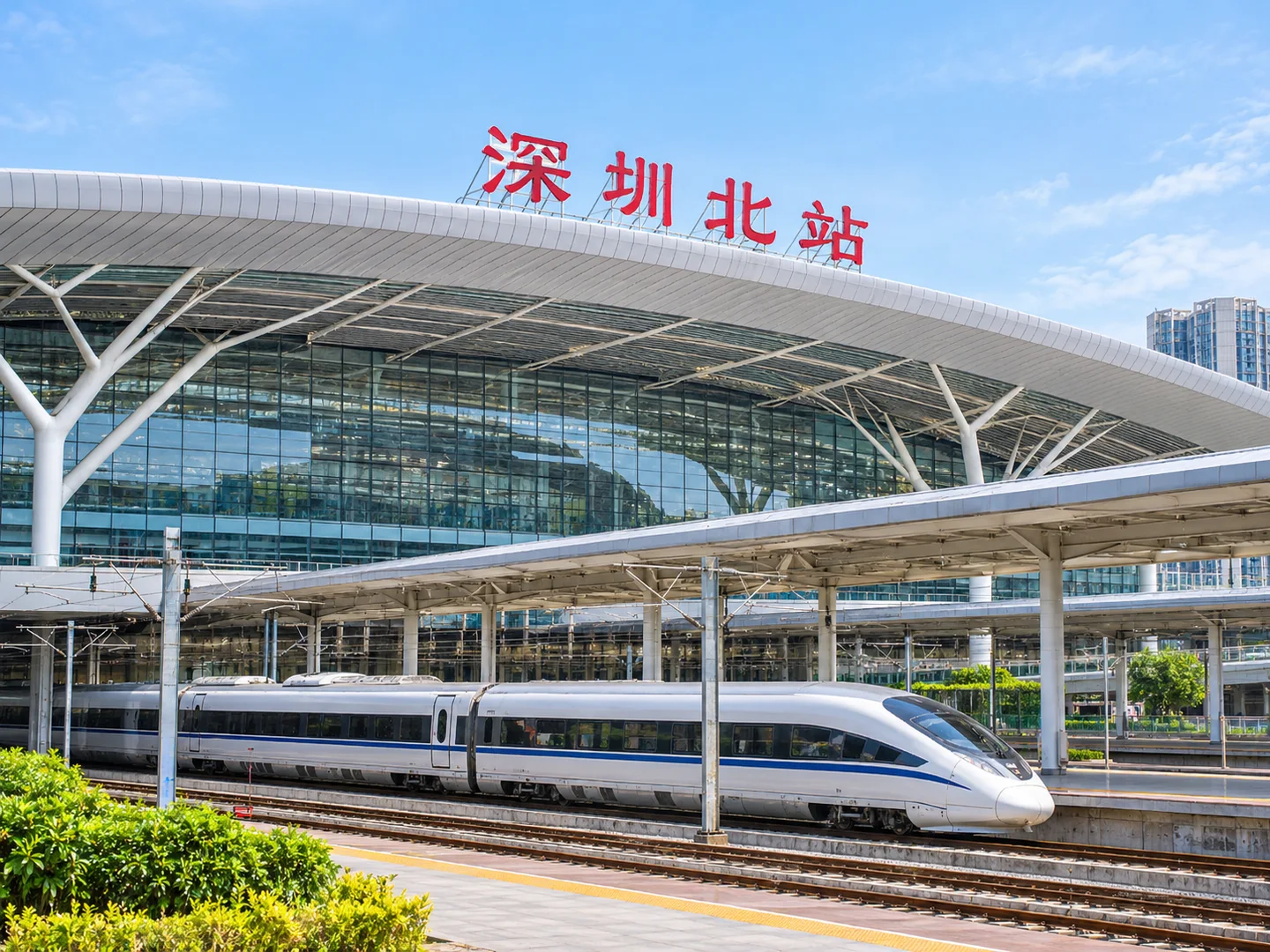
Shenzhen North Railway Station (深圳北站) is a major high-speed rail hub in Longhua District, with Shenzhen Metro Lines 4, 5 and 6. The most useful thing to decide before arrival is which side of the station you need: East Square for the metro, city buses and most taxi pickups, or West Square for ride-hailing, private pickups and long-distance coaches. [1]
- Boarding: Use the valid passport registered on your train booking. A paper ticket is normally unnecessary; ask for a staffed lane if document scanning fails. [2]
- Train departures: Gates numbered 1–10 are generally nearer East Square; gates 10–20 are generally nearer West Square. Check station screens for your actual gate. [1]
- Arrivals: Railway exits A1/A2 lead toward East Square; B1/B2 lead toward West Square. [1]
- Connecting trains: Follow signs marked 便捷换乘 (convenient transfer) before leaving the platform area. [1]
- Time buffer: First-time international visitors should plan to arrive roughly 45–60 minutes before departure, or earlier during holidays. This is planning advice, not a compulsory railway rule.

Shenzhen North is straightforward once you understand its two squares, separate railway exit labels and metro connections. But choosing the wrong pickup area—or confusing Shenzhen North with a different Shenzhen station—can cost precious time. This guide follows the passenger journey from ticket check to train boarding, arrival, onward transport and Hong Kong connections.
Shenzhen North Railway Station at a Glance
| Detail | What to know |
|---|---|
| Chinese station name | 深圳北站 (Shenzhen Bei) |
| Area | Minzhi, Longhua District, Shenzhen, Guangdong |
| Address | 28 Zhiyuan Central Road |
| Rail services | Primarily G- and D-series high-speed trains |
| Rail infrastructure | 11 platforms and 20 tracks |
| Metro connections | Lines 4, 5 and 6 |
| Main passenger areas | East Square (东广场) and West Square (西广场) |
Trains connect Shenzhen North with cities including Guangzhou, Hong Kong West Kowloon, Changsha, Wuhan, Xiamen, the Chaoshan area and Guilin, depending on the timetable. Check your exact station name on the booking: Shenzhen North (深圳北), Shenzhen Railway Station (深圳) near Luohu, and Futian (福田) are three different stations. For the broader network, see Shenzhen railway stations and train travel in China. [3]
Station Layout: East Square and West Square
East Square vs. West Square
Both squares provide access to the railway departure hall. East Square is convenient when arriving by metro, local bus or ordinary taxi. West Square is generally better for ride-hailing, private vehicles and long-distance coaches. A passenger entering from the less convenient side can still board, but may face a longer walk. [1]
| Where you need to go | Better side | Rail exit / nearby gates |
|---|---|---|
| Metro Lines 4, 5 and 6 | East Square | A1/A2 for arriving passengers |
| Local city buses | East Square | A1/A2 |
| Most regular taxis | East Square | A1/A2; follow pickup signs |
| Ride-hailing / Didi | Usually West Square | B1/B2; follow the app location |
| Private car pickup | West Square | B1/B2 |
| Long-distance coaches | West Square | B1/B2 |
| Departure gates 1–10 A/B | East Square | Closer entrance |
| Departure gates 10–20 A/B | West Square | Closer entrance |
The overlapping gate number 10 is not a reason to guess which entrance your train uses. Gate assignments and boarding instructions on the station displays take precedence. Taxi services can also operate from more than one signed pickup area; a ride-hailing booking may designate a particular bay rather than the square as a whole. [1]
Understanding the Station Levels
The railway waiting and boarding hall sits above the train platforms. Arriving travelers use separate exit passages to reach the squares. Metro Lines 4 and 6 are accessed on the elevated side of the East Square complex, whereas Line 5 is below the square; signs and elevators connect them. Do not assume identical floor numbers on the East and West sides refer to the same physical level. [1]
A published local walkthrough measured approximately five to eight minutes between the squares via the pedestrian link. Treat that as a light-luggage walking reference, not a guaranteed transfer time. Travelers with heavy bags, children or mobility needs should allow longer and use elevators. [4]
How to Board a Train at Shenzhen North Station
How Early Should You Arrive?
Plan to reach the station with time for the correct entrance, identity checks, baggage screening and the walk to your gate. The following are conservative planning buffers for travelers who already have valid electronic tickets, not official minimum entry requirements.
| Travel situation | Suggested arrival buffer |
|---|---|
| Familiar with the station, light luggage | 30–45 minutes |
| First visit with a foreign passport | 45–60 minutes |
| Children or substantial luggage | 60–90 minutes |
| Chinese public-holiday crowds | 60–90 minutes or more |
| Ticket or document problem requiring assistance | 60–90 minutes |
A September 2026 station guide says boarding checks commonly stop around four minutes before departure. Do not use that margin as your arrival plan: gate closure and staff instructions on the day govern, and train doors and station access may close before the scheduled departure time. [1]
Passport Checks, Security and Boarding
- Check your ticket details. Confirm 深圳北 (Shenzhen North), your train number, departure time, carriage and seat before traveling. Keep the booking record available offline.
- Enter using your ticket identity. Present the original valid passport used for the booking. If a gate cannot scan it, request staffed identity verification instead of repeatedly trying a different document. [2]
- Pass security screening. Place baggage on the X-ray conveyor and follow staff instructions. Items restricted on Chinese trains are covered in the China train luggage rules.
- Find the departure gate. Match the G- or D-series train number on departure displays to the assigned gate; do not assume the gate solely from the entrance you used.
- Pass the boarding check and locate your carriage. Use the passport associated with your booking, ask for staffed assistance when needed, then follow platform and carriage markers to your seat.
China uses electronic railway tickets for ordinary passenger journeys; collecting a paper ticket is normally unnecessary. A trip-information printout or reimbursement document is not a substitute for the required identity document. If your passport number changed after buying the ticket, resolve the discrepancy with the ticket provider or station staff before travel. See the 12306 guide for foreigners and train passport checks. [2]
Arriving at Shenzhen North Station: Which Exit to Use
Choosing the Right Arrival Exit
On the platform, look for the hanging signs for metro, taxis, buses and ride-hailing before following the crowd. Railway exits A1 and A2 lead to East Square; B1 and B2 lead to West Square. These are railway exit numbers, not the similarly lettered exits of the metro station. [1]
| Next connection | Preferred railway exit |
|---|---|
| Metro Lines 4 / 5 / 6 | A1 or A2 — East Square |
| City bus | A1 or A2 — East Square |
| Ordinary taxi | A1 or A2 — East Square |
| Didi or another ride-hailing app | Usually B1 or B2 — confirm booking bay |
| Private pickup | B1 or B2 — West Square |
| Long-distance coach | B1 or B2 — West Square |
Finding Your Pickup Point
For a driver or friend, agree on the square, railway exit and any signed pickup level; “Shenzhen North” alone is not a precise meeting point. Ride-hailing apps designate specific pickup areas that can change with traffic operations. Match the app’s bay and level with the posted signs rather than waiting wherever you happen to exit. The finding a Didi pickup point guide covers this problem in more detail.
For a metro connection from A1/A2, follow the Metro signs; Line 5 access is generally directed toward the lower level and Lines 4/6 toward elevated access. Allow extra walking time for elevators or substantial luggage. Some holiday periods have used a temporary, one-way no-repeat-security shortcut at A2; it is not a permanent service and should not feature in your normal travel plan. [1]
How to Transfer Between High-Speed Trains
If both tickets use Shenzhen North, a station-internal transfer may save you from exiting and clearing security again. Before following ordinary arrivals toward a square, check the next train’s station and the signed convenient-transfer passage (便捷换乘). [1]
- Step off your train and locate signs marked 便捷换乘, often shown with blue directional markings.
- Follow the dedicated transfer corridor from the platform area to the verification point.
- Present the passport and onward booking details if staff request them; use staffed verification when an automatic reader does not accept your document.
- Enter the waiting hall, confirm the next train number and gate on the departure displays, and proceed when boarding opens.
For first-time international travelers, a 40–60-minute connection is generally safer than a tightly planned 20–30-minute transfer; allow at least an hour with children or large luggage, and more during peak periods or when a late inbound train would jeopardize the connection. These are recommendations, not guarantees. If the shortcut is closed or staff direct you outside, be prepared to re-enter through normal security. See changing trains in China, train-ticket changes and refunds and missed trains in China. [1]
Getting from Shenzhen North Station to the City
Taking the Shenzhen Metro
All three connecting metro lines—4, 5 and 6—are reached on the East Square side. The best line depends on your destination, not simply which station entrance is nearest. Below are workable directional examples; confirm the specific destination exit and current operating conditions in a live map. [5]
| Destination | Suggested route |
|---|---|
| Futian central business district | Line 4 toward Convention & Exhibition Center; for Civic Center, confirm the nearest station and transfer |
| Futian Checkpoint / border crossing | Line 4 toward Futian Checkpoint |
| Huaqiangbei electronics district | Line 6 toward Science Museum; walk or transfer depending on the address |
| Luohu Railway Station and Luohu border | Line 4 to Convention & Exhibition Center, then Line 1 toward Luohu |
| Window of the World | Line 4 to Convention & Exhibition Center, then Line 1 |
| Bao’an Center | Line 5 toward Bao’an Center |
| Houhai area | Line 5 toward Qianhaiwan, then Line 11 toward Houhai |
| Guangming area | Line 6 in the appropriate direction |
Metro travel can be easier than a taxi during road congestion, but the final walk from a metro stop may matter more than the line number. For a district-by-district overview, see the Shenzhen Metro guide, getting around Shenzhen and where to stay in Shenzhen. Check the day’s last-train time when arriving late; high-speed rail services may continue after some metro connections stop.
Taxi, Didi and City Buses
A regular taxi may be simplest with bags or when your accommodation is far from the metro. Confirm the destination in Chinese, join the signed taxi queue and use the meter rather than accepting unsolicited offers in the concourse. The taking taxis in China guide covers general taxi practices. Ride-hailing is convenient when the pickup pin is understood: book in-app, verify the driver and license plate, then walk to the designated bay. See using Didi as a tourist.
Local buses leave from the East Square side and may suit short connections not served directly by rail. Service numbers and stops can change, so verify them on the day rather than relying on a static station-wide route list. For help with ticketing and apps across the country, see metro travel in China.
Transfers to the Airport and Other Railway Stations
Shenzhen North Railway Station to Bao’an Airport
For Shenzhen Bao’an International Airport Terminal 3, take Metro Line 5 from Shenzhen North to Qianhaiwan, then transfer to Line 11 toward Airport Station (机场站). The journey is often budgeted at roughly 55–70 minutes for metro travel; allow additional time for leaving the railway station, waiting and transferring. These estimates are for planning, not a fixed timetable. [6]
| Option | Indicative time | Best reason to choose it |
|---|---|---|
| Metro: Lines 5 + 11 | About 55–70 minutes, plus station access | Predictable travel when roads are busy |
| Taxi or ride-hailing | About 35–60 minutes or longer | Door-to-door transport with heavy bags |
| Late-night airport bus | Depends on currently operating service | Possible alternative after metro service ends |
Airport Station on Metro Line 11 serves T3; Airport North Station is not interchangeable with it. The airport also has its own rail/metro stations: none is Shenzhen North. Add a substantial buffer for airline check-in, security and international departure formalities. Check the airport and flight information independently in the Shenzhen Bao’an Airport guide, airport-to-Shenzhen-North transfer guide and Shenzhen airport transfer.
Shenzhen North to Futian and Shenzhen Railway Stations
For Futian Railway Station, one metro option is Line 4 to Children’s Palace (少年宫), then Line 3 to Futian. For Shenzhen Railway Station at Luohu, take Line 4 to Convention & Exhibition Center (会展中心) and change to Line 1 toward Luohu (罗湖). Check each ticket carefully: neither station is inside the Shenzhen North complex. Each requires a separate station-entry, security and boarding process. [5]
Use the Futian railway station guide or Shenzhen railway station guide for detailed exits, and the Guangzhou to Shenzhen travel guide and Guangzhou South station guide when planning wider regional train connections.
Taking a High-Speed Train to Hong Kong
Direct services connect Shenzhen North with Hong Kong West Kowloon, with some journeys taking roughly 18–30 minutes on the train. This is only the rail travel time—not the time needed for station access or border formalities. Always check the actual ticketed departure and arrival stations, train schedule and eligibility to enter both jurisdictions. [7]
From Shenzhen North to Hong Kong, complete your ordinary rail boarding procedures at Shenzhen North. After arriving at West Kowloon, follow signs to the Mainland departure and Hong Kong arrival immigration checks conducted within the West Kowloon station complex before entering Hong Kong. On the reverse journey, passengers clear Hong Kong departure and Mainland entry formalities at West Kowloon before boarding northbound trains; they do not repeat those same border procedures at Shenzhen North. [7]
Passport holders may need extra time for staffed immigration processing at West Kowloon when departing Hong Kong. Hong Kong and Mainland China have distinct entry rules, so do not assume that admission to one automatically permits entry to the other. Consult the Shenzhen to Hong Kong guide, Hong Kong West Kowloon station guide and Shenzhen–Hong Kong border crossings before selecting a crossing or ticket. Travelers combining all three regional cities can also use the Guangzhou–Shenzhen–Hong Kong itinerary.
Station Facilities and Practical Tips
Expect signed restrooms, drinking-water points, seating, food outlets, convenience shops, elevators and passenger-assistance counters around the station complex. Family care facilities and accessible restrooms may be available; ask station staff for the nearest working facility or assistance. Do not assume a particular shop, locker bank or service counter is open around the clock.
Luggage storage availability, location, accepted bag size and fees should be checked at the station on the day; third-party listings are inconsistent. For broader advice, see railway station luggage storage and accessible train travel. Travelers needing help can show a staff member their Chinese destination or the term in the table below.
| English sign | Chinese sign |
|---|---|
| Entrance | 进站口 |
| Exit | 出站口 |
| Boarding gate | 检票口 |
| Platform | 站台 |
| Convenient transfer | 便捷换乘 |
| East Square | 东广场 |
| West Square | 西广场 |
| Taxi | 出租车 |
| Ride-hailing pickup | 网约车上车点 |
| Luggage storage | 行李寄存 |
FAQs About Shenzhen North Railway Station
Is Shenzhen North Station the same as Shenzhen Railway Station?
No. Shenzhen North (深圳北) is in Longhua, while Shenzhen Railway Station (深圳) is at Luohu. Futian Railway Station is a third, separate station. Confirm the full Chinese station name on the train booking before traveling.
How early should I arrive at Shenzhen North Railway Station?
For a first visit using a foreign passport, plan to arrive about 45–60 minutes before departure. Allow 60–90 minutes or more with bulky luggage, children, ticket problems or major holiday crowds. These are practical buffers, not official minimum times.
Can foreigners board trains at Shenzhen North with a passport?
Yes. Use the valid passport registered when buying the train ticket. Electronic tickets usually remove the need to collect a paper ticket. If an automatic identity gate rejects your passport, ask staff to direct you to a staffed verification lane.
Can I transfer between trains without leaving Shenzhen North Station?
Usually, if both trains use Shenzhen North and the designated convenient-transfer passage is operating. Follow the 便捷换乘 signs from the platform, present your onward ticket and passport as required, and confirm the new departure gate inside the waiting hall.
Do I go through immigration at Shenzhen North when traveling to Hong Kong?
No. For high-speed rail services to Hong Kong West Kowloon, the Mainland departure and Hong Kong arrival checks take place at West Kowloon. For travel in the reverse direction, both jurisdictions’ departure and entry checks are completed there before boarding.
Sources
[1] Nanfang Daily. Shenzhen North station travel guide, September 2026
[2] China Railway 12306. 12306 English passenger services and identity document guidance
[3] Shenzhen Municipal Government. Shenzhen North Railway Station overview
[4] Guangming Online. Shenzhen North station wayfinding and East–West connection
[5] Shenzhen Municipal Government. Shenzhen metro network and service information
[6] Longhua District Government. Airport and railway station transport connections
[7] MTR High Speed Rail. Arrival and departure procedures at Hong Kong West Kowloon





