
Quick Answer: What Is the Best Way to Get Around Shenzhen?
For most sightseeing days, use the metro for the long part of the trip, then walk or take Didi or a metered taxi for the last mile. Shenzhen is spread across a wide area, so walking between districts is rarely practical. The best choice changes when you have large luggage, travel after the metro closes, cross into Hong Kong, or visit the eastern coast.
| Option | Best for | Main advantage | Main limit |
|---|---|---|---|
| Metro | Daytime travel across districts | Fast, inexpensive and protected from road traffic | Busy at rush hour; some transfers and exits are long |
| Didi or taxi | Luggage, groups, late nights and the last mile | Door-to-door travel with a preset destination | Traffic, pickup-zone rules and higher cost |
| Bus | Metro gaps and Dapeng connections | Wide coverage and low fares | Routes change and road delays are common |
| Walking or shared bike | Short trips within one district | Flexible and inexpensive | Superblocks, highways, heat and rain limit usefulness |
| Train or ferry | Hong Kong and regional travel | Efficient for specific corridors | Separate tickets, documents and departure times |
Shenzhen may look compact on a map, but expressways, border facilities and large developments can turn a short straight-line distance into a long door-to-door trip.
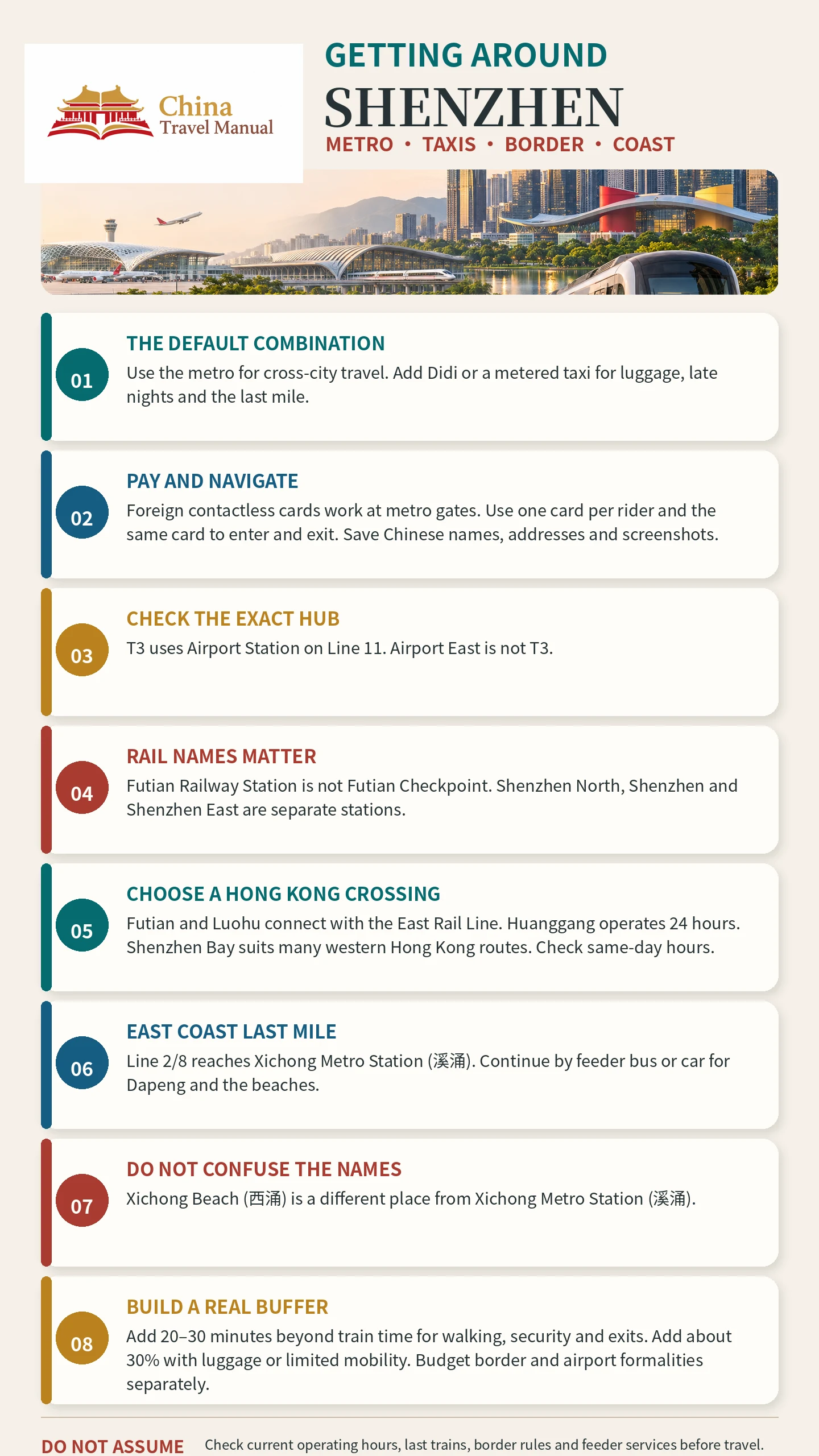
Shenzhen is easier to navigate than its size first suggests, but only if you match the transport mode to the job. The metro is the everyday backbone. Taxis and ride-hailing cars solve luggage, late-night and awkward last-mile trips. Buses matter most where the rail network ends, especially toward Dapeng.
The details become more important around Shenzhen Bao’an International Airport, the city’s several railway stations and the border with Hong Kong. Similar English names can lead to completely different places, so check the Chinese name, station and terminal before leaving your hotel. For wider planning, start with the Shenzhen travel guide.
Set Up Payment, Maps and Chinese Addresses
As of November 2026, every Shenzhen Metro fare gate accepts eligible contactless Visa, Mastercard, American Express and JCB cards. One traveler should use one card, and the same card or device must be used to enter and exit. A physical card and the same card inside a phone wallet may be treated as different payment tokens, so do not switch between them during one journey.[1]
Keep a backup even when your bank card normally works. A foreign bank may decline a small overseas transit charge, or a phone wallet may fail to produce the same token at the exit gate. A single-journey ticket from a machine or service counter is the simplest fallback. Shenzhen Tong and mobile payment are useful for longer stays, but neither is required simply to ride the metro. The detailed ticket choices belong in the Shenzhen Metro guide.
Bus payment is a separate system. Shenzhen’s official bus guidance lists Shenzhen Tong, Lingnan Tong, the national transport card and UnionPay among accepted physical methods, but visitors should not assume that every bus accepts the same overseas cards as the metro.[3] Carry a small amount of renminbi as an emergency backup rather than depending on one payment channel.
For navigation, save all four of these before leaving Wi-Fi:
- Chinese place name: Save the hotel’s complete Chinese name, not only its English marketing name.
- Full address: Include the district, street and building or mall entrance.
- Map pin: Check that it marks the real entrance rather than the center of a large complex.
- Screenshot and phone number: These help a driver or station employee when mobile data fails.
Amap and Baidu Maps usually provide the most detailed local routing. Whichever app you use, compare the destination’s Chinese characters before accepting a route.
Use the Metro as the Main Network
The metro should carry most cross-city sightseeing trips. It connects the airport, major rail stations, central business districts, shopping areas and much of the eastern coast. It is usually more predictable than a car during weekday peaks, but the network is large enough that travelers should plan by district and hub rather than memorizing every line.
Read the Network by District and Hub
Use these anchors to understand the system:[2]
- Futian: Futian Railway Station, Convention & Exhibition Center, Shopping Park, Gangxia North and Chegongmiao form the main central cluster.
- Luohu and Dongmen: Laojie, Guomao, Luohu Checkpoint and Shenzhen Railway Station serve the traditional commercial center and border area.
- Nanshan and Shekou: Window of the World, Houhai, Nanshan, Sea World and the Shekou cruise area cover major attractions and waterfront districts.
- Bao’an and the airport: Line 11 links Airport Station with Qianhai, Nanshan and Futian. Airport North serves a different part of the airport transport area.
- Shenzhen North: Lines 4, 5 and 6 connect with Shenzhen North Railway Station.
- Yantian and the eastern coast: Lines 2 and 8 operate through services toward Dameisha, Xiaomeisha and Xichong Metro Station.
- Longgang and Pingshan: Lines 3, 14 and 16 carry many longer trips to the northeast and east.
Two naming mistakes deserve special attention. Shenzhen Airport Terminal 3 uses Airport Station on Line 11. Airport East, served by Lines 1 and 12, is not the current T3 passenger terminal. Futian Railway Station is also different from Futian Checkpoint, even though both appear as “Futian” in English.
Allow for Security, Transfers and Exits
Train time is only part of a Shenzhen Metro journey. Passengers and bags pass through security before the platforms. At large interchanges, the route between lines may include long corridors, escalators and several level changes. Add time for finding the correct platform and waiting for the next train.
The exit can matter as much as the station. A wrong exit may put you across a divided road, on the far side of a mall or several hundred meters from the accessible route. Check the exit number before reaching the station and look separately for an elevator if you use a wheelchair, stroller or heavy suitcase. An elevator at one entrance does not mean every entrance is step-free.
Weekday peaks are most difficult around the major Futian interchanges and the central sections of Lines 1, 3, 4, 5 and 11. With bulky luggage, avoid the busiest commuting periods when possible. Last-train planning also requires more than checking one line: confirm the train direction and whether the final connection still operates when you reach the interchange.
Use Taxis and Didi for Specific Trips
Choose a metered taxi or Didi when you have two or more large suitcases, travel with three or more people, arrive after the metro closes, need a step-minimized route or face heavy rain. Cars are also useful between a metro exit and a hotel, beach, industrial park or residential address that is awkward by bus.
Official taxis use a meter. Night service, waiting time, tolls and longer trips can increase the final fare, so treat app estimates and online examples as guidance rather than fixed prices. At airports and stations, join the marked taxi queue instead of accepting a person who approaches you inside the terminal. Do not use an unmarked car offering a cash-only flat price.
Didi reduces the language problem because the destination is entered before pickup. Set up the account and payment method before you need the ride, and keep mobile data active so you can see the vehicle and contact the driver. Airports, rail stations, checkpoints and large malls use designated ride-hailing zones; the pin may be in a parking garage or on another level rather than at the door where you are standing.
Always compare the license plate before boarding. If the pickup point is across a divided road, walk to the correct side instead of asking the driver to stop illegally or make a difficult detour. During weekday rush hour, a cross-city car trip from Luohu to Nanshan can take much longer than the metro.
Use Buses, Walking and Shared Bikes Selectively
Buses fill important gaps but are rarely the easiest default for a first visit. They are most useful for a fixed connection from a metro station to a hotel, community, beach or attraction, and for routes beyond the rail network. The new connections from Xichong Metro Station toward Dapeng are a good example.
Bus numbers, stopping patterns and service hours can change. Two stops with similar names may sit on opposite sides of a wide road, and road congestion makes arrival times less reliable than metro travel. Follow your location on a map and prepare the Chinese stop name. Do not assume the bus accepts the same foreign card that you used at a metro gate.
Walking works well inside compact activity zones such as Futian CBD, Sea World, Shenzhen Talent Park or OH Bay. It works poorly as a way to connect districts. Large blocks, elevated roads, gated developments and underground mall passages often create longer routes than a map suggests.
Shared bikes can solve a flat, short last mile on a greenway or waterfront. Registration may require real-name verification, and parking is restricted to marked areas. Foreign-document acceptance and platform rules can change. Do not rely on bike access until your account works, and avoid riding with luggage, in heavy rain or on fast multilane roads. Families can compare these constraints with the broader advice in Shenzhen with kids.
Plan Airport and Railway Station Trips Door to Door
Shenzhen’s airport and railway hubs are not interchangeable. Always follow the exact name printed on the flight or train booking and calculate from the hotel door to the check-in or security entrance, not only the vehicle’s running time.
Shenzhen Bao’an International Airport
Shenzhen Bao’an International Airport (SZX) uses Terminal 3 for regular passenger operations. Airport Station on Metro Line 11 connects directly with the T3 transport complex. Shenzhen Airport Railway Station, an underground intercity rail stop near T3, is a separate rail service that also connects with Line 11.[4]
Do not navigate to Airport East simply because its name contains “Airport.” That station is east of the current terminal and is not the normal T3 arrival point. Airport North is another distinct transport hub. Check the flight terminal and current airport instructions before departure.
Line 11 is the usual public-transport choice from Futian, Nanshan and Qianhai. Large luggage, a very early flight or a late arrival may make a taxi, Didi or prebooked transfer easier. Include hotel-to-station walking, metro security, waiting and the walk inside T3 when deciding when to leave. The Shenzhen airport transfer guide covers the city routes, while the Shenzhen Bao’an Airport guide covers terminal procedures.
Choose the Correct Railway Station
The words “Shenzhen station” are not enough when booking a ride. These hubs serve different districts and train patterns:[5]
| Station | Main role | Useful metro connection | Costly mistake to avoid |
|---|---|---|---|
| Shenzhen North | Largest national high-speed rail hub | Lines 4, 5 and 6 | Going to Shenzhen Railway Station instead |
| Futian | Underground central station, including Hong Kong services | Lines 2, 3 and 11 | Confusing it with Futian Checkpoint |
| Shenzhen Railway Station | Rail station beside Luohu Checkpoint | Line 1 at Luohu | Treating “Shenzhen” as Shenzhen North |
| Shenzhen East | Rail hub in Buji | Lines 3, 5 and 14 nearby | Assuming it is in central Luohu |
| Shenzhen Pingshan | Eastern rail connection | Metro and bus transfer | Underestimating the trip from Futian or Nanshan |
Foreign passports may require a staffed identity lane. Add time for station security, finding the departure level and walking to the gate. Use the Shenzhen railway stations comparison before booking, then open the dedicated guides for Shenzhen North, Futian Railway Station or Shenzhen Railway Station when that is your departure point.
Cross Between Shenzhen and Hong Kong
The best Shenzhen-Hong Kong crossing depends on both sides of the border. A checkpoint close to your Shenzhen hotel can still be a poor choice if the Hong Kong connection heads away from your final destination. Check the operating hours on the day of travel and budget immigration separately from the trip to the checkpoint.
Choose the Right Border Crossing
The following operating windows were published for November 2026 and can change during maintenance, holidays or special controls:[6]
| Crossing | Usually useful for | Published hours | Main planning point |
|---|---|---|---|
| Futian Checkpoint / Lok Ma Chau | Futian and Hong Kong East Rail destinations | 6:30 a.m.–10:30 p.m. | Shenzhen Lines 4 and 10 connect with the checkpoint building |
| Luohu / Lo Wu | Luohu, Dongmen and East Rail destinations | 6:30 a.m.–midnight | Convenient beside Shenzhen Railway Station; queues can be heavy |
| Huanggang | Late-night crossings and southern Futian | 24 hours | Road-based Hong Kong onward transport; follow current new-building signs |
| Shenzhen Bay | Nanshan, Qianhai and western Hong Kong | 6:30 a.m.–midnight | Cross-border buses and road transport are important after immigration |
| Liantang / Heung Yuen Wai | Eastern Shenzhen and northeastern Hong Kong | 7 a.m.–10 p.m. | Shenzhen Metro Line 2 reaches Liantang Checkpoint |
| Wenjindu | Selected road and coach routes | 7 a.m.–10 p.m. | Less convenient for most first-time leisure visitors |
Futian and Luohu are usually easiest when the Hong Kong East Rail Line suits the onward trip. Huanggang is the main 24-hour option, but it should not be treated as a substitute for Futian Checkpoint without checking the Hong Kong-side transport. Shenzhen Bay is often logical from Nanshan or Qianhai and for destinations in western Hong Kong. Liantang can work well from Yantian or eastern Luohu.
The two cities use different local transport systems. A Hong Kong Octopus card is not a Shenzhen Metro payment card, and Shenzhen transport payment should not be assumed to work on Hong Kong MTR services. Keep separate payment plans and working mobile data for each side. The detailed decision process belongs in the Shenzhen-Hong Kong border crossings guide.
High-Speed Rail and Ferries Are Separate Options
Cross-border high-speed rail is not the same process as walking through Futian or Luohu. Trains leave Shenzhen North or Futian Railway Station for Hong Kong West Kowloon. Travelers need a valid ticket and original travel document, and must allow time for rail security, identity checks and immigration before the train. Do not arrive as though it were a domestic metro departure. Compare the complete options in How to travel between Shenzhen and Hong Kong.
Ferries from the Shekou cruise area serve selected Hong Kong and Macao routes. They can be convenient from Nanshan or Shekou, especially when a sailing connects with Hong Kong International Airport, but timetables, check-in cutoffs, baggage rules and airline eligibility are separate from ordinary city ferry travel. Confirm the exact terminal and sailing before leaving the hotel. For Macao, use the dedicated Shenzhen to Macao guide rather than assuming the Hong Kong process is identical.
Whichever crossing you choose, keep an independent buffer after immigration. Queues, document checks and the Hong Kong-side transfer can vary sharply even when the Shenzhen metro arrives on time.
Plan Longer Trips to Yantian and Dapeng
Lines 2 and 8 run through toward Yantian and the eastern coast, making Dameisha, Xiaomeisha and Xichong Metro Station easier to reach than before. However, the rail extension does not place every Dapeng attraction at a metro exit.
After Xichong Metro Station opened, feeder routes were introduced toward destinations including Dapeng Fortress, Jiaochangwei, Nan’ao, Baguang and coastal communities.[7] Service hours and stopping patterns can change, so check the current route before travel. A Didi or taxi may be worth the cost for a group, large luggage or a time-sensitive return.
The most dangerous naming error is hidden by English spelling:
- Xichong Metro Station is 溪涌: It is the Line 8 rail terminus and a transfer point for eastern routes.
- Xichong Beach is 西涌: It lies farther into the Dapeng Peninsula and still needs a bus or road transfer.
Do not search only “Xichong” and accept the first result. Compare the Chinese characters and map pin. Weekend and holiday traffic can make the return much slower than the outward journey, so do not place a Dapeng day immediately before a flight or tightly timed train. The Dapeng Fortress guide and day trips from Shenzhen help with the destination side of the plan.
Budget Time for Rush Hour, Security and Long Distances
Use door-to-door time rather than the map’s train or driving estimate. These conservative planning rules are not guarantees, but they expose the time that route apps often hide:
| Situation | Practical buffer beyond vehicle time |
|---|---|
| Ordinary metro trip | Add 20–30 minutes for walking, security, waiting and the exit |
| Large luggage, older traveler, child or limited mobility | Increase the complete estimate by about 30% |
| Airport or high-speed rail departure | Add terminal walking, security, identity checks and check-in or boarding requirements separately |
| Hong Kong crossing | Add immigration queues and the transport on the Hong Kong side |
| Yantian or Dapeng on a weekend | Add road, feeder-bus and return-traffic uncertainty |
| Heavy rain | Expect bus delays, longer taxi waits and more crowded metro stations |
Avoid four fragile combinations: leaving Dapeng shortly before an evening flight, making a same-day Hong Kong trip with no return margin, taking a car from Luohu to Nanshan in the weekday evening peak, or starting a multi-line metro transfer close to the last-train window. If a fixed departure matters, choose the route with the fewest failure points rather than the shortest ideal estimate.
Common Mistakes and Accessibility
Most serious Shenzhen transport errors come from choosing the wrong named place rather than the wrong train. Check these before confirming a route:
- Airport East is not the normal station for Airport Terminal 3; use Airport Station on Line 11.
- Futian Railway Station and Futian Checkpoint are different destinations.
- Shenzhen Railway Station, Shenzhen North and Shenzhen East are separate rail hubs.
- Xichong Metro Station (溪涌) and Xichong Beach (西涌) are not the same place.
- A metro station near an attraction may still have a long exit-to-entrance walk.
- An English hotel name may identify the wrong branch or a shopping complex instead of the entrance.
- Hong Kong Octopus should not be treated as a Shenzhen Metro card.
- The flight’s landing time does not show whether you can catch the last metro; immigration and baggage come first.
- Several large suitcases can turn a technically possible three-transfer route into a poor choice.
- An unmarked car approaching passengers outside an airport, station or checkpoint is not the official taxi queue.
Accessibility is route-specific. A station may have elevators while the desired exit has stairs, a long detour or an inconvenient road crossing. Check the elevator exit before travel and allow extra time for large interchanges. Wheelchair users should request airport or rail assistance in advance when available and favor a door-to-door vehicle when the complete public-transport chain includes several transfers. No cross-city itinerary should be described as fully step-free without checking every station and exit.
FAQs About Getting Around Shenzhen
Is the Shenzhen Metro Easy for Foreign Visitors?
Yes. Signs use English, ticket machines provide an English interface, and foreign contactless cards work at the fare gates. The harder parts are the city’s scale, long transfers, exit choice and last-train limits. Save Chinese destination details and check the exit before boarding.
Can You Tap a Foreign Visa or Mastercard on the Shenzhen Metro?
Yes. Eligible contactless Visa and Mastercard cards, along with American Express and JCB, are accepted at all Shenzhen Metro gates as of November 2026. Each traveler needs a separate card or device and must use the same payment token to enter and exit. Keep a single-journey ticket option as backup.
What Is the Best Way from Shenzhen Airport to the City?
For most daytime trips, take Metro Line 11 from Airport Station at Terminal 3. A taxi, Didi or prebooked transfer is easier with several suitcases, a group, limited mobility or a late-night arrival. Do not route yourself to Airport East for T3.
Which Shenzhen Border Crossing Should You Use for Hong Kong?
Choose according to the Hong Kong destination and operating time, not only the nearest Shenzhen checkpoint. Futian and Luohu work well with the East Rail Line, Huanggang is the 24-hour option, Shenzhen Bay suits many western Hong Kong routes, and Liantang can be useful from eastern Shenzhen. Recheck the day’s official hours.
Can You Take the Metro Directly to Dapeng or Xichong Beach?
Not directly to the main Dapeng attractions or Xichong Beach. Line 8 reaches Xichong Metro Station (溪涌), where travelers can continue by feeder bus or car. Xichong Beach (西涌) is a different place farther into the peninsula.
Sources
[1] Shenzhen Government Online. All Shenzhen Metro gates now accept overseas bank cards
[2] Shenzhen Municipal Transport Bureau. Shenzhen Metro Line Information
[3] Shenzhen Municipal Transport Bureau. Shenzhen Bus Travel Guide
[4] Shenzhen Municipal Transport Bureau. Metro Line 11 Connection at Shenzhen Airport
[5] Shenzhen Government Online. Railway Stations in Shenzhen
[6] Shenzhen Municipal Port Office. Shenzhen Port Clearance Services
[7] Shenzhen Government Online. Dapeng Peninsula Opens Three Metro Tourism Feeder Routes





