

Quick Answer: How to Use Shenzhen Metro
Shenzhen Metro is an affordable way to reach the city’s major neighborhoods, attractions, railway stations and Bao’an International Airport. Standard rides cost ¥2–15, and eligible international contactless bank cards work at fare gates throughout the network.
- Payment: Tap a supported Visa, Mastercard, American Express, JCB or UnionPay card. Use the same payment credential to enter and exit.
- Alternatives: Buy a single-journey ticket, use a transit QR code or choose a Shenzhen Tong card. No advance reservation is needed.
- Airport: Take Line 11 to Airport Station for Terminal 3.
- Hong Kong: Select the appropriate land checkpoint; the Shenzhen Metro itself does not cross the border.
Check the destination station, travel direction and last train for every leg before leaving, particularly if you are traveling at night or connecting to a flight. Each passenger needs a separate valid payment credential or ticket.
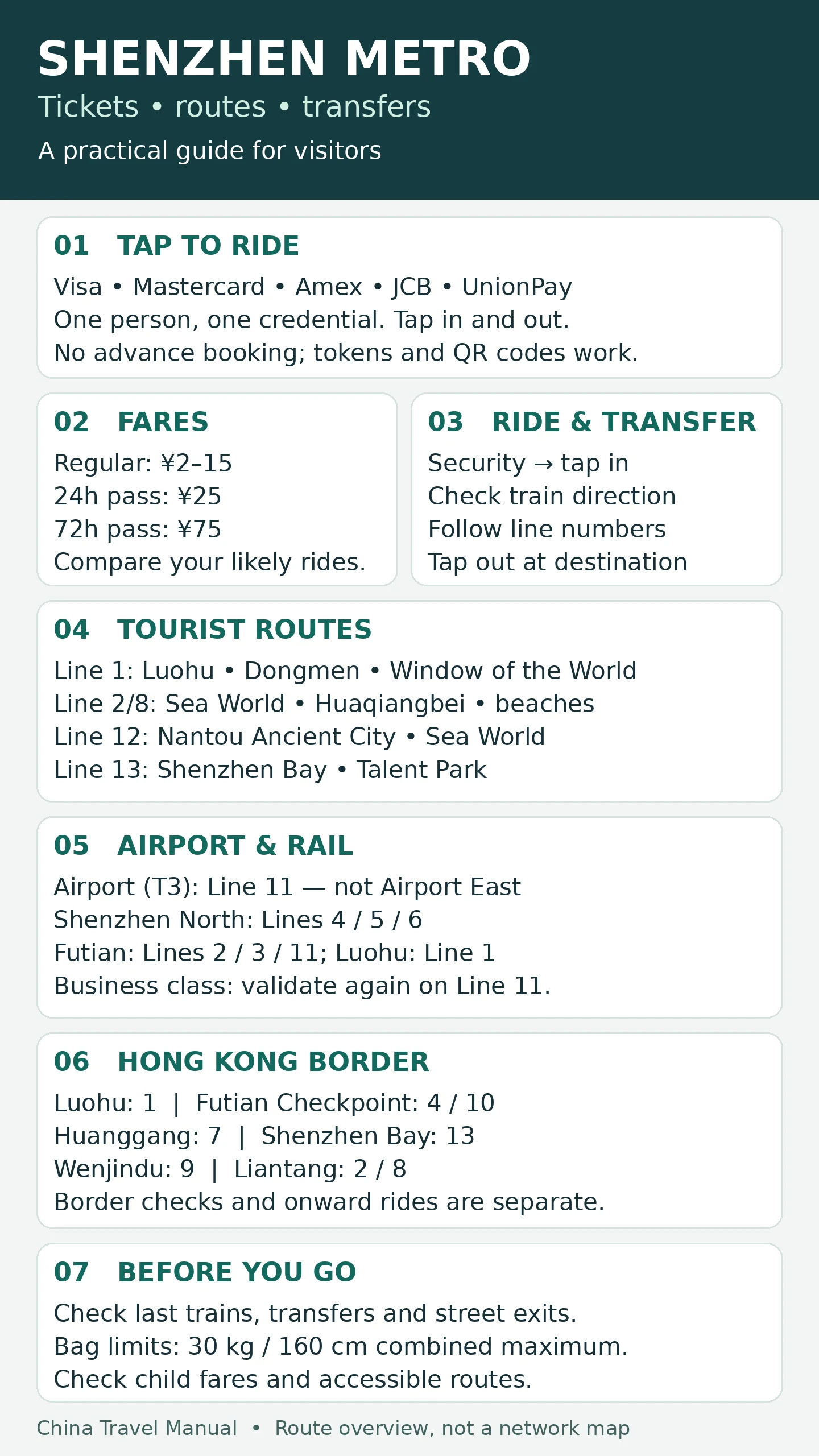
You can explore Shenzhen without a local transit account or a Chinese bank card. This guide explains how to navigate the subway, select the right fare and make connections across a city that stretches from the airport in the west to beaches in the east. If you are choosing between the metro and road transport, see our guide to getting around Shenzhen.
Shenzhen Metro Map and Network Overview
Bao’an District’s October 9, 2026 transport overview reports 18 operating lines, 452 stations and 653.7 kilometers of track. Earlier reports use different counts, so treat these figures as a dated snapshot rather than a live network total.[1]
Open the official Shenzhen Metro website for the current network map and station information. Save a screenshot before leaving your hotel if you expect to have limited mobile data. A map downloaded before a new line opens may send you on an unnecessary detour.
Each line has a number and a color, and station signs generally include Chinese and English names. Interchange symbols indicate where lines meet. For the direction of travel, look at the terminal station shown on the platform sign and the actual train destination on the electronic display. Some trains terminate before the end of the line.
Shenzhen Metro Lines Most Useful for Tourists
You do not need to memorize the entire system. These lines cover most of the places in a typical Shenzhen travel itinerary. Use the station names rather than the district names when searching for a route.
| Line | Useful stops and areas |
|---|---|
| 1 | Luohu, Guomao, Laojie, Huaqiang Road, Shopping Park, Window of the World |
| 2 / 8 | Sea World, Houhai, Futian, Huaqiang North, Liantang Checkpoint, Dameisha, Xiaomeisha |
| 3 | Shopping Park, Futian, Children’s Palace, Buji, Dafen |
| 4 | Futian Checkpoint, Civic Center, Shenzhen North |
| 5 | Qianhaiwan, Shenzhen North, Buji, Grand Theater |
| 6 | Science Museum, Shenzhen North, Guangming |
| 7 | Huanggang Checkpoint, Huaqiang North, Chegongmiao |
| 9 | Shenzhen Bay Park, Renmin South, Wenjin |
| 10 | Futian Checkpoint, Gangxia North |
| 11 | Airport, Nanshan, Houhai, Futian, Gangxia North, Hongling South |
| 12 | Sea World, Nantou Ancient City, Shenzhen World |
| 13 | Shenzhen Bay Checkpoint, Talent Park, Houhai, Shenzhen University, Guangmingcheng |
| 14 | Gangxia North, Buji, Pingshan |
| 20 | Airport North, Shenzhen World |
Lines 2 and 8 offer through-running services, so passengers on a through train do not normally need to change at Liantang. Line 11 connects the airport to the central districts, while Line 13 provides a direct rail link to Shenzhen Bay Checkpoint. Its northern extension opened on June 28, 2026, extending service to Lisonglang in Guangming. Check the operator map for intermediate stops and current service patterns.[1][2]
If your hotel is in Futian, Lines 1, 2, 3, 4 and 11 are particularly useful. Nanshan visitors often benefit from Lines 2, 9, 11, 12 and 13. Choosing where to stay in Shenzhen based on the nearest station can save more time than choosing a hotel based only on its district.
Shenzhen Metro Tickets and Payment Methods
Paying with an International Bank Card
Contactless payment is the simplest option for many visitors. Following a trial introduced on June 30, 2026, overseas bank-card acceptance became available at every fare gate on September 10. Supported networks are Visa, Mastercard, American Express, JCB and UnionPay. Cards must support contactless transactions, with low-value PIN-free payments enabled where required by the issuer.[3][4]
Hold your card against the reader and wait for confirmation before walking through. At the destination, tap the same physical card or the same supported mobile-wallet credential. A physical card and a phone containing that card can have different payment identifiers, so do not switch between them mid-journey. Each adult traveling together should have their own payment method.
If a gate rejects your card, ask at the customer service center instead of repeatedly tapping different cards. A staff member can help resolve a fare record or explain how to buy a separate ticket. Keep a second payment option available in case your bank declines an overseas transaction.
Buying a Single-Journey Ticket
Use a station ticket machine or ask at the service counter. Select the destination and ticket class, confirm the fare and pay using a supported method. The single-journey token is normally tapped on entry and returned through the collection slot on exit. It is valid for one journey from the issuing station during the operating day.[5][6]
Buy separate tickets for everyone who needs one. Keep the token until the end of the ride, including when you change lines. A damaged or lost token may require assistance before you can exit.
Using Alipay or WeChat Transit QR Codes
If your payment setup already works in China, open the dedicated Shenzhen transit code in the appropriate app, not the ordinary retail payment code. Activate the service before reaching the gate and scan the code on entry and exit. The corresponding account needs to remain available throughout the ride. Our Alipay guide and WeChat Pay guide explain payment setup for visitors.
Using Shenzhen Tong and Day Passes
| Method | Best for |
|---|---|
| Contactless bank card | Short visits and no local app |
| Single-journey ticket | Occasional trips or backup payment |
| Transit QR code | Visitors with a working transit account |
| Shenzhen Tong stored-value card | Frequent local public transportation |
| One-day or three-day pass | Multiple trips within a fixed period |
A Shenzhen Tong card can be useful if you regularly combine buses and metro rides. Ask about the card purchase cost and refund arrangements before deciding whether to get one. A day pass is a separate product, not an automatic daily cap on bank-card spending.
Shenzhen Metro Fares and Day Passes
The operator publishes regular-class fares from ¥2 to ¥15 per journey. The fare uses the shortest chargeable regular-class route and a graduated distance scale. Longer rides therefore do not increase in price at the same rate as short rides.[7]
| Distance band | Regular fare calculation |
|---|---|
| First 4 km | ¥2 |
| Over 4 to 12 km | ¥1 for each additional 4 km |
| Over 12 to 24 km | ¥1 for each additional 6 km |
| Over 24 km | ¥1 for each additional 8 km |
Eligible Shenzhen Tong regular-class fares receive a 5% discount. There are also time-based passes: a one-day pass costs ¥25 and lasts 24 hours from first use, while a three-day pass costs ¥75 and lasts 72 hours. They cover unlimited eligible regular rides, not Line 11 business class or trams. Confirm sales availability at the station; major hubs such as Airport, Luohu, Futian and Shenzhen North are useful places to ask.[5][8]
For example, five rides averaging ¥4 cost ¥20 individually, less than a ¥25 day pass. A day with seven rides at the same average costs ¥28, making the pass potentially cheaper. Calculate your likely trips before buying, particularly if your Shenzhen travel budget is tight or you plan to explore one neighborhood on foot.
How to Ride Shenzhen Metro: Step by Step
- Find the entrance: Search for your actual metro station. At a railway complex, follow Metro (地铁), not High-Speed Rail.
- Pass security: Follow staff instructions for bag screening and have large items ready for inspection. Do not bring prohibited items.
- Enter the paid area: Use your chosen ticket, card or transit code at the fare gate. Retain the same credential for the entire journey.
- Choose the platform: Read the line number and direction. Compare the next station on the platform diagram with your planned route before boarding.
- Change lines: Follow the Transfer (换乘) signs to the next platform. Stay within the paid area for an ordinary internal interchange.
- Exit: Complete fare validation, then check the street-exit directory for your hotel, attraction or next transport connection.
For groups, agree on a meeting point before boarding in case the doors close between passengers. Let people leave the train before entering, and move away from the doors once aboard. Keep bags clear of the walking space during rush hour. You do not need a reserved seat or a real-name advance ticket on the ordinary metro, unlike many national railway services. For general background, see using metro systems in China.
How to Transfer Between Shenzhen Metro Lines
| Interchange | Connected lines |
|---|---|
| Gangxia North (岗厦北) | 2, 10, 11, 14 |
| Chegongmiao (车公庙) | 1, 7, 9, 11 |
| Qianhaiwan (前海湾) | 1, 5, 11 |
| Shenzhen North (深圳北站) | 4, 5, 6 |
| Futian (福田) | 2, 3, 11 |
| Houhai (后海) | 2, 11, 13 |
| Window of the World (世界之窗) | 1, 2 |
A regular internal line transfer does not require a new single-journey ticket. Follow the numbered signs rather than exiting through the street gates. Large interchanges can involve several escalators and lengthy corridors, so a journey with fewer transfers may be easier with suitcases even if the route planner suggests a slightly faster alternative.
A national railway station is a different ticketing system, even when it shares a name with the metro. At Futian Checkpoint, Lines 4 and 10 do not have an ordinary direct internal interchange; follow the local signs or choose a different interchange if you need to switch lines.[9]
Shenzhen Metro Operating Hours and Last Trains
For rough planning, think of Shenzhen Metro as an early-morning to late-evening service, approximately 6 a.m. to 11 p.m. on many routes. This is not a universal timetable. First and last departures vary by station, direction and service pattern; some airport trains continue after midnight.
Look up every leg of your return journey. A late train from your starting station may reach an interchange after the connecting line has closed. A train labeled with an intermediate destination may also stop short of your hotel. If the complete journey is no longer possible, use an official taxi or a ride-hailing service for the remaining distance.
Temporary notices can change the normal schedule. For example, the transport bureau’s November 13, 2026 APEC announcement specifies half-price distance-based fares on November 16–20 and an extra operating hour on November 16–19 except on Line 20. Day passes are excluded from that promotion, and some entrances face temporary restrictions. These are dated event arrangements, not permanent rules.[10]
Getting to Shenzhen Attractions by Metro
Plan your sightseeing by neighborhood, then match each destination to a station. Many attractions have multiple entrances; use the address of the entrance you actually intend to visit when choosing a street exit. The following stations are useful starting points for the main things to do in Shenzhen.
| Attraction | Suggested station | Line |
|---|---|---|
| Dongmen Pedestrian Street | Laojie | 1, 3 |
| Huaqiangbei electronics markets | Huaqiang North | 2, 7 |
| Lianhuashan Park | Children’s Palace | 3, 4 |
| Shenzhen Civic Center | Civic Center | 2, 4 |
| Window of the World | Window of the World | 1, 2 |
| Splendid China | OCT | 1 |
| OCT-LOFT | Qiaocheng East / Qiaocheng North | 1 / 2 |
| Nantou Ancient City | Nantou Ancient City | 12 |
| Dafen Oil Painting Village | Dafen | 3 |
| Shenzhen Bay Park | Shenzhen Bay Park | 9 |
| Shenzhen Talent Park | Talent Park | 13 |
| Sea World | Sea World | 2, 12 |
| Dameisha Beach | Dameisha | 8 |
| Xiaomeisha Beach | Xiaomeisha | 8 |
Huaqiang Road and Huaqiang North are different stations. For the electronics market, Huaqiang North is a useful starting point, but your particular shopping building may be closer to another entrance. Shenzhen Bay Park covers a long stretch of waterfront, so a nearby station on the map may still be far from the section you want.
Combine central sights on one day and western cultural or waterfront stops on another. Beaches on Line 8 are better treated as a dedicated outing rather than a short detour during a downtown visit. Dapeng Fortress and other remote destinations require onward surface transportation; do not assume that a metro station reaches the attraction itself.
Shenzhen Metro to the Airport and Railway Stations
Getting to Shenzhen Bao’an International Airport
For Terminal 3, use Airport Station (机场站) on Line 11 and follow signs to the ground transportation center. Airport North and Airport East are distinct stations. Do not use Airport North as a shortcut to a satellite boarding gate: passengers should follow their airline and airport instructions through T3 and the internal airport transfer system. For detailed arrivals and departures, consult the Shenzhen Bao’an Airport guide.
Getting to Shenzhen Railway Stations
| Railway station | Metro station | Lines |
|---|---|---|
| Shenzhen North | Shenzhen North | 4, 5, 6 |
| Futian | Futian | 2, 3, 11 |
| Shenzhen Railway Station | Luohu | 1 |
| Shenzhen East | Buji | 3, 5, 14 |
| Journey | Suggested route |
|---|---|
| Airport to Futian | Line 11 |
| Airport to Shenzhen North | Line 11 to Qianhaiwan; change to Line 5 |
| Airport to Luohu | Line 11 to Chegongmiao; change to Line 1 |
| Futian to Shenzhen North | Line 2 to Civic Center; change to Line 4 |
An airport-to-railway connection includes far more than the metro ride: allow time for baggage collection, walking, transfers and the second transport system’s security procedures. The airport to Shenzhen North transfer guide explains that particular journey in more detail.
Line 11: Regular vs Business Class
Line 11 offers regular and business carriages. Regular class is sufficient for most tourists. Business class offers more spacious seating and a designated boarding area, but requires a valid business-class fare. The operator calculates it from the regular fare for the whole journey plus a surcharge based on twice the regular fare for the Line 11 portion. It is not automatically three times the price of every journey involving a transfer.[7]
| Feature | Regular | Business |
|---|---|---|
| Fare | Standard mileage fare | Additional charge |
| Boarding | Regular platform area | Designated waiting area |
| Day pass | Accepted on eligible rides | Not included |
| Overseas bank card | Tap at gates | Additional platform validation |
If paying by international card, tap at the business-class validator in the designated waiting area before boarding. For a journey involving transfers, check the amount using the official fare query rather than multiplying the entire regular fare yourself.[4]
Taking Shenzhen Metro to the Hong Kong Border
The metro can bring you to land crossings, but it does not operate across the boundary into Hong Kong. Immigration and onward Hong Kong transport are separate steps. The Shenzhen government’s January 2026 guide gives the following standard passenger hours; confirm any temporary changes before traveling.[9]
| Checkpoint | Metro station | Line | Published hours |
|---|---|---|---|
| Luohu | Luohu | 1 | 06:30–23:59 |
| Futian | Futian Checkpoint | 4, 10 | 06:30–22:30 |
| Huanggang | Huanggang Checkpoint | 7 | 24 hours |
| Shenzhen Bay | Shenzhen Bay Checkpoint | 13 | 06:30–23:59 |
| Wenjindu | Wenjin | 9 | 07:00–22:00 |
| Liantang | Liantang Checkpoint | 2 / 8 | 07:00–22:00 |
At Luohu and Futian, you can connect to Hong Kong’s East Rail Line after completing immigration. Shenzhen Bay is convenient for travelers using onward buses into western Hong Kong. Wenjin station requires a walk to the crossing, while other ports have their own onward bus arrangements. Do not confuse Futian Railway Station with Futian Checkpoint. Huanggang is open around the clock, but Line 7 is not a round-the-clock rail service.
Check your eligibility to enter Hong Kong and to return to mainland China independently, as well as the last onward service. See our Shenzhen–Hong Kong border crossing guide for help choosing a port.
Luggage, Children and Accessibility on Shenzhen Metro
| Bag weight and combined dimensions | Rule |
|---|---|
| Up to 20 kg and 140 cm | No extra luggage ticket |
| Over 20 to 30 kg or over 140 to 160 cm | Buy a luggage ticket in regular class |
| Over 30 kg or over 160 cm | Not permitted |
Dimensions mean length plus width plus height. The operator charges the ordinary-class fare for a required luggage ticket at the service center; eligible free-fare passengers and business-class passengers are exempt from that extra ticket, not from the maximum size or weight restriction.[6]
The operator lists child tickets for children 1.2–1.5 meters tall or aged 6–14. Smaller children may qualify for free travel; ask staff about age, height and proof requirements rather than assuming every discount applies automatically to international visitors. For step-free travel, look for elevator symbols and contact staff if an accessible transfer is unclear. The normal paid-area time limit is 210 minutes, after which additional fare may be due.[5][7]
Practical Tips and Common Metro Mistakes
- Save both Chinese and English station names, and the full hotel address, before you leave.
- Keep a backup payment method and avoid tapping an entire wallet against a reader.
- Check the actual train destination, not only the line color.
- Do not enter the national railway gates when you want the metro.
- If luggage is too large for the subway or the final connection has stopped, consider taking a taxi in China instead.
On busy evenings, give yourself an alternative route before leaving a restaurant or attraction. A direct taxi may cost more, but it can avoid a difficult transfer with tired children or bags.
FAQs About Shenzhen Metro
Can foreigners use Shenzhen Metro without Alipay or WeChat?
Yes. Eligible international contactless bank cards can be tapped at the fare gates, and single-journey tickets remain available. You do not need to install a Chinese payment app simply to ride the subway.
How much does Shenzhen Metro cost?
The published regular-class fare is ¥2–15 per journey, depending on the chargeable distance. Business class on Line 11 costs extra. Check the official fare query for the exact price between your stations.
Is the Shenzhen Metro day pass worth buying?
It depends on your route and number of rides. A ¥25 one-day pass can save money on a busy sightseeing day, but travelers making only a few short trips will usually spend less paying per ride.
Which metro line goes to Shenzhen Airport?
Line 11 serves Airport Station, the usual stop for Terminal 3. Follow the signs to the ground transportation center and terminal after leaving the metro. Airport East and Airport North are separate stops.
Can you take Shenzhen Metro directly to Hong Kong?
No. Use the Shenzhen Metro to reach a land checkpoint, go through the appropriate border controls and then take Hong Kong transportation. Cross-border high-speed trains use separate tickets and a different immigration arrangement.
Sources
[1] Bao’an District Government. Shenzhen Metro
[2] Shenzhen Government. Shenzhen Metro & MTR
[3] Qianhai Authority. Metro now accepts overseas bank cards at all gates
[4] Shenzhen Government. Shenzhen Metro to accept international bank cards at fare gates
[5] Shenzhen Metro. Ticket Types
[6] Shenzhen Metro. Rules of Use of Tickets
[7] Shenzhen Metro. Ticket Use Policy
[8] Shenzhen Metro. Ticket Purchase Instructions
[9] Shenzhen Government. Shenzhen-Hong Kong travel guide: 6 major border crossings & tips
[10] Shenzhen Municipal Transport Bureau (republished by Beijing Daily). November 13, 2026 APEC metro operating notice





