

Quick Answer: How to Spend 3 Days in Shanghai
This three-day Shanghai itinerary covers the historic old city, the Bund, Pudong’s skyline, the Former French Concession, a museum and a Shikumen neighborhood, with three alternative choices for Day 3.
- Day 1: Yu Garden and Yuyuan Bazaar → the Bund → Lujiazui, then return to the Bund for the Huangpu River night view.
- Day 2: Wukang Road and Anfu Road → choose one Shanghai Museum location → Xintiandi.
- Day 3: Choose one: Zhujiajiao water town, a full day at Shanghai Disneyland, or a high-speed-rail day trip to Suzhou.
Important: These are three full sightseeing days. Arrival and departure days are not included. If you arrive late or leave early, shorten the route rather than rushing.
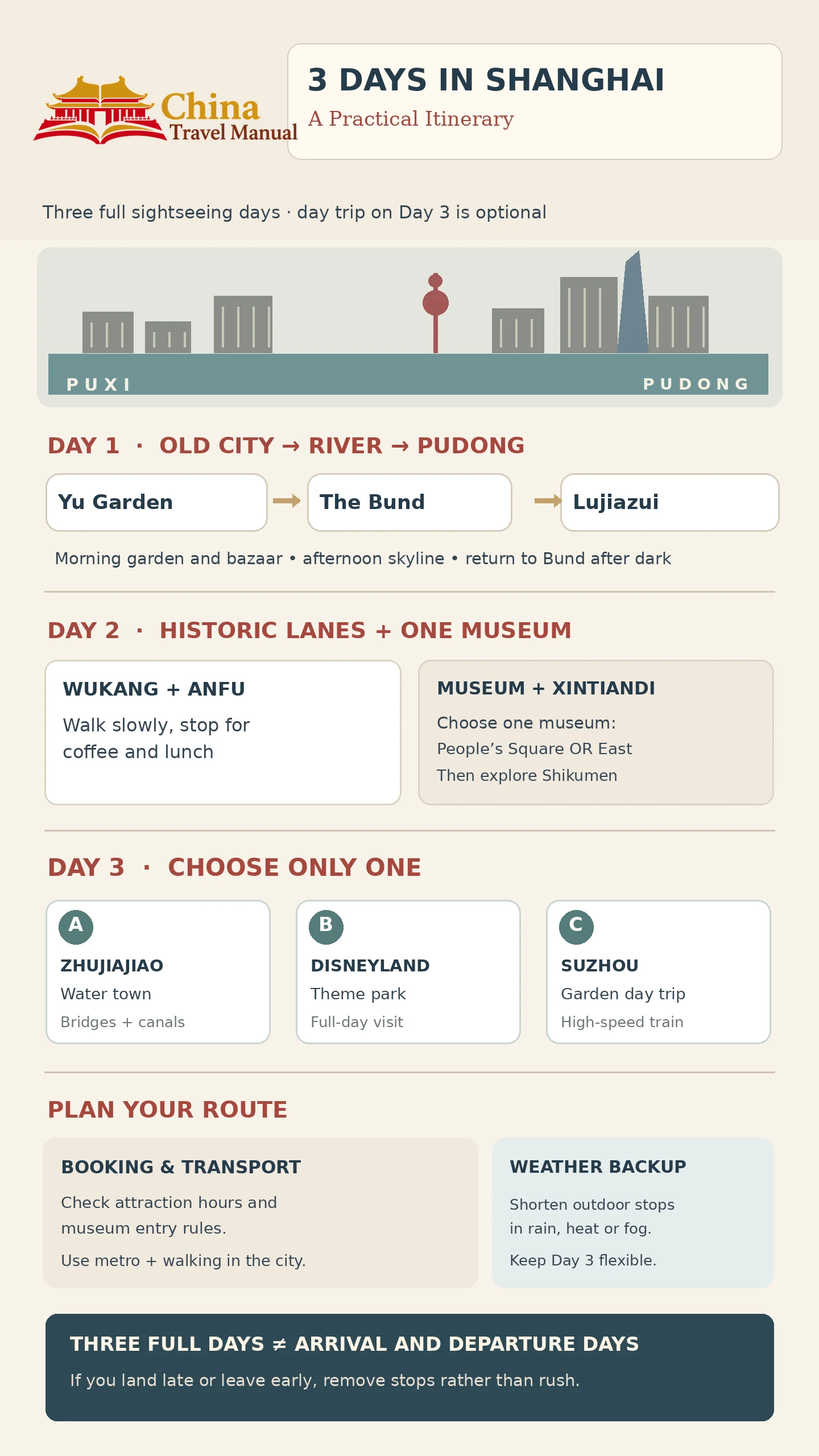
Three days in Shanghai are enough to experience the contrast between historic lanes and a futuristic skyline, provided you group your visits by area. This practical route spends Day 1 in the old city, on the Bund and in Pudong; Day 2 around Wukang Road, a museum and Xintiandi; and Day 3 on one optional day trip. It assumes three full sightseeing days, not a late-arrival day followed by an early departure. For wider planning context, see the Shanghai travel guide and China itineraries overview.
Before You Follow This Shanghai Itinerary
Is Three Days in Shanghai Enough?
Three full days are enough to see Shanghai’s best-known landmarks, try representative local food and understand the contrast between its historic neighborhoods and modern skyline. They are not enough to explore every suburb, small museum or distant water town in depth. Treat this as a highlights itinerary, not a checklist that must be completed minute by minute.
Hot, humid weather, heavy rain, typhoon warnings, fog or haze can affect outdoor sightseeing and observation-deck views. Adjust the plan to conditions rather than rushing to preserve every stop.
Where to Stay for a Three-Day Visit
- People’s Square or East Nanjing Road: A convenient first-visit base with metro connections and easy access to the Bund, old city and Xintiandi. See Where to Stay in Shanghai.
- Former French Concession: A quieter, walkable choice for cafés and neighborhood streets around Wukang Road and Anfu Road. It can take longer to reach Pudong or Zhujiajiao.
- Hongqiao transport hub: Useful if you arrive at Hongqiao Airport or plan to take a train to Suzhou, but farther from central sights.
For most first-time visitors, Puxi is the more practical base. Lujiazui suits travelers who prioritize river views, but crossing the river adds time when visiting the old city.
What to Check or Book Before You Go
Visitor policies change, so check official venue information close to your travel date.
- Shanghai Museum: The People’s Square Museum and East Museum are separate venues with different locations and opening schedules. Choose one and confirm current opening days, entry arrangements and any special-exhibition reservation rules.
- Shanghai Tower: Check ticket availability and visibility. A ticket cannot guarantee a clear view on a foggy day.
- Shanghai Disneyland: Buy admission for the correct date and use the official app for hours, shows and in-park queue arrangements.
- Yu Garden: Distinguish the ticketed garden from the surrounding Yuyuan Bazaar, which is a separate commercial area.
- Zhujiajiao: Historic streets can be explored separately from individual ticketed attractions.
- Suzhou: Check reservation rules for the garden you plan to visit.
During major Chinese holidays, popular attractions can be crowded. Check availability in advance and keep a backup plan.
Day 1: Old Shanghai, the Bund and Pudong
Follow this sequence: the old city in the morning, the Bund after lunch, Lujiazui across the river in the afternoon, then the Bund again after dark. This avoids unnecessary cross-river backtracking.
Morning at Yu Garden and Yuyuan Bazaar
Start around 8:30 a.m. at Yu Garden, a compact classical Jiangnan garden known for rockeries, ponds, pavilions and winding corridors. Arriving early can make the visit more comfortable before tour groups build up. Confirm current opening hours and admission arrangements in advance.
After the garden, explore Yuyuan Bazaar. It is the surrounding commercial area, not the same attraction as the garden. Shops and snack stalls sell traditional pastries, souvenirs and Shanghai-style snacks. It is convenient for a first taste of local food, although tourist-area prices may be higher than in residential neighborhoods.
Lunch and the Historic Bund
Have lunch before or near the Bund. Scallion-oil noodles, pork-and-vegetable wontons or soup dumplings make a convenient local meal. For a broader introduction to local dishes, see What to Eat in Shanghai.
Walk along the historic waterfront, lined with early twentieth-century buildings once used by banks, trading houses and other institutions. In daylight, look at the architecture and the view across the river to Pudong. The riverfront can feel windy, especially in cooler months.
Cross the river by metro, taxi or public ferry. A public ferry is a local transport service, not a sightseeing cruise. For example, the Dongjin ferry links East Jinling Road in Puxi and Dongchang Road in Pudong, but this crossing is a daytime service and is not suitable for a late-night return.[3] Check the current pier, route, operating hours and fare on the day; do not assume every route runs late into the evening.
Afternoon in Lujiazui
Lujiazui’s skyline includes the Oriental Pearl Tower, Jin Mao Tower, Shanghai World Financial Center and Shanghai Tower. The Top of Shanghai observation deck is on the 118th floor of Shanghai Tower; you do not need to visit every observation deck.[6] If you want one elevated view, choose the venue that fits your budget and current visibility. Ground-level plazas and waterfront areas also offer impressive views without an observation-deck ticket.
Evening Views Along the Huangpu River
Return to the Bund around sunset or after dark, when the historic buildings and Pudong skyline are illuminated. Walk along the riverfront, take a sightseeing cruise if you prefer, or use a public ferry if its current service suits your schedule. Dinner near East Nanjing Road or the Bund makes an easy finish.
Day 2: French Concession, Xintiandi and Museums
Make Day 2 slower and neighborhood-focused. Combine a walk through the Former French Concession with one museum visit and an evening in a redeveloped Shikumen district.
Explore Wukang Road and Anfu Road
Begin around Wukang Road, where the distinctive Wukang Building is a familiar landmark. Nearby streets contain historic residences, leafy sidewalks, small galleries and cafés. Continue toward Anfu Road for independent shops, coffee and casual dining. Enjoy the walk at your own pace. See our Former French Concession guide for more context.
Have lunch nearby, choosing from local home-style dishes, cafés or Shanghai-style Western food such as a fried pork chop with local dipping sauce or Shanghai-style borscht.
Choose One Shanghai Museum Location
Choose either the People’s Square Museum or the Shanghai Museum East. They are in different parts of the city and have different opening schedules. As published by the museum, the People’s Square building normally opens 9 a.m.–5 p.m. Tuesday to Sunday, while the East Museum normally opens 10 a.m.–6 p.m. Wednesday to Monday. Both generally allow individual walk-in entry without advance reservation, but peak periods and selected exhibitions or digital galleries may require booking. Verify current notices before your visit.[1][2] The People’s Square location is usually more convenient for this route because it fits naturally between the Former French Concession and Xintiandi. The East Museum has a larger modern exhibition setting, but reaching it from western central neighborhoods adds cross-city travel time.
Before setting out, verify the selected venue’s current opening day, hours, entry policy and special-exhibition arrangements through our Shanghai Museum guide and official notices.
Discover Xintiandi
In the late afternoon, head to Xintiandi. Its restored Shikumen buildings retain the appearance of traditional stone-gate lane houses, while many interiors now contain restaurants, bars and shops. It is an example of urban redevelopment rather than an untouched historic neighborhood. Walk through the lanes, browse the shops and stop for a meal.
Evening Options in Central Shanghai
Keep the evening flexible. Stay for dinner in Xintiandi, look for a nearby live-music venue or bar, or return to your hotel early. There is no need to add another distant attraction after a full day of walking.
Day 3: Choose a Day Trip or a Special Experience
Pick one of the following options. Each can take most or all of the day; combining two would create an unnecessarily rushed schedule.
Option A: Zhujiajiao Ancient Water Town
Choose Zhujiajiao for a slower contrast with central Shanghai. Canals, stone bridges, old lanes, teahouses and waterside shops give the town its Jiangnan character. Walk the historic streets, sample local snacks and take a boat ride if services are operating.
Metro Line 17 is useful for reaching the area, but the station is not the same as the historic town entrance. The local tourism transport guide lists a walk from Zhujiajiao Station or bus links from Exit 1 to the ancient-town visitor area.[4] Allow time for the onward walk or local connection, and check current bus and transfer information before leaving. Individual gardens, exhibition spaces and attractions may charge separately.
Option B: Shanghai Disneyland
Choose Shanghai Disneyland if you are traveling with children or enjoy theme parks. Treat it as a full-day commitment: arrive early, prioritize the experiences that matter most and leave after the evening program if you wish. Use the official park app to check that day’s hours, parade and show schedules, and in-park queue options.
Admission is date-specific and prices vary. The resort’s official booking calendar and park-app listings are the sources to check for your particular day.[5] Weekends and holiday periods can be crowded, and food inside the resort may cost more than meals in ordinary neighborhoods. Do not add another distant attraction to this day.
Option C: A Day Trip to Suzhou
Choose Suzhou if classical gardens and historic canal-side streets interest you more than another Shanghai attraction. High-speed trains from Shanghai Hongqiao can make the intercity journey relatively short, but allow extra time for station access, security checks and local transport at both ends. Check current train times and book a suitable return before planning the day.
Visit one major garden, such as the Humble Administrator’s Garden or Lingering Garden, then explore Pingjiang Road or Shantang Street. Popular gardens may require advance reservations. Read our guide to booking train tickets in China and Shanghai Hongqiao Railway Station guide before you go.
Getting Around Shanghai During Your 3-Day Trip
Using the Shanghai Metro
The metro is the main transport option for this itinerary. It connects the central sightseeing districts and is generally easier than crossing the city by road during busy periods. Large interchange stations can be crowded; avoid carrying bulky luggage during weekday commuting peaks where possible. See our Shanghai Metro guide for route planning.
Check which payment methods are currently available to overseas visitors. Depending on your setup, you may use an accepted mobile payment option, a transport card or a single-journey ticket. Do not assume every foreign bank card or app works in exactly the same way at every gate.
Walking, Ferries and Taxis
Walking is often best for exploring the old city, Former French Concession and Xintiandi once you arrive in each area. Public ferries can be a practical river crossing, but they are not interchangeable with sightseeing cruises. Taxis and ride-hailing are useful at night, with luggage or when a metro journey involves several transfers. Road traffic can make cross-river car trips slow at peak times. See Getting Around Shanghai.
Where to Eat During Your Shanghai Itinerary
- Day 1: Try snacks around Yuyuan Bazaar, then choose a local restaurant near the Bund or East Nanjing Road.
- Day 2: Use the cafés and casual dining choices around Wukang Road and Anfu Road; Xintiandi offers many dinner options.
- Day 3: In Zhujiajiao, look for water-town snacks; at Disneyland, plan around in-park dining; in Suzhou, try local noodles or Suzhou-style dishes.
Shanghai food is not uniformly sweet. Local cuisine includes rich soy-braised dishes as well as lighter options. If you have allergies or dietary restrictions, ask about stocks, sauces and shared preparation surfaces. Our Shanghai food guide explains local dishes and ordering basics.
Practical Tips for a Smooth 3-Day Shanghai Trip
- Check admission rules: Confirm current opening days, tickets and reservation requirements for the exact venue you plan to visit.
- Dress for the season: Summers are hot and humid, rainy periods affect outdoor walks, and winter can feel damp and cold. The riverfront is often breezier.
- Prepare a payment backup: Set up a suitable mobile payment option before arrival, but carry a little cash for contingencies.
- Time popular sights thoughtfully: Yu Garden, Wukang Building and the Bund can be busy. Early starts often make walking and photography more comfortable.
- Explain food allergies clearly: Ask whether broths, sauces or fillings contain ingredients you need to avoid. Severe allergies require extra caution about cross-contact.
- Plan airport connections separately: Use our Pudong Airport transfer or Hongqiao Airport transfer guide as appropriate, and see China travel tips for general planning.
FAQs About Spending 3 Days in Shanghai
Can I cover all the famous spots in three days?
You can visit many of Shanghai’s best-known landmarks, but not every suburb, small museum or water town. Choose the places that match your interests and keep the schedule realistic.
Which Day 3 trip is best for first-time visitors?
Zhujiajiao is the lower-pressure choice for a water-town experience. Choose Disneyland for a theme park, or Suzhou if you are interested in classical gardens and comfortable taking high-speed rail.
Do I need a tour guide for this itinerary?
No. The route is designed for independent travelers using public transport, walking and official visitor information. A guide may still be useful if you want deeper historical interpretation.
Is it better to stay in Puxi or Pudong?
For most first-time visitors following this plan, Puxi is more convenient because the old city, Bund, Former French Concession and Xintiandi are on that side of the river. Pudong may suit travelers who prioritize a river view or have business nearby.
When should I avoid this itinerary?
Expect more disruption during major public holidays, typhoon warnings and extreme heat. Shorten outdoor walks, move flexible visits indoors and avoid trying to complete every stop.
Sources
[1] Shanghai Museum. Shanghai Museum on People’s Square visitor information
[2] Shanghai Museum. Shanghai Museum East visitor information
[3] Shanghai Municipal Administration of Culture and Tourism. Ferry transport routes in Shanghai
[4] Zhujiajiao Ancient Town Tourism. Zhujiajiao travel and transport information
[5] Shanghai Disney Resort. Shanghai Disneyland official park information
[6] Shanghai Municipal Government. Shanghai Tower visitor information





