
Quick Answer: Using Shanghai Railway Station
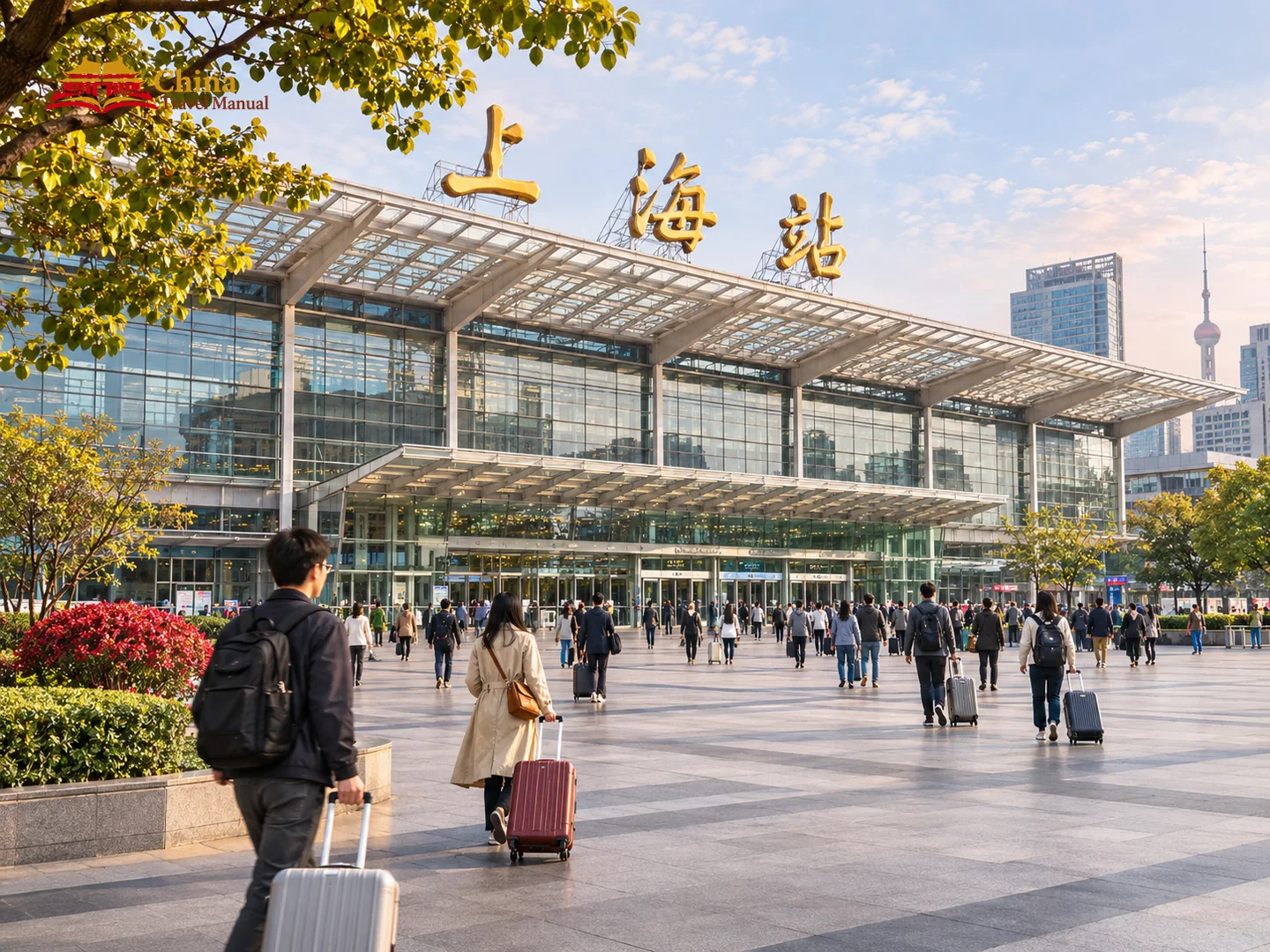
Shanghai Railway Station (上海站) is in central Shanghai’s Jing’an District. On a railway ticket, the departure station “Shanghai” (上海) means this station—not Shanghai Hongqiao or Shanghai South. Both the south and north railway entrances are operating, and you can board the same railway services from either side.
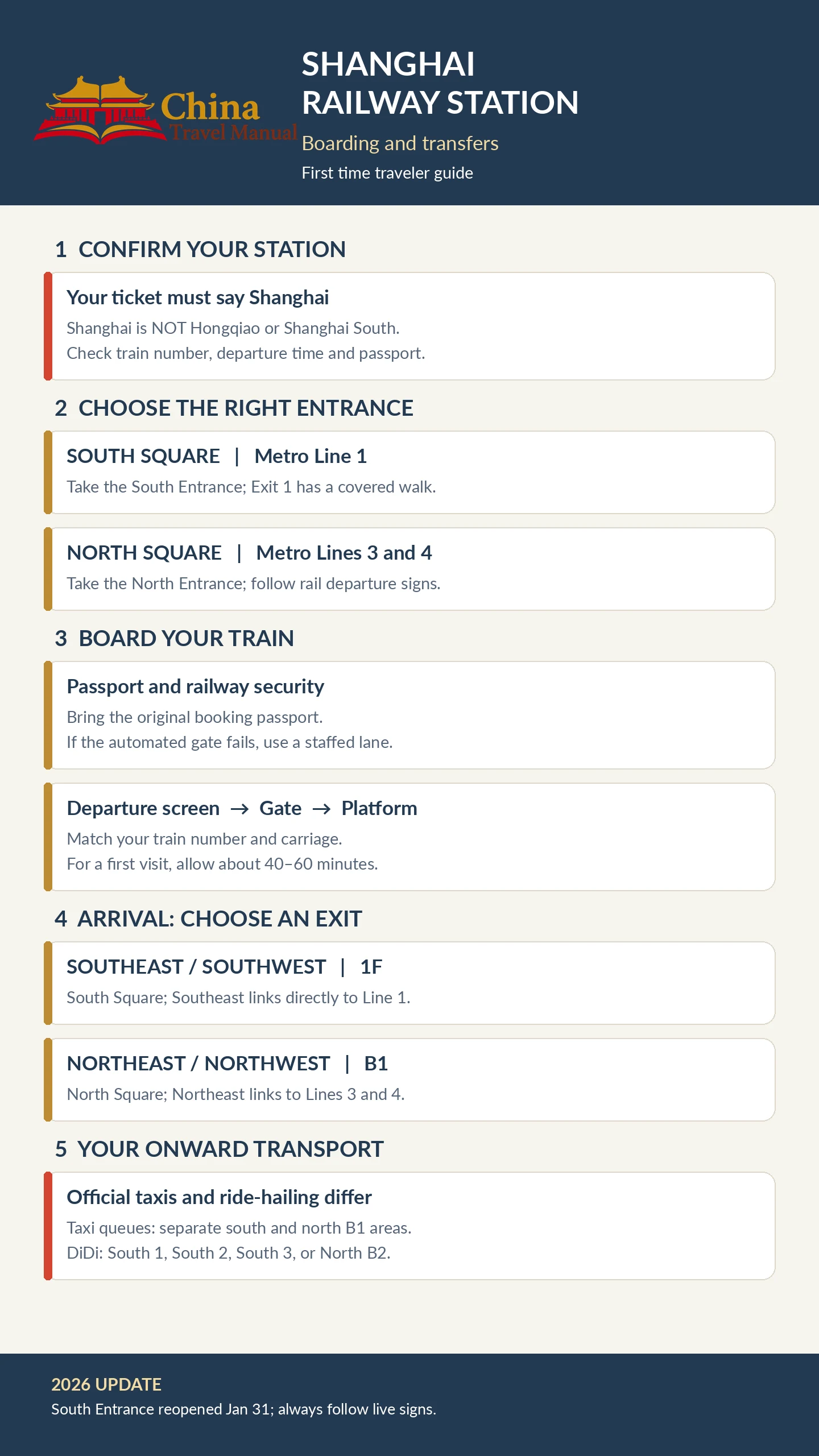
- Metro: Line 1 serves the South Square; Lines 3 and 4 serve the North Square.
- Arrivals: Southeast and Southwest exits lead to the South Square on 1F; Northeast and Northwest lead to the North Square on B1.
- Metro transfers: Designated Southeast–Line 1 and Northeast–Lines 3/4 routes can avoid repeat security screening; follow the current signs.
- Taxis and DiDi: Official taxis use separate south and north B1 areas. Ride-hailing uses three south-side points and one north-side B2 point.
- Documents: Bring the original passport used to book your ticket. If an automated gate cannot read it, request manual verification.
- Buffer: First-time international travelers should aim to reach the railway entrance 40–60 minutes before departure, earlier during busy periods. This is advice, not a guaranteed minimum.
Shanghai Railway Station is convenient for central Shanghai, but two separate forecourts and several exit routes can make the first visit confusing. This guide follows the order you will actually travel: identify the correct station, choose your entrance, board with your passport, then find the right exit and onward transport. For the wider city context, start with our Shanghai travel guide
Shanghai Railway Station at a Glance
Location and Station Name
The official English name is Shanghai Railway Station, commonly called Shanghai Station or Shanghai Train Station (上海站 or 上海火车站). Its South Square faces Moling Road in Jing’an District. The Chinese destination 上海站 is useful to show a driver or station attendant. The station is not part of the Hongqiao airport complex. [1]
What Trains Use Shanghai Railway Station?
Shanghai Station accommodates several train categories, including G-series high-speed services, D-series EMU services and conventional Z-, T- and K-series trains. The letters describe train service types, not a permanent platform, entrance or destination. Availability changes with the operating timetable. Check the precise departure station, date and train number in 12306 rather than relying on an old route list. Our China train travel guide explains the service categories; train ticket booking guide covers purchasing steps.
Shanghai Station vs. Hongqiao and Shanghai South
| Ticket station | Where it is | What to remember |
|---|---|---|
| Shanghai (上海) | Jing’an District | This guide; metro Lines 1, 3 and 4. |
| Shanghai Hongqiao (上海虹桥) | Minhang District | Different station near Hongqiao Airport; see the Shanghai Hongqiao Railway Station guide. |
| Shanghai South (上海南) | Xuhui District | Separate platforms and waiting halls; see the Shanghai South Railway Station guide. |
Even trains serving the same destination may depart from different Shanghai stations. The station printed on your ticket—not the city you are traveling to—is the deciding detail.
Shanghai Railway Station Layout and Entrances
South Square and North Square
The station has two working railway entrances on opposite sides of the building. The South Entrance is convenient from Moling Road and Metro Line 1. The North Entrance is more convenient from Metro Lines 3 and 4. Both feed into the railway waiting and boarding areas after the required security and identity checks. Neither entrance is reserved for one particular class of train. [1][2]
Arriving by car, confirm that your driver knows whether you need the south or north entrance. The squares have different taxi, bus and ride-hailing arrangements, and switching sides with luggage takes extra walking.
The South Entrance and Its 2026 Upgrade
The South Entrance reopened after its upgrade on January 31, 2026. Shanghai’s government reported approximately 70% more entrance and security-channel capacity than before, a covered connection from Metro Line 1 Exit 1, and a new service center east of the entrance with seven staffed service windows. A lost-property collection point on the west side allows eligible passengers to collect items without entering the railway security zone. [2]
Older instructions describing the South Entrance as closed during construction are outdated. Approach from the South Square and follow the current signs toward the operating rail security checkpoint. The covered connection makes this side more comfortable in wet weather, but queues can still build around holidays.
The North Entrance
For travelers on Metro Lines 3 and 4, exits 7 and 8 have been identified in station-area guidance as practical approaches to the North Square. The entrance remains operational and has railway screening and staff assistance. Metro exit numbers and pedestrian lanes can change during local works, so prioritize the overhead signs for North Railway Entrance once you arrive. [3]
Waiting Areas, Boarding Gates and Platforms
After railway security and document verification, check the live departure displays in the waiting hall. Look for the train number first, then its destination, boarding gate and status. A gate can serve different trains during the day and may change. Boarding opens when announced; it is not safe to assume the same gate or a universal cutoff time from an online guide.
After your ticket and identity are checked at the boarding gate, follow the designated passage to the platform. Look for your carriage number on the reservation and platform indicators. Conventional and high-speed services have different carriage layouts, so use today’s displays rather than a remembered station diagram.
How to Get to Shanghai Railway Station
Metro Line 1 to the South Entrance
Take Line 1 to Shanghai Railway Station, then follow South Square signage. Exits 1 and 2 are commonly used for this approach, with the newly covered connection from Exit 1 leading toward the upgraded South Entrance. Keep following railway departure and security-check signs; leaving the metro station does not mean you have entered the railway waiting hall. [2][3]
Metro Lines 3 and 4 to the North Entrance
Metro Lines 3 and 4 serve the north side. Exit references 7 and 8 are useful starting points for reaching the North Entrance. If you find yourself on the wrong side, use the station-area pedestrian links described below rather than improvising a taxi journey around the station. For more local navigation choices, see getting around Shanghai
Arriving by Taxi or Ride-Hailing
For railway departure, tell your driver “Shanghai Railway Station, South Entrance” or “North Entrance,” not just “Shanghai train station.” Drop-off locations are separate from the official taxi pickup queues and ride-hailing collection points used by arriving passengers. During events or heavy travel periods, vehicle access may be adjusted and the final walk may be longer. Keep enough time for security after you are dropped off.
How to Board a Train at Shanghai Railway Station
Verify Your Departure Station and Train
Before leaving your hotel, confirm the departure station is Shanghai (上海), not Shanghai Hongqiao (上海虹桥) or Shanghai South (上海南). Check the date, service number, departure time, destination, passenger name and passport details on the reservation. Your actual 12306 booking controls the journey, not a printed itinerary from a third-party blog. If you need to correct a booking, see our 12306 guide for foreign visitors
Security and Passport Verification
Enter through either official railway entrance and send your bags through the required screening. Carry the original valid passport used for the booking. An electronic ticket does not eliminate identity checks, and a screenshot or trip-information slip alone is not a substitute for the required document. If the reader at an automated gate cannot process your passport, use the staffed manual-check lane. [4]
Keep the passport easy to reach: you may be asked to present it again at the boarding gate or during inspection. Check the current China travel documents guide for broader documentation guidance.
Find Your Waiting Area and Boarding Gate
Locate your train number on the main departure screen after screening, then confirm the gate and its live status. Allow time to walk through the hall and to join the correct queue. If information on the app differs from the screen, ask a railway staff member before changing gates; station operations can be revised close to departure.
Do not assume boarding remains available until the scheduled departure minute. The station’s displayed status and staff instructions govern entry to the platform.
Board the Correct Train and Carriage
Proceed through the boarding checkpoint only when your train is called. On the platform, compare the train and carriage numbers against your reservation, follow the position markers, and board promptly. After entering, find your assigned seat or berth and stow luggage without blocking doors or aisles. Be particularly attentive on long-distance trains because services and carriage layouts vary.
Arriving at Shanghai Railway Station: Exits and Transfers
The Four Railway Exits Explained
Choosing the correct exit is the most useful decision on arrival. Shanghai’s 2026 departure-area guidance identifies four railway exit channels, split between the south and north sides. [5]
| Exit sign | Level | Leads to | Typical onward choice |
|---|---|---|---|
| Southeast (东南) | 1F | South Square | Direct designated link to Metro Line 1; south taxi or ride-hailing points. |
| Southwest (西南) | 1F | South Square | South Square taxis and south ride-hailing points; reach Line 1 via the square. |
| Northeast (东北) | B1 | North Square | Designated direct transfer toward Metro Lines 3 and 4; north taxi links. |
| Northwest (西北) | B1 | North Square | North-side transport, including the designated B2 ride-hailing area. |
These are railway exit labels, not interchangeable metro exit numbers. Look at your destination and pickup assignment before you commit to one side.
Transferring to Metro Lines 1, 3 and 4
For Metro Line 1, the Southeast railway exit offers a designated direct transfer route with security-screening recognition under the published station arrangement. For Metro Lines 3 and 4, the corresponding route is through the Northeast exit. These are specific railway-to-metro flows; other paths, including the Southwest and Northwest exits, may involve exiting the controlled area and undergoing metro screening again. [5]
Follow the current transfer signage and security staff directions. The existence of a recognized arrival transfer does not mean that a passenger coming from the metro can skip railway security when boarding a train.
Finding the South and North Taxi Queues
Official metered taxi pickup is separated by square. From South Square exits, follow Taxi signs to the south-side parking-garage B1 queue; published guidance identifies lifts and escalators leading down. From North Square exits, follow Taxi signs to its separate B1 holding and pickup area. Do not use a DiDi pickup point as a place to hail a metered taxi. [5]
If you have a large suitcase or mobility needs, follow lift symbols rather than choosing a stair route simply because it looks shorter. The queues for the two squares are not a single shared taxi rank.
The Four Ride-Hailing Pick-Up Points
A 2026 station-area guide identifies three designated ride-hailing points south of the station and one on the north side. The distinction matters because drivers cannot wait indefinitely at these managed collection zones. [6]
| Pick-up zone | Published location | How to use it |
|---|---|---|
| South 1 | Hengfeng North Road service road | Match the app’s zone and follow South 1 signs. |
| South 2 | Magnolia Plaza opposite the South Square | Use the newer 2026 location guidance, not an older Moling Road description. |
| South 3 | Near Huaxiang Building on the east side of South Square | Convenient from the Southeast railway exit. |
| North | North Square parking garage B2 | Follow the north ride-hailing signs, near the Northwest railway exit. |
Book only after identifying the pickup zone or check the app’s designated point immediately after ordering. Verify the license plate and driver before entering. The location selected by your ride-hailing app and temporary signs override a fixed description in an article.
Connecting to City Buses
Both squares have city bus connections, but route numbers, stops and last departures change. Follow the Bus signs to the correct stop and use a live local transit map or the SH MaaS service to check direction and operating hours. If you arrive late at night, verify the bus is still running before you leave the railway terminal.
How to Move Between the South and North Squares
Passengers can change sides on foot using designated underground station-area connections. Published guidance describes the Metro Lines 3/4 corridor between the directions marked Exit 6 on the south side and Exit 10 on the north side. Follow the pedestrian-wayfinding instructions to find the appropriate access route; this is not a transfer between railway platforms and should not be assumed to provide a free ride through metro fare gates. [3][5]
If the connecting passage is temporarily restricted, station guidance identifies the Datong Road underpass as an alternative. Since the permitted walking route and fare-control boundaries can change, ask a station employee if an entrance appears to lead into the metro paid area rather than a public pedestrian link. Do not cross traffic lanes to shortcut between squares.
Facilities and Practical Tips for Travelers
Passenger Services and Accessibility
The upgraded South Entrance’s service center and the staffed railway service points can help with booking questions, document checks and missed-train procedures. The facility has lifts, toilets, waiting areas and food options. Travelers using wheelchairs or requiring assistance should seek the official accessible route and contact the railway operator in advance where possible. Our accessible travel in China guide provides broader planning context. [2]
Luggage and Storage Arrangements
Do not assume a particular locker bank is available, staffed or large enough for every suitcase. Ask the official information desk about currently operating luggage-storage services and payment rules. For boarding, observe the operator’s limits for oversized or restricted items. If bags are heavy, prefer designated lifts and allow additional time between the entrance and boarding gate.
When to Arrive and What to Prepare
For a first journey using a foreign passport, arriving at the railway entrance approximately 40–60 minutes before departure is a useful planning buffer, not a legal minimum or promise of successful boarding. Arrive earlier around public holidays, with heavy luggage, or if you need staffed assistance. Keep your passport and electronic reservation accessible and take note of the correct entrance before setting out.
What to Do If You Miss Your Train
Go promptly to an official ticket-service counter or consult 12306 about the applicable change rules. Whether you can move to a later service, whether a fee applies and whether seats remain available depend on your ticket and current railway rules. Never board a different train on the assumption that an expired reservation is automatically valid. For extra background, see the China railway stations guide
FAQs About Shanghai Railway Station
Is Shanghai Railway Station the Same as Shanghai Hongqiao?
No. Shanghai Railway Station (上海站) is in Jing’an District, while Shanghai Hongqiao (上海虹桥) is a different railway station by Hongqiao Airport. Check the station name on your ticket.
Which Metro Lines Serve Shanghai Railway Station?
Metro Line 1 is most convenient from the South Square. Lines 3 and 4 connect with the North Square. Use the railway exit suited to your line.
Should I Use the South or North Entrance?
Both are functioning railway entrances. Choose the side nearest your arriving metro line or drop-off location, and complete the required railway checks.
Which Exit Should I Use for Metro Line 1?
The Southeast railway exit provides the designated direct connection toward Metro Line 1. Follow current signs for any screening or access adjustments.
Where Can I Find DiDi at Shanghai Railway Station?
There are three south-side ride-hailing zones and one North Square B2 zone. Match your app’s pickup instructions to on-site signs rather than assuming taxis and DiDi share a queue.
Sources
[1] Shanghai Municipal Government. Railway Stations in Shanghai
[2] Shanghai Municipal Government. Shanghai Station South Entrance Upgrade
[3] Shanghai Observer. Shanghai Railway Station Entry and Metro Access Guide
[4] China Railway 12306. Official FAQ on Railway Tickets and Travel Documents
[5] Jiefang Daily. Shanghai Railway Station Exit and Transfer Guide 2026
[6] Jiefang Daily. Shanghai Station Ride-Hailing Pickup Guidance 2026





