

Quick Answer: Using Nanjing South Railway Station
Nanjing South Railway Station (南京南站, Nánjīng Nán Zhàn) is Nanjing’s main high-speed rail hub at 98 Yulan Road. Check that your ticket says 南京南站, then use the live display to choose the north or south railway entrance.
- Metro: Lines 1, 3, 6, S1 and S3 serve the station; not every Line 6 train goes to the airport.
- Passport: Carry the original valid passport used for your booking; ask staff for manual checks if needed.
- Boarding: Confirm your train number, waiting area and gate on the live display.
- DiDi: Pickups use P2, P5, P6 or P7; follow the location assigned in your app.
- Transfers: Use a convenient-transfer passage only when it is open and your ticket is eligible.
Exit numbers, passenger routes and parking access can change. Follow current bilingual signs, electronic displays and app instructions.
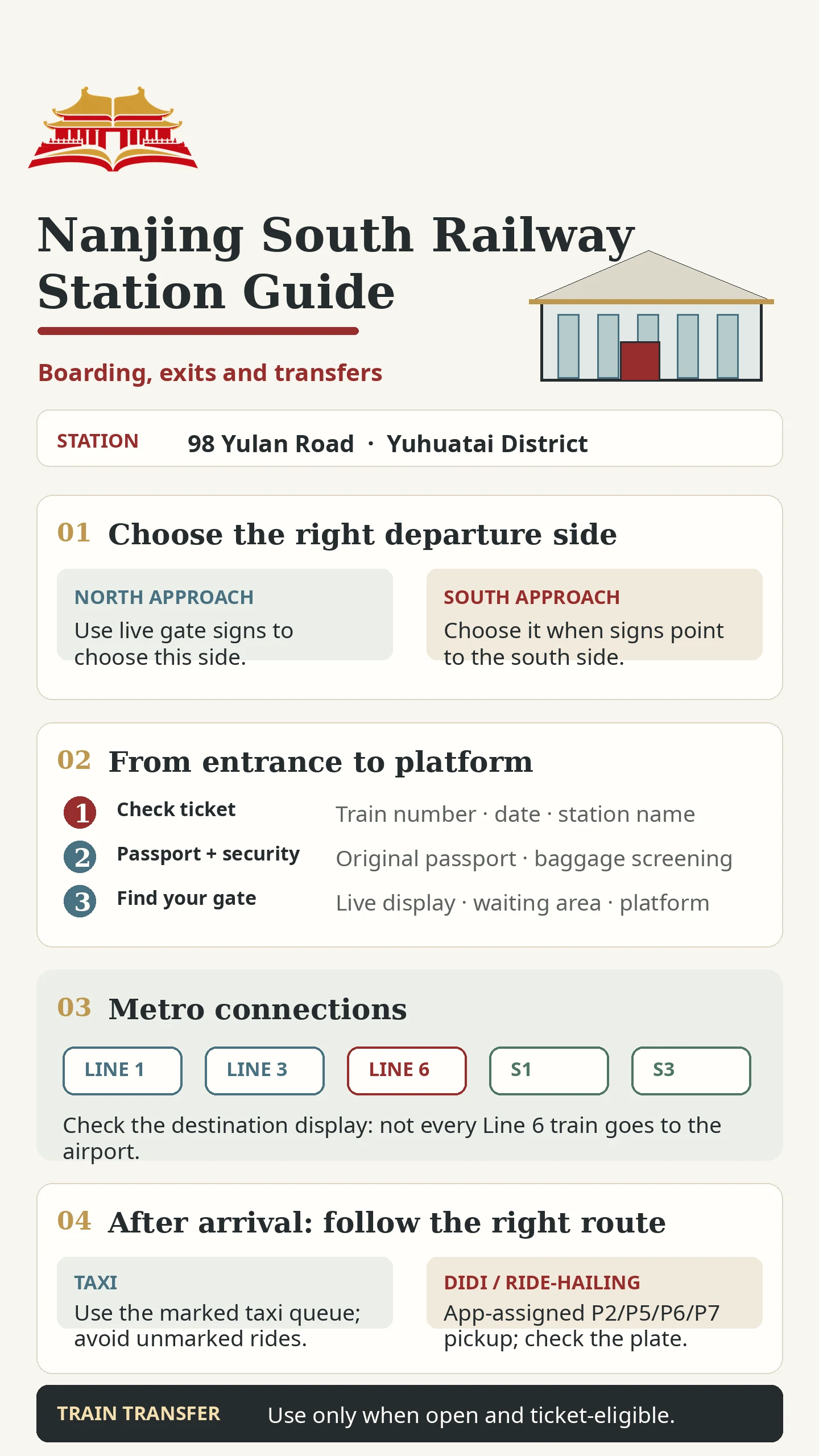
Nanjing South Railway Station (南京南站, Nánjīng Nán Zhàn) is the city’s principal high-speed rail hub, linked with metro, taxi and ride-hailing services. First-time visitors need to distinguish its north and south railway approaches from the metro exits and designated pickup areas.
This guide follows the journey in practical order, from choosing the right entrance to boarding, leaving the station and changing trains. For a broader introduction to the city, see the Nanjing Travel Guide. This page stays focused on Nanjing South itself rather than repeating the city-wide station comparison and cross-station transfer advice in Nanjing Railway Stations and Transfers.
Confirm You Have the Right Railway Station
Before leaving your hotel, open the booking and check the Chinese departure-station name, not just the English wording shown in a map app. Nanjing South is written as 南京南站. The station address is No. 98 Yulan Road, Yuhuatai District, Nanjing. The official city transport guide lists this address for Nanjing South Railway Station.[1]
The word “South” matters. Nanjing South is a separate railway facility from the station named simply Nanjing Railway Station. Do not assume that a taxi driver, map result or booking summary showing only “Nanjing” identifies the correct departure point. Match the Chinese station name in your 12306 order to the name on the station entrance signs.
If you are still deciding which Nanjing railway station your itinerary requires, use the parent Nanjing railway station overview. This guide begins once you have confirmed that your train departs from 南京南站.
Understand the Station Layout and Exits
North and South Railway Departure Areas
Nanjing South has north and south railway departure approaches leading into the station’s main passenger areas. Both sides serve train departures, but the walking route to your waiting area may differ. The useful question is not “Which side is always best?” but “Which entrance is currently most convenient for the gate shown for my train?”
Check your train number and the current boarding or ticket-check gate before choosing a drop-off point. Then follow the overhead and ground-level signs for the corresponding railway departure entrance. Gate assignments and passenger-flow arrangements can change, so avoid treating a gate-number range copied from an older guide as a permanent north/south rule. If the gate has not yet appeared, ask station staff or use the live departure screens before committing to a long walk.
The two approaches are not interchangeable shortcuts outside the building. With luggage, choosing the wrong side can mean a long walk across a busy complex. If someone is driving you, share the Chinese station name and confirm the drop-off side before setting off.
Metro Exits, Station Maps and Wayfinding
The railway and metro share a transport complex but have separate passenger flows. Railway departures, railway arrivals and metro ticketed areas are not one universal entrance, so follow the sign for your next task.
Look for bilingual directions such as Railway Departures, Railway Arrivals, Metro, Taxi and Ride-Hailing. Nanjing’s transport authority introduced colour-coded “rainbow” floor guidance at the station to help arriving passengers find buses, ride-hailing, taxis, metro entrances, the coach station and the airport city-terminal connection. The station’s floor guidance was reported to extend about 9.5 kilometres, with 47 additional internal location markers.[2]
Use station maps, 3D navigation displays where available, electronic screens and staff directions rather than memorizing an exit number from an old screenshot. Construction and crowd controls can change the best route. If you have a wheelchair, stroller or heavy suitcases, look for lifts and accessible routes.
Getting to Nanjing South Railway Station
By Metro
Metro Lines 1, 3, 6, S1 and S3 serve Nanjing South. Lines 1 and 3 are useful for central Nanjing; S1 connects with Lukou Airport; S3 serves its suburban corridor; and Line 6 adds a north–south route through eastern Nanjing.
Line 6 began initial operation on September 29, 2026, and operates through with S1. Passengers on a designated through-running service can continue across Nanjing South without getting off to change trains. The opening notice describes different weekday peak patterns and a different single pattern at other times and on weekends, so the service is not uniform throughout the day. Do not assume every Line 6 train is airport-bound. Check the destination shown on the platform screen and train display before boarding, and recheck service notices on the day of travel.[3]
For a wider view of city routes and local transport choices, use Getting Around Nanjing. For an airport-specific journey, see the Nanjing Airport Guide and Transfers rather than relying on a general station guide for current airport service times.
By Taxi, Ride-Hailing and Bus
Taxis and ride-hailing use managed pickup arrangements. Follow the official Taxi signs to the queue; do not wait in a traffic lane or accept unsolicited rides inside the station. Drivers dropping off passengers should use the signed drop-off area and leave promptly. The drop-off lane is not a waiting point for arriving passengers; use the marked pickup queue instead.
For DiDi and other ride-hailing services, the designated underground pickup areas include P2, P5, P6 and P7. These facilities have dedicated waiting areas and vehicle-location displays. At some points, passengers can wait in a designated hall and use a screen or their app to match the arriving car with its parking bay. The exact assigned parking area can vary, so follow the pickup location in your booking rather than choosing a car park from memory.[4]
Parking access routes have also been adjusted. In June 2026, the P1 and P2 entrances were reorganized, with a shared entrance introduced for those facilities. This is another reason not to rely on an old driving map or a saved screenshot when guiding a driver to the pickup area.[5]
City buses and long-distance coaches also serve the complex. Follow current signs and check the route for your travel date; use Getting Around Nanjing for city-wide bus planning.
Departing from Nanjing South: From Entrance to Platform
Prepare Your Booking and Passport
Before entering, confirm the travel date, train number, departure time, destination and station name in your current booking. The departure station must read 南京南站. Check each ticket separately if your trip involves more than one train.
Foreign visitors should carry the original valid passport used for the booking. China Railway’s 12306 English FAQ says that foreign passengers can use valid passports for real-name tickets and must keep the identity document used to buy the e-ticket for station check-in, exit and boarding. An itinerary sheet or reimbursement receipt is not a ticket and cannot replace the required identity document.[6]
Check that the passenger name and passport details in the booking match the document. If 12306 shows an identity-verification issue, resolve it before travel where possible. The dedicated 12306 guide for foreign visitors explains the wider account and booking process, while How to Book Train Tickets in China covers ticket purchase beyond the station itself.
Pass Identity Verification and Security
At the entrance, follow the signs for identity verification and security screening. If your passport is not read by an automatic gate, do not repeatedly try a different gate or follow another passenger through. Ask a member of staff to direct you to the staffed or manual channel for identity verification. China Railway’s entry guidance distinguishes between documents that can be read by automatic gates and other valid documents that require a manual channel.[7]
All passengers and carried belongings are subject to railway security checks. Place your bags on the screening belt and follow instructions from security staff. Queues can form at security, identity-check counters and ticket gates, particularly during holidays and busy departure periods. Allow enough time for the whole sequence rather than arriving at the building just before the train leaves.
Find the Waiting Hall, Gate and Platform
After the entrance checks, find your train number on the departure screen and note the waiting area and gate. Search by train number, not destination alone, because several trains may serve the same city and assignments can change.
Keep checking the displays and announcements. When boarding begins, follow the gate and platform signs, then match your carriage number to the platform markings. If a saved screenshot conflicts with live information, follow the display or ask staff.
China Railway notes that the ticket office, entrance, ticket gate and platform may be separated by walking distance, and queues can occur at several points. It advises passengers to allow sufficient time and pay attention to announcements, electronic displays and staff reminders about the waiting room, gate and boarding time.[7]
Arriving at Nanjing South: Exits and Pickups
From the Train to the Station Exit
After leaving the train, follow the Railway Arrivals signs. Decide whether you are leaving the railway complex, transferring to the metro or meeting a driver before choosing a passage. The station’s colour-coded floor guidance and bilingual signs are designed to direct arriving passengers toward the main onward transport modes.[2]
A direct connection from the railway arrival area toward the metro may be available through a dedicated passage, but do not assume that it is open at every hour or under every crowd-control arrangement. If the passage is closed or staff direct passengers to the normal exit, leave through the indicated route and follow the Metro signs to the metro security and ticketing area. Railway exit procedures and metro entry procedures are separate; a railway ticket does not replace a metro fare.
Finding Your Taxi or DiDi Pickup
For a taxi, follow the signs to the marked queue and board in order. Avoid unmarked vehicles and general traffic lanes. If someone is meeting you, agree on the exact area before leaving the train.
For DiDi, open the ride details before walking away from the station. Check the assigned car park—P2, P5, P6 or P7—and follow the matching signs to its pickup hall. Once there, use the electronic screen or app information to confirm the vehicle’s plate number and parking bay. The city’s upgraded system is designed to match passengers and cars by specific parking spaces, reducing the need to search for a driver on the road.[4]
Do not choose a car park by proximity. If the app updates the pickup point, follow the new instruction; ask staff if it conflicts with the signs.
Connecting to Other Transport
Metro, buses, taxis, ride-hailing and coaches connect with the station. For Lukou Airport, check whether your train is an S1 service or a designated Line 6/S1 through-running service; confirm the destination before boarding.[3]
If you are going to a hotel, keep its Chinese address ready for your driver. Use Where to Stay in Nanjing to compare accommodation areas or the three-day Nanjing itinerary to plan your arrival day.
Changing Trains at Nanjing South Railway Station
Same-Station Train Transfers
Nanjing South may offer a convenient transfer passage for passengers changing between trains, but availability and eligibility should not be assumed for every connection. After getting off your first train, look for Convenient Transfer (便捷换乘) signs and follow staff directions. Use the dedicated route only when it is open and staff or the station signs indicate that your ticket combination can use it.
If it is closed or unavailable for your ticket, use the normal exit and re-entry process, including identity checks and security. Keep your onward booking ready and check its gate before choosing a route.
Allow Enough Time Between Separate Tickets
Two separately purchased tickets do not create a guaranteed connection. A delay, long platform walk, closed transfer passage or identity-check queue can cause you to miss the next train. Avoid connections that depend on every step going perfectly.
Allow a larger buffer on a first visit, with bulky luggage, or if you may need staff-assisted passport checks. For general rail advice, see Train Travel in China and the China railway station guide. This section covers Nanjing South only, not transfers between separate Nanjing stations.
Practical Tips for International Travelers
- Save the Chinese name: keep 南京南站 on your phone to show a driver or station employee.
- Keep your passport accessible: carry the original document used for the booking, not only a photo or itinerary sheet.
- Check the live gate: choose the north or south departure approach only after confirming the current boarding information.
- Follow colour-coded guidance: use the station’s ground markings and bilingual signs instead of an old exit map.
- Confirm your ride-hailing car park: check whether the app assigns P2, P5, P6 or P7 before walking to a pickup hall.
- Allow a time buffer: include walking, security, identity checks and the distance to the platform.
- Ask for assistance early: if you need a lift, wheelchair access or help with a transfer, speak to station staff before entering a long route.
For storage options, consult the China railway station luggage-storage guide; services vary by station.
FAQs About Nanjing South Railway Station
Which Metro Lines Stop at Nanjing South Railway Station?
Lines 1, 3, 6, S1 and S3 serve Nanjing South. Line 6 through-runs with S1 on designated services, but the operating pattern varies. Check the train’s destination display before assuming it will continue to Lukou Airport.[3]
Which Exit Should I Use for High-Speed Train Departures?
There is no permanently best exit for every train. Check your current gate and follow the signs to the north or south railway departure approach that serves it. Live station directions take priority over old exit maps.
Can Foreign Travelers Board Trains With a Passport?
Yes. Use the original valid passport associated with your booking. If the automatic gate cannot read it, ask staff for the manual identity-check channel. An itinerary sheet is not a substitute for the required document.[6][7]
Where Is the DiDi Pickup Point at Nanjing South?
Ride-hailing pickups use designated areas in P2, P5, P6 and P7. Your app assigns the pickup location, so check the car park and bay information before leaving the station building.[4]
Can I Take Metro Line 6 Directly to Lukou Airport?
Some Line 6/S1 through-running services may continue toward the airport, but not every Line 6 train is airport-bound. Check the destination shown on the platform and train displays and consult current service notices before boarding.[3]
Sources
[1] Nanjing Municipal Transport Bureau. Railway transport and Nanjing South station address
[2] Nanjing Municipal Transport Bureau. Colour-coded floor guidance at Nanjing South Railway Station
[3] Nanjing Municipal Government. Metro Line 6 opening and Line 6/S1 through-running service patterns
[4] Nanjing Municipal Government. Nanjing South ride-hailing parking areas P2, P5, P6 and P7
[5] Nanjing Municipal Transport Bureau. P1/P2 parking entrance traffic improvements
[6] China Railway 12306. English FAQ: real-name tickets, foreign passports and boarding
[7] China Railway 12306. Entry, exit, security screening and manual identity-check guidance





