

Quick Answer: What Is the Best Nanjing Airport Transfer?
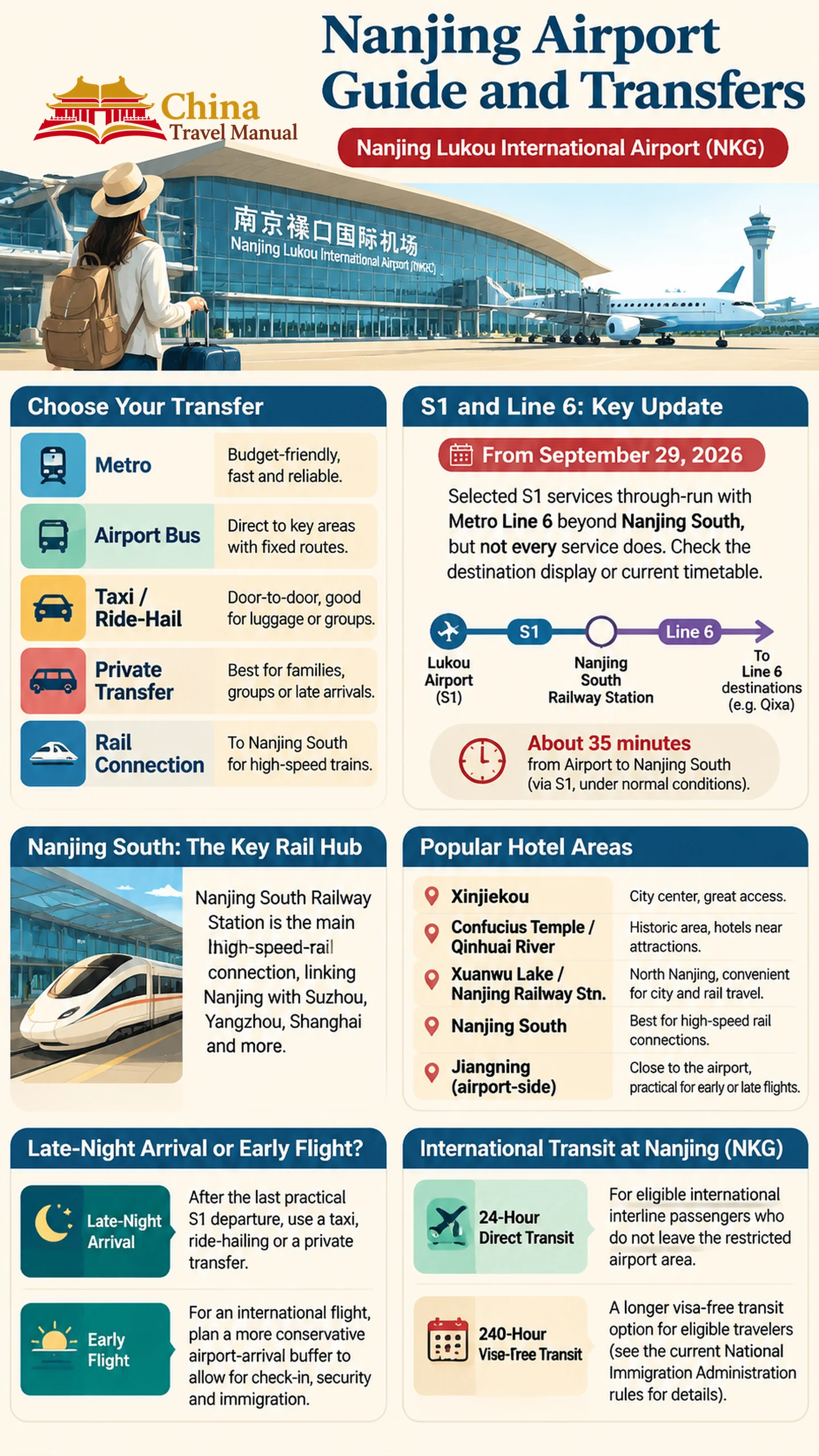
At Nanjing Lukou International Airport (NKG), choose your transfer by luggage, destination, arrival time and whether you are connecting to a train.
- Metro: Best for most independent travelers with light or moderate luggage. S1 links the airport with Nanjing South, and selected services now through-run with Line 6.
- Airport bus: Useful when a current route stops near your hotel or railway station, but routes and schedules change.
- Taxi or ride-hailing: Best for families, heavy luggage, hotels far from metro stations, or late arrivals.
- Private transfer: Best for groups, very late arrivals and travelers who want a pre-arranged pickup.
- Rail connection: If you are going straight to a high-speed train, Nanjing South is the key transfer point. Allow time beyond the S1 journey for station walking and security.
Schedules and fares can change, so check airport or metro information on the day of travel.
Nanjing Lukou International Airport (NKG) is in Lukou Town, Jiangning District, southeast of central Nanjing. It is roughly 35–40 kilometers from the central city, so the difference between a rail transfer and a road transfer can be significant during busy periods. Nanjing Lukou has T1 and T2 passenger terminals. Terminal assignments depend on the airline and flight, so confirm your terminal before leaving for the airport rather than relying on an old guide. [1]
Nanjing Lukou International Airport: What First-Time Visitors Need to Know
After arrival, follow the bilingual ground-transport signs and confirm three things: your terminal, your final destination and whether you need to connect to a high-speed train.
Metro, airport buses and taxis are available from the airport’s designated transport areas. Current airport information also shows S1 service between Lukou Airport and Nanjing South, while city airport-bus routes are organized by fixed destinations rather than by a single all-purpose downtown route. [2][3]
For international arrivals, allow time for immigration, baggage collection and customs before starting the transfer. Door-to-door time therefore begins after landing, not at the gate.
How to Get from Nanjing Airport to the City
There are four choices: metro, airport bus, taxi or ride-hailing, and a private transfer. The choice depends on hotel location, luggage and arrival time.
Metro S1 and Line 6
Metro S1 is the airport rail link and connects Lukou Airport with Nanjing South Railway Station. The airport-to-Nanjing South ride is about 35 minutes under normal conditions, but waiting and station walking add to the real door-to-door time. [3]
The most important update is the opening of Metro Line 6 on September 29, 2026. Line 6 began through-running with S1, so selected services can continue from the airport through Nanjing South toward the Line 6 corridor without requiring passengers to leave the train at Nanjing South. The city government says weekday peak periods use both longer and shorter service patterns, while other weekday periods and weekends use a different operating pattern. It also notes that the former S1 express and through-service patterns were adjusted after Line 6 opened. [2]
Do not assume every S1 train runs through Line 6. Check the platform display and current timetable; if the train terminates at Nanjing South, transfer there.
The S1 timetable lists the first airport departure at about 6:00 a.m. and the last toward Nanjing South at about 10:42 p.m.; weekend and holiday arrangements can differ. [3] Recheck the schedule before travel.
Nanjing metro uses distance-based fares. The 2026 price guide lists RMB 7 for a journey in the 28–37 km fare band and RMB 8 for 37–48 km. The actual fare for your destination is shown by the ticketing system. [4]
Best for: solo travelers, couples, moderate luggage, daytime arrivals and travelers staying close to a metro station.
Main limitation: service ends at night, and large suitcases can make station walks or transfers inconvenient.
Airport Bus
Nanjing Airport’s city airport buses operate as fixed routes rather than one universal downtown shuttle. Current listings include services connecting the airport with Nanjing Railway Station, Nanjing South Railway Station, the Confucius Temple area and western destinations. Some routes also serve the Nanjing South passenger terminal or other transport hubs. [3]
The network has changed, so older English travel guides can be misleading. Nanjing’s transport authority approved additional airport passenger-transport capacity in late 2025 and confirmed the plan in January 2026. [5] Current route listings also show different operating periods and frequencies for individual lines. [3]
For a visitor, the practical rule is simple: use the airport bus when its current stop is close to your hotel or next transport connection. Main city routes are commonly around RMB 20 per person, but the fare and timetable should be checked for the specific service you are taking.
Best for: travelers with moderate luggage whose destination is directly covered by a current route.
Main limitation: a fixed route may be less convenient than a taxi if your hotel is several blocks from the stop, and road congestion can make arrival times unpredictable.
Taxi and Ride-Hailing
Official taxi stands are available at the airport’s designated arrival transport areas. Use the marked queue rather than accepting offers from people approaching you inside or outside the terminal. For ride-hailing, follow the airport’s current pickup instructions shown after you place the order.
Nanjing’s 2026 municipal price guide sets the ordinary cruising-taxi reference fare at RMB 11 for the first 3 km, followed by a RMB 2.4 per km reference rate. Actual cruising-taxi fares can move within the permitted range, and low-speed charges apply when a vehicle is moving at 12 km/h or below. Between 11:00 p.m. and 5:00 a.m., a 20% night service charge is applied to the actual per-kilometer fare. Expressway and other road tolls are paid by the passenger. [4]
Ride-hailing prices are market-based rather than fixed by the municipal taxi fare schedule. They can rise during periods of high demand or heavy traffic. [4]
Best for: families, groups, heavy luggage, hotels away from metro stations and travelers arriving after the metro has stopped.
Main limitation: road traffic can increase both travel time and cost.
Private Airport Transfer
A private airport transfer is a pre-booked car with a driver meeting you according to the reservation and taking you directly to your hotel or another destination.
It is most useful for groups, multiple large bags, very late flights, or travelers who want a simple pickup after a long journey.
It is normally the most expensive option and requires advance booking. This guide does not recommend individual providers.
Which Nanjing Airport Transfer Is Best for You?
| Option | Best for | Transfers | Luggage | Late arrival | Main trade-off |
|---|---|---|---|---|---|
| Metro | Budget-conscious independent travelers | Depends on destination; selected S1–Line 6 services can continue through Nanjing South | Moderate | Limited to operating hours | Lowest cost, but less convenient with large bags |
| Airport bus | Hotels or stations covered by a current route | Usually direct | Moderate | Depends on the route | Fixed stops and road traffic |
| Taxi | Families and heavy luggage | None | Very good | Good | Higher and variable cost |
| Ride-hailing | App users who want door-to-door service | None | Very good | Usually available, but demand varies | Requires the correct pickup point and mobile data |
| Private transfer | Groups and very late arrivals | None | Best | Best fit | Highest cost and advance booking |
For most visitors, use the metro when your hotel is metro-friendly; choose road transport when luggage, the last mile or arrival time makes rail inconvenient.
Nanjing Airport to Nanjing South Railway Station
Nanjing South Railway Station is the airport’s most important high-speed-rail connection. It is the main point to use when you land in Nanjing and continue by train toward cities such as Shanghai, Suzhou or Yangzhou.
The simplest option is S1. It runs directly between Lukou Airport and Nanjing South, with a normal rail journey of about 35 minutes. The 2026 metro change does not remove Nanjing South’s importance: it makes the station a through-running point for selected S1–Line 6 services, while ordinary S1 travel still uses it as the airport’s main railway interchange. [2][3]
Airport buses also connect with Nanjing South; check the current operating hours before relying on the route. [3]
Do not treat the 35-minute metro journey as your complete airport-to-train connection. After leaving the airport, you still need to reach the station platform, locate your railway departure area, pass any required checks and walk to the correct gate. For a same-day flight-to-train connection, a buffer of at least 60 minutes beyond the rail running time is a safer planning baseline, with more time if your flight is international or your ticket has a tight departure window.
For station exits and onward transfers, see the Nanjing South Railway Station Guide and Nanjing Railway Stations and Transfers.
Nanjing Airport to Popular Areas and Hotels
Your hotel location can matter more than the difference between two airport transfer modes. A metro trip that ends beside your hotel can be easier than a nominally faster road journey that leaves you searching for the final address.
| Destination area | Practical first choice | Why |
|---|---|---|
| Xinjiekou | Metro or taxi | Metro works well when the hotel is close to a station; taxi is easier with large luggage |
| Confucius Temple and Qinhuai River | Metro or a current airport-bus route | A bus can reduce transfers; metro is useful when the hotel is near a station, but the last walk still matters |
| Xuanwu Lake / Nanjing Railway Station | Metro, especially when a current through-running service fits your destination | Line 6 improves east–north connections, but service patterns vary by time |
| Nanjing South area | S1 or airport bus | Best for travelers using the high-speed rail hub or staying nearby |
| Jiangning / airport-side hotels | Taxi or ride-hailing | Shorter road journeys can make more sense than traveling into the city first |
If you have not chosen a hotel yet, compare the airport connection with the rest of your route in Where to Stay in Nanjing. For the city overview, use the Nanjing Travel Guide.
Once you know your hotel area, use Getting Around Nanjing for city transportation rather than treating the airport route as a substitute for the full urban network.
Late-Night Arrivals and Early Flights
Late-night airport planning is where a small schedule mistake can become an expensive taxi ride.
The airport-to-Nanjing S1 service currently runs until around 10:42 p.m. from the airport, although schedules can change by day or holiday. [3] If your flight lands after the last practical metro departure, do not plan on reaching the city by rail. For most late arrivals, the realistic choices are a taxi, ride-hailing or a private transfer.
Airport-bus service also varies by route. Current listings show that some routes continue later than others, while others stop much earlier, so do not assume that a bus is available simply because your flight is late. [3]
For an early flight from NKG, work backward from the airline’s check-in and airport-arrival recommendation, not from the road journey alone. Include the time needed to leave your hotel, reach the pickup point, allow for traffic, find the correct terminal and complete security or border procedures. For an international flight, planning to reach the airport about three hours before departure is a useful conservative baseline, especially if you have checked baggage.
If the first metro service is too close to your flight time, use a road transfer instead. The extra cost is usually easier to manage than a missed flight.
International Arrivals, Transfers, and Visa-Free Transit
International passengers should separate the airport transfer question from the immigration question. After an international arrival, complete the required border and baggage procedures before entering the normal ground-transport flow. Do not assume that a short connection on a ticket means you can skip immigration procedures.
Nanjing Lukou International Airport is one of the airports covered by China’s 24-hour direct-transit arrangement. Since November 5, 2025, eligible passengers with international interline tickets who transit to a third country or region within 24 hours without leaving the airport can be exempt from immigration inspection procedures. [6]
That is different from the 240-hour visa-free transit policy. As of August 20, 2026, the policy covers nationals of 57 countries and allows eligible travelers transiting to a third country or region to enter China visa-free through designated ports and stay for up to 240 hours within the permitted areas. Nanjing Lukou is among the eligible ports in Jiangsu. [7]
The two situations are different:
- 24-hour direct transit: stay within the designated airport restricted area and continue to a third country or region.
- 240-hour visa-free transit: eligible travelers can enter China and travel within the permitted areas during the 10-day period, subject to the policy’s nationality, passport, onward-ticket and other conditions. [7]
This article does not determine individual visa eligibility. Check the latest National Immigration Administration rules before relying on either policy.
How to Get from Nanjing to the Airport
For the reverse journey, the same four choices are available: S1 metro, airport bus, taxi or ride-hailing, and private transfer.
The metro is usually the easiest budget option when your departure time fits the S1 schedule. Check the current airport-bound departure time rather than assuming that the schedule is identical every day. Current listings show different last-train times by direction, and the airport’s operating information notes that holiday arrangements can differ. [3]
Airport buses are useful when a current route starts near your hotel or your departure point is a railway station. Because the airport-bus network changes, verify the exact route, pickup location and departure time on the day of travel. [3][5]
For international flights, check your airline’s terminal and arrival-time requirement before leaving the city. T1 and T2 are separate terminal buildings, so going to the wrong terminal can add unnecessary walking and delay. If you are carrying heavy luggage or traveling with children, a taxi or pre-booked transfer may be worth the extra cost.
For broader planning, see the Nanjing Travel Budget or 3 Days in Nanjing guide.
FAQs About Nanjing Airport Transfers
What is the cheapest way to get from Nanjing Airport to the city?
The metro is usually the cheapest practical option. S1 connects Lukou Airport with Nanjing South, and Nanjing’s 2026 metro fare schedule is distance-based. The airport-to-Nanjing-South fare falls in the RMB 7 band under the current fare table; fares to other destinations depend on the total route distance. [4]
Does Nanjing Airport have a direct metro connection to the city?
Yes. S1 connects Lukou Airport with Nanjing South Railway Station. Since September 29, 2026, selected services also through-run with Line 6, so some passengers can continue beyond Nanjing South without changing trains. The exact through-running pattern depends on the service, so check the destination display before boarding. [2][3]
What should I do if I arrive at Nanjing Airport late at night?
If you arrive after the last practical S1 departure, use a taxi, ride-hailing service or a private transfer. Airport-bus availability depends on the individual route and its current schedule. Use official or marked pickup areas and avoid unsolicited transport offers. [3]
Can I use Nanjing Airport for visa-free transit?
Potentially, if you meet the conditions of the relevant policy. Nanjing Lukou is covered by the 24-hour direct-transit arrangement, and it is also a designated port under the 240-hour visa-free transit policy. The two policies have different requirements and travel conditions, so check the current National Immigration Administration rules before departure. [6][7]
Sources
[1] Air China. Nanjing Lukou International Airport airport information, current airport and terminal details.
[2] Nanjing Municipal Government. Nanjing Metro Line 6 Opens Initial Operation, September 29, 2026, including S1–Line 6 through-running and service patterns.
[4] Nanjing Municipal Development and Reform Commission. Nanjing Price Handbook 2026, metro and taxi fare rules.
[5] Nanjing Municipal Transportation Bureau. Airport passenger-transport capacity adjustment notices, December 2025–January 2026.
[6] National Immigration Administration. Announcement on expanding 24-hour direct-transit inspection exemption, effective November 5, 2025.
[7] National Immigration Administration. Transit Visa-Free Policy, updated August 20, 2026.





