

Quick Answer
Allow 10 calendar days in China for a first trip with three stops such as Beijing, Xi’an and Shanghai. In a week, two bases leave more time in each place. With 14 days, you can add one region or take the same three-city route more slowly. If you only have 3–5 days, stay in one city and consider a day trip once your arrival and departure times are fixed.
| Time in China | Comfortable scope | Example |
|---|---|---|
| 3–5 days | One base with an optional day trip | Beijing with a Great Wall outing |
| 7 days | Two overnight bases | Beijing and Shanghai |
| 10 days | Three bases with travel time built in | Beijing, Xi’an and Shanghai |
| 14 days | Three or four bases | The classic three plus Chengdu |
| 21 days or more | Two or three connected regions | North China, Sichuan and the lower Yangtze |
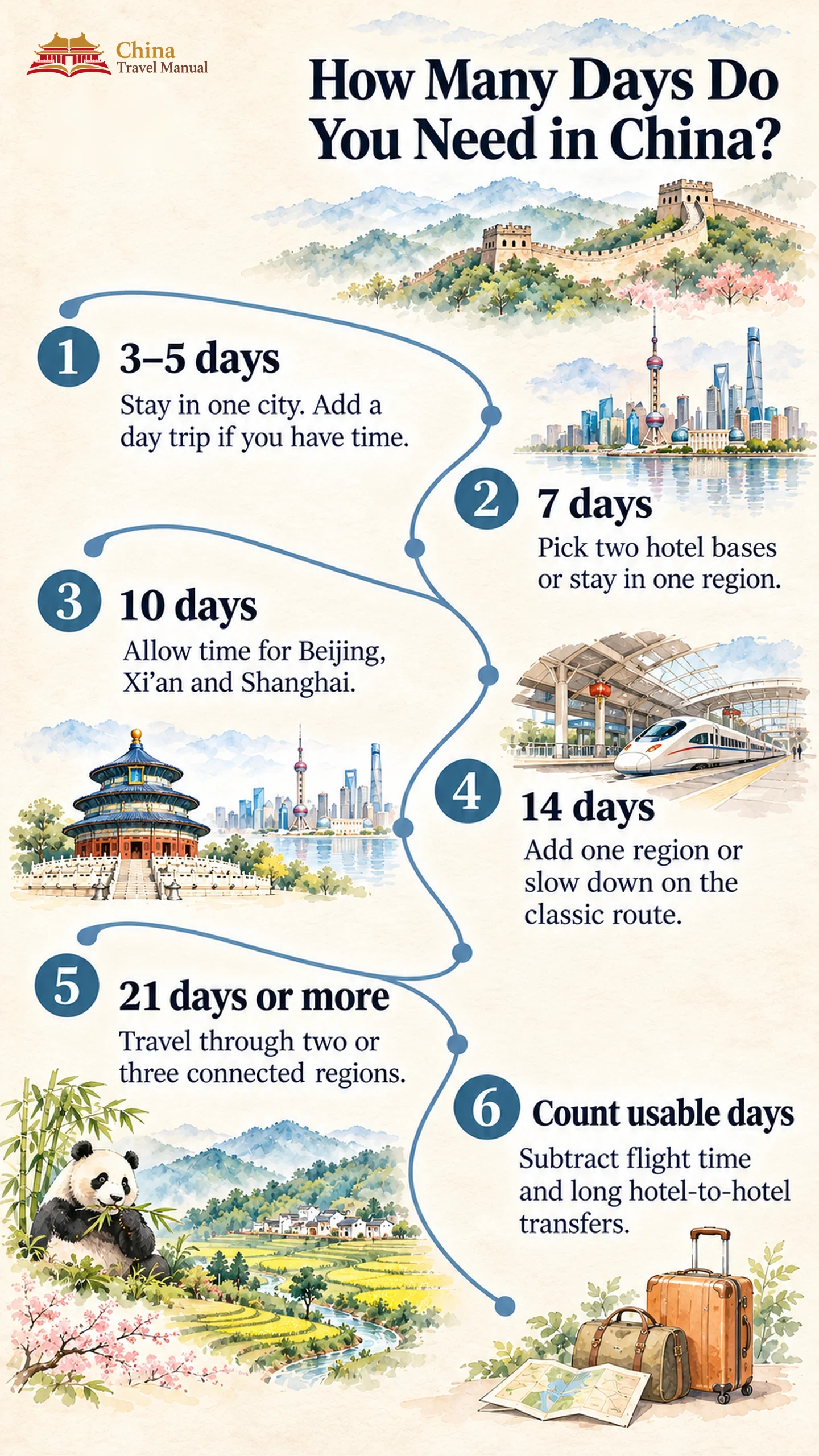
Start with the number of mornings you can wake up somewhere and stay there all day. A late arrival, an early departure and two long transfers can leave a seven-day trip with only three clear sightseeing days. Work from your flight times and the trip you want to take, then choose cities that fit.
What You Can Fit Into Your Trip
The durations below count your first and last dates on the ground in mainland China. An overnight flight may start on the previous date back home. Check the local arrival date before asking for leave or reserving the first hotel. Within China, pack the days according to what you can do from one base without changing hotels.
3–5 Days: One City and a Day Trip
For three days with a late arrival and early departure, plan around one full day in the city. For Beijing, pick one group of central sights or give that day to the Great Wall. For Shanghai, choose the waterfront and a nearby neighborhood. The three-day Beijing itinerary and three-day Shanghai itinerary help you scale the days to your actual flights.
With five calendar days, a full-day outing is easier to fit. Return to the same hotel. From Shanghai, Suzhou is a rail day-trip option if you leave enough time for both station transfers and sightseeing. The five-day China itineraries give you several ways to use a short vacation. Keep your last full outing close enough to your flight’s departure city.[2]
7 Days: Two Main Bases
A north-to-east pairing gives you two cities with contrasting sights and meals. One balanced split is three nights in Beijing and three in Shanghai. If you arrive in Beijing on Day 1 and travel on Day 4, you have Days 2–3 clear in Beijing and Days 5–6 clear in Shanghai before a Day 7 departure. You can also spend the week in one region, such as the Shanghai, Hangzhou and Suzhou route, and visit one of those cities on a day trip.
Fit a third overnight city into a week only if its main sight is a priority and the flight and train times leave room. A published eight-day Beijing–Xi’an–Shanghai route illustrates how compact three bases can be when the transfers are scheduled in advance. Compare the seven-day China itineraries if you are deciding between a compact region and a longer rail journey.[1]
10 Days: Three Cities for a First Visit
For the classic route, try four nights in Beijing, two in Xi’an and three in Shanghai. With travel days on Days 5 and 7, this leaves three clear days in Beijing, one in Xi’an and two in Shanghai, even if Days 1 and 10 are mostly tied up by flights. If Xi’an is a bigger draw, move one night there from either end. Book the inbound and outbound flights from different cities if the schedule and fare make sense.
Test the split against the Beijing, Xi’an and Shanghai itinerary before reserving rooms. If you are comparing nature and food priorities, use the ten-day China itineraries to see which cities could take Xi’an’s place. With ten days, every additional overnight base takes time from one of the first three.
14 Days: Three Cities and a Regional Extension
Two weeks leave room for a fourth base when its contribution is clear. Add Chengdu for several food-focused days or make a countryside stop around Guilin and Yangshuo. Give the extension enough nights to justify both the trip in and the trip onward. Consider stretching the existing stays if you like unstructured mornings, have children who need a break after travel, or want to make a day trip without packing again. The 14-day China itineraries show how the same vacation length can support different travel styles.
21 Days or More: Travel by Region
Spend the extra time in a few connected regions. For example, follow the Beijing–Xi’an leg with several Sichuan nights and finish in the lower Yangtze. Choose one or two hotel bases per region and add days out from them as your energy allows. If you are considering a fifth or sixth stop, first decide which region deserves an extra night and what a transfer will displace. Use the 21-day China itineraries for route options with enough time to deal with check-ins, laundry and transport changes.
How to Count the Days You Can Actually Use
- Mark your local flight dates. Separate the time in China from the international travel dates on your leave calendar. Treat the first and last dates as partial days until you know you can use them.
- Work out every hotel-to-hotel transfer. Add checkout, travel to the terminal or station, waiting time and the ride to the next hotel. For help estimating those totals, use the China travel times guide before choosing trains or flights.
- Give each priority a block of time. Use a whole block for an outing with a long approach and keep a shorter neighborhood visit nearby for after a transfer. Leave room to eat, rest and reach the next place.
- Cut or add a night after testing the route. Remove the stop with the weakest payoff if every day has a fixed booking. For an open-jaw trip, check the China route-order guide before deciding where to start and end.
For example, suppose you land Monday night, transfer Thursday morning and fly out Sunday before lunch. Tuesday, Wednesday, Friday and Saturday are clear days. If you add a second long transfer on Saturday, you have three clear days and whatever time the journey leaves. A single good outing is ample on a transfer day.
Where to Spend an Extra Day
Spend the extra day on a priority you will already be near. In Beijing, an added night can separate a Great Wall day from a central sightseeing day. If you are adding a countryside stay, place the night where it gives you another morning and room to change plans for weather. Near the end of a long trip, the extra night may be most valuable in the city you fly from, especially if you need to arrive there on a separate domestic ticket.
A day with nothing fixed can also rescue a missed attraction. Check closing days and timed tickets before deciding where to put it. If you take a slower pace, add one extra night to the middle of the trip so you can rest without cutting the main sights at either end. The flexible China itinerary guide explains where a free half-day tends to help.
FAQs About How Many Days to Spend in China
Is one week in China enough?
Yes. A week is enough for two main bases or a deeper trip in one region. A late arrival and early departure take away both end days, so build your main city visits around the middle of the week.
Is ten days enough for Beijing, Xi’an and Shanghai?
Yes. A workable first split is four nights in Beijing, two in Xi’an and three in Shanghai, with two intercity journeys. If you need to fly out of the same city you arrived in, add time for the return or trim a stop.
Do arrival and departure days count?
Count them in your total trip length and hotel calculation. For sightseeing, count only the usable hours after immigration and transport or before you head to the airport. If you are checking an immigration allowance, use the authority’s counting rules for your specific entry arrangement.
Does 240-hour visa-free transit mean I can take any ten-day China trip?
Eligibility depends on your passport, onward itinerary, designated ports and permitted area. Check the China visa-free transit guide and the current official rules before booking a route. The examples here are planning durations and do not determine your allowed stay.[3]
Sources
[1] TravelChinaGuide. Eight-day Beijing, Xi’an and Shanghai route
[2] Shanghai Municipal Government. Rail connections between Shanghai and Jiangsu
[3] National Immigration Administration. 240-hour visa-free transit policy





