

Quick Answer: What Is the Best Way from Hangzhou Airport to the City?
For a first-time visitor with light luggage, the metro is usually the most predictable and economical choice. Use the line that matches your actual destination rather than automatically choosing the fastest train.
- Line 19: Best for Hangzhou East Railway Station, Hangzhou West Railway Station, and useful interchange points along the express route.
- Line 1: Usually easiest for Longxiangqiao, the east side of West Lake, Hubin, Wulin Square, and hotels near its stations.
- Line 7: Useful for Wushan Square, Qianjiang New Town, the Olympic Sports Center, and parts of southern Hangzhou.
- Official taxi, Didi, or prebooked transfer: Better for two or more large suitcases, families, wheelchair users, hotels far from a station, and late-night arrivals.
- Airport bus: Worth considering only when its listed city stop is close to your hotel or when rail service has ended.
Judge the last-train question by the time you enter the public arrivals hall, not the scheduled landing time. Airport station closing time is not the same as the last useful departure toward your destination.
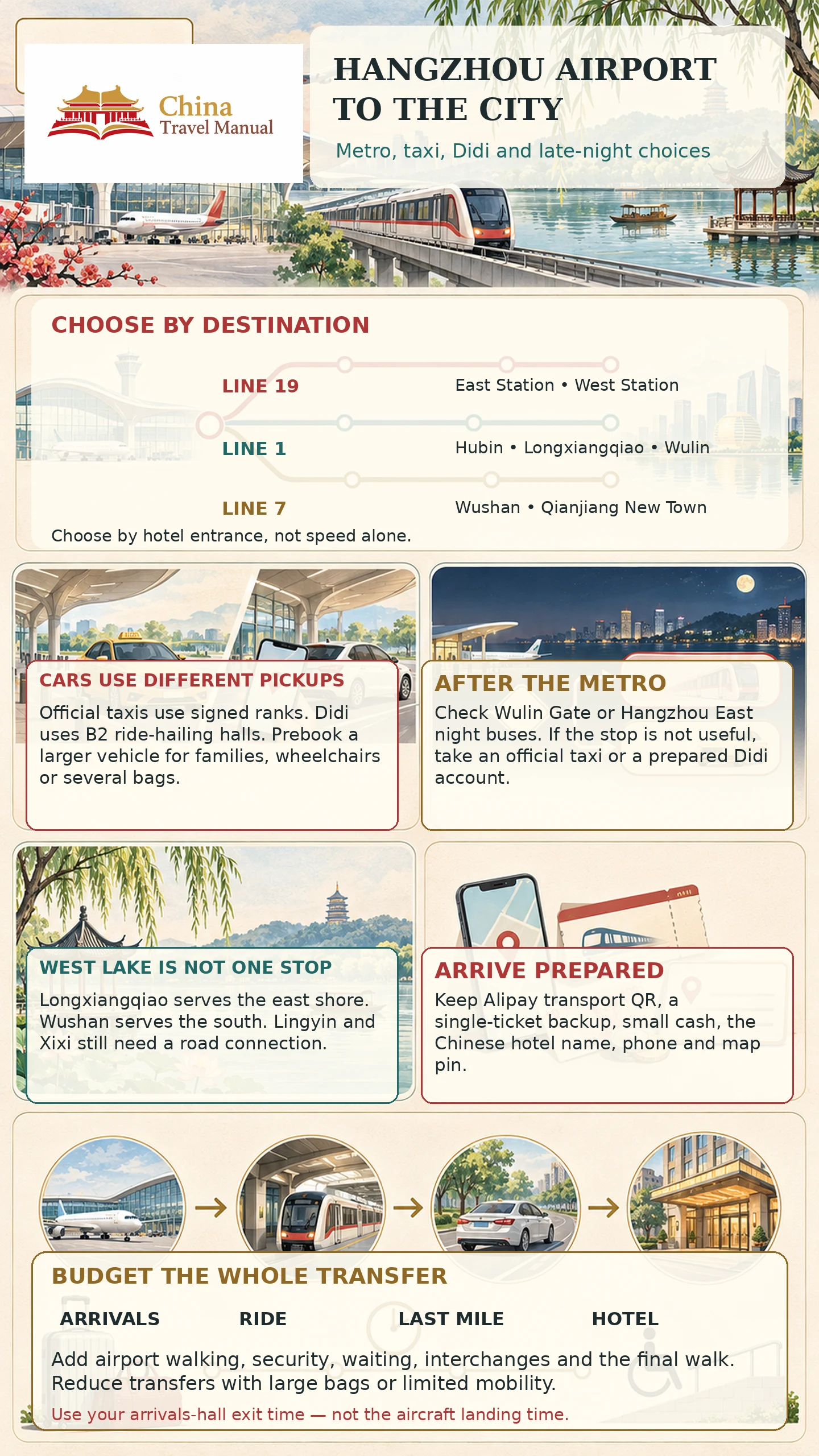
Hangzhou Xiaoshan International Airport (HGH) is well connected to the city, but the best transfer depends on the exact location of your hotel. West Lake, Wulin Square, Wushan Square, Qianjiang New Town, Hangzhou East Railway Station, and Hangzhou West Railway Station are different destinations, not interchangeable versions of “downtown Hangzhou.”
This guide measures travel from the public arrivals hall to your hotel lobby or the security entrance of your next railway station. Immigration, customs, and baggage collection happen before that clock starts. Before landing, save your hotel’s full Chinese name, street address, phone number, nearest metro station, and map pin. Use the wider Hangzhou travel guide to place this arrival transfer within the rest of your stay.
Check Your Terminal, Hotel Area and Arrival Time First
Start with your terminal. Passenger flights use Terminals 3 and 4, and both connect to the airport’s ground transportation system, but their walking routes and vehicle pickup points are different. Follow the current bilingual signs after entering the public arrivals hall. The separate Hangzhou Xiaoshan Airport guide explains the terminal layout and arrival process in more detail.
Next, identify the nearest metro station to your hotel. A property name containing “West Lake,” “Wulin,” or “Hangzhou East” does not prove that the hotel is within walking distance of that landmark. Search the actual entrance, not only the English marketing name. Some hotels described as near West Lake sit several kilometers from Longxiangqiao Station.
Use your expected exit time from the arrivals hall. An international passenger may land while the metro is still running but reach public arrivals after immigration and baggage collection have taken long enough to miss the useful citybound train. Build a second plan before flying if the timing is close.
Finally, count luggage and passengers. One cabin bag is normally manageable on every rail option. Two large checked cases, a stroller, a wheelchair, or limited mobility change the calculation because airport corridors, lifts, interchanges, and the final walk all add effort. A car may cost more but remove two or three separate luggage moves.
Compare Every Transfer Option from Hangzhou Airport
The table below is a selection tool, not a fixed timetable. Fares, final departures, airport bus stops, and pickup controls can change, so confirm them on your arrival date.
| Transport | Best for | Main advantage | Main limitation |
|---|---|---|---|
| Metro Line 19 | East and West railway stations, fast cross-city travel | Faster airport rail segment and useful interchanges | Not direct to every popular hotel area |
| Metro Line 1 | Hubin, Longxiangqiao, Wulin, straightforward first visits | Direct service through several central districts | More stops and potentially longer ride |
| Metro Line 7 | Wushan, Qianjiang New Town, Olympic Sports Center | Fewer changes for selected southern and riverside areas | Poor fit for many northwestern West Lake hotels |
| Official taxi | Heavy luggage, families, late arrivals | Simple metered door-to-door ride | Traffic, queue, and higher cost |
| Didi | Travelers with an account and payment already working | Destination is entered before pickup | Separate B2 pickup area and app dependence |
| Prebooked transfer | Groups, wheelchairs, child seats, oversized luggage | Vehicle and waiting terms can be arranged | Highest cost |
| Airport bus | Hotels near a listed stop, some late arrivals | May continue after useful metro departures | Limited stops and another last-mile ride |
Metro Lines 19, 1 and 7
Xiaoshan International Airport Station serves Metro Lines 1, 7, and 19. The station’s published opening window currently begins at 5:50 am and ends at 12:27 am, but that does not mean all three lines carry passengers toward central Hangzhou until 12:27 am.[1] Direction-specific final departures are earlier, so read the platform timetable for the line and direction you need.
Line 19 is the express-style choice. It links the airport with Hangzhou East Railway Station, Hangzhou West Railway Station, and several useful transfer points. Choose it when your hotel is close to the line or when you are connecting to a train. Do not choose it only because its airport segment is faster. A later metro change and a long final walk can make Line 1 or Line 7 quicker door to door.
Line 1 is often the easiest route for a first visit. It serves Longxiangqiao for the east shore of West Lake and Hubin, continues through Wulin Square, and also reaches Hangzhou East Railway Station. It makes more stops than Line 19, but a direct ride is often easier than an express ride followed by a transfer.
Line 7 is useful for Wushan Square, including access toward Hefang Street and the southern end of the lake, as well as Qianjiang New Town and the Olympic Sports Center area. It is less useful for a hotel on the north or northwest side of West Lake.
The current official direction table shows different final useful departures: Line 1 toward Xianghu has recently left the airport at 10:30 pm, Line 7 toward Wushan Square at 10:49 pm, and Line 19 toward Tiaoxi at 11:14 pm.[1] Treat these as details to recheck, not permanent promises. A much later departure shown in the opposite direction does not help a traveler going into the city.
Allow time to walk from either terminal, find the metro entrance, pass security, buy or activate a ticket, and wait. Even when the train itself is fast, the public-arrivals-to-platform stage may take 15–25 minutes for a first-time visitor with luggage. Check the Hangzhou transportation guide if you need a broader explanation of local metro use after reaching the city.
Official Taxi, Didi and Prebooked Transfers
An official taxi is the simplest no-app option. Follow the airport Taxi signs and join the managed queue. Current airport guidance places the Terminal 3 taxi pickup outside Arrivals Gate 14. The Terminal 4 pickup is on the first-floor corridor between T4 and the Ground Transportation Center.[2] Temporary crowd controls can alter the walking approach, so follow on-site signs instead of searching for a driver at the curb.
The driver should use the meter. Show the complete Chinese address before departure and ask for the printed receipt at the end. The receipt can help if you leave an item in the car or need to question the fare. Do not accept an unsolicited private driver inside arrivals, a request to share the vehicle with strangers, or an unmetered cash quote.
A taxi to a central hotel commonly takes around 40–70 minutes after boarding, but commuter traffic, rain, road incidents, and the exact side of West Lake can push the journey beyond that range. A group of three or four may find the total taxi cost reasonable compared with buying several tickets and handling luggage through a transfer.
Didi reduces spoken communication because the destination is entered in the app. It does not use the taxi queue. The official ride-hailing areas are on B2 of the Ground Transportation Center, around the third and fourth elevator halls. Terminal 3 passengers are directed from Gate 14 through the C2 transportation core; Terminal 4 passengers reach the pickup level from the transportation center’s second floor.[3] Confirm the hall number, vehicle plate, and pickup code in the app before approaching a car.
Set up Didi, a working phone number, mobile data, and payment before the flight. Do not rely on registering after midnight while moving through the airport. The Didi guide for tourists and the guide to finding a Didi pickup location cover those separate tasks.
A prebooked transfer is the most controlled option for a family, wheelchair user, large group, or traveler requiring a child seat. Confirm the vehicle’s passenger and luggage limits, the meeting point, how long the driver waits after a delayed flight, and the cancellation policy. A driver is not automatically an English-speaking guide.
Airport Buses and Late-Night Services
Airport buses work best when a stop is close to your hotel. They are not automatically more convenient than the metro: road traffic affects arrival time, the stop may be several kilometers from the hotel, and you may still need a taxi for the final leg. Tickets are sold through the airport’s coach system; passport holders may need to use the staffed counter for real-name ticketing.[4]
The Wulin Gate night line is the most useful budget fallback for many central-city stays. The current published schedule lists departures at 11:30 pm, 11:55 pm, 12:20 am, 12:40 am, 1:00 am, and 1:30 am. After 1:30 am, departures may continue according to arriving flights until the day’s last flight. The current fare is CNY 20, with about 55 minutes of road time in normal conditions.[5] Recheck the exact stop and schedule before relying on it.
The Hangzhou East Railway Station night line currently lists departures at 11:50 pm, 12:30 am, 1:10 am, and 1:50 am, with a CNY 28 fare and roughly 60 minutes under normal road conditions.[6] It is useful for an East Station hotel or an onward trip the next morning, but it is not a safe way to connect to a tightly timed train because road conditions and baggage handling remain variable.
Choose a night bus when you are traveling light, your accommodation is near the listed stop, and you are not racing a fixed departure. Skip it when traveling with small children, several cases, limited mobility, or a hotel that still requires two more transfers.
Choose the Route for Your Hotel or Connection
“West Lake” is not one station. The lake is large, roads and scenic areas interrupt direct walking, and hotels on different shores require different arrival plans. Use this destination table as a starting point, then check the hotel’s exact entrance.
| Destination | Default public-transport choice | When a car is better |
|---|---|---|
| Hubin, Longxiangqiao, east West Lake | Line 1 | Hotel is far from the station, late arrival, heavy luggage |
| Wulin Square | Line 1, or Line 19 with a useful interchange | Several passengers make a taxi cost reasonable |
| Wushan Square and Hefang Street | Line 7 | Long walk from station or large cases |
| Qianjiang New Town and Olympic Sports Center | Line 7, sometimes Line 19 plus a transfer | Riverside hotel is far from the metro |
| Hangzhou East Railway Station | Line 19 for speed; Line 1 is also possible | Tight connection, heavy luggage, or rail service has ended |
| Hangzhou West Railway Station | Line 19 | Late arrival or difficult last-mile hotel transfer |
| Lingyin Temple or Xixi area | Metro plus bus or taxi | Most late arrivals and travelers with luggage |
For Longxiangqiao, remember that the station is useful for the east side of West Lake, not every property using “West Lake” in its name. A hotel near Lingyin Temple, Xixi Wetland, or the lake’s western hills will still require a substantial road connection. Check where to stay in Hangzhou before assuming a scenic location is easy to reach with luggage.
For Hangzhou East or West Station, measure the transfer to the railway security entrance, not the metro platform. Add time to exit the metro, find the correct railway entrance, pass security, complete any passport check, and locate the departure gate. Hangzhou East, Hangzhou West, and Hangzhou South are separate stations. The Hangzhou railway stations guide explains which station your ticket uses, with separate guides for Hangzhou East Railway Station and Hangzhou West Railway Station.
What to Do After a Late-Night Arrival
Use this order after entering the public arrivals hall:
- Check the final useful metro departure for your line and direction. Do not use the airport station’s general closing time.
- If a suitable train remains and you have enough time to reach the platform, follow Metro signs immediately.
- If the metro has ended, check the current Wulin Gate and Hangzhou East Station night-bus schedules and stops.
- If neither bus finishes near your hotel, join the official taxi queue.
- Use Didi only if the account, mobile data, and payment method already work and you can reach the B2 pickup hall.
- Choose a taxi or prebooked transfer immediately when traveling with children, limited mobility, or several large cases.
Never follow someone who approaches you in the arrivals hall offering a “special taxi” or asking for a cash price. Official ground transport has signed pickup areas.
If you arrive between roughly 2:00 am and 5:00 am and need an early train, compare two realistic plans: travel to a city or station hotel immediately, or sleep near the airport and make the railway transfer after waking. The second plan may involve more travel later, but the first can leave you exhausted and still unable to check in early. Do not book a tight morning train based only on the fastest possible driving time.
Tickets, Payment, Chinese Addresses and Luggage
Hangzhou supports several payment routes, but no single option should be your only plan. An international visitor can set up Alipay and use its transport QR service where supported.[7] The separate Alipay guide for tourists explains account preparation.
At the metro, a single-journey ticket can be bought from a machine or service point. Available card and cash options depend on the equipment. Do not assume that a foreign contactless Visa or Mastercard can be tapped directly at Hangzhou metro gates merely because this works in another Chinese city. If the first payment method fails, use a staffed counter, a single ticket, or a small amount of renminbi cash.
For a taxi, carry the address in Chinese and keep a backup payment method. Not every vehicle should be assumed to accept a foreign physical credit card. Didi needs a stable data connection and a payment method already accepted by the app. Airport bus tickets use their own ticketing channel and may require passport details.
Save this information offline:
- Hotel name in Chinese and English
- Full Chinese street address
- Nearest metro station and exit
- Hotel phone number
- Map pin and screenshot of the entrance
- Railway station name in Chinese if continuing by train
One cabin bag is manageable on the metro. With two or more large cases, prioritize a direct train or a car rather than a route with repeated changes. Keep bags away from doors and aisles. A station having lifts does not prove that every interchange or hotel approach is step-free.
Budget the Full Door-to-Door Time
Calculate the journey as:
Finding the transport area + walking + ticketing or app pickup + waiting + vehicle time + interchange + station exit + last mile.
For a hotel directly beside a metro station, add roughly 20–35 minutes to the advertised train time for the airport walk, security, waiting, and exit. For one interchange, add about 30–45 minutes rather than the few minutes shown between trains. For a West Lake hotel away from the station, estimate the final taxi or walking leg separately.
A practical planning range from the public arrivals hall to a central hotel is often about 60–90 minutes by metro. A taxi may take roughly 45–75 minutes after joining the queue, but congestion can make it slower than rail. These are planning ranges, not service guarantees.
For Hangzhou East Railway Station, Line 19 reduces the rail segment, but you still need time to enter the railway area and clear security. Hangzhou West Station also has a direct Line 19 connection, yet the transfer ends only when you reach the correct waiting area. Add at least 30–45 minutes beyond arrival at the metro station before a high-speed train, and use a larger buffer during holidays, rain, or when traveling with a foreign passport and checked luggage.
Common Mistakes and Accessibility
Avoid these common errors:
- Treating West Lake as one stop: Choose the station for the hotel’s actual shore and entrance.
- Assuming Line 19 is always best: A faster train can lose time through an unnecessary change.
- Using station closing time as the last train: Check the line, direction, and useful final departure.
- Planning from aircraft landing time: Use the time you expect to reach public arrivals.
- Saving only an English hotel name: Drivers and staff need the Chinese name and address.
- Entering only “West Lake” in Didi: Use the hotel’s exact entrance or map pin.
- Mixing taxi and ride-hailing areas: Taxis use official curbside ranks; Didi uses B2 pickup halls.
- Choosing multiple changes with large bags: Reduce transfers or use a car.
- Confusing railway stations: Match the exact Chinese and English station name on the ticket.
- Accepting an arrivals-hall solicitation: Use signed airport transport only.
- Assuming every option accepts a foreign card: Carry a tested alternative.
- Treating a bus stop as the hotel: Plan the final leg before buying the ticket.
For wheelchair users and travelers with limited mobility, a route shown as accessible may still involve long corridors, indirect lift locations, and crowded platforms. Request airport assistance from the airline before departure when needed. A prebooked accessible vehicle or official taxi is normally more predictable than a multi-line metro route. Families using strollers should avoid commuter peaks when possible and keep extra time for lifts.
FAQs About Hangzhou Airport Transfers
Does Hangzhou Airport Have a Metro to the City?
Yes. Xiaoshan International Airport Station is served by Metro Lines 1, 7, and 19. The right line depends on your hotel area, and the final citybound departure differs by line and direction.
Which Metro Line Is Best from Hangzhou Airport?
Line 19 is usually best for Hangzhou East and West railway stations. Line 1 is convenient for Longxiangqiao, Hubin, and Wulin Square. Line 7 is useful for Wushan Square, Qianjiang New Town, and the Olympic Sports Center. Choose by destination, not speed alone.
How Long Does It Take from Hangzhou Airport to West Lake?
Allow roughly 60–90 minutes from the public arrivals hall for many east- or south-side West Lake hotels. The exact time depends on the shore, metro line, waiting, interchange, and the final walk or taxi. Hotels on the west side can take longer.
How Do You Reach Hangzhou After the Metro Stops?
Check the Wulin Gate or Hangzhou East Station night bus first. If its stop is not useful, use the official taxi queue, a Didi account that is already working, or a prebooked transfer. Do not accept an unsolicited private ride.
Can You Pay for Hangzhou Airport Transport with a Foreign Card?
Payment support varies by machine and transport mode. Do not rely on tapping a foreign bank card directly at the metro gate. Prepare Alipay transport QR, a single-journey ticket, and a small amount of renminbi cash as backups.
Sources
[1] Hangzhou Xiaoshan International Airport. Metro
[2] Hangzhou Xiaoshan International Airport. Taxi
[3] Hangzhou Xiaoshan International Airport. Online Ride-Hailing
[4] Hangzhou Xiaoshan International Airport. Airport Coach Service
[5] Hangzhou Xiaoshan International Airport. Wulin Gate Night Line
[6] Hangzhou Xiaoshan International Airport. Hangzhou East Railway Station Night Line
[7] Hangzhou Municipal Government. Foreign Visitors Can Use Alipay on Hangzhou Public Transport





