
Quick Answer
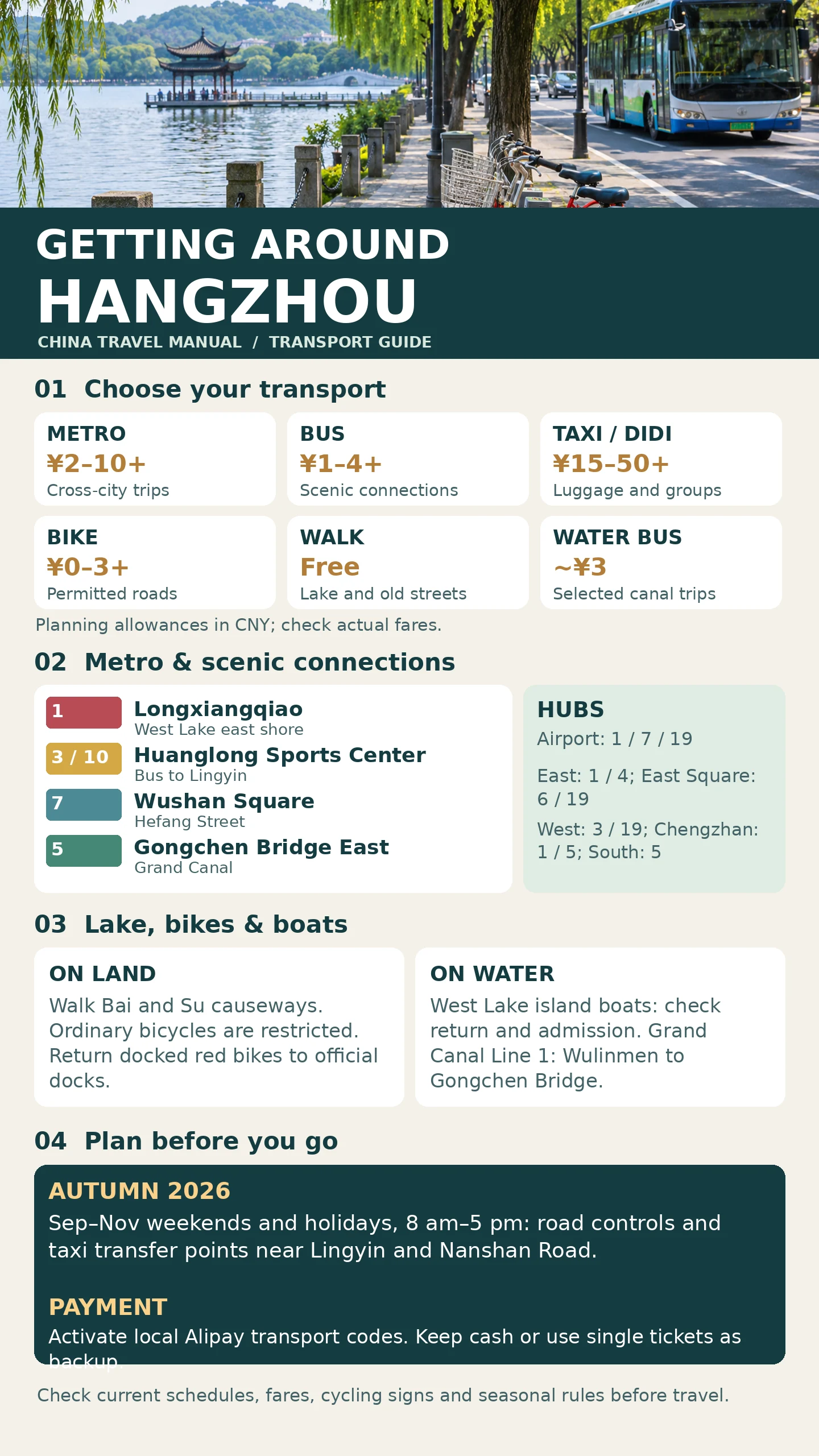
The best way to get around Hangzhou is to combine the metro, public buses and walking. Use the metro for longer distances, then switch to the appropriate local transport once you reach a scenic area.
- Best overall: Metro for cross-city journeys and airport or railway connections.
- West Lake: Walk along the lake and take scenic buses between distant sections.
- Lingyin and Longjing: Use a metro and bus combination; neither has a metro station at the main attraction.
- Luggage and groups: Take a taxi or Didi when road access permits.
- Short trips: Rent a bicycle on roads where cycling is allowed.
- Grand Canal: Try a scheduled public water bus if time permits.
Set up Alipay, save a map and carry small amounts of cash. Seasonal road restrictions can make a direct taxi ride less convenient than public transport.
Hangzhou is easy to navigate once you stop treating the metro as the only way to get around. The city has a useful rail network for airport trips and cross-town journeys, but many of its signature landscapes sit beyond a subway entrance. If you are planning a first visit, choose your base using our where to stay in Hangzhou guide and organize outings by neighborhood rather than crossing the city repeatedly. Our Hangzhou travel guide covers the wider trip.
Hangzhou Transportation Options at a Glance
The following budgets are in Chinese yuan (CNY). Metro, bus and boat estimates are per passenger unless otherwise indicated; taxi estimates are per vehicle. They are planning allowances, not live quotes or fares guaranteed for every route.
| Method | Planning cost | Best for |
|---|---|---|
| Metro | ¥2–10+ | Longer urban journeys |
| Public bus | ¥1–4+ | Scenic areas and village connections |
| Taxi or Didi | ¥15–50+ | Short urban trips and luggage |
| Bicycle | ¥0–3+ | Short rentals on permitted roads |
| Walking | Free | Lakefront and historic streets |
| Water bus | Around ¥3 on selected services | Canal journeys |
| Sightseeing boat | Varies by boat and route | Lake sightseeing |
Traveling with children or several suitcases changes the calculation: a direct car journey may be worth the extra cost, but allow for scenic-area restrictions. For longer stays, our Hangzhou travel budget helps put local expenses in context.
Getting Around Hangzhou by Metro
The Most Useful Metro Lines for Tourists
Stations are generally signposted in Chinese and English. Follow the line number and direction shown on the platform, not just the color of the line. A station with a familiar landmark in its name may still be some distance from the attraction itself.
| Line | Useful connections |
|---|---|
| 1 | Airport, Hangzhou East, Wulin Square, Longxiangqiao, Ding’an Road, Chengzhan |
| 2 | Fengqi Road, Qianjiang Road |
| 3 | Wulin Square, Huanglong Sports Center, Xixi Wetland South, Hangzhou West |
| 4 | Hangzhou East, Citizen Center |
| 5 | Chengzhan, Gongchen Bridge East, western districts |
| 7 | Airport, Wushan Square, Citizen Center |
| 19 | Airport, Hangzhou East (East Square), Wensan Road, Hangzhou West |
Line 1 is particularly useful for visitors staying near the east shore of West Lake. Line 19 connects major transport hubs with fewer stops, while Line 3 gets you closer to western scenic areas. You may still need to change lines to reach your hotel. Use the current network map to plan rather than assuming a line shown on a future construction map is open.[1]
Which Metro Station Should You Use?
| Destination | Station | Line |
|---|---|---|
| West Lake east shore | Longxiangqiao (龙翔桥) | 1 |
| Northern West Lake | Fengqi Road (凤起路) | 1, 2 |
| Hefang Street | Wushan Square (吴山广场) | 7 |
| Southern Song Imperial Street | Ding’an Road (定安路) | 1 |
| Lingyin Temple | Huanglong Sports Center (黄龙体育中心) + bus | 3, 10 |
| Lingyin Temple | Wensan Road (文三路) + bus | 10, 19 |
| Xixi Wetland south entrance area | Xixi Wetland South (西溪湿地南) | 3 |
| Gongchen Bridge | Gongchen Bridge East (拱宸桥东) | 5 |
| Qianjiang New City | Citizen Center (市民中心) | 4, 7 |
At Longxiangqiao, choose the exit closest to your intended section of Hubin rather than following the largest crowd. For Lingyin, a bus connection is part of the journey, not an optional shortcut. At Xixi, locate the entrance on a map before deciding where to get off.[1][2]
Metro Fares and Operating Hours
Standard metro fares depend on distance. Budget roughly ¥2–6 for many central journeys and more for airport or peripheral trips. Check the actual fare at a ticket machine or in the route planner. Stations have security screening before the fare gates; allow extra time when carrying luggage.
First and last train times vary by line, station and direction. On a late journey involving a transfer, check the final connecting train as well as the first segment. Our guide to using metros in China explains how to navigate gates and ticket machines if this is your first subway trip in China.
Taking Public Buses in Hangzhou
When to Use Public Buses
Buses are particularly valuable for the hills and villages west and south of West Lake. Use them for Lingyin and Feilai Peak, Longjing Village, Meijiawu, Manjuelong and Jiuxi, as well as stretches of the waterfront around Leifeng Pagoda and Yanggong Causeway.
Routes 7 and 27 are useful starting points when researching services toward Lingyin and Longjing respectively, but verify the current stop list and direction before boarding. Some services change their route or frequency during peak periods. A bus serving a nearby village may leave you with a steep final walk, so check the distance from the stop to your actual destination.
West Lake Scenic Shuttle Buses
During the September–November 2026 peak season, shuttle services connected 12 metro stations to popular scenic locations.[2] These are examples of announced connections, not a permanent year-round timetable:
| Metro hub | Scenic destination |
|---|---|
| Fengqi Road | Broken Bridge and northern lake area |
| Longxiangqiao | Southern lake area and Leifeng Pagoda |
| Wushan Square | Leifeng Pagoda area |
| Huanglong Sports Center | Lingyin and Feilai Peak |
| Wensan Road | Lingyin and Feilai Peak |
For seasonal planning, see the best time to visit Hangzhou. Check the day’s shuttle announcements, especially outside peak season. Ordinary city buses may offer a better alternative on weekdays.
How to Board a Bus
Find the stop on the correct side of the road and match the destination or route number with the vehicle display. Scan an eligible transport code or use the accepted cash fare. Carry small denominations because cash boxes may not give change. Check the next stop on your map and follow the vehicle’s instructions for exiting.
Taking Taxis and Didi in Hangzhou
Taxi Costs and When to Take One
For an ordinary short ride across central Hangzhou, a budget of ¥15–50 or more is a reasonable starting allowance, not an official tariff. The final meter or app fare depends on distance, time, vehicle type and applicable supplements. A long airport journey will generally cost more. Check the meter or fare estimate before committing to a ride.
For a longer trip, compare the actual quoted cost with the number of passengers rather than multiplying the vehicle fare by the group size. A taxi works well when your hotel is away from a subway station, you are traveling with several people, or you arrive after rail services finish. It is less dependable when reaching a restricted scenic road on a crowded weekend. In those cases, a ride to the nearest transfer point followed by a shuttle may be necessary.
Using Didi as a Foreign Visitor
International visitors can use the Didi Greater China app with supported foreign phone numbers and international cards, or access ride-hailing through Alipay.[3]
- Enter the destination in the app, checking its Chinese name and exact address.
- Select a service and review the fare estimate.
- Follow the instructions to the assigned pickup point.
- Match the vehicle’s license plate before getting in.
At a large railway station, a driver cannot necessarily meet you at the closest railway exit. Use the designated pickup area in the order. See how to use Didi in China and taking taxis in China for setup and payment details.
Walking and Cycling in Hangzhou
Exploring West Lake on Foot
Walking is ideal for the east shore, Bai Causeway, Su Causeway and the old streets around Hefang. Treat the lake as several connected sightseeing areas rather than a single short stroll. A complete circuit takes a substantial part of a day once you include gardens, photographs and breaks. If you want to see the west shore and the tea villages on the same day, take a bus between the two areas instead of walking every connecting road.
Use our West Lake walking routes to decide which stretches to combine. In summer, bring water and plan shaded breaks; in wet weather, stone paths can become slippery.
Public Bicycles and Shared Bikes
Hangzhou’s docked red public bicycles and commercial dockless bike fleets operate separately. In 2024 the public-bike system introduced deposit-free access through Alipay for overseas users; the published offer included the first hour without a rental charge.[4] Check current conditions in the mini-program before unlocking a bicycle.
Search Alipay for the Diing mini-program (叮嗒出行), or scan the code on an official dock. Follow the account-opening instructions, authorize the rental, and return the bicycle to a compatible dock. Confirm that the trip has ended before leaving.
Commercial shared bicycles use their own rental rates and permitted parking areas. A red-bike docking station is not necessarily an authorized return point for a commercial bicycle. Our bike sharing in China guide covers these differences in more detail.
Where You Cannot Ride a Bicycle
Do not plan to ride across Bai Causeway or Su Causeway: ordinary bicycles are prohibited on the designated sections at all hours.[5] Use permitted sections of the surrounding street network, such as Beishan Street or Yanggong Causeway, where signs allow cycling. Do not assume wheeling a bicycle through a prohibited section is permitted. Return your bike before entering the causeways if necessary.
West Lake Boats and Grand Canal Water Buses
West Lake Sightseeing Boats
A lake cruise can be part of the day’s sightseeing rather than merely transportation. For a visit to Xiaoying Island, associated with the Three Pools Mirroring the Moon, use an island boat. Confirm that the fare includes island admission and a return boat before paying for a separate ticket.
| Boat product | Indicative planning budget |
|---|---|
| Island excursion | ¥55–70 per person |
| Short lakeshore segment | ¥6–8 per segment, where offered |
| Full sightseeing loop | Around ¥70 per person |
| Hand-rowed boat | Around ¥150 per boat per hour |
These are reference amounts, not verified live dock prices.[10] Check the posted fare and departure pier. Our West Lake visitor guide explains which areas are worth visiting.
Grand Canal Water Bus
The Grand Canal has a different water transport system. The low-cost Line 1 public water bus connects Wulinmen and Gongchen Bridge, with a reference fare of ¥3.[6] Check whether the route is running, which pier is served and when the last boat departs. Do not confuse this service with the more expensive canal sightseeing cruises.
Allow time to queue, especially on weekends. A boat is a pleasant way to reach the historic canal district, but a metro is a better choice when you have a train or flight to catch. See our Hangzhou Grand Canal visitor guide for the area.
How to Get to Hangzhou’s Main Attractions
If you are visiting the city with children, our Hangzhou with kids guide can help you build in appropriate rest stops. The following example journeys start near Hubin and Longxiangqiao. Times include approximate urban travel, ordinary waiting and some walking, but exclude attraction entry queues. Allow more time on busy weekends, in rain or if a particular scenic entrance requires an additional shuttle.
| From Hubin to | Suggested transport | Planning time |
|---|---|---|
| Lingyin | Bus or scenic shuttle | 30–60 min |
| Longjing Village | Bus or taxi | 30–60 min |
| Hefang Street | Metro or walk | 20–35 min |
| Xixi Wetland | Metro and walk | 40–60 min |
| Gongchen Bridge | Metro | 35–50 min |
| Leifeng Pagoda | Bus or walk | 25–50 min |
| Qianjiang New City | Metro | 25–40 min |
For Lingyin Temple, use a bus from Huanglong Sports Center or Wensan Road when that connection is available. Visit the temple separately from an extended lake walk if time is limited. For the Longjing tea villages, confirm whether your destination is Longjing Village itself or a different tea-growing settlement. They are not interchangeable taxi destinations. Our Longjing tea experiences guide distinguishes activities by location.
At Hefang Street, walk between the historic streets after arriving by metro; taxis may be unable to enter pedestrian sections. For the Xixi Wetlands, select the station based on the actual entrance, not just the park name. Gongchen Bridge works well as a separate half-day accompanied by a canal walk. If you are staying several nights, our three-day Hangzhou itinerary groups destinations to reduce unnecessary journeys.
Airport and Railway Station Transfers
Getting from Hangzhou Airport to Downtown
Hangzhou Xiaoshan International Airport (HGH) offers three useful metro lines. Take Line 1 for Longxiangqiao or Wulin Square, Line 7 for Wushan Square, or Line 19 for the East and West railway stations. The faster hub connection does not necessarily make Line 19 the simplest choice for every downtown hotel. Check the number of transfers and final walk before choosing it.[1][2]
For late arrivals, consider an official taxi or ride-hailing vehicle if the metro no longer runs. See Hangzhou airport to the city and our Xiaoshan Airport guide for terminal-specific directions.
Getting from Hangzhou’s Railway Stations to the City
| Railway station | Metro connection |
|---|---|
| Hangzhou East (杭州东站) | 1, 4; East Square: 6, 19 |
| Hangzhou West (杭州西站) | 3, 19 |
| Hangzhou Railway Station (杭州站) | 1, 5 at Chengzhan |
| Hangzhou South (杭州南站) | 5 |
At Hangzhou East, Lines 1 and 4 are in one metro station; Lines 6 and 19 are in the separate East Square metro station. Changing between the two requires exiting and walking through the railway complex.[7] Consult the Hangzhou East station guide or Hangzhou West station guide before departure. If arriving on a train from Shanghai to Hangzhou, match your ticket with the correct station; the railway stations and transfers guide compares them.
How to Pay for Transportation in Hangzhou
Using Alipay and Transport QR Codes
Hangzhou supports local transport codes for international visitors.[8] Set up Alipay before traveling, link a supported payment method and complete any required identity checks. In the app, open Transport, select Hangzhou and activate the relevant metro or bus code. Scan the metro code both when entering and leaving. On buses, follow the instructions for that vehicle and route.
In May 2026, Hangzhou also introduced an inbound-tourism QR program integrating selected travel and attraction services.[9] Its offers depend on eligibility and availability. Do not assume a tourism voucher or a standard payment QR code automatically functions as a valid metro ticket.
Cash, Tickets and Transport Passes
If a transport code fails, buy a single-journey metro ticket or ask at a staffed service counter. Keep a small cash reserve for buses and other accepted payments. Do not rely on foreign credit-card tapping at every gate.
Metro tourist passes have been advertised at ¥15 for 24 hours and ¥40 for 72 hours.[11] Confirm their current availability and validity at a station before purchasing. Compare the pass price against your planned journeys; two short trips in a day may cost less with ordinary tickets. Integrated bus and metro discounts may require a particular card or code, so check the applicable payment terms.
West Lake Traffic Restrictions and Practical Tips
Seasonal Traffic Restrictions
During the autumn peak season from September through November 2026, West Lake traffic management applies on weekends and public holidays from 8 a.m. to 5 p.m. Private passenger vehicles face odd-even license plate rules. Parts of Lingyin and Nanshan Road also have entry quotas requiring advance vehicle permits.[2] These are seasonal measures; consult the current notices for other dates.
Taxi and Scenic Shuttle Transfer Points
During the specified restriction periods, taxis and ride-hailing cars use designated transfer arrangements in the affected areas. Examples announced for autumn 2026 include:[2]
| Area | Transfer point |
|---|---|
| Lingyin | Xixi Road No. 608 parking lot (西溪路608号停车场) or Xiaoyawu bus stop (小牙坞公交站) |
| Nanshan Road | Litaizuwan No. 157 parking lot (里太祖湾157号停车场) |
Continue by the designated shuttle, following signs and staff directions. If you are staying inside a managed area, ask your hotel where your luggage can be dropped off. A room reservation is not itself a vehicle permit.
Practical Transportation Tips
Save the Chinese name of your destination and an offline map. Group your outings by area instead of returning to Hubin between every stop. Before heading to Lingyin, reserve admission: the autumn 2026 notice specifies advance real-name reservations, not same-day bookings.[2] Check the latest requirements for your visit date.
For evening plans, see Hangzhou at night and verify your return transport. For wider trip planning, see getting around China. First-time visitors rarely need a rental car: rail, buses and occasional taxi rides are more practical for most sightseeing trips.
FAQs About Getting Around Hangzhou
What is the best way to get around Hangzhou?
Use the metro for longer trips, buses for scenic destinations outside the rail network and walking around West Lake. Taxis are useful for luggage and late arrivals when road access permits.
Can foreigners use the Hangzhou Metro?
Yes. International visitors can buy single-journey tickets or use a supported transport QR code. If a mobile payment fails, visit the staffed station counter rather than relying on contactless foreign cards.
Can I cycle around West Lake?
Yes, on permitted roads. Do not ride across restricted sections of Bai or Su Causeway. Plan to leave your bicycle at an authorized return point and explore those routes on foot.
Is there a metro station at Lingyin Temple?
There is no direct metro stop at the temple entrance. Huanglong Sports Center and Wensan Road are useful transfer stations; check the current bus or scenic shuttle connections before traveling.
Do I need a car in Hangzhou?
Most visitors do not. Public transport covers the major city areas, while buses and occasional taxis provide scenic-area connections. A car can be inconvenient when West Lake traffic restrictions are active.
Sources
[1] Hangzhou Metro. Hangzhou transportation guide
[2] Hangzhou CPPCC. Autumn 2026 West Lake transportation arrangements
[3] State Council of China. Guide to Working and Living in China
[4] Hangzhou News. Overseas users can rent free bikes to tour around Hangzhou
[5] Hangzhou News. Non-motorized vehicle restrictions on Su and Bai causeways
[6] Hangzhou Government. Springtime boat excursions in Hangzhou
[7] Hangzhou News. Hangzhou East Railway Station travel guide
[8] Hangzhou Government. Alipay accesses public transportation in Asian Games cities
[9] Hangzhou Government. Hangzhou launches one-scan travel system for inbound tourists
[10] Hangzhou Bendibao. 2026 West Lake sightseeing boat guide
[11] TravelChinaGuide. Hangzhou Metro routes and ticket fares





