
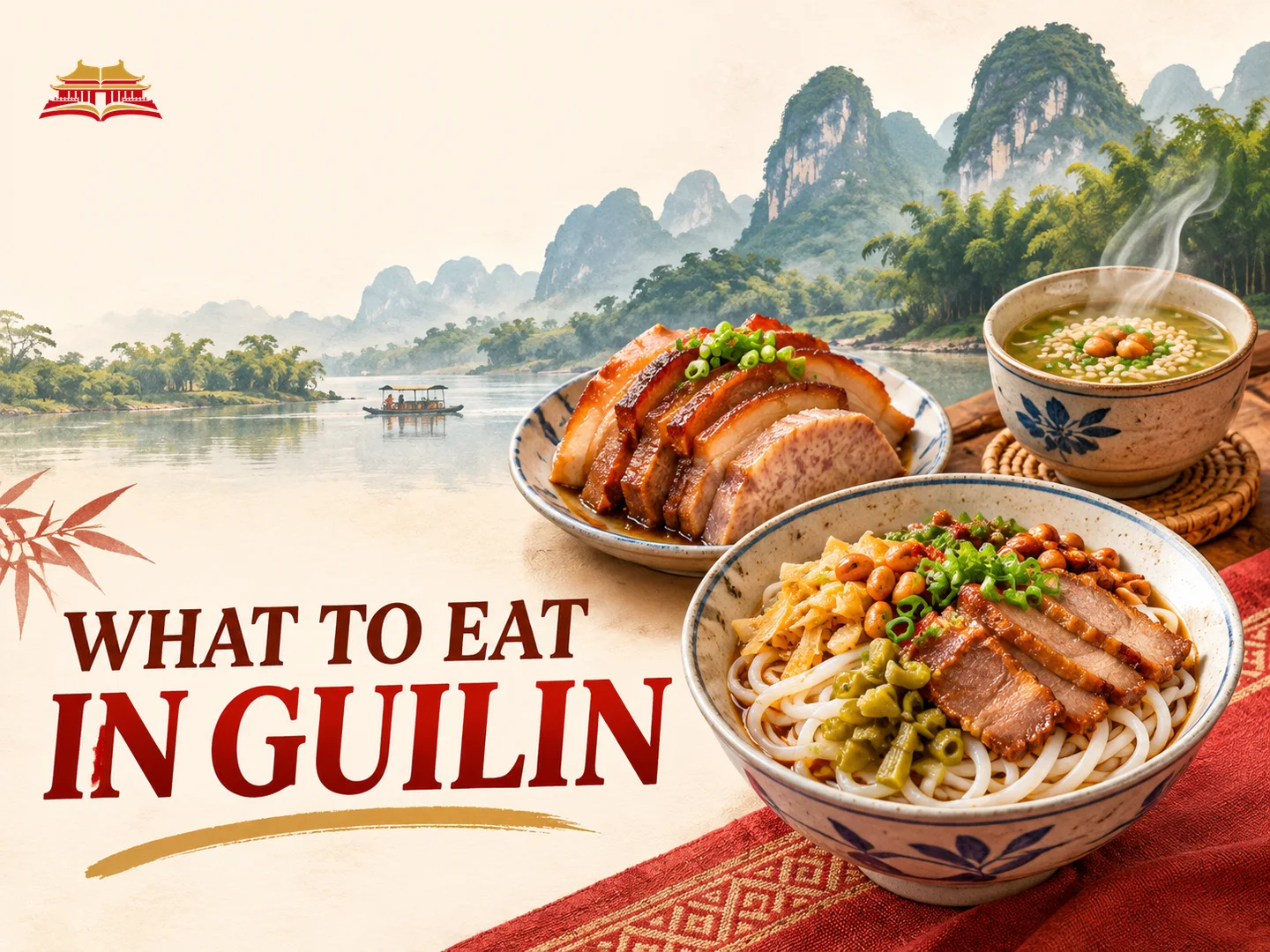
Quick Answer: What Should You Eat in Guilin?
Start with Guilin rice noodles (桂林米粉, Guìlín mǐfěn), then choose one sit-down local meal based on where your trip takes you. The city’s everyday food is different from the signature dishes you may see advertised in Yangshuo.
- Best everyday meal: Guilin rice noodles, especially dry-mixed lu-cai noodles, are inexpensive and easy to try alone.
- Best dish for sharing: Lipu taro pork (荔浦芋扣肉, Lìpǔ yù kòuròu) or local stuffed dishes makes a substantial meal with rice.
- Best-known Yangshuo specialty: Yangshuo beer fish (阳朔啤酒鱼, Yángshuò píjiǔ yú) is worth considering with companions, provided you agree on the fish and total price first.
- Most distinctive savory drink: Gongcheng oil tea (恭城油茶, Gōngchéng yóuchá) is gingery, herbal and sometimes bitter, not sweet milk tea.
- Best quick sweets: Osmanthus cake and water chestnut cake suit a short snack stop.
With limited time, eat rice noodles in Guilin city and plan a local dinner near your accommodation. You need not travel to Yangshuo solely for beer fish.
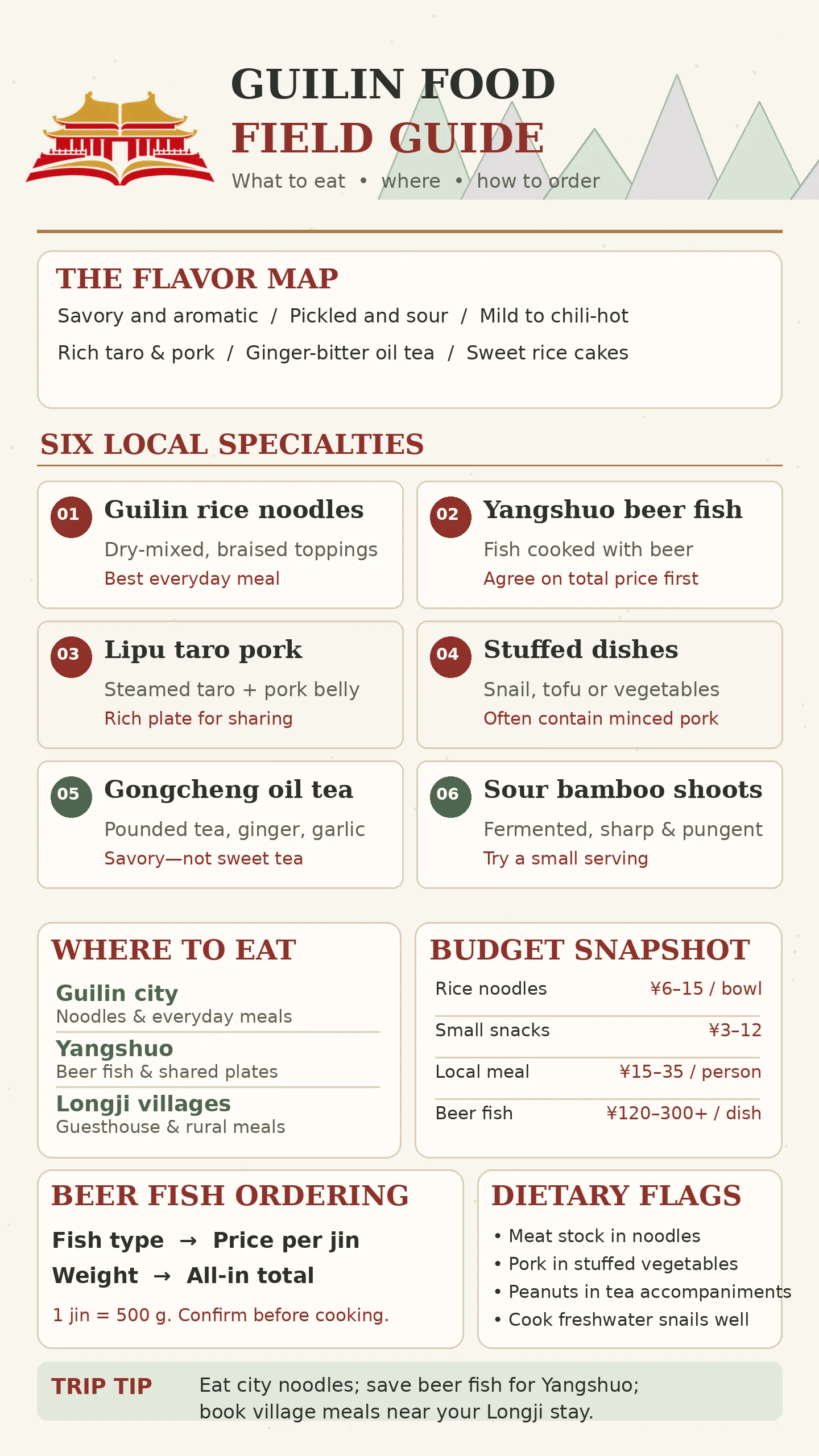
Guilin’s best-known food is not elaborate restaurant cooking but a bowl of rice noodles eaten throughout the city. When you have time for a longer meal, try layered Lipu taro pork, stuffed vegetables or snails, or the locally distinctive oil tea. Beer fish belongs especially to a visit to Yangshuo. This guide helps you match each dish to your location, appetite and budget, with practical advice on portions, ingredient questions and ordering when the menu is only in Chinese. For the wider trip, begin with the Guilin travel guide.
What Does Guilin Food Taste Like?
Northern Guangxi cooking combines savory braising sauces with pickled vegetables, herbs, ginger and chili. Guilin rice noodles get much of their character from a concentrated braising sauce called lu shui; pickled long beans and bamboo shoots add sharpness. Richer dishes, such as pork belly layered with taro, are designed to be shared with plain rice.
The local flavor range is broader than the description “spicy Chinese food” suggests:
- Savory and aromatic: Braised meats, garlic and seasoning sauces are common in noodle bowls and home-style meals.
- Sour and fermented: Pickled long beans and bamboo shoots may taste punchy or unfamiliar at first.
- Spicy when requested: Some dishes arrive with chili, while others can be ordered mild; asking for no chili does not remove a premade spicy sauce.
- Rich or starchy: Taro, rice noodles and steamed pork provide filling alternatives to hot, sour flavors.
- Herbal and bitter: Oil tea has a character of its own and is not usually treated as dessert.
For a broader regional context, the Guangxi food guide covers specialties beyond Guilin.
Best Local Dishes to Try in Guilin
Guilin Rice Noodles: The Everyday Essential
Guilin rice noodles (桂林米粉, Guìlín mǐfěn) are a practical first choice for breakfast, lunch or a quick dinner. The local favorite is often lu-cai fen (卤菜粉, lǔcài fěn): rice noodles drained of cooking water, dressed with a small amount of concentrated braising sauce, and topped with sliced braised beef or pork, crisp pork belly and other shop-specific toppings. You mix everything together rather than expecting a large bowl of soup. Guilin rice-noodle preparation was added to China’s national intangible cultural heritage list in 2021. [1]
An ordinary shop may offer a choice such as er liang (二两, èr liǎng) or san liang (三两, sān liǎng), usually indicating smaller and larger noodle portions. These are local menu conventions: do not assume that the finished bowl weighs exactly 100 or 150 grams. Some shops take payment at the counter before you collect your noodles; others serve at your table. Point to a displayed bowl or the Chinese dish name if needed.
Condiment stations may offer pickled beans, sour bamboo shoots, chopped chili, garlic or fried soybeans. Add small amounts at first. Some shops offer soup separately or allow diners to add broth after eating part of a dry bowl, but that is a shop practice, not a universal rule. If you want noodles served in soup from the start, look for tang fen (汤粉, tāng fěn).
Be aware that even plain-looking rice noodles can come with meat-based sauce or stock. For noodle types, topping choices and more precise ordering help, see the Guilin rice noodles guide.
Yangshuo Beer Fish: What to Check Before Ordering
Yangshuo beer fish (阳朔啤酒鱼, Yángshuò píjiǔ yú) is a cooked fish dish associated with Yangshuo, often prepared with beer, tomatoes, peppers and seasonings. Some versions are fairly mild; others include plenty of chili. It is generally a shared restaurant dish, not the obvious choice for someone who wants a fast, inexpensive solo meal.
The important question is how the fish is priced. Restaurants may offer different fish species at very different prices per jin (斤, jīn), a Chinese weight unit equal to 500 grams. A menu’s ¥68 or ¥128 figure might mean per jin, not per whole fish. The final bill depends on the selected fish, its weight and any separately charged items. Local market inspections have explicitly checked beer-fish restaurants for clear pricing, accurate scales and misleading menus. [5]
Before agreeing to a fish, ask which species is being offered, the price per jin, the measured weight and the estimated total. Ask whether cooking and side dishes cost extra. If you are traveling alone, ask whether a smaller portion is available rather than assuming an entire fish will be economical. Expect bones, and avoid this dish if you need to exclude alcohol entirely: cooking with beer does not prove that every trace of alcohol disappears.
Eat it when your itinerary already includes Yangshuo. The Yangshuo food guide can help you plan a meal there without turning this Guilin overview into a restaurant directory.
Lipu Taro Pork: A Rich Sharing Dish
Lipu taro pork (荔浦芋扣肉, Lìpǔ yù kòuròu) pairs slices of pork belly with thick-cut taro. The ingredients are seasoned, layered and steamed until the taro is soft and absorbs the savory pork juices. The result is creamy and starchy with a rich, fatty meat component, usually accompanied by rice and lighter vegetables.
This is not a vegetarian taro dish. A serving can be substantial, so two or more diners may prefer to share one plate with other dishes. If you dislike fatty meat, check whether your dining companions want it before ordering. It may be listed simply as 荔浦芋扣肉 on a Chinese menu; showing those characters is more reliable than trying to translate a poetic menu description.
Lipu is a county-level city within the Guilin area, but you do not need a separate trip there to taste this dish. Restaurants elsewhere in Guilin also serve versions of taro pork. Cooking style, portion size and pricing depend on the establishment.
Stuffed River Snails and Other Niang Dishes
The word niang (酿, niàng) on local menus describes a filling placed inside another ingredient; it does not mean the finished dish is alcoholic. Stuffed river snails (田螺酿, tiánluó niàng) typically combine snail meat with minced pork and seasonings, then fill the shells or prepare the mixture in a similar stuffed style. Diners usually share a plate, taking care with hot shells and small pieces.
You may also find stuffing made with tofu, eggplant, peppers or egg. A tofu or vegetable casing does not make the filling vegetarian. Pingle’s “Eighteen Stuffed Dishes” (平乐十八酿, Pínglè shíbā niàng) is a particular local culinary tradition associated with Pingle County, not a fixed list of eighteen foods sold identically throughout Guilin. Contemporary Pingle food events include stuffed snails, tofu and eggs among the examples. [4]
These dishes are worthwhile when you want a shared local restaurant meal and are comfortable with mixed ingredients. Ask what is inside before ordering. Freshwater snails must be thoroughly cooked; visitors with shellfish or other food allergies should not assume that removing a visible ingredient makes the dish safe.
Gongcheng Oil Tea: A Savory Tea Tradition
Gongcheng oil tea (恭城油茶, Gōngchéng yóuchá) is a savory tea-based food or drink traditionally made by pounding tea leaves with ingredients such as ginger and garlic, then preparing a hot, aromatic liquid. It is often served with puffed rice, peanuts, sesame, fried snacks or other accompaniments. Depending on the recipe, the taste can be gingery, bitter, salty and warming rather than sweet.
The preparation method is closely associated with Gongcheng’s Yao communities. The named oil-tea preparation technique was listed as Guangxi regional intangible cultural heritage in 2008. Separately, “Yao oil-tea customs” was included as a component of China’s traditional tea-processing and related social practices in UNESCO’s 2022 inscription. These are related cultural descriptions, not interchangeable heritage titles. [2][3]
Ask how a shop serves it: a bowl, several refills or a set with snacks may have different prices. First-time visitors can try a little before buying a large set. Peanuts, sesame, and occasionally animal fats or other ingredients can appear in a serving, so ask about the preparation if you have dietary restrictions. The tea’s caffeine content also varies with the leaves and strength.
Sour Bamboo Shoots and Home-Style Guilin Dishes
Sour bamboo shoots (酸笋, suānsǔn) are fermented bamboo shoots with a pronounced sour smell and taste. They may appear at a noodle condiment station or in stir-fried dishes, including versions prepared with beef, chili and garlic. If you like pickled vegetables, they can add a welcome contrast to rich foods; if you find strong fermented flavors difficult, taste a small amount first.
For a less adventurous shared meal, order a seasonal green vegetable alongside steamed rice and a meat, fish or tofu dish after checking how it is prepared. “Tofu” does not guarantee a vegetarian meal when pork or meat stock is used. Some premixed sauces are already sour or hot, so asking a cook to remove chili may not change the dish entirely. For broader comparisons between everyday Chinese dishes, use the Food and Drink in China guide.
Guilin Snacks and Easy Breakfasts
Rice noodles remain the simplest breakfast to seek out, but they are not the only choice. Food stalls, small bakeries and market-side shops sell snacks that can fit around sightseeing. Availability varies by neighborhood and season.
| Snack | Chinese name | What to expect |
|---|---|---|
| Osmanthus cake | 桂花糕 | A lightly floral sweet; texture and sweetness vary by recipe. |
| Water chestnut cake | 马蹄糕 | A gently sweet, often springy cake. |
| Sticky rice | 糯米饭 | A filling rice-based snack or breakfast, sometimes with savory toppings. |
| Rice cakes | 米糕 | Steamed or prepared rice cakes with shop-specific flavors or fillings. |
| Bamboo rice | 竹筒饭 | Rice cooked in bamboo, more commonly encountered around some countryside and terrace visits. |
Do not assume a snack is free of pork, peanuts or other allergens because it looks like a sweet or rice-only item. If you are exploring broader Chinese street food, choose stalls that handle and serve food hygienically; hot, freshly cooked options are generally easier to assess than food sitting uncovered.
Where to Eat: Guilin City, Yangshuo or Longji?
Your location matters more than a generic “best restaurant in Guilin” list. Choose food you can eat along the route you are already taking rather than spending hours crossing the region for a single dish.
| Area | Good dining fit | What to watch for |
|---|---|---|
| Guilin residential neighborhoods | Everyday noodles, modest local meals, quick breakfasts | Menus may be Chinese-only. |
| Zhengyang Street and East–West Alley | Snacks and convenient meals between city sights | Compare posted prices in busy tourist areas. |
| Yangshuo West Street area | Beer fish, stuffed dishes, visitor-oriented restaurants | Check fish weight, unit price and total cost. |
| Yangshuo countryside and Yulong River area | Home-style shared meals near guesthouses and outings | Dining options are more spread out. |
| Longji rice-terrace villages | Guesthouse meals, bamboo rice and local produce | Choices depend on the village and your accommodation. |
If you are deciding whether to sleep in Guilin or Yangshuo, the Guilin versus Yangshuo accommodation comparison can clarify the trade-off. For actual dining in Yangshuo, choose a restaurant near your evening plans rather than treating West Street as the only option. A trip to the Longji Rice Terraces is different again: ask your host about dinner options before arriving late, especially in smaller villages.
How Much Does Food Cost in Guilin?
The following are broad, illustrative 2026 planning ranges drawn from the Phase 1 research, not a standardized local price survey or a promise about a particular restaurant. Tourist-heavy streets, larger portions and extra ingredients may cost more. Check the displayed menu and confirm the charge before ordering.
| Food or meal | Approximate budget | Typical pricing basis |
|---|---|---|
| Basic Guilin rice noodles | ¥6–15 | Per bowl; size and toppings affect price. |
| Cake or street snack | ¥3–12 | Per piece or portion. |
| Simple local meal | ¥15–35 | Per person. |
| Sit-down local restaurant meal | ¥40–80 | Per person when sharing several dishes. |
| Lipu taro pork or stuffed dishes | ¥30–80+ | Often per shared plate. |
| Yangshuo beer fish | ¥120–300+ | Whole dish varies with fish type, weight and pricing. |
A cheap noodle breakfast and a fish dinner should not be budgeted the same way. The fish is the main variable: one jin is 500 grams, and a menu price per jin must be multiplied by the agreed weight. Request the total, including preparation charges or side dishes, before the kitchen starts. Inspect the itemized bill if the total differs from what you approved. Local market inspections have paid particular attention to clear price displays and accurate measuring equipment. [5]
If you are building a total trip budget, use the Guilin travel budget guide; it separates food costs from transport, accommodation and activities.
How to Order Guilin Food Without Speaking Chinese
You do not need fluent Mandarin to eat well, but a few visible Chinese words and one clear price question can remove most uncertainty. Keep the name of the dish on your phone so you can point to it. For more general menus and payment customs, see how to order food in China.
For noodles, follow the shop’s posted ordering system: choose the style, indicate a smaller or larger portion, state any meat preference, pay if asked, then collect your bowl or wait for table service. Add condiments sparingly until you know their flavor. For beer fish, follow a simple ordering sequence:
- Ask which fish species the restaurant will use.
- Confirm the price per jin (500 grams).
- Ask to see the fish weight before preparation.
- Request the total charge, including any cooking fee and side dishes, before agreeing to the order.
| Show the staff | What it means |
|---|---|
| 卤菜粉 | Dry-mixed Guilin rice noodles with braised toppings. |
| 二两 / 三两 | Smaller / larger noodle portion, as labeled by the shop. |
| 少辣 / 不要辣 | Less chili / no chili, where the recipe permits. |
| 多少钱一斤? | How much per jin (500 grams)? |
| 这条鱼一共多少钱? | How much will this entire fish cost? |
| 我不吃猪肉。 | I do not eat pork. |
| 我对花生过敏。 | I am allergic to peanuts. |
When you have a serious allergy, explain the ingredient and cross-contact risk carefully. A single translated sentence cannot establish that a kitchen, sauce or shared utensil is safe. If the staff cannot confirm, choose something else.
Dietary Needs, Ingredients and Food Safety
Different Guilin specialties present different ingredient risks. Look at the actual recipe rather than assuming safety from the dish’s English name.
- Vegetarian or vegan: Rice noodles themselves may be plant-based, but their braising sauce, broth or toppings may contain meat. Stuffed tofu and vegetables can contain minced pork. The vegetarian food guide for China explains what to ask.
- Peanuts, soy and sesame: Noodle condiment stations and oil-tea accompaniments may include these ingredients. Prepacked sauces and shared utensils can also matter.
- Fish and snails: Beer fish contains bones and freshwater snails need thorough cooking. Check both the shellfish or mollusk ingredient and any meat in the filling.
- Spice sensitivity: Ask for no chili when ordering, but an already seasoned sauce may not be changeable.
- Alcohol avoidance: Beer fish is prepared with beer; do not assume cooking removes all alcohol.
For allergy-specific communication and cross-contact decisions, see food allergies and dining in China.
How to Fit Local Food into Your Guilin Trip
If you have only one meal in Guilin city, a noodle bowl makes sense for a short stop, while a shared home-style dinner suits a longer evening. With a full day, start with rice noodles, then choose taro pork or stuffed dishes at a sit-down restaurant and add a small cake or oil-tea tasting if convenient.
Keep beer fish for time already scheduled in Yangshuo, rather than making a special round trip from Guilin city. On a Guilin–Yangshuo–Longji itinerary, arrange a village meal with your accommodation if dining options will be limited after a late arrival. The three-day Guilin itinerary gives a useful wider route framework.
FAQs About Eating in Guilin
What is the most famous food in Guilin?
Guilin rice noodles are the city’s best-known everyday specialty. Yangshuo beer fish is another popular dish, especially for travelers spending time in Yangshuo. For a wider local meal, try Lipu taro pork or a selection of stuffed dishes.
Is Guilin food very spicy?
Not necessarily. Pickled vegetables and chili appear in some dishes, but steamed taro pork, plain rice and many noodle variations need not be particularly hot. Ask for less chili, while remembering that premade spicy sauces cannot always be altered.
Can vegetarians eat Guilin rice noodles?
Potentially, but never assume a noodle bowl is vegetarian. The rice noodles can be plant-based while the sauce, stock, toppings or condiments include meat or animal products. Ask about the exact preparation before ordering, especially if you are vegan.
Is Yangshuo beer fish worth ordering for one person?
It depends on portion size and pricing. Many restaurants serve a whole fish by weight, which may be expensive and too large for one diner. Ask about small portions and the all-in price; otherwise, choose a noodle or individual dish.
Sources
[1] China Intangible Cultural Heritage Digital Museum. Guilin Rice Noodle Preparation Technique
[2] China Agriculture Information Network / Guilin Daily. Gongcheng Oil Tea Preparation and Regional Heritage
[3] Ministry of Culture and Tourism of China. Yao Oil-Tea Customs in the UNESCO Tea-Culture Inscription
[4] Guilin Daily. Pingle Eighteen Stuffed Dishes Preparation Competition
[5] Guilin Daily. Yangshuo Tourism Market Pricing and Food-Safety Inspections





