

Quick Answer: What Should You Eat in Guangxi?
Start with dry Guilin rice noodles, then try Liuzhou’s luosifen (螺蛳粉, luósīfěn) or Nanning’s laoyoufen (老友粉, lǎoyǒufěn) if your route reaches those cities. Share Yangshuo beer fish (啤酒鱼, píjiǔ yú) when you have time for a sit-down meal.[1][2][3][4]
- Guilin breakfast: Order a dry bowl with savory seasoning and toppings.
- Liuzhou lunch: Expect a rich snail broth and the sharp aroma of sour bamboo shoots.
- Nanning lunch: Try the garlicky, sour and spicy old-friend noodles.
- Yangshuo dinner: Confirm the fish, weight and total price before the kitchen starts.
Try the local bowl in each city you already plan to visit. Leave time for a savory tea or coastal seafood if either fits your route.
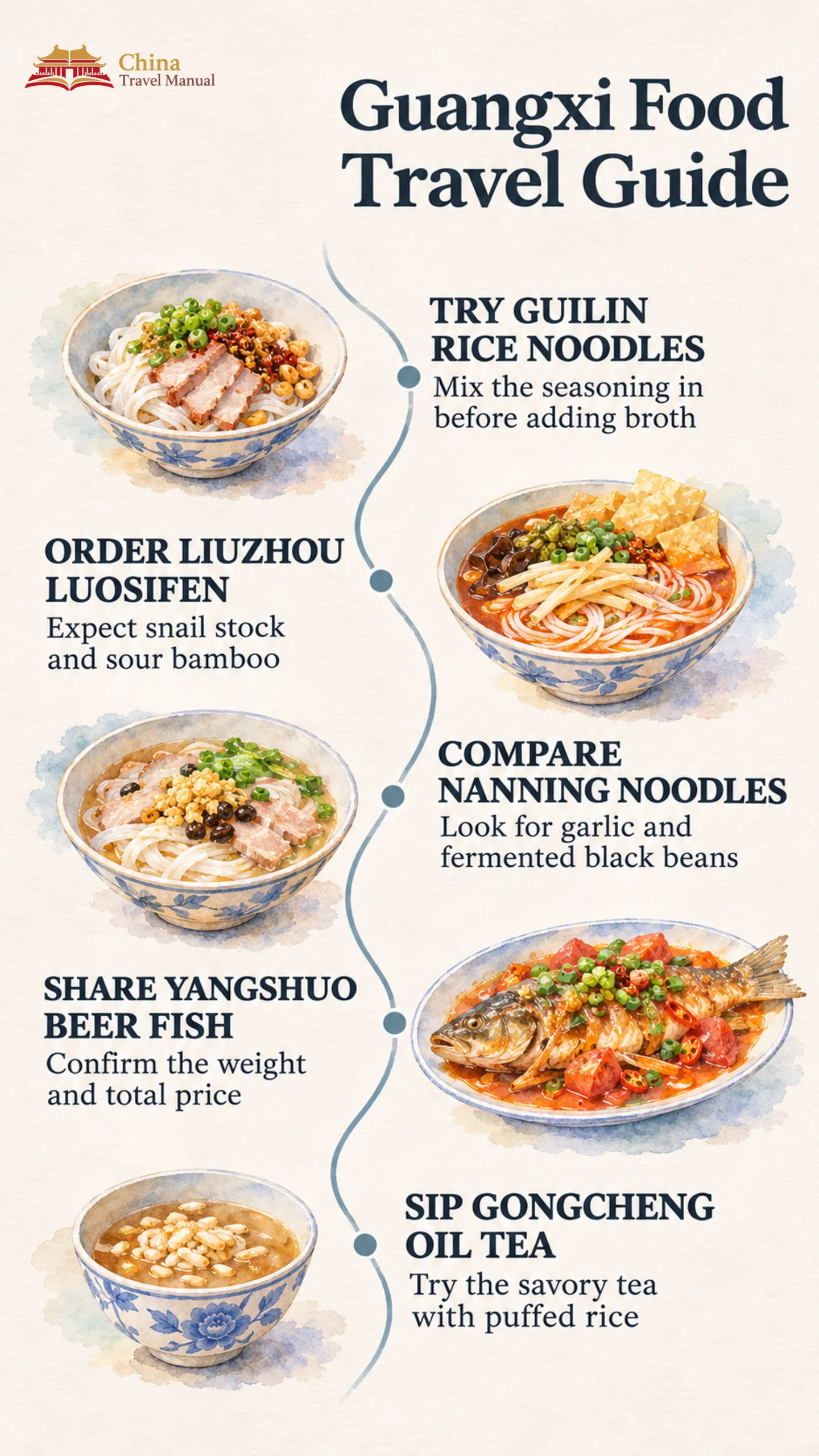
Rice noodles are common across Guangxi, but the broth, toppings and way of eating change from one city to the next. Taste the dry Guilin style first if you are new to the region. Then compare a sour broth elsewhere on your Guangxi trip instead of ordering the same bowl every day.[1][2][3]
Three Rice Noodle Styles and How to Order Them
| City and dish | What distinguishes it | Useful first order |
|---|---|---|
| Guilin rice noodles (桂林米粉) | The dry style is mixed with a small amount of concentrated savory seasoning | Ask for 卤菜粉 and mix the noodles before adding any broth. |
| Liuzhou luosifen | Rice noodles in snail stock, commonly with pickled bamboo shoots | Start with one bowl and check the chili level. |
| Nanning laoyoufen | Sour bamboo, garlic, fermented black beans and chili flavor the broth | Ask what meat or toppings come in the standard bowl. |
Rice noodles in Guilin can also come in soup. Order the dry style if you want the contrast between brined meat or crispy toppings and lightly dressed noodles. The Guilin rice noodle guide covers the local menu choices in more detail. In Liuzhou, the snail is often used to make the stock. A bowl can therefore contain a snail-based broth even if there are no visible snail pieces.[1][2][3]
Beer Fish, Oil Tea and Coastal Meals
In Yangshuo, beer fish typically comes cooked with beer, tomato and chili. Many places offer several fish choices. Ask what will be used, how it is priced, and how much the entire order costs. Choose a smaller fish or a portion if you want room for another dish.[3][4]
Try Gongcheng oil tea (油茶, yóuchá) if a regional restaurant offers it. It is a savory tea that can arrive with puffed rice or nuts. In Zhuang communities, five-color sticky rice is associated with spring celebrations. Menu availability depends on the place and date.[5][6]
In Beihai, choose a seafood restaurant if you want a meal different from the inland noodle stops. Ask whether the seafood price is per item or by weight and whether there is a separate preparation charge.[4]
Where to Eat on a Guangxi Trip
On a Guilin and Yangshuo trip, fit noodles into a city breakfast and save beer fish for dinner in Yangshuo. A family meal near your lodging gives you time to ask questions about the fish without working around the next day’s river or cycling schedule.
If your onward route stops in Liuzhou, use lunch for luosifen and compare how the shop balances sour bamboo, chili and broth. In Nanning, order laoyoufen for a quick meal and try Wuming lemon duck if you want a larger shared dish. Allow enough time to reach your onward station after sitting down.[1][2][4]
For a Nanning evening with several smaller bites, look around Zhongshan Road (中山路) in the old center. Try a bowl of noodles and one snack, such as rolled rice sheets. If you want a full meal before a train, choose a seated noodle shop and check how far the station is before ordering.[7]
Ordering Tips for Heat, Stock and Price
- For less chili: Ask for 少辣 and check whether the soup base is already spicy. Request chili separately if the kitchen can do it.
- For a meat-free order: Ask what the stock and seasoning contain, even if no meat appears on top. Check for animal fat, fish or snail stock.
- For fish and seafood: Confirm the unit price, weight, preparation fees and final cost for the group. If a price is per jin (斤), that means 500 grams.
- For a short stop: Choose one noodle bowl and add a side only if you want it.
FAQs About Guangxi Food
What Is the Difference Between Guilin Rice Noodles and Luosifen?
The dry Guilin style uses concentrated savory seasoning and toppings. Luosifen is a soup noodle from Liuzhou, typically with snail broth and sour bamboo.
Do Luosifen Noodles Contain Snails?
Traditional luosifen is made with snail stock. Ask about the broth if you avoid snails, even when you cannot see snail meat in the bowl.
What Should You Try in Guangxi Besides Noodles?
Order beer fish in Yangshuo or share a seafood dinner in Beihai. Gongcheng oil tea is a smaller, savory option if you find it on the menu.
Sources
[1] China Intangible Cultural Heritage. Liuzhou luosifen preparation and broth
[2] China Daily Guangxi. Nanning laoyoufen and other Guangxi rice noodle traditions
[3] Visit Guilin. Guilin rice noodles and Yangshuo beer fish
[4] China Daily Government Portal. Guangxi dining and regional specialties
[5] China Daily Guangxi. Gongcheng oil tea and typical accompaniments
[6] China Daily. Five-color sticky rice and Zhuang spring celebrations
[7] Open Travel Guide. Nanning Zhongshan Road food street and typical snacks





