

Quick Answer: How Do You Read a Chinese Menu?
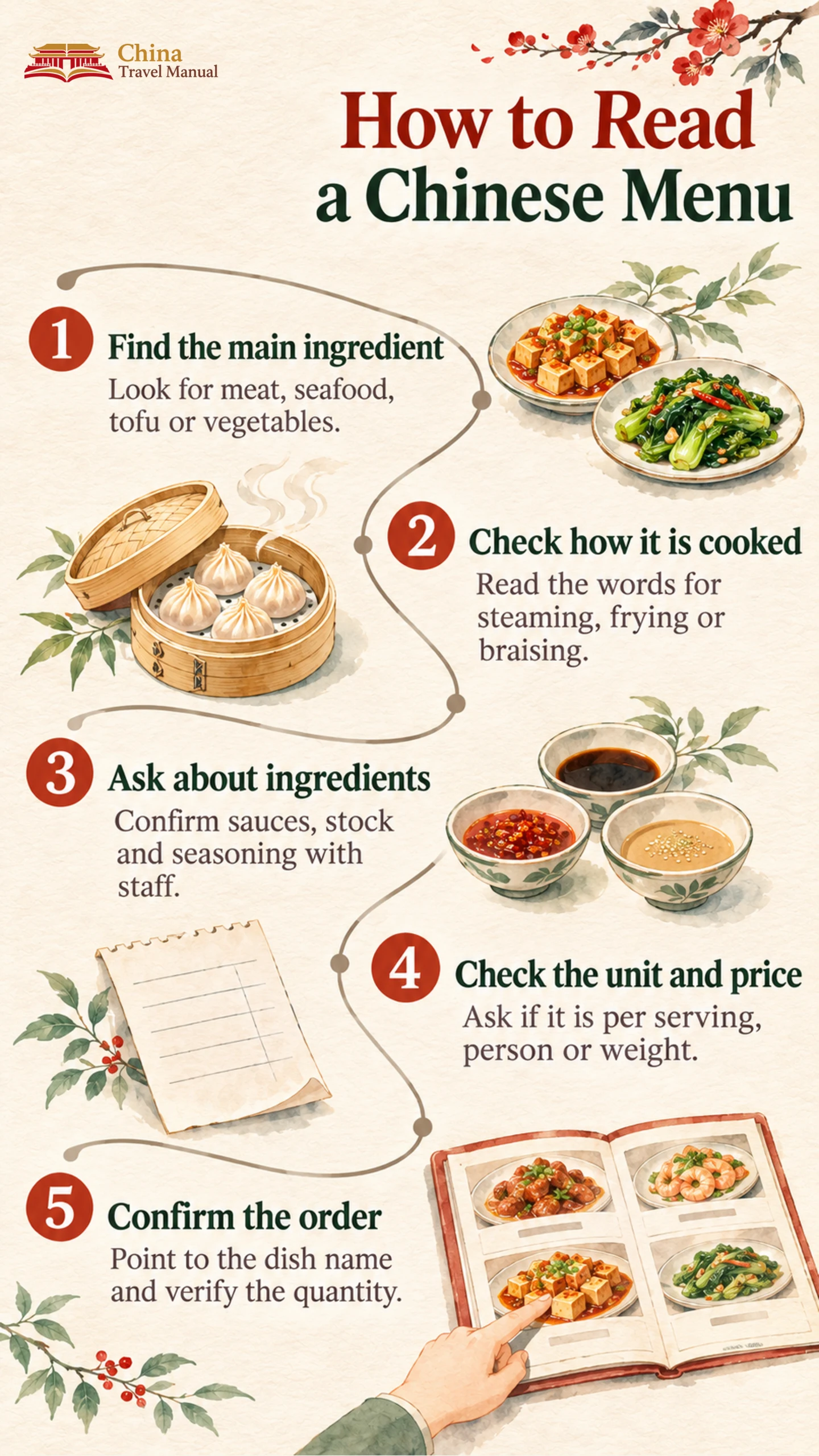
Start by identifying what you are buying, how it is cooked and how much it costs. Ask the server when a dish name or translation leaves out ingredients you need to know.
- Ingredient: Look for the main food, such as chicken, beef, fish or tofu.
- Method: Check whether the dish is steamed, stir-fried, fried or braised.
- Seasoning: Ask about both chili heat and the numbing effect of Sichuan pepper.
- Portion: Verify whether the price is per serving, item or weight.
- Order: Point to the Chinese name, confirm the quantity and ask how to pay.
Use menu translation to narrow choices, then ask staff to confirm anything that affects your order.
A Chinese menu is easier to use once you know which words tell you about the ingredient, cooking method or sauce. Menus can be paper lists, wall signs or digital screens, and a picture shows only part of the dish. Use the Chinese name to point or show staff the exact item you mean, especially when comparing similar dishes.
Read the Ingredient and Cooking Method
Look for the ingredient you can recognize and then read the words around it. Beijing’s menu translation guidance uses the main ingredient and cooking method to make many names intelligible in English. It also recommends explanations beside some traditional foods whose names give little information about their preparation.[1] These terms can help you match a menu description to what arrives.
| Menu clue | Meaning | What you can infer |
|---|---|---|
| 鸡 (jī), 牛肉 (niúròu), 猪肉 (zhūròu) | Chicken, beef, pork | Main ingredients or toppings to ask about |
| 鱼 (yú), 虾 (xiā), 豆腐 (dòufu) | Fish, shrimp, tofu | The listed ingredient. Ask about the sauce separately. |
| 清蒸 (qīngzhēng) | Plain-steamed | Preparation is steamed. Check toppings and sauces |
| 炒 (chǎo), 炸 (zhá) | Stir-fried, deep-fried | A clue to texture and preparation |
| 红烧 (hóngshāo) | Red-braised | A braised dish. Ask about the sauce if needed |
| 辣 (là), 麻辣 (málà) | Spicy, numbing and spicy | Ask about chili and Sichuan pepper separately |
The ending of a name can describe the cut, such as 丝 (sī) for shreds or 丁 (dīng) for cubes. Ask the server to point out the main ingredient if the translation gives you only a cooking style. The Chinese spice levels guide explains how to ask about heat and numbing seasoning.
Check What the Dish Name Leaves Out
Some names refer to a seasoning rather than a main ingredient. Fish-fragrant eggplant (鱼香茄子, yúxiāng qiézi) is named for a Sichuan flavor profile. The title alone does not tell you whether the restaurant uses seafood, meat or a particular paste in its own recipe.[2] Other names may indicate a traditional style without listing what goes into the broth or sauce.
If you need to avoid a particular ingredient, ask the kitchen about sauces, stock and cooking oil. The vegetarian dining guide covers common ingredients to check in vegetable dishes. For a food allergy, write the exact allergen in Chinese and show it to staff to discuss ingredients and cross-contact from shared cookware or oil. Use a translated note or menu icon to begin that conversation. If the restaurant cannot confirm how it will prepare the food, choose another option.[3]
Read Prices, Portions and Menu Sections
Menus can group cold dishes (凉菜, liángcài), hot dishes (热菜, rècài), staples (主食, zhǔshí), soups and drinks. A staple such as rice may be an extra order. Shanghai’s Mandarin ordering guide provides useful dish and ingredient names, as well as ways to call a server and ask for recommendations.[4] Before ordering several plates, ask whether the listed dish is a shared plate, an individual meal or a smaller portion. On combination menus, check whether the pictured sides and drinks are included.
Look for 份 (fèn, serving), 位 (wèi, person) and 斤 (jīn, 500 grams in mainland China). One jīn in mainland Chinese usage is 500 grams.[5] If you see 元/斤, ask staff to confirm the price for that amount. For seafood or another item sold by weight, ask staff to confirm the weight and total before cooking. If you see 时价 (shíjià, current market price), ask for the price today. At a hot pot restaurant, check whether the broth and dipping sauces are priced separately.
How to Order From a Chinese Menu
- Find the menu: Open the table menu or ask staff for a paper copy or help ordering.
- Identify the exact dish: Point to the Chinese name and ask what the main ingredient and cooking method are.
- Confirm any requirements: Describe the ingredient, seasoning or preparation you need staff to check.
- Agree on the quantity and price: Confirm the order size, unit and total for anything sold by weight.
- Review the order: Check both dish and quantity before submitting a digital order or repeating it to the server.
If you are sharing plates, ask staff how many people one portion usually serves. Keep a screenshot of a digital order for questions at the table. Use Chinese phrases for travel and the Chinese dining etiquette guide for the rest of the meal.
FAQs About Reading a Chinese Menu
Can I Ask for a Paper Menu Instead of Using a QR Code?
Yes. Ask whether the restaurant has one or if staff can take your order. Point to a photograph or the dish’s Chinese name to confirm which item you want.
How Do I Ask for a Dish With No Chili?
Say “请不要放辣椒” to ask for no chili. Ask whether the dish already contains chili in a prepared paste, sauce or broth.
How Can I Tell Whether a Price Is per Dish or by Weight?
Look for the unit beside the price. A serving can be marked 份, while 斤 means 500 grams. Ask the server to confirm the weight and final price before agreeing.
Sources
[1] Beijing Foreign Affairs Office. Chinese dining menu translation guidance
[2] The Woks of Life. Fish-fragrant eggplant and its seasoning
[3] Food Allergy Research & Education. Dining out with food allergies
[4] Shanghai Municipal Government. Ordering food in Mandarin for newcomers
[5] Shanghai International Studies University. Common Chinese measurement words and weight units





