

Quick Answer
The tables use mainland standard Mandarin (普通话, Pǔtōnghuà), simplified characters and tone-marked pinyin (拼音, pīnyīn). Save the characters for pointing or showing on your phone. Begin a question with “excuse me,” then use a short phrase for directions, payment or help.[1][2][3]
| English | Simplified Chinese | Pinyin |
|---|---|---|
| Hello | 你好 | Nǐ hǎo |
| Excuse me, may I ask | 请问 | Qǐngwèn |
| Thank you | 谢谢 | Xièxie |
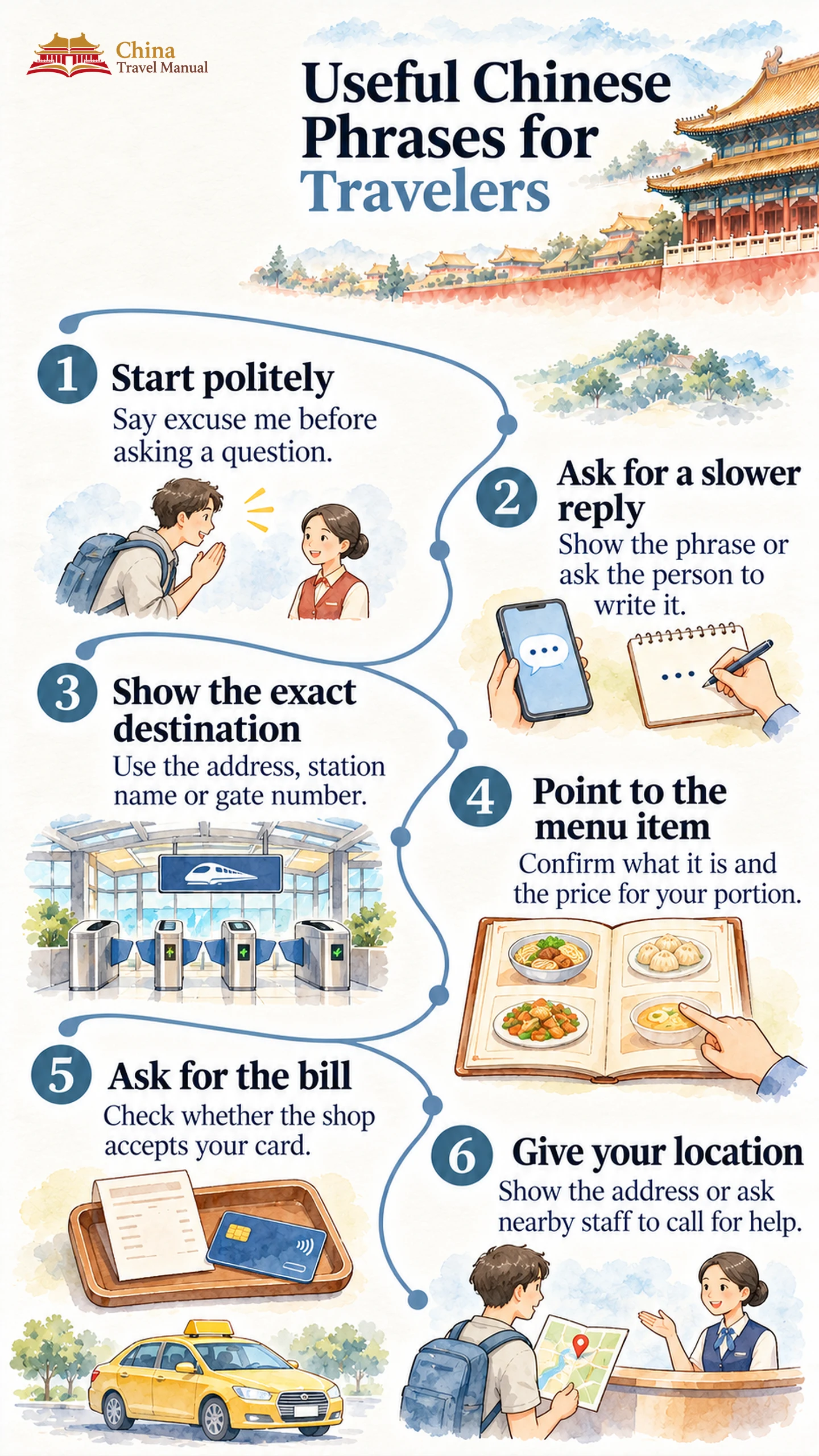
Learn a few phrases you will use on the first day and save the rest for reference. A short request and an exact address often get you further in a noisy station than a full sentence you have only practiced once.
When You Need Someone to Slow Down
Say “excuse me” before asking a question. If the reply is hard to follow, ask the person to speak more slowly or write the detail you need. Check written prices, station names and times directly. The China language guide has more advice for communicating without fluent Chinese.[3]
| English | Simplified Chinese | Pinyin |
|---|---|---|
| I don’t understand. | 我听不懂。 | Wǒ tīngbudǒng. |
| Could you speak a little slower? | 请说慢一点。 | Qǐng shuō màn yìdiǎn. |
| Could you write it down for me? | 可以帮我写下来吗? | Kěyǐ bāng wǒ xiě xiàlai ma? |
| Do you speak English? | 你会说英语吗? | Nǐ huì shuō Yīngyǔ ma? |
Directions, Trains and Taxis
Pair the question with a name from your booking or the station board. Keep the original characters visible when there are similarly named places. A station exit and a train ticket gate are different. If you show your ticket to staff, point to the train number and departure time and ask for the exact place to go. Use the Chinese address guide when you need to give a driver details.
| English | Simplified Chinese | Pinyin |
|---|---|---|
| Where is the restroom? | 洗手间在哪里? | Xǐshǒujiān zài nǎlǐ? |
| Where is the metro station? | 地铁站在哪里? | Dìtiězhàn zài nǎlǐ? |
| Which exit should I take? | 我该走哪个出口? | Wǒ gāi zǒu nǎge chūkǒu? |
| Where is the ticket gate? | 检票口在哪里? | Jiǎnpiàokǒu zài nǎlǐ? |
| Please take me to this address. | 请带我到这个地址。 | Qǐng dài wǒ dào zhège dìzhǐ. |
Hotels, Meals and Prices
At a hotel, show the booking when you say you have a reservation. At a restaurant, point to the item and confirm the portion, price and anything you need to leave out. “No chili” expresses a preference. For an allergy, show a reviewed card in Chinese and have staff check ingredients and cross-contact. See the translation apps guide for a camera or conversation backup.[4]
| English | Simplified Chinese | Pinyin |
|---|---|---|
| I have a reservation. | 我有预订。 | Wǒ yǒu yùdìng. |
| Here is my booking confirmation. | 这是我的预订确认。 | Zhè shì wǒ de yùdìng quèrèn. |
| I’d like this one. | 我要这个。 | Wǒ yào zhège. |
| No chili, please. | 请不要放辣椒。 | Qǐng bú yào fàng làjiāo. |
| The bill, please. | 请买单。 | Qǐng mǎidān. |
| How much is this? | 这个多少钱? | Zhège duōshao qián? |
| Can I pay by card? | 可以刷卡吗? | Kěyǐ shuākǎ ma? |
If a market price is per unit of weight, ask the seller to show the price for the total amount you want before confirming. For a taxi or transfer, confirm the actual address on the phone and whether the fare is the whole trip price. The China shopping guide covers price labels and receipts.
Getting Help
Use the simplest phrase that describes the need, and show the address or share which station, entrance, floor or road you are at. For an urgent situation in mainland China, the published services include 110 for police, 119 for fire, and 120 for an ambulance. If you cannot describe the location, ask nearby staff to call and give the details. Use the China emergency help guide for the service and location checks.[5]
| English | Simplified Chinese | Pinyin |
|---|---|---|
| Please help me. | 请帮帮我。 | Qǐng bāngbang wǒ. |
| Please call an ambulance. | 请叫救护车。 | Qǐng jiào jiùhùchē. |
| Please call the police. | 请报警。 | Qǐng bàojǐng. |
| I’ve lost my passport. | 我的护照丢了。 | Wǒ de hùzhào diū le. |
FAQs About Chinese Phrases for Travelers
Do I have to pronounce the tones perfectly?
Tones help distinguish words. Try a short phrase in context and show the characters if it is unclear. In the tables, unmarked syllables can indicate a neutral tone, and a few everyday pronunciations reflect tone changes in connected speech.[1][2]
Can I show the Chinese text instead of saying the phrase?
Yes. Keep the phrase and any name, address or exit number in a large, readable note. For a taxi, show the exact destination from your booking.
Which few phrases should I learn before arriving?
Start with hello, excuse me, thank you, where the restroom is and asking for help. Save a copyable Chinese version of your hotel address as well.
Sources
[1] The Open University. Getting started with Chinese: pinyin and tones
[2] State Administration for Market Regulation. GB/T 16159-2012 pinyin orthography
[3] Cambridge Dictionary. Excuse me in simplified Chinese
[4] Food Allergy Research & Education. Tips for international travel
[5] Shanghai Municipal Government. Public service hotlines





