
Quick Answer: Which China Train Class Should You Choose?
Second class is a useful starting point for a daytime high-speed train. Consider first class for more room, business class for the most space on trains that offer it, or a sleeper berth if you want to lie down overnight.
- Daytime rail: Compare the price and row layout for second, first and business class.
- Conventional rail: Hard and soft seats are daytime seat categories. Check what the departure actually sells.
- Overnight rail: Choose the berth type and check how many people share the space.
- No seat: A no-seat ticket comes without an assigned seat.
Check the class and any seat or berth assignment on the issued ticket before traveling.
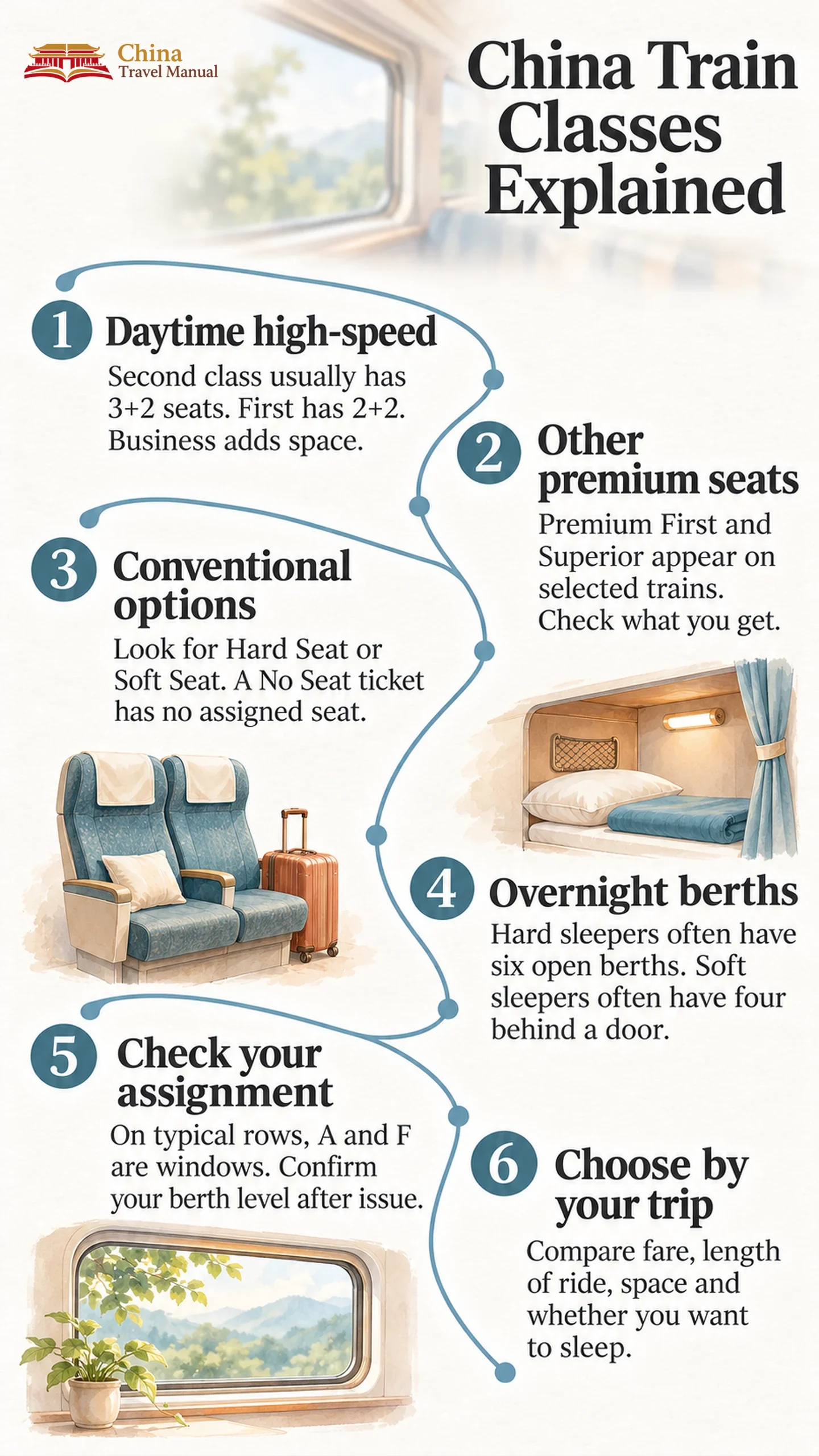
China’s railway search can show several class names for the same trip. The label determines whether you get an assigned seat, a berth or a ride without an assigned place. Check the train’s layout for the space that comes with each label. This guide explains the common mainland China classes by what you get on board.
Daytime High-Speed Train Classes
Many services sell second, first and business class. The common layouts below vary by train model.[1][2]
| Class | Common layout or setup | When to consider it |
|---|---|---|
| Second class (二等座) | 3+2 seating, with three seats on one side of the aisle and two on the other | A shorter daytime trip or a group prioritizing fare |
| First class (一等座) | Usually 2+2 seating | Two travelers who want a pair without a middle seat, or a rider who wants more room |
| Business class (商务座) | More space per rider, often 2+1 seating, with recline depending on the train | A long ride where you value space or want to rest |
| Premium First Class (优选一等座) | On selected trains, a more spacious product with adjustable seats | When offered and the actual seat features justify the higher fare |
Premium First Class is a separate choice on some upgraded trains. Under that name, some upgraded Beijing–Shanghai services have individual adjustable seats with more space between rows. Check the features and price shown for your train.[3] You may also see Superior Class (特等座) on select services. Treat that as its own label and check what the operator lists.[2][4]
For more specific decisions, see first vs second class on China high-speed trains and high-speed rail business class.
Conventional Seats and No-Seat Tickets
Conventional services can offer Hard Seat (硬座) and sometimes Soft Seat (软座). These labels identify the seat categories on the ticket. Hard seat is generally the basic fare with denser seating. Soft seat is an alternative on some trains, with a different seat layout and fare. Check the carriage photos or service description for the actual seat.[4]
No Seat (无座) is a booking without an assigned seat. Depending on the train and booking flow, the system may offer it when regular seats sell out. Read the final class line before paying. If you need to sit, look for another departure with assigned seats or check the official waitlist process. Use the carriage stated on the ticket if one is listed. Ask staff where to board if your ticket gives no carriage.[4][8]
Sleeper Classes for Overnight Trips
Start by checking that the listing sells a berth for your part of the trip. Conventional trains and overnight electric multiple units use overlapping labels, and an upgrade can change who shares your space.[4][5][6][7]
| Class | Common setup | What to check |
|---|---|---|
| Hard Sleeper (硬卧) | Typically six open berths in a bay, with upper, middle and lower on both sides | Whether you can manage the climb and sleep in an open carriage |
| Soft Sleeper (软卧) | Often four berths in a compartment with a door | How many berths are assigned to your group and whether you need a lower one |
| Deluxe Soft Sleeper (高级软卧) | Usually two berths where offered; some coaches have a private toilet | Whether that carriage has a toilet and whether your order covers both berths |
| First-Class Sleeper (一等卧) | Often upper and lower berths; layout depends on the overnight service | Actual compartment and berth placement |
| Second-Class Sleeper (二等卧) | Layout depends on the train; some offer upper, middle and lower berths | Whether the berth bay fits your privacy and access needs |
A booking for one berth in a shared compartment leaves the other berths available to other passengers. Check whether your group has each berth it needs. The China sleeper train guide covers overnight choices, including how to compare departure and arrival times.
How to Read Seat Letters and Berth Assignments
On a common second-class row, the order is A–B–C on one side of the aisle and D–F on the other. A and F are window seats, C and D are aisle seats, and B is the middle of the three-seat side. First class commonly uses A–C and D–F. A pair such as D and F on the same row can suit two people on a 3+2 carriage. Check the actual assignment because the seating chart depends on the train.[1][2]
If the seller offers seat or berth selection, request your preference before payment and check the assignment after issuance. For a sleeper, confirm the upper, middle or lower assignment on the ticket. On trains with berth selection, 12306 may show a selectable option in checkout.[6] If room to move or particular boarding assistance matters, check accessible train travel in China before you reserve.
Choose the Class You Will Actually Use
If two classes are available on the same train, the higher fare buys a different seat, berth or service. For a quick ride, choose by schedule, price and seat availability. On a longer daytime trip, compare the actual upgrade charge with the time you will spend in the seat. When the point is to sleep, compare a berth on an overnight train with a daytime trip and a night at your destination.
If you are traveling with children, check how many assigned seats or berths you have before paying. Review train travel in China with children for family ticket rules. If only a higher class is available at your preferred time, compare it with another confirmed departure in the class you want. The high-speed trains guide explains how to compare the full trip.
FAQs About China Train Classes
Will a higher train class arrive sooner?
Every passenger on the same train has the same scheduled arrival at the same stop. If you want a faster journey, compare the schedules for the different services.
Is a no-seat ticket the same as second class?
A no-seat ticket allows you to travel on the booked train without an assigned seat. Choose an order that confirms a seat if you need one for the journey.
Can I request a lower berth or seats together?
Request the position through the seller if it offers the option. Check the final seat or berth assignment when the ticket is issued, since preferences depend on available space.[6]
Sources
[1] CCTV. High-Speed Rail Seat Layouts and Seat Letters (Chinese)
[2] China Railway 12306. Train Fleet and Seating Layouts (Chinese)
[3] Xinhua. Upgraded Fuxing Train for the Beijing–Shanghai High-Speed Railway (Chinese)
[4] China Railway 12306. Train Fare Search by Seat Class (Chinese)
[5] TravelChinaGuide. Hard Sleeper on China Trains
[6] Hongkou District Government, Shanghai. Guide to Online Berth Selection (Chinese)
[7] CCTV. 12306 Explains Deluxe Soft Sleeper Features (Chinese)
[8] China Railway 12306. Online Booking (Chinese)





