

Quick Answer: What’s the Best Way to Get Around Zhangjiajie?
The best way to get around Zhangjiajie depends on which part of the destination you are visiting. Use city buses for short urban trips, city-to-scenic tourist coaches for transfers to Wulingyuan and major attractions, and taxis or DiDi when you need a direct ride. Inside Zhangjiajie National Forest Park, switch to the park’s separate shuttle and mountain transport network.
- Short urban trips: Local buses or walking in downtown Zhangjiajie and Wulingyuan town.
- Between city and scenic areas: Tourist coaches from designated stations, with current departures checked before travel.
- With luggage or after hours: Licensed taxis, DiDi or a prearranged transfer.
- Inside the forest park: Eco-friendly shuttles, followed where needed by separately ticketed elevators or cableways.
- Very short trips in Wulingyuan: Walking, or an eligible shared e-bike where available.
Choose the exact park entrance before leaving. The city, Wulingyuan, Tianmen Mountain and the Grand Canyon do not share one all-purpose bus or ticket system.
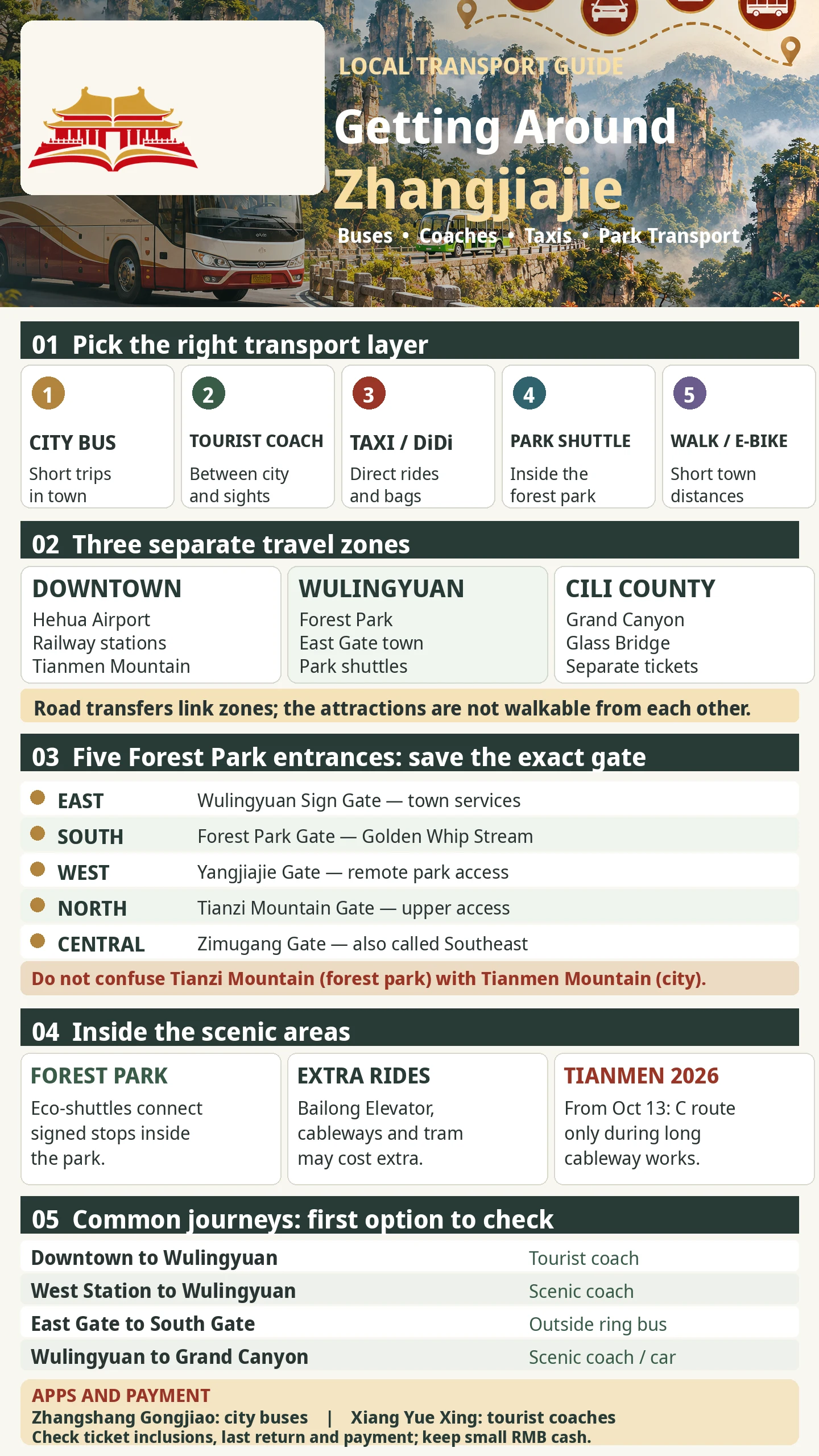
Zhangjiajie is not a destination where you can walk from one famous attraction to the next. Its downtown transport hubs, Wulingyuan forest-park entrances and Grand Canyon area sit in different locations. This guide explains how to match city buses, scenic coaches, taxis and in-park transport to each trip. For the broader visit, see our Zhangjiajie Travel Guide. Operating details were checked against information available on November 12, 2026.
Understanding Zhangjiajie’s Transport Geography
Downtown Zhangjiajie, Wulingyuan and Cili Are Separate Travel Zones
Downtown Zhangjiajie, mainly in Yongding District, is the starting point for city buses and many tourist coaches. Zhangjiajie Railway Station and the Central Bus Station are in this urban area; Zhangjiajie West Railway Station is a separate high-speed rail hub farther out. Hehua Airport is another independent arrival point. Do not enter a generic “Zhangjiajie Station” into a taxi app without checking your actual ticket.
Wulingyuan is the town and scenic district associated with the sandstone-pillar landscape of Zhangjiajie National Forest Park. It is a road journey from downtown, not an extension of the city-center bus network. The Grand Canyon and Glass Bridge are farther east in Cili County and require a separate road connection. A stay near Wulingyuan’s East Gate can reduce repeated cross-town journeys; compare bases in Where to Stay in Zhangjiajie.
The Five Forest Park Entrances and Two Confusing Mountains
Zhangjiajie National Forest Park has five ticket entrances: East Gate (Wulingyuan Sign Gate / Wujiayu, 吴家峪), South Gate (Forest Park, 森林公园门票站), West Gate (Yangjiajie, 杨家界), North Gate (Tianzi Mountain, 天子山) and the Zimugang gate (梓木岗), which may be labeled Central or Southeast Gate. The Hunan tourism authority identifies the five sites, but gate translations differ between travel materials; use the Chinese name and your booked entrance. [4]
Tianzi Mountain (天子山) belongs to the Wulingyuan forest-park area. Tianmen Mountain (天门山) is a separate attraction near downtown with its own tickets and transport. Mistaking the two can send you to the wrong side of Zhangjiajie. The forest-park visitor guide explains entry choices in more detail.
Public Transport in Zhangjiajie: City Buses and Tourist Coaches
City Buses for Short Local Trips
Ordinary city buses are most useful for short trips within downtown Zhangjiajie or around Wulingyuan town. They are not the same as tourist coaches running between districts. Before boarding, compare the Chinese stop name, route direction and actual destination; two stops that look close on a map may serve different sides of a road. For travelers with suitcases, a short taxi ride may be simpler than changing local buses.
In July 2026, the local operator introduced citywide real-time route information through the Zhangshang Gongjiao (掌上公交) app. The published service includes bus-location tracking, arrival estimates, stop searches and service-change notices. It is useful for checking whether a bus is approaching rather than guessing from an old timetable, but English-language support for every screen has not been confirmed. [3]
City-to-Scenic Tourist Buses
For travel from the city toward Wulingyuan, the Forest Park, the Grand Canyon and other outlying attractions, look for Zhangjiajie’s city-to-scenic tourist coach network (城景旅游客运专线). The network launched in April 2024 and was described again in April 2026 by China’s national political consultative body. It operates regular scenic links alongside a flexible, prebookable transport service. The Central Bus Station and Zhangjiajie West Railway Station are important city-side starting points. [1]
The official network covers routes involving Wulingyuan, the Forest Park and the Grand Canyon, but a published route network is not a guarantee that every departure serves every station. Match the actual vehicle listing with your destination gate, boarding point and travel date. The service uses Xiang Yue Xing (湘悦行), including a WeChat service channel, for route information and booking. The 2026 report describes demand-based scheduling; published opening and last-departure windows should therefore be reconfirmed for your chosen service. [1]
A seat on a tourist coach is generally the practical budget choice for a solo traveler or couple who can follow its schedule. Factor in getting to the coach stop, the ride itself and the last walk or local taxi to your hotel. For a direct arrival from high-speed rail, the Zhangjiajie West Railway Station transfer guide covers the station-side steps; the airport transfer guide handles flight arrivals.
Getting Between Forest Park Entrances
The East Gate in Wulingyuan and the South Gate at the Forest Park entrance are separate road-access points. In June 2025, the Hunan transport authority announced a two-way ring bus connecting Wulingyuan Bus Station on the East Gate side with the South Gate. It launched with 12 buses and planned service adjustments according to visitor demand. This is an outside-the-park bus, not one of the park’s internal eco-shuttles. [2]
If your walk ends at a different gate from where you started, confirm the ring bus’s current operating hours before entering. Other gates, particularly remote ones, may require a separately arranged road ride. Do not assume you can board a single free shuttle between all five outside entrances. For an actual sequence of viewpoints and exits, use Zhangjiajie Forest Park Routes.
Taxis, DiDi and Private Transfers in Zhangjiajie
When to Choose a Taxi, DiDi or Private Transfer
Licensed taxis and DiDi ride-hailing cars are useful when you have large bags, travel with children, want to leave early or need a direct hotel-to-gate transfer. A coach usually costs less per passenger, while a car avoids one or two station connections. For a group sharing the same vehicle, compare the final car price with the total cost of multiple coach tickets plus local transfers, rather than comparing a per-person fare with a per-car quote.
Ask a metered taxi to use its meter where applicable, or check the displayed app quote before confirming a ride. Tolls, waiting, demand and late-night conditions can affect the final amount. An advance-booked vehicle can be useful for a remote park gate or an early departure, but confirm the operator, number of seats, luggage space, pickup address and cancellation terms. Do not accept an unsolicited driver claiming that the official bus has stopped without checking independently.
Booking a Ride and Finding the Correct Pickup Point
China’s government guidance says international visitors can use DiDi with an overseas phone number and eligible international cards, or access ride-hailing through Alipay or WeChat. Successful setup still depends on account verification and the payment method. Register while you have reliable internet, not at a remote roadside pickup point. The full steps are in How to Use DiDi in China. [6]
Save the hotel’s Chinese address and the exact park gate, then inspect the pickup pin before booking. A major entrance may have a designated vehicle area away from the pedestrian gate; remote mountain locations can also have fewer available drivers. If a driver cannot reach you, move only to an authorized pickup spot, confirm the plate number and communicate through the app. See Finding Your DiDi Pickup Point in China for troubleshooting.
Getting Around Inside Zhangjiajie’s Scenic Areas
Eco-Friendly Shuttle Buses in Zhangjiajie National Forest Park
After entering Zhangjiajie National Forest Park, you switch from road transport to the scenic area’s own eco-friendly shuttle buses. They connect designated stops around the main landscape zones, including lower-valley areas and mountaintop sections reached by elevators or cableways. Park shuttles cannot be used to travel from downtown Zhangjiajie to Wulingyuan: you must first reach a ticket entrance by an outside road service.
Check the exact admission product before relying on a shuttle ride. Some products bundle park admission with eco-shuttle access, while admission-only products may list transport separately. Even a ticket including eco-shuttles does not automatically cover the Bailong Elevator, cableways or sightseeing tram. Shuttle operating areas and transfers may change with weather, maintenance or crowd management. [5]
Cableways, Bailong Elevator, Sightseeing Tram and Boats
The Bailong Elevator provides a rapid vertical connection between a valley-level stop and the Yuanjiajie highland area. Tianzi Mountain, Yangjiajie and Huangshi Village each have cableway services serving different parts of the forest park; the Ten-Mile Gallery sightseeing tram covers a short scenic corridor. These are not interchangeable tickets. Decide which landscape area you want first, then verify the direction, open status and whether a particular lift or ride requires separate payment. [5]
You will still walk between many lookout points and some shuttle stops. A person who cannot handle stairs should not assume that paying for a cableway makes every viewpoint step-free. The nearby Baofeng Lake and Yellow Dragon Cave operate as separate visitor attractions with their own transport or boat arrangements, not branches of the forest-park ticket. Their individual guides explain what is included: Baofeng Lake and Yellow Dragon Cave.
Tianmen Mountain and Other Attractions Have Separate Transport Systems
Tianmen Mountain has its own admission and mountain-access system. A significant change applies from October 13, 2026: the long Tianmen Mountain cableway suspended passenger operation for reconstruction, and the attraction announced that only the round-trip C route would operate until a further notice. The C-route arrangement uses the Tianmen Cave express cableway from the mountain gate, with a shuttle connection between the downtown cableway lower-station area and that gate. Do not follow older directions that tell every visitor to start by riding the long cableway from downtown. Recheck the attraction’s notice immediately before travel. [7]
The Grand Canyon and Glass Bridge in Cili are another independent attraction, accessed by road from the city or Wulingyuan. A forest-park ticket does not admit you to the Glass Bridge. Plan the return road leg separately, especially if you finish close to the last available coach. For further detail, see the Tianmen Mountain visitor guide and the Grand Canyon Glass Bridge guide.
Walking and Shared E-Bikes for Short Trips
Walking often works well within the compact parts of Wulingyuan town: you may be able to reach a restaurant, nearby hotel or the East Gate area without waiting for a bus. Check the real walking route, though. A property labeled “Wulingyuan” on a booking website is not necessarily within a comfortable walk of the gate. In the wider Zhangjiajie region, mountain roads and separate scenic districts make walking between headline attractions impractical.
Hunan media reported the deployment of helmet-equipped shared electric bikes in Wulingyuan in 2024. If these vehicles are still offered on your visit, check eligibility, licensing or registration requirements, helmet condition, parking restrictions and the operator’s current service boundary. Use one only for a permitted short town journey, never to reach a distant mountain gate or the Grand Canyon. [8]
Which Transport Should You Choose for Common Journeys?
Choose the vehicle by your actual starting point and final gate, not only by the attraction name. This comparison shows useful first options; it is not a live timetable or fare quote.
| Journey | Practical first choice | Check before leaving |
|---|---|---|
| Downtown Zhangjiajie to Wulingyuan | City-to-scenic coach; taxi or DiDi for a direct ride | Which Wulingyuan stop and which forest-park entrance? |
| Zhangjiajie West Station to Wulingyuan | Tourist coach from the station-side service area; booked car if needed | Boarding point, actual coach departure and final hotel connection |
| Downtown to Tianmen Mountain | Local taxi or bus to the current visitor departure point | 2026 C-route arrangements and gate shuttle |
| Forest Park East Gate to South Gate | Outside-the-park ring bus; taxi if the service has ended | Today’s direction, pickup point and last trip |
| Wulingyuan to Grand Canyon | Scenic coach where scheduled; prearranged car for flexibility | Exact canyon entrance, return coach availability and road time |
| Short trip inside Wulingyuan town | Walk, local city bus or an eligible shared e-bike | Actual walking distance and legal riding area |
For an economical trip, compare the coach fare per person with the complete door-to-door cost. For a late arrival or a family with several bags, a licensed direct car can justify the higher price by avoiding extra handling and waiting. Do not schedule a train or flight immediately after a remote scenic-area visit: the time needed to exit the park, reach a coach stop and travel to the station is separate from the driving time. A sensible three-day routing framework appears in 3 Days in Zhangjiajie.
Payment, Apps and Navigation Tips for International Visitors
Finding Local Bus and Tourist Coach Information
Use Zhangshang Gongjiao (掌上公交) for ordinary city-bus routes and arrival estimates, and Xiang Yue Xing (湘悦行) for the city-to-scenic coach network and its booking channels. They answer different questions. A map search or old screenshot is not enough to confirm where a specific coach stops today. If an interface is only in Chinese, show the destination’s written Chinese name to staffed transport personnel; do not assume a foreign-language toggle exists. [1][3]
Paying for Local Transport
Set up Alipay or WeChat Pay before traveling and try a small ordinary purchase to confirm your international card works. China’s official foreign-visitor guidance also describes RMB cash, bus cards and eligible bus QR codes as ways to pay for public buses. Actual acceptance depends on the operator and route, so follow onboard signs or ask at the ticket point. A merchant-payment QR code and a dedicated transport code are not necessarily interchangeable. [6]
For scenic coaches, confirm the current Xiang Yue Xing booking method, identity requirements and payment steps; a local bus QR code does not automatically buy an interdistrict coach seat. Keep some small RMB notes as a backup where cash is accepted. If an overseas-linked card is declined, try another supported payment channel rather than assuming the service itself is unavailable. More general fare-card options are explained in Public Transport Tickets and Travel Cards in China.
Save Chinese Addresses and Plan Your Return Journey
Before the first ride, save the Chinese names of your hotel, selected forest-park gate, return coach stop and departure station. Check the last available ride before entering a large scenic area, and arrange a legal car pickup if the timetable will not suit your exit. Allow extra time for security, long queues, mountain transport closures and phone-signal problems. For general navigation setup, see Essential China Travel Apps.
FAQs About Getting Around Zhangjiajie
Does Zhangjiajie Have a Metro System?
No urban metro network is available for ordinary sightseeing around Zhangjiajie. Use buses, tourist coaches, taxis or DiDi for road travel, then the scenic area’s own transport after entering a park.
Can You Get from Zhangjiajie West Railway Station to Wulingyuan by Bus?
Yes. The city-to-scenic network includes West Station connections toward Wulingyuan. Check the actual destination, boarding bay and departure for your date; the final stop may not be your hotel’s front door. [1]
Are There Public Buses to Zhangjiajie National Forest Park?
There are city-to-scenic coaches serving the forest-park area, plus an outside-the-park ring bus linking its East and South Gate areas. These are different from the eco-friendly shuttles operating after park admission. [2]
Can Foreign Tourists Use DiDi in Zhangjiajie?
Generally, yes: China’s foreign-visitor guide describes overseas-number registration and eligible international-card payments for DiDi. Car availability varies by time and pickup location, especially at remote mountain gates. [6]
Are Shuttle Buses Included in the Zhangjiajie National Forest Park Ticket?
Check the exact ticket product. Park admission may be sold separately from eco-shuttle access or bundled with it; elevators, cableways and sightseeing rides can still cost extra. The city-to-scenic coach and East–South Gate ring bus are outside the park system.
Sources
[1] National Committee of the Chinese People’s Political Consultative Conference. Zhangjiajie scenic transport network update
[2] Hunan Provincial Department of Transport. Wulingyuan East–South Gate ring bus announcement
[3] Zhangjiajie Public Transit / Rednet. Zhangjiajie real-time bus information launch
[4] Hunan Provincial Department of Culture and Tourism. Wulingyuan scenic transport and five park gates
[5] Wulingyuan visitor information. Scenic area transport and ticket distinctions
[6] State Council of the People’s Republic of China. Guide to working and living in China
[7] Hunan Daily / Xinhunan. Tianmen Mountain cableway closure and C-route notice
[8] Hunan Daily / Xinhunan. Helmet-equipped shared e-bikes introduced in Wulingyuan





