

Quick Answer: How Should Tourists Pay in China?
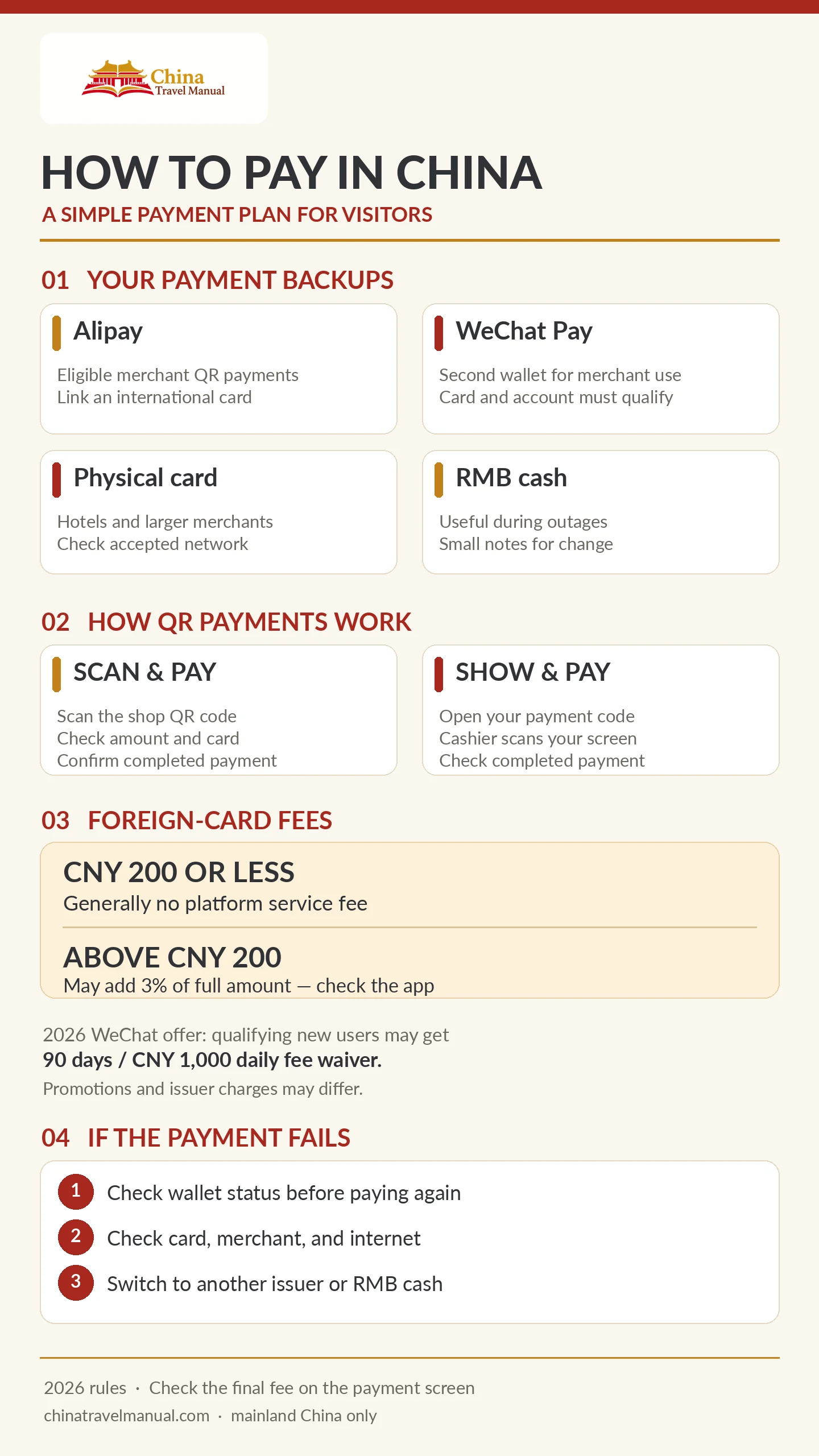
For most short visits, set up at least one mobile-payment app before departure and do not make it your only option:
- Alipay: Link a supported international card for eligible merchant purchases; individual transfers and some financial features are not available with that funding source.[1][2]
- WeChat Pay (Weixin Pay): Another widely used merchant-payment option, subject to its own verification, card and merchant requirements.[1][3]
- Physical card: Bring a Visa or Mastercard that works internationally for hotels, larger retailers and merchants displaying a compatible card-network logo.[1]
- RMB cash: Carry a modest reserve of smaller notes for outages, cash-only situations and failed card payments. Cash remains a lawful payment method.[4]
- Two independent backups: Consider a second issuing bank and enough mobile connectivity to receive verification prompts.
A successful account registration does not guarantee that every payment will work. The merchant, payment channel, wallet, and issuing bank must all approve the transaction.
China’s payment system can be unfamiliar to a first-time visitor from the United States. A cafe may display only QR codes; a hotel may accept a physical foreign card; and a street vendor’s collection code may not process a foreign-card-funded wallet payment. None of that means visitors need a Chinese bank account for everyday purchases.
The practical approach is to prepare a mobile wallet, test an eligible U.S.-issued card, and carry an independent fallback. This guide explains how to pay in mainland China, what fees and restrictions actually mean, and what to do when a transaction fails. Information was checked in October 2026; payment terms and offers may change.
Payment Methods in China: Alipay, WeChat Pay, Cards and Cash
| Payment method | Most useful for | Limitation to check |
|---|---|---|
| Alipay with an overseas card | Everyday eligible merchant QR payments | Not all merchant codes or wallet features support foreign cards |
| WeChat Pay with an overseas card | Eligible merchant QR payments and connected services | Account, card and merchant eligibility can differ |
| Physical international card | Hotels, airports, larger stores and some attractions | Merchant must support the card network and transaction type |
| RMB banknotes | Small payments and a network-free fallback | Change may be inconvenient, especially for large notes |
| ATM withdrawal | Replenishing RMB notes | Bank/network fees and withdrawal limits vary |
China’s official foreign-visitor guide lists mobile payments, bank cards and cash as available methods, but instructs travelers to check each merchant’s actual payment options. It also recognizes the possibility of linking overseas-issued cards in Alipay or WeChat without opening a domestic bank account.[1]
Practical choice: Use a wallet as the first method where supported, retain a physical card, and keep some cash. For an app-by-app decision rather than this broader payment overview, see Alipay versus WeChat Pay for China travel.
Can Foreign Tourists Use Alipay and WeChat Pay Without a Chinese Bank Account?
Yes. China’s official guide allows foreign mobile numbers for registration and lists international card networks including Visa, Mastercard, American Express, JCB, Discover and Diners Club. Specific networks, issuers and card types accepted by each wallet vary; a logo on a card is not an approval guarantee.[1]
Set Up Alipay With an International Bank Card
- Download the official Alipay app and register with a phone number you can access, including a supported U.S. number.
- Add an eligible foreign-issued bank card and complete any required bank authorization.
- Provide identity details or passport verification if the app requests them. Required checks depend on the account and transaction.
- Locate the Scan and Pay functions, then review the selected funding card before confirming a purchase.
- Keep the detailed Alipay tourist setup guide handy for changing menus or verification problems.
Alipay’s own international-card guidance says such cards are intended for eligible purchases in mainland China; person-to-person transfers, red packets, wealth management and other financial services are excluded.[2] You generally do not need to load money into an Alipay balance to make supported card-funded purchases.
Alipay describes an optional “International Version” view inside the official Alipay app after registration; it is not a separate app to download. Menus and verification prompts may change. Complete as much verification as possible while you can reach your U.S. bank, but a genuine merchant-payment test usually has to wait until you can make an eligible purchase.
Set Up WeChat Pay With an International Bank Card
- Install the official WeChat app, register and verify access to the account.
- Find the wallet or Weixin Pay entry available in your current app version.
- Add an eligible foreign card; follow prompts for identity information and issuer verification.
- Review whether the card is available for merchant payments, then locate the Money or payment-code function.
- Consult the WeChat Pay tourist setup guide for any verification or menu differences.
Creating a WeChat messaging account is not the same as successfully enabling payments. Tenpay’s 2026 user terms describe foreign-card services specifically for qualifying merchant purchases; a foreign card alone does not unlock wallet balance, personal transfers or top-ups.[3]
There is no reliable nationwide evidence that a U.S. card must work better in one app than the other. If one wallet fails, the other is useful only if that card, merchant and payment channel are eligible.
How to Pay With QR Codes in Chinese Shops
There are two common ways to pay. Neither the appearance of a QR code nor a successful scan proves that a foreign-linked card will be accepted.
Scan the Merchant’s QR Code
- Ask the cashier for the merchant payment code and open Scan in Alipay or WeChat.
- Read the displayed recipient or merchant details. Enter the amount only if prompted, and confirm it with the seller.
- Check the selected funding card, any displayed fee and the final RMB amount.
- Authorize the payment and verify that the app shows a completed transaction before leaving.
Some static codes lead to personal collections or other flows that do not support foreign-card-funded merchant purchases. Not every static QR code is a personal code, and merchant eligibility cannot reliably be inferred by its appearance. If the app reports that your funding card is unsupported, ask whether the seller has a supported merchant checkout or pay in RMB cash instead.[2][3]
Show Your Payment Code to the Cashier
At a supermarket, convenience store or larger restaurant, the cashier may scan a payment barcode or QR code displayed inside your app. Open the payment-code screen, select your card, let the cashier scan, and verify the final receipt or app status.
A payment code may authorize spending. Never send a screenshot of it through chat, share it with a stranger or leave it on display unnecessarily. Codes can refresh, and some transactions need an active connection or further verification. A scanned code and a completed charge are different things.
International Card Fees, Payment Limits and Exchange Rates
International Card Fees and Temporary Waivers
Official China payment guides have described a common foreign-card service-fee benchmark for both Alipay and WeChat Pay: transactions of CNY 200 or less generally have no platform fee, while an eligible single transaction above CNY 200 may incur 3% of the entire transaction amount, not merely the amount over CNY 200. The actual checkout screen and current product terms control the fee shown to you.[5][6]
| Example, without promotion | Possible platform service fee | Payment before bank-side charges |
|---|---|---|
| CNY 150 purchase | CNY 0 | CNY 150 |
| CNY 200 purchase | CNY 0 | CNY 200 |
| CNY 300 purchase, if 3% applies | CNY 9 | CNY 309 |
Tenpay’s January 15, 2026 notice explicitly states the CNY 200/3% rule and proportional fee return after a refund.[6] A 2026 WeChat Pay new-user offer announced May 27 provides eligible first-time international-card users, after their first purchase, a 90-calendar-day waiver on qualifying spending up to CNY 1,000 per day. The announcement does not establish a permanent entitlement; confirm the offer’s current availability, eligibility and remaining benefit inside the app.[7]
Do not assume that the promotion, its limits, or the displayed service fee applies identically to Alipay. Nor should you assume Alipay always has a different base rate: the official published benchmark can be the same even when account-specific charges or waivers differ.
Payment Limits, Exchange Rates and Bank Charges
China announced higher limits for foreign-card-funded mobile payments—up to US$5,000 per transaction and US$50,000 annually—but these figures are not a guaranteed spending allowance for an individual traveler.[5][8] Your wallet’s identity status, issuer controls, merchant channel and card authorization may impose lower limits.
Three distinct charges can affect a U.S. card statement: (1) a mobile-wallet platform service fee, if shown; (2) conversion from renminbi by the applicable card network or issuer; and (3) any foreign-transaction fee charged by your own bank. Alipay identifies the card scheme and issuing bank as the exchange-rate sources for its international-card transactions.[2]
For a high-value hotel bill, inspect the charge and currency before approving it, and consult your card issuer’s actual foreign-transaction terms. Avoid claiming a universal conversion rate or a fixed 1%–3% bank charge for every card.
Paying With Physical Cards, RMB Cash and ATMs
Where Can You Use Visa, Mastercard and Other Foreign Cards?
Some hotels, airports, large retailers, tourist attractions and established restaurants accept physical overseas cards when the corresponding network logo and terminal are available. China’s payment-access policies emphasize card acceptance at major hotels and tourist venues, but that does not mean every checkout desk or transaction type will work.[8]
Hotel deposits deserve a separate check. A property may accept a foreign card for the room but use different rules or equipment for a refundable preauthorization. Ask in advance whether your card works for both the bill and the deposit, what alternative is accepted, and how a refund is processed.
Do not assume your U.S. credit card will be accepted by a street-food stall or ordinary taxi. Likewise, some metro systems support a dedicated transport QR code, but that code may require separate activation or a payment source different from ordinary store purchases. Consult the relevant operator’s current rules.
Cash, ATM Withdrawals and Currency Exchange
Renminbi (RMB) cash remains lawful and useful. China’s Regulations on RMB Cash Receipts, Payments and Services, effective February 1, 2026, generally prohibit businesses from refusing valid RMB cash, subject to specified legal exceptions and procedures for self-service transactions.[4]
For a short trip, CNY 300–500 in small denominations is a practical starting suggestion, not an official requirement. CNY 10, 20 and 50 notes can reduce change problems. Cash remains helpful when your phone has no service, a payment app is unavailable or a merchant’s QR channel rejects an overseas card.
Look for ATMs displaying your card network logo, preferably at a recognized bank or airport. Withdrawals depend on the ATM and your issuer’s approval, per-withdrawal and daily limits, plus possible machine, issuer and conversion charges. Authorized bank counters and marked exchange outlets are alternatives; avoid unlicensed street money changers. For details, see cash and ATMs in China and currency exchange in China.[1]
How to Pay for Common Travel Expenses in China
A payment method that works at a hotel may fail for a ticket or a taxi. Check how the actual provider collects payment:
| Expense | First option to check | Fallback or extra check |
|---|---|---|
| Street food and small restaurants | Alipay or WeChat supported merchant QR | Small RMB notes; personal-collection channels may reject overseas cards |
| Hotel room and deposit | Hotel-approved physical card or merchant payment | Confirm preauthorization and cash-deposit terms |
| Metro or local bus | Local operator’s ticket, transport code or accepted contactless card | Station ticket counter or cash option where offered |
| Ride-hailing and taxis | In-app payment method supported by the provider | Ask whether a licensed taxi accepts cash or an overseas card |
| Trains and domestic flights | Official or reputable booking channel supporting your card | Check the issuer, platform and ticket conditions before payment |
| Attractions and shopping | Merchant QR checkout or supported card terminal | Cash where practical; check official ticketing requirements |
The 2025 government visitor guide specifically identifies cash and ticket machines for metro use, selected foreign-card transit acceptance, and international-card support in some ride-hailing apps. Payment choices vary by city and operator.[1]
It is misleading to claim that 12306 can never accept any overseas card or that all city-transit codes support international cards. Verify the actual checkout and the travel service rather than extrapolating from a single app. For a broader preparation list, see the China travel checklist.
Why Do Payments Fail in China, and What Should You Do?
| What you see | Possible reason | First response | Backup |
|---|---|---|---|
| Card will not link | Issuer verification, unsupported card or account checks | Read the precise error; contact the wallet or bank | Another issuer’s card |
| QR scanned but card unavailable | Merchant channel or payment type does not support overseas cards | Ask for an eligible merchant checkout | Cash or card terminal |
| Previously working card declined | Issuer fraud control, card limit or temporary restriction | Check bank notifications and call the issuer | Separately issued card |
| No internet access | Data, roaming or account connectivity problem | Restore connectivity without exposing account codes | Cash or physical card |
| Payment says pending | Authorization or merchant confirmation has not settled | Compare wallet order and bank activity; ask seller to check | Do not immediately pay twice |
| Refund is missing | Wallet and issuing bank process refunds on different schedules | Keep order and refund references; contact the proper provider | Track the original card statement |
The most important recovery step is not to repeat an unclear payment immediately. A bank-side pending authorization is not proof that the merchant received funds, but it is also not proof the charge failed. Check the wallet transaction and ask the seller to verify the merchant order first; a fixed “wait 10–30 minutes and it will clear” is not an official guarantee. Refund timing likewise depends on payment route and issuer, so avoid promising a universal 7–30-business-day window.
For more specific error cases, use payment problems and backup options or tracking mobile-payment refunds.
Before You Fly: Your China Payment Setup Checklist
- ☐ Download current official Alipay and WeChat apps.
- ☐ Register using a phone number you can access abroad.
- ☐ Complete identity checks requested by each wallet.
- ☐ Link a supported primary foreign-issued card and review the selected funding source.
- ☐ Prepare another payment method, ideally from a different issuing bank.
- ☐ Ask your issuer about cross-border transactions, verification methods and any limits; a formal travel notice is not always necessary.
- ☐ Check wallet fees and whether you qualify for a current waiver.
- ☐ Arrange mobile data through an eSIM, roaming or suitable local SIM; internet access and a mainland number are different things.
- ☐ Plan how to obtain a modest reserve of RMB notes, preferably small denominations.
- ☐ Save your bank’s overseas help contact and payment-platform support channels offline.
- ☐ On arrival, try a small legitimate merchant payment before depending on the wallet for expensive bookings.
Payment readiness is a chain: accessible phone account → supported bank card → any required identity check → eligible merchant → confirmed charge. If you have problems with internet or verification, consult the roaming, SIM and eSIM comparison and essential China travel apps.
FAQs About Paying in China as a Tourist
Can I Use Alipay in China Without a Chinese Bank Account?
Yes. Eligible visitors can register with a supported overseas mobile number and link a foreign-issued bank card for qualifying merchant payments. The card and issuer must pass authorization, and additional identity checks may apply. Such a card cannot be used for every wallet feature, including personal transfers.[1][2]
Can Tourists Use WeChat Pay With a U.S. Credit Card?
Yes, if the card and account meet Weixin Pay’s requirements. You need to set up the payment function; a working WeChat messaging account is not enough. Supported purchases, fees and verification depend on current Tenpay terms and the transaction.[3][6]
Can I Pay With Cash or a Credit Card Instead of Alipay?
Yes. RMB cash remains a lawful payment method, and many hotels, larger stores and tourist venues accept compatible overseas-issued cards. Neither option is equally convenient everywhere: card terminals may not support your network, and a small vendor may struggle to provide change for a large note.[4][8]
What Should I Do if Alipay or WeChat Pay Stops Working?
Check whether the charge is completed, pending or declined before trying again. Then verify your internet connection, selected bank card, account restrictions and the merchant’s acceptance of overseas cards. If the problem remains, switch to an independent card or RMB cash and contact the wallet or issuer.[1][3]
Sources
[1] State Council of China. A Guide to Working and Living in China (2025)
[2] Alipay+. Pay with Alipay in the Chinese Mainland
[3] Tenpay. WeChat Pay User Service Agreement (2026)
[4] People’s Bank of China, NDRC and NFRA. Regulations on RMB Cash Receipts, Payments and Services
[5] Shanghai Municipal Government. Pay with Overseas Bank Cards (September 2026)
[6] Tenpay. Statement on International Card Payment Service Rules (January 2026)
[7] Tencent. Three Initiatives for International Visitor Payments (May 2026)
[8] State Council of China. Payment Service Guide for Overseas Visitors (April 2024)





