

Quick Answer: What Teaware Should You Buy in China?
Buy one piece that fits the way you make tea. A mug with a removable strainer is convenient for a full serving, a lidded bowl suits small repeated infusions, and a teapot works well if you often serve several people. Handle the exact item you’ll take home and ask the seller to show you how it pours.
- Match the capacity to a real serving. Ask how much water it holds in normal use, with room for leaves and the lid.
- Buy for food contact. Look for clear manufacturer and product information if you plan to brew or drink from it.
- Pack the lid separately. Ask for a sturdy box and check the packed size before committing to a set.
These checks apply to new teaware sold in shops, workshops and markets in mainland China. Treat antique purchases and any export paperwork as a separate decision.
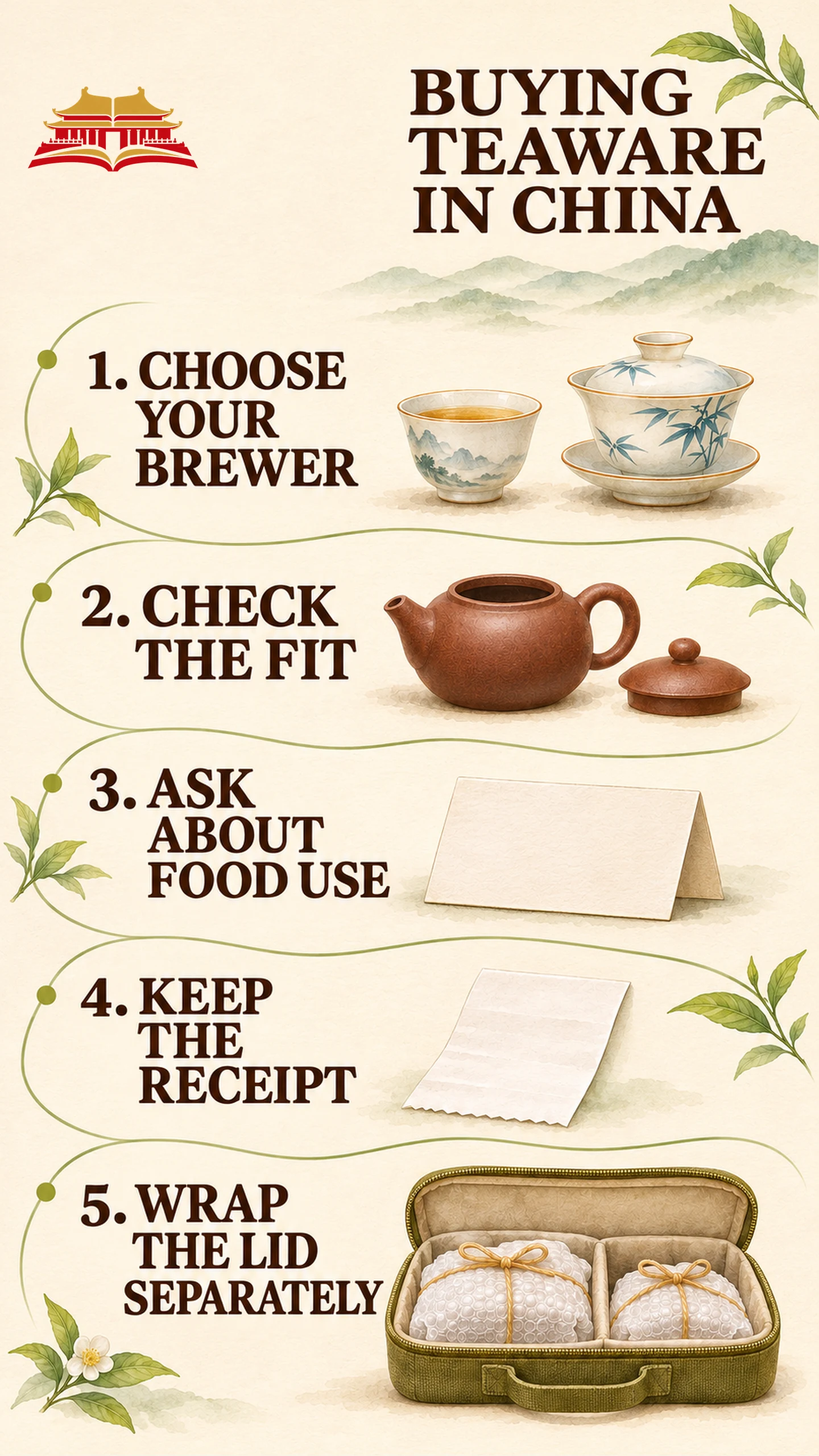
A teapot that looks compact on a display shelf can take up half the space you left for souvenirs once the shop boxes it. Start with a piece you can picture using at home. Work out whether you want one full mug of tea or several small pours, inspect the actual piece you’ll take with you, and ask to see its packaging before paying. If you’re also buying tea in China, try handling the kind of brewer the shop uses to serve your sample.
Choose the Piece You Will Use
Shop for the size of pour you want and consider how you’ll wash the piece in your kitchen. You can buy a brewer on its own and use the cups you already own.
| Teaware | Best for | What to check at the counter |
|---|---|---|
| Mug with a removable strainer | A single full serving at a desk or kitchen table | Lift the basket out and see where you can set it to drip. Check that you can empty and rinse it easily. |
| Lidded bowl or gaiwan (盖碗, gàiwǎn) | Short infusions or tasting the same tea several times | Pick up the lid and grip the rim with the seller’s help. Tilt the bowl gently to see whether the grip feels secure. |
| Teapot and separate cups | Serving several small cups or pouring into a larger mug | Compare the usable volume with your cups. Check that your fingers have room around the handle and that the lid stays secure as you tilt. |
A large gift set makes sense if you expect to use all the pieces. If a friend asked for an everyday tea gift, a cup and matching strainer are easier to use and replace than a tray, pitcher and six tiny cups.
How to Inspect Teaware Before Paying
- Ask to hold the actual piece. A display model may differ from the one in the box, particularly for handmade pieces. Ask the seller to unpack it with you. Check the rim, handle, lid edge and spout tip for chips or cracks, and put the base on a level counter to see if it rocks.
- Test the fit and the pour. Ask the seller to demonstrate with cool water. On a teapot, check how the lid sits, how easily you can control the stream and where a small dribble lands. On a lidded bowl, ask how far to open the lid so liquid flows while the tea leaves stay in the bowl.
- Check the intended use. Ask if the exact piece is made for brewing or serving hot tea. Look for the maker, product identifier and food-contact instructions. If the seller shows a test report, check that its model or batch matches the piece or its packaging. FDA consumer guidance describes how lead can leach from some glazes or decorations, and its foodware guidance also addresses cadmium. Appearance alone cannot establish that a specific piece is appropriate for food contact. Leave a decorative or unidentified piece for display.[1][2]
- See how the seller will pack it. Have the seller show you the box and how they immobilize the lid and body. Get an itemized receipt and photograph the label or maker’s information if you might need to follow up.
When a Teapot Costs More for Its Origin
Yixing purple clay (宜兴紫砂, Yíxīng zǐshā) is associated with teapots from Yixing in Jiangsu. The National Palace Museum identifies this clay in a historic teapot in its collection.[3] Shops may sell pots in the same visual style at different prices. If you are paying for a specific workshop, maker or clay source, ask the seller to put the exact claim on the receipt or item documentation. A seal and a reddish surface are insufficient to verify a maker or origin on their own.
Someone who wants to see the work before buying can plan a visit to teaware workshops in Yixing. Porcelain buyers can use the Jingdezhen travel guide to organize a ceramics stop and the guide to buying porcelain in China for options beyond tea tools. At any shop, decide how much the piece is worth to you as a functioning brewer before adding a premium for a documented origin.
Pack the Lid and Body Separately
Use a separate padded pocket for each lid, saucer and cup. Support the pot around its body so the thin spout and handle sit clear of the sides of the box. Fill empty space around the wrapped body so the pot can’t slide. Check the wrapped parcel in your own bag before leaving the shop. Carry-on gives you more control over the box if your carrier accepts its packed size and weight. If carrying several pieces, compare the extra baggage cost with tracked shipping and get the terms for breakage in writing before agreeing.
Keep the receipt and item details where you can show them if you’re asked what is in the parcel. If the box also holds loose tea, bamboo tools or wooden accessories, check your destination’s declaration and import rules for those materials. The guide to taking souvenirs home from China covers what to look up before departure.
FAQs About Buying Teaware in China
Can I buy just a teapot instead of a full set?
Ask for the individual pieces and their prices. Bring a photo or volume measurement of the cups you use at home, so you can check whether a single steep from the pot fills the servings you want.
Can I tell if glaze is suitable for brewing by looking at it?
Color and shine cannot tell you how much lead or cadmium could migrate from a particular piece. Look for verifiable information about the exact product and its intended food use, and reserve decorative or unidentified ware for display.[1][2]
Is a small teapot easier to pack than a lidded bowl?
Compare the packed boxes. A tiny teapot can need extra protection around its spout and handle. A lidded bowl, lid and saucer have three separate pieces that can each be wrapped and fitted into the same small box.
Sources
[1] US Food and Drug Administration. Questions and Answers on Lead-Glazed Traditional Pottery
[2] US Food and Drug Administration. Cadmium in Food and Foodwares
[3] National Palace Museum. Yixing Teapot with Assorted Treasures Decoration in Carved Lacquer





