
Quick Answer
Buy porcelain for a specific use. A small cup or bowl is easy to examine and pack. For studio work, look for a seller who can tell you who made and decorated the piece. If you want to use it for food or drink, ask for written care and use guidance.
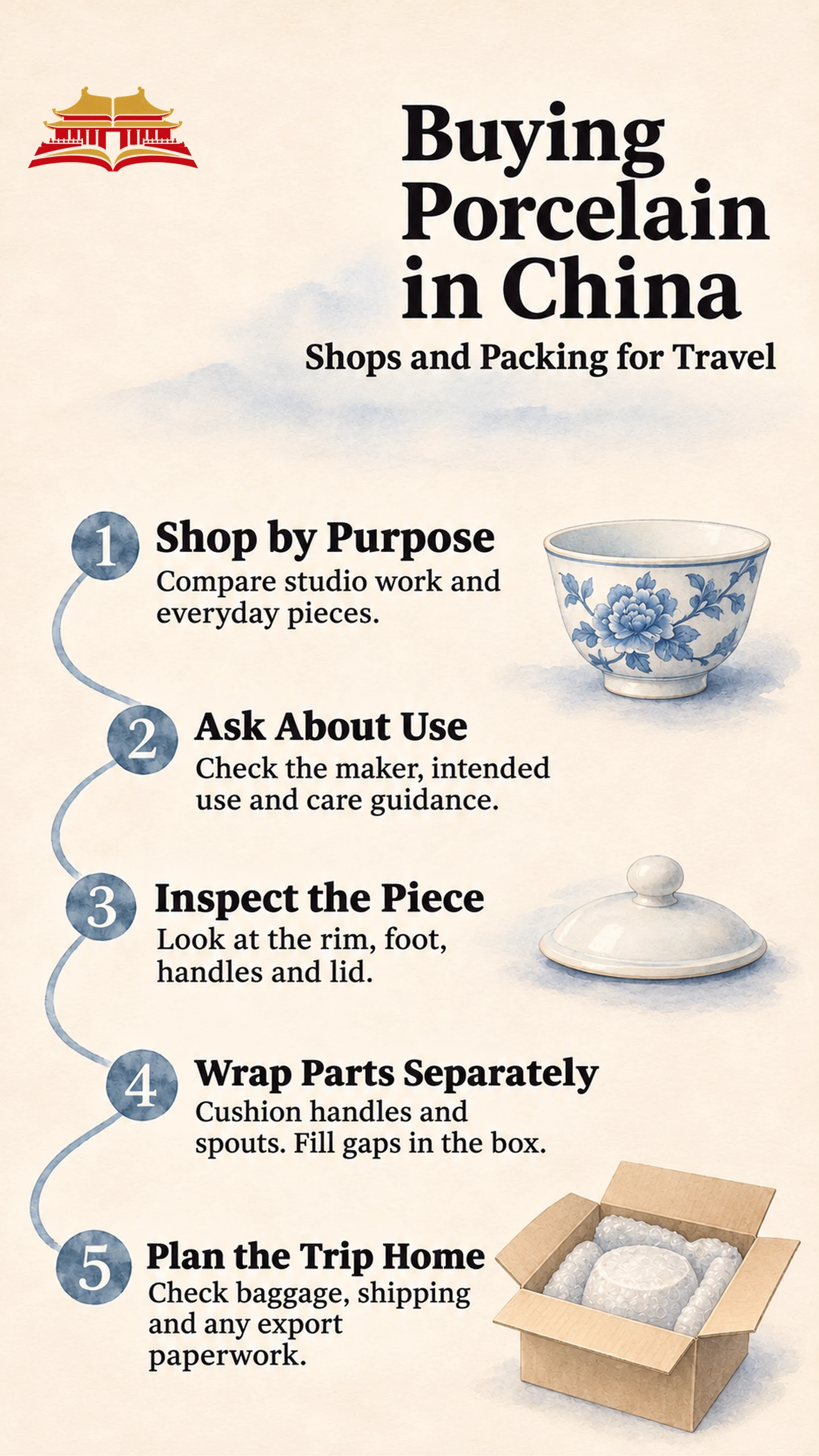
- Shop by purpose: Compare studios for maker-led work and established shops for everyday pieces or gifts.
- Check condition: Look at the rim, foot, handles, glaze and any separate lid before you pay.
- Pack each part: Wrap pieces separately and get a box that keeps them from touching or shifting.
If a seller describes an object as genuinely old, check provenance and export requirements before buying it.
A small cup that fits your hand travels more easily than a large set you have to ship. Decide whether you want an everyday object, something made by a named artist or a piece to display. Then choose where to shop and leave room in your luggage for the packaging as well as the porcelain.
Where to Buy Porcelain in China
Jingdezhen in Jiangxi is a practical base if you want to compare historic styles, contemporary studio work and everyday pieces in one trip. Its surviving porcelain industry sites show how specialized workshops and supply networks supported production.[1] For a current shopping stop, visit Taoxichuan, a creative district with studios and retail spaces in a former porcelain factory complex.[2] Confirm the program for your date if you want a market as well as the shops. The Sculpture Porcelain Factory district also has artist studios and ceramics displays.[9] Ask current shops or studios about their hours. Consider a Jingdezhen pottery workshop if you want to see how pieces are made before buying.
Blue-and-white porcelain (青花瓷, qīnghuā cí) is a style you will see in Jingdezhen. Historical examples use cobalt blue beneath the glaze.[3] If the decoration matters to you, ask whether it was painted by hand or applied using a transfer, and whether the piece was decorated in the studio that sells it. A maker can give a more specific answer than a shelf label.
Dehua in Fujian is another good stop if you prefer white porcelain. Dehua white porcelain (德化白瓷, Déhuà báicí) includes work often called blanc de Chine, such as white sculptural pieces and vessels.[4] Dehua International Ceramic Art City brings together shops selling decorative and everyday ceramics.[5] For a visit centered on making as well as buying, compare ceramics workshops in Dehua. The China ceramics itinerary can help you decide how much of the trip to dedicate to pottery.
If you are staying in a major city without a ceramics stop, try a design shop, a museum shop or an established homewares store. Ask for a maker or production label where origin matters, and check how well the shop can pack the object for your route.
What to Ask Before You Buy
- Who made it? Ask for the workshop or artist name and whether the quoted price reflects the shaping, hand decoration or the maker’s reputation. A foot mark is one detail to record if you need to research the object later.
- Is it meant for daily use? Ask whether the piece is sold for food or drink and what the maker says about heat, dishwasher and microwave use. Decorative ceramicware can contain materials that are unsuitable for food contact.[6] Treat it as display ware if you cannot verify the intended use.
- Is the piece sound? Hold it in good light and check the rim, base and joins for chips, cracks or repairs. Sit a bowl on a flat surface and check whether a teapot lid fits well. Ask about any imperfections the shop calls seconds.
- What will the receipt say? Ask for a description, maker or shop name, quantity and price. If provenance or age is important, ask for documentation before you pay.
Compare prices on the same kind of piece. For daily teaware, check weight and how comfortable the rim or handle feels. For a signed studio piece, ask what the maker did and what documentation comes with it.
How to Pack Porcelain for the Trip Home
Ask the seller to show you the packing before sealing the box. Use these steps if you are wrapping it yourself or checking the shop’s work.
- Separate loose parts. Lift out lids and wrap each lid, saucer or cup on its own so no two pieces can strike each other.
- Pad the vulnerable points. Use cushioned wrapping around handles, spouts and finials. Keep protruding parts clear of the sides of the box.
- Stop the pieces from moving. Put them in a rigid box with cushioning underneath and between items. Fill gaps so the pieces do not slide when you move the box.
- Protect the inner box. If you are shipping a fragile piece, ask the carrier about a padded outer box and any packaging it requires. Keep photos of the packing and condition before you hand it over.
A two-box method is a recognized carrier option for fragile items.[7] Plan for the dimensions and weight of the finished box when comparing fares or shipping quotes.
Carrying, Shipping and Customs
For a small box, carry it in the cabin if the operating airline permits the size and weight. Check airline baggage in China before booking a tight connection with a fragile item. For larger sets, ask the shop how it packs, tracks and handles breakage before shipping purchases home from China. Get the quote for the packed box.
If an item may be a regulated cultural relic, check its classification and departure paperwork with a relevant authority. China restricts certain exports and requires permission and declaration for relics cleared to leave.[8] Use the guide to taking souvenirs home from China to check what applies on both sides of the journey and keep the documents with your purchase.
FAQs About Buying Porcelain in China
What kind of porcelain is easiest to take home?
A small cup, bowl or dish without a long spout or several loose parts is usually easier to pack. Check the price and size with the packing included.
Is a reign mark proof that a piece is antique?
Use a mark as a clue to discuss with the seller or an expert. Ask for independent identification and supporting documents if you would pay more for a historic piece.
Can I use a decorative teacup for tea?
Ask the maker or shop whether it is designed and labeled for contact with hot drinks. If the intended use is unclear, keep it for display.
Sources
[1] UNESCO World Heritage Centre. Jingdezhen Handicraft Porcelain Industry Sites
[2] Jingdezhen Municipal Government. Taoxichuan Cultural and Creative District
[3] Metropolitan Museum of Art. Jar: Qing-Dynasty Jingdezhen Ware
[4] Victoria and Albert Museum. Blanc de Chine: White Porcelain From China
[5] Dehua County People’s Government. Dehua International Ceramic Art City
[6] U.S. Food and Drug Administration. Questions and Answers on Lead-Glazed Traditional Pottery
[7] UPS. How to Pack a Box or Pallet for Shipping
[8] Datong Municipal People’s Government. Cultural Relics Protection Law of the People’s Republic of China, 2024 Revision
[9] Jingdezhen Municipal Foreign Affairs Office. Jingdezhen Sculpture Porcelain Factory





