

Quick Answer
Quick Answer: How to Spend 3 Days in Shangri-La
For a first visit, plan three full sightseeing days and arrive the evening before Day 1. Keep the first day gentle because Shangri-La is around 3,200–3,300 metres above sea level.
- Day 1: Explore Dukezong Old Town at an easy pace and allow time to acclimatize.
- Day 2: Visit Songzanlin Monastery in the morning, then continue to Napa Lake and Yila Grassland if conditions allow.
- Day 3: Spend a full day at Pudacuo National Park for highland lakes, forest and meadow scenery.
This route works for travelers without a rental car, but out-of-town transport should be arranged in advance. If you have only three days and two nights, prioritize Dukezong, Songzanlin and Napa Lake and skip Pudacuo rather than rushing.
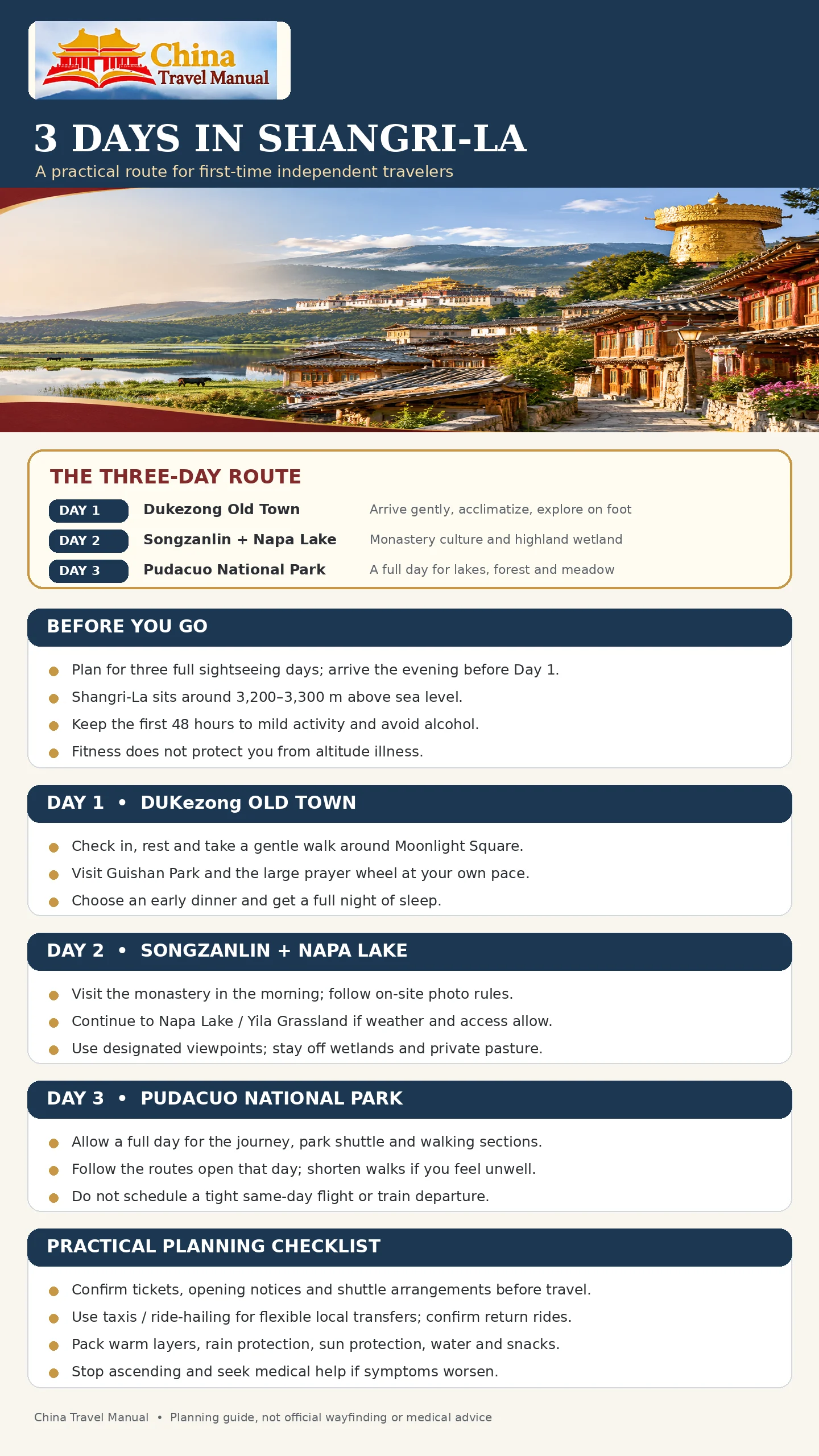
Shangri-La is a high-altitude destination in northwestern Yunnan, and a good three-day visit depends as much on pacing as on sightseeing. This itinerary is designed for first-time independent travelers who want to see the town’s main cultural and natural highlights without renting a car or turning every day into a race. The route groups nearby places together: Dukezong Old Town on Day 1, Songzanlin Monastery and Napa Lake on Day 2, and Pudacuo National Park on Day 3.
For this plan, “three days” means three full sightseeing days. Arrive the evening before Day 1 if possible. If your train or flight arrives on the first morning, use the shorter alternative itinerary below rather than trying to complete every stop. Shangri-La’s urban area is roughly 3,200–3,300 metres above sea level, so allow time to adjust and be ready to change plans if you feel unwell. [1]
Before You Follow This 3-Day Shangri-La Itinerary
Is Three Days Enough for Shangri-La?
Three full days are enough to visit the main sights around Shangri-La: Dukezong Old Town, Songzanlin Monastery, Napa Lake and Yila Grassland, and Pudacuo National Park. They are not enough to cover every destination in Diqing Prefecture. Meili Snow Mountain, Balagezong and Tiger Leaping Gorge involve separate journeys and should be treated as additional trips, not quick stops to squeeze between the places on this route.
There is an important difference between three full sightseeing days and a three-day, two-night stay. The first version works best when you arrive the previous evening and leave after Day 3. With only two nights, your arrival and departure days are partly occupied by transport. In that case, prioritize the old town, Songzanlin Monastery and Napa Lake, and leave Pudacuo for a longer visit.
Altitude and Acclimatization Before Sightseeing
Shangri-La’s city area is around 3,200–3,300 metres above sea level. For a broader overview of the destination and its main attractions, start with the Shangri-La Travel Guide and Things to Do in Shangri-La. Arriving by train or road from Lijiang still involves a substantial increase in sleeping altitude. The CDC’s 2026 Yellow Book advises travelers to keep activity mild during the first 48 hours at high altitude and avoid alcohol during that period. It also notes that physical fitness does not determine whether someone will develop altitude illness. [1]
Treat the first day as a gentle introduction rather than a fitness test. Walk slowly, avoid strenuous climbs, drink normally, and do not assume that feeling well on arrival means you are fully acclimatized. Headache, nausea, unusual fatigue and dizziness can be warning signs. Stop exertion if symptoms appear. Do not continue to higher ground if symptoms are worsening; seek medical advice promptly. Breathlessness at rest, confusion, loss of coordination or a worsening cough requires urgent medical attention and descent where possible. This article is travel-planning information, not a diagnosis or medication guide.
Day 1 – Explore Dukezong Old Town at a Relaxed Pace
Keep the first day close to your accommodation. The aim is to settle in, get used to the altitude and experience the historic centre without adding a long road transfer or a demanding walk.
Morning – Arrival and a Gentle Start
If you arrive in Shangri-La on the morning of Day 1, travel from the airport or railway station to your accommodation near Dukezong Old Town by taxi or a ride-hailing service. Local buses may also be an option, but routes, frequency and first or last departures should be checked locally before relying on them. If you follow the recommended schedule, arrive the previous evening so that the morning can be used for rest, breakfast and a short, easy walk.
Check in, leave your luggage and take time to recover from the journey. If you arrive close to midday, have lunch and rest before sightseeing. Avoid a long walk, a steep climb or an excursion outside town on your first few hours at altitude.
Afternoon – Discover Dukezong Old Town
Explore the old town on foot, starting around Moonlight Square and continuing toward Guishan Park and its large prayer wheel. From there, wander through the lanes and look at the traditional-style buildings, courtyards, small shops and cafés. Keep the route flexible: the stone streets and gentle slopes can feel more tiring at this elevation than they would at sea level.
Dukezong is a living town as well as a visitor area. Be considerate when photographing residents, ask before taking close-up portraits, and follow signs around religious sites. If you visit a prayer wheel or other religious feature, observe how local worshippers use it and follow the local clockwise direction where applicable. For a fuller introduction to the old town’s layout and sights, see the Dukezong Old Town Visitor Guide.
Evening – Tibetan Food and Old Town Night Views
Spend the evening close to your hotel. The old town is atmospheric after dark, but there is no need to stay out late on the first night. Choose a nearby restaurant and try a local dish such as yak meat or a barley-based staple if it suits your diet. Butter tea is a distinctive local drink, but it is rich and salty and may not appeal to everyone. For more food ideas, use the Shangri-La food guide. Prioritize sleep over nightlife while you are adjusting to the altitude.
Day 2 – Visit Songzanlin Monastery and Napa Lake
Day 2 combines one of Shangri-La’s most important cultural landmarks with the highland wetland landscape outside town. Visit Songzanlin Monastery first, then continue to Napa Lake and the surrounding Yila Grassland if road access, weather and your energy level allow.
Morning – Explore Songzanlin Monastery
Songzanlin Monastery, also known as Ganden Sumtseling, is a major Tibetan Buddhist monastery on the outskirts of Shangri-La. Its white walls, red-and-gold buildings and hillside setting make it one of the area’s defining sights. Allow time for the visitor-centre process, the shuttle transfer where required, the approach to the monastery and the steps within the complex. The official scenic-area guide places the monastery at about 3,300 metres and gives the town-to-visitor-centre journey as roughly five kilometres. [2]
Dress respectfully and follow the instructions displayed at the site. Photography rules can differ between outdoor areas and interior halls, so obey signs and staff rather than assuming that every room can be photographed. Move slowly on stairs and take breaks if needed. The official scenic-area website currently lists a full ticket at RMB 90, including shuttle and explanation services, and publishes different seasonal opening windows; check its latest notice and booking channel before visiting because operating details can change. [2] For the site’s history and visitor details, see the Songzanlin Monastery Visitor Guide.
Afternoon – Explore Napa Lake and Yila Grassland
After the monastery, continue toward Napa Lake and Yila Grassland. Napa Lake is a seasonal plateau wetland and a provincial-level nature reserve. The Yunnan Forestry and Grassland Administration identifies its protected values as the wetland and lake ecosystem, surrounding marsh and meadow habitats, aquatic plant communities, biodiversity, and important wintering birds including black-necked cranes and black storks. [3]
The landscape changes through the year. Water levels, grassland exposure and bird activity vary with season and weather, so avoid promising one fixed view in every month. Use established public viewpoints and lawful visitor areas. Do not drive onto wetland ground, cross fences, enter private pasture without permission or approach wildlife. The reserve is an ecological area, not an unrestricted off-road attraction. Exact access points and any temporary restrictions should be checked on the day.
Evening – Return to Dukezong Old Town
Return to Dukezong for dinner and a quiet evening. Do not add another distant attraction after Napa Lake. The purpose of grouping the monastery and wetland on one day is to reduce unnecessary backtracking, not to fill every remaining hour. If weather, road conditions or altitude symptoms slow the day down, shorten the Napa Lake visit and return earlier.
Day 3 – Spend a Full Day at Pudacuo National Park
Reserve the third day for Pudacuo National Park. It is a substantial excursion from town, and the journey, park transport and walking sections make it unsuitable as a rushed half-day stop. The Ministry of Culture and Tourism lists Pudacuo as a national 5A-rated scenic area; official descriptions highlight its highland lakes, forests, wetlands and meadows. [4]
Morning – Travel to Pudacuo National Park
Start early enough to make the most of the park’s operating window. The park’s official English website currently displays an opening time of 08:00 and a closing time of 16:30, while warning that hours may change by season and on public holidays. It also currently lists an admission ticket of RMB 68 plus a RMB 70 sightseeing-bus fare, or RMB 138 in total. Treat these as the figures displayed by the official site when checked for this guide, not as a guarantee for your travel date. Recheck the official ticket page and notices before departure. [5]
The same official website lists public buses from Shangri-La Passenger Station to the park, with four outward departures and four return departures shown. Because these details can change and may be affected by seasonal demand, confirm the current timetable, boarding point and return service before relying on it. A pre-arranged private car is more flexible, while a local taxi or ride-hailing car may require you to arrange the return in advance. Do not assume a driver will be waiting at the park when you finish.
Explore Shudu Lake and the Park’s Scenic Routes
Follow the routes and transport arrangements open on the day. Shudu Lake is one of the park’s signature landscapes, with a high-altitude lake, forest and meadow setting. The park’s official information describes Shudu Lake as one of its principal scenic areas and gives its lake surface elevation as about 3,595 metres. [5] The park has used sightseeing buses to connect visitor areas, while walking sections allow closer views of the lakeside environment. The exact combination of open areas and walking routes can change, so follow current staff instructions rather than planning around an old map.
Keep your walking pace conservative. Boardwalks and exposed paths can feel more demanding at altitude, particularly if you have only recently arrived. Carry water, a warm layer and rain protection, and shorten the walk if you feel unwell. Do not leave marked routes or approach wildlife. The park’s management has emphasized ecological protection and the closure of some high-impact visitor activities, so do not assume that boats, horse rides or every historic attraction remain available. [6]
Return to Dukezong Old Town
Return to town with enough daylight and time for delays. Do not schedule a tightly timed flight or train departure on the same day as Pudacuo. Road conditions, weather, shuttle queues and the park’s closing procedures can all affect your return. If you must leave Shangri-La on Day 3, move Pudacuo to Day 2 only if you are prepared to drop another stop, or choose the shorter itinerary instead.
Alternative 3-Day Shangri-La Itineraries
If You Have Only 3 Days and 2 Nights
For a three-day, two-night trip, do not treat all three calendar days as full sightseeing days. On arrival day, check in and explore a small part of Dukezong Old Town only if time and energy allow. Use the one full day for Songzanlin Monastery and Napa Lake. On departure day, have a relaxed breakfast, take a short walk or buy souvenirs near your accommodation, then leave with a generous transfer buffer. Skip Pudacuo rather than trying to fit a full park visit between check-out and a train or flight.
If You Prefer More Remote Scenery
Travelers more interested in dramatic canyon scenery and a remote mountain setting can consider replacing Pudacuo with Balagezong. It is a separate, longer excursion from Shangri-La and should be planned as a full day with transport confirmed in advance. Do not combine Balagezong with Napa Lake or Pudacuo on the same day. Check current access, road conditions, park operations and any shuttle arrangements before committing to the trip. For other excursions, see Day Trips from Shangri-La.
If You Need a Slower or Lower-Activity Trip
If you are concerned about altitude, have limited mobility or simply prefer a slower holiday, spend longer around Dukezong and reduce the number of excursions. At Pudacuo, choose only the shorter routes that are open and comfortable for you. Do not treat completing the itinerary as a goal in itself. If symptoms develop or worsen, stop sightseeing and seek appropriate medical help.
Getting Around Shangri-La During Your 3-Day Trip
Dukezong Old Town is best explored on foot. For the airport or railway station, taxis and ride-hailing services are usually the most straightforward choices for visitors with luggage; check the pickup point and fare before setting off. The railway station is outside the old town, so allow time for the road transfer. If you are arriving from Lijiang, the train is a practical connection. Compare the options in the Lijiang Travel Guide and Lijiang Railway Station Guide, and use the China Railway 12306 service for the timetable and ticket available on your actual date rather than relying on a copied schedule. For the full city-to-city transfer, see How to Travel Between Lijiang and Shangri-La.
| Route | Practical transport choice | Planning note |
|---|---|---|
| Airport → Dukezong | Taxi / ride-hailing | Confirm the hotel drop-off point. |
| Railway station → Dukezong | Taxi / ride-hailing / local bus | Check current bus service if using public transport. |
| Dukezong → Songzanlin | Taxi / local bus | The scenic-area guide gives about 5 km from the town area. |
| Songzanlin → Napa Lake | Pre-arranged car / taxi | Agree on the next pickup before leaving the monastery. |
| Dukezong → Pudacuo | Official shuttle / private car | Confirm the current timetable and return ride. |
| Within Dukezong | Walking | Take breaks on slopes and stone streets. |
Public transport is less flexible for linking several out-of-town stops in one afternoon. If you do not drive, a combination of walking, taxis, ride-hailing and a confirmed park shuttle is more realistic than expecting frequent buses between every attraction. For route-specific guidance, see Getting Around Shangri-La. For airport transfers, use the Shangri-La Airport Guide.
Where to Stay for Three Days in Shangri-La
For a first visit, stay in or near Dukezong Old Town. Accommodation just outside the busiest lanes can offer a useful balance: you can walk into the historic centre but may have an easier time reaching the property by car with luggage. Before booking, ask whether a vehicle can reach the entrance or whether you will need to carry bags over cobbled streets. Also confirm the room’s heating arrangements, especially for late autumn, winter and early spring, when nights can be cold.
Avoid choosing a remote hotel solely for a mountain view if it adds a long daily transfer. For neighborhood comparisons and accommodation planning, see Where to Stay in Shangri-La.
What to Eat During Your Shangri-La Itinerary
Keep meals convenient to each day’s route. On Day 1, eat in Dukezong so you can return to your hotel early. On Day 2, plan lunch around the monastery and the Napa Lake drive, but do not assume there will be a wide choice at every stop. On Day 3, bring drinking water and a small snack in case the park’s food options do not match your timing or dietary needs; follow the park’s current rules on food and waste. For local dishes and dining ideas, see What to Eat in Shangri-La.
Practical Tips for Planning Three Days in Shangri-La
- Altitude: Keep the first 48 hours to mild activity, avoid alcohol and take symptoms seriously. [1]
- Weather: Conditions can change quickly at high elevation. Check the forecast before each excursion and be prepared to change the order of activities.
- Clothing: Use layers, including a warm mid-layer and wind- or rain-resistant outerwear. Bring sun protection even when the air feels cool.
- Tickets: Recheck official ticket channels, opening notices and temporary closures shortly before visiting.
- Transport: Confirm the return journey for out-of-town stops before setting out, especially if using a taxi or private car.
- Accommodation: Check vehicle access and heating before booking.
- Departure: Leave a generous buffer before a train or flight. Avoid pairing Pudacuo with a same-day departure.
For seasonal conditions and month-by-month planning, see Best Time to Visit Shangri-La. For a more detailed approach to pacing activities at this elevation, read Altitude and Itinerary Planning in Shangri-La. For trip-cost planning, use the Shangri-La Travel Budget.
FAQs About Spending 3 Days in Shangri-La
Is Three Days Enough to Visit Shangri-La?
Yes, three full sightseeing days are enough for the main town and nearby highlights: Dukezong, Songzanlin Monastery, Napa Lake and Pudacuo. They are not enough for every remote destination in Diqing, such as Meili Snow Mountain or Balagezong.
Can You Visit Shangri-La Without a Car?
Yes. You can explore Dukezong on foot and use taxis, ride-hailing services, local buses where available and the official Pudacuo shuttle. The main limitation is flexibility between out-of-town stops, so confirm connections and return transport in advance.
Is Pudacuo National Park Worth Visiting on a 3-Day Trip?
It is a strong choice if you enjoy highland lakes, forests and meadows and can devote a full day to the visit. If you have only three days and two nights, or prefer a slower schedule, skip it rather than rushing through the park.
Should You Visit Songzanlin Monastery or Napa Lake First?
The practical order is Songzanlin Monastery in the morning and Napa Lake in the afternoon. This gives the monastery a dedicated visit window and leaves the wetland stop more flexible. Reverse the order only if weather, access or a confirmed transport arrangement makes that more sensible.
Can You Visit Shangri-La in Three Days Without Getting Altitude Sickness?
No itinerary can guarantee that you will avoid altitude illness. A gentle first day and avoiding strenuous activity and alcohol during the first 48 hours follow CDC advice, but individual susceptibility varies. Stop exertion and seek medical help if symptoms develop or worsen. [1]
Sources
- U.S. Centers for Disease Control and Prevention, CDC Yellow Book 2026: High-Altitude Travel and Altitude Illness.
- Songzanlin Scenic Area official website, Songzanlin Scenic Area Self-Driving Guide (published March 28, 2025; dynamic ticket and opening details should be reconfirmed).
- Yunnan Provincial Forestry and Grassland Administration, Napa Lake Provincial Nature Reserve.
- Ministry of Culture and Tourism of the People’s Republic of China, 5A Scenic Area: Pudacuo National Park.
- Pudacuo National Park official English website, Ticketing, opening information and transportation route (check the latest notices before travel).
- Diqing Release, Pudacuo National Park’s ecological protection and visitor management (June 30, 2026).
- Diqing Tibetan Autonomous Prefecture People’s Government, Shangri-La–Lijiang Expressway and local elevation context.





