

Quick Answer: Where Is the Best Area to Stay in Shangri-La?
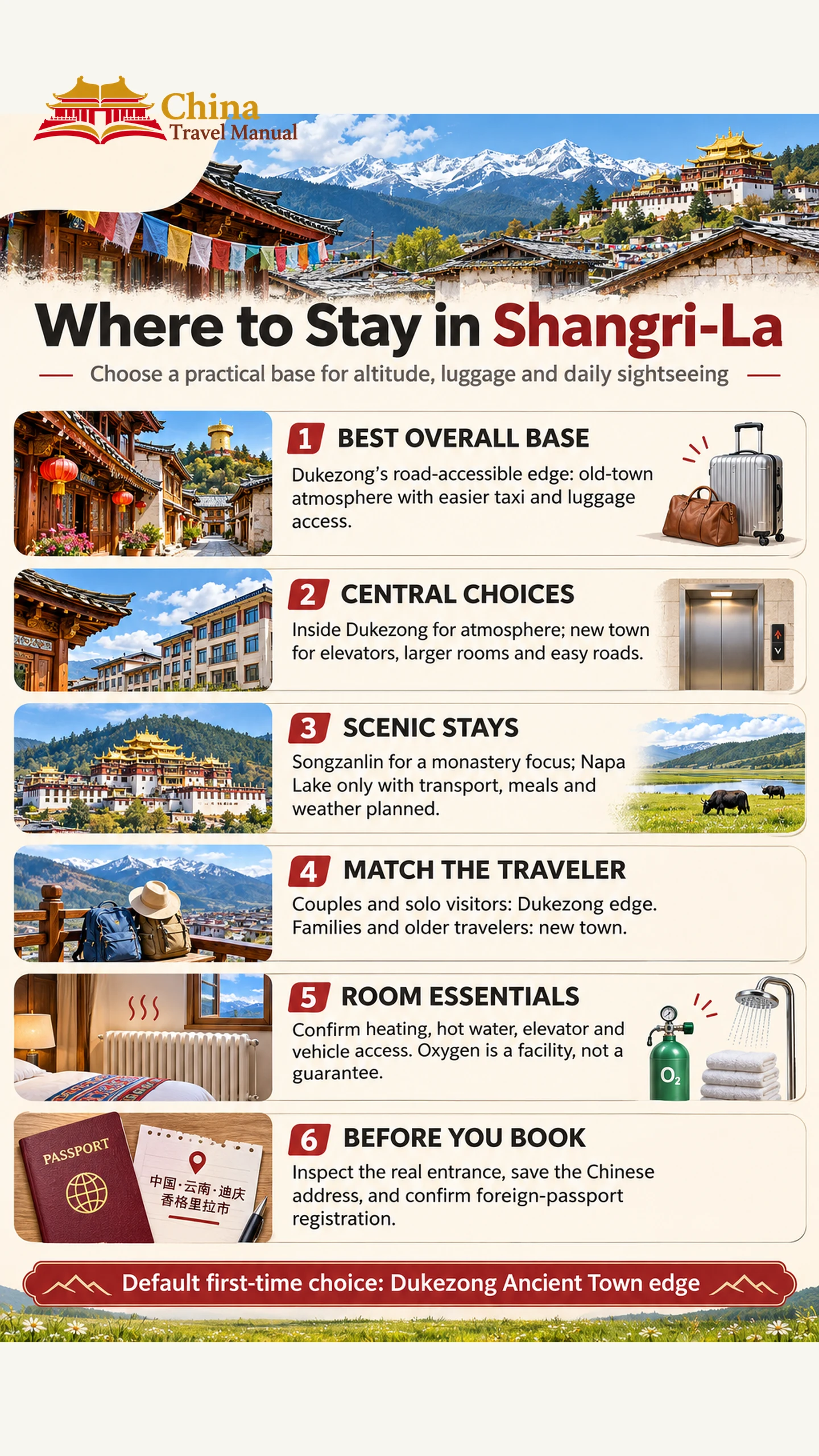
For a first visit of two to four nights, choose a hotel on the vehicle-accessible edge of Dukezong Ancient Town. Confirm that a taxi can stop at the actual entrance—not merely “near the old town”—and that the room has reliable winter heating.
- Best overall: Dukezong’s edge, especially near an entrance that taxis can reach.
- Best atmosphere: Inside Dukezong, if you travel light and accept cobbles, slopes, and possible stairs.
- Best for comfort: The newer town around Changzheng Avenue and Tancheng Square, where elevators, larger rooms, and vehicle access are easier to find.
- Best for Songzanlin: A short special-purpose stay near the monastery, not the default base for a whole first trip.
- Best for scenery: Napa Lake countryside stays, only when you accept weather-dependent views and arrange transport.
- Best for one-night transit: Near the railway station or airport when an early departure matters more than sightseeing.
No area removes the effects of Shangri-La’s elevation. A room with oxygen equipment may feel reassuring, but heating, sleep quality, an elevator, and a low-effort first day usually matter more.
Shangri-La is compact on a map, but the wrong hotel can add steep cobbled walks, difficult luggage transfers, or long rides to every meal. The best base depends less on a district name than on the hotel’s exact entrance, road access, heating, elevator, and distance from the places you will actually visit.
For most first-time visitors, the most practical choice is the edge of Dukezong Ancient Town. It keeps the old town’s restaurants and evening atmosphere within walking distance while making taxi drop-offs and luggage transfers much easier than a stay deep inside the pedestrian lanes.
Compare the Best Areas to Stay in Shangri-La
Use this table to narrow the choices before comparing individual properties.
| Area | Best for | Main advantage | Main trade-off |
|---|---|---|---|
| Dukezong interior | Atmosphere, evening walks, photography | Historic lanes at the door | Cobbles, slopes, stairs, limited vehicle access |
| Dukezong edge | Most first-time visitors | Old town access plus easier luggage transfers | Quality varies by exact street and entrance |
| New town | Families, older travelers, longer stays | Elevators, larger rooms, everyday services | Less historic atmosphere |
| Songzanlin area | Monastery-focused stay | Quiet early-morning access | Fewer dining and evening options |
| Napa Lake countryside | Views, quiet, slow travel | Open landscape and rural setting | Transport and weather dependence |
| Railway or airport area | Early departure, late arrival | Lower transfer risk | Weak sightseeing value |
Shangri-La sits at roughly 3,300 meters above sea level, so a location that reduces stairs and unnecessary transfers can be more valuable than a prettier address. [1] Treat easy access as a core room feature.
Best Central Areas for First-Time Visitors
Inside Dukezong Ancient Town
Staying inside Dukezong gives you the strongest sense of place. You can walk to the central lanes, restaurants, small shops, and evening activity without arranging a ride. Early mornings are especially pleasant, before day visitors fill the main streets.
The compromise is physical effort. Many lanes are paved with uneven stone, and some guesthouses sit uphill or behind narrow passages. A property described as “in Dukezong” may still require a 10- to 20-minute walk from the nearest vehicle drop-off. This matters after a long train ride, in rain or snow, and on your first day at altitude.
Vehicle controls in the ancient town also mean that a driver may not be able to reach the door. Local traffic measures direct larger visitor vehicles to designated points, including the North Gate area, rather than allowing unrestricted access through the core. [2] Before booking, ask the property to mark the exact drop-off point and explain whether staff will meet you with a luggage cart.
Choose the interior only if atmosphere is a priority, you have light luggage, and you are comfortable with steps. Do not assume that a traditional-style guesthouse has an elevator, central heating, strong sound insulation, or 24-hour reception.
The Edge of Dukezong Ancient Town
The edge of Dukezong is the best-balanced base for most visitors. You remain within walking distance of the old town but avoid the hardest luggage transfer. Restaurants, convenience stores, and ride-hailing pickups are usually easier to reach, and day-trip drivers can collect you without entering the most restricted lanes.
“Edge” is not a formal district, so verify the actual route. A good property should be within about a 5- to 12-minute walk of the old town and on a road where a normal taxi can stop. The hotel’s entrance should not require a steep climb, a long stone alley, or an unmarked courtyard search.
This area works particularly well for a first two- or three-night stay, travelers arriving by train, and anyone planning day trips to Songzanlin Monastery, Napa Lake, or nearby countryside. It also reduces the need to split hotels: you can enjoy Dukezong at night while using the same address for every driver pickup.
The main risk is marketing language. “Near Dukezong” may mean the property is beside a busy road or farther from the pedestrian core than the name suggests. Check the map pin, recent entrance photos, and walking route rather than relying on the English hotel name.
Also check nighttime noise. A room facing a busy approach road may be easy for pickups but poor for sleep, while a courtyard-facing room can be much quieter. Ask for a room away from street speakers, bars, and the main vehicle entrance when sound matters.
New Town, Changzheng Avenue and Tancheng Square
The newer center is the practical alternative to Dukezong. Properties around Changzheng Avenue and Tancheng Square are more likely to offer elevators, wider access roads, larger rooms, reliable reception, and nearby pharmacies or supermarkets. It is a sensible choice for families, older travelers, people carrying several bags, and anyone staying long enough to value daily convenience over atmosphere.
The newer town is not remote, but it is not the same experience as sleeping beside Dukezong’s lanes. You will usually take a short taxi or ride-hailing trip to the old town, and the immediate streets feel more functional than historic. That trade-off can be worthwhile in winter, when reliable heating and easy vehicle access matter more.
When comparing hotels, ask about the building rather than accepting a broad “new town” label. Confirm the elevator reaches every guest floor, the room is not in a separate walk-up annex, and the heating is available during your dates. Travelers who want a calmer first day at altitude may find this area more comfortable than a beautiful but stair-heavy old-town guesthouse.
Scenic and Special-Purpose Places to Stay
Near Songzanlin Monastery
Staying near Songzanlin Monastery suits travelers who want a quiet setting and early access to the monastery area. It can work for photographers, slow travelers, or a second visit focused on Tibetan Buddhist culture rather than nightlife.
It is not the default base for a first short trip. Dining choices are thinner, evening activity is limited, and rides to Dukezong or the newer center add time and cost. The monastery is also an attraction with its own admission and operating arrangements; staying nearby does not remove the need to follow the current visitor rules.
Choose this area only when the monastery is a central purpose of the trip. For a two- or three-night first visit, a central base plus a morning trip is usually simpler.
Napa Lake and Countryside Stays
Napa Lake countryside properties offer open views, quiet nights, and a stronger sense of the plateau landscape. The lake is a seasonal highland wetland, so water levels and scenery change through the year; a property’s old promotional photos may not match the view during your stay. [3] Ask for recent photos before paying for a view.
These stays work best for travelers who want to slow down, have arranged transport, and are willing to eat at the property or travel for meals. They are less suitable for a first-night arrival, a very short visit, or anyone who expects to walk to a dense selection of restaurants.
Avoid using a remote countryside property as your first base if you are uncertain how altitude will affect you. A central first night gives easier access to food, pharmacies, transport, and help; move only after you know that the extra isolation is comfortable.
Ask whether the access road remains practical in rain, snow, or ice, and whether the driver can reach the entrance after dark. Winter conditions can affect roads and local services, so a scenic rural stay needs more planning than a central hotel. [4] Also confirm room heating, hot water recovery time, power backup, and the property’s procedure for foreign-passport registration.
Near Shangri-La Railway Station or the Airport
A station- or airport-area hotel is useful when you arrive very late, leave very early, or have only one transit night. It reduces the risk of missing a train or flight and can simplify a trip with heavy luggage.
It is a poor sightseeing base for most visitors. You will spend more time riding to Dukezong, restaurants, and attractions, and the surrounding area may offer fewer evening choices. If your arrival is early enough to reach a central hotel without stress, go directly to Dukezong’s edge or the newer town.
Always verify the exact terminal or station transfer. “Airport hotel” does not guarantee a free shuttle, and “railway station hotel” may still require a vehicle. Confirm the pickup location, operating hours, reservation requirement, and whether the service runs for a single guest.
Choose an Area by Traveler Type
- First-time couples: Dukezong’s edge gives the best balance of atmosphere, food, and easy day-trip pickups.
- Families with children: Choose the new town or a road-accessible Dukezong-edge hotel with an elevator, larger rooms, and dependable heating.
- Older travelers or weak knees: Prioritize a vehicle-accessible entrance, elevator, and minimal slopes; the newer center is often easier than Dukezong’s interior.
- Solo travelers: Dukezong’s edge keeps restaurants and evening streets close without requiring a rural taxi after dark.
- Photographers: Consider one countryside night only if the weather forecast and transport plan justify moving; otherwise use Dukezong as the base.
- Business travelers: The newer town offers practical roads, meeting-friendly hotels, and more predictable room facilities.
- Travelers with an early train or flight: Use a transit-area hotel for the final night only when the departure time makes a central transfer risky.
For a broader view of the province and how Shangri-La fits with Lijiang or Dali, see the Yunnan travel guide.
Altitude, Heating and Hotel Facilities to Check
Shangri-La is high enough for altitude symptoms to affect travelers who arrive quickly from lower elevations. The CDC lists Shangri-La at about 3,280 meters and recommends gradual ascent and time to acclimatize. [5] This guide cannot predict how any individual will respond, but your hotel choice can reduce avoidable strain.
For the first day, choose easy meals, short walks, and a room that does not require repeated stair climbing. A hotel with an elevator and a taxi-accessible entrance may be more useful than one with a famous rooftop view. If symptoms worsen or become severe, seek medical help rather than relying on hotel oxygen equipment. The China travel health guide covers broader preparation.
Ask these questions before paying:
- Is heating central, electric, underfloor, or only a portable unit?
- Is heating available throughout the night during my dates?
- Does the elevator reach my room, or is there a stair-only annex?
- Can a taxi stop at the entrance?
- Does the bathroom have reliable hot water and a heated area?
- Is room oxygen supplied by a concentrator, a central system, or a disposable canister?
- Is oxygen included, or charged separately?
Do not treat oxygen as a guarantee of safety or comfort. A quiet room, good heating, adequate hydration, gentle pacing, and access to professional care are more important than a marketing label such as “oxygen hotel.”
Check the Exact Hotel Location Before Booking
Run a practical map check before you book:
- Find the hotel’s real entrance, not only the property pin.
- Switch to walking directions and inspect the final 300–500 meters.
- Look for cobbles, steep slopes, stairs, courtyards, and pedestrian-only lanes.
- Test the drive route from the railway station or airport to the entrance.
- Save the hotel’s full Chinese name, Chinese address, phone number, and a map screenshot.
- Read recent reviews for heating, hot water, noise, construction, and staff availability.
- Ask where a taxi or tour driver should collect you.
In Dukezong, a short straight-line distance can hide a difficult luggage route. In the countryside, a beautiful map location can conceal a long unpaved access road. In the newer town, a property beside a major avenue may have a rear entrance that requires a substantial detour.
If the hotel cannot provide a clear Chinese drop-off point or explain the last part of the route, choose another property. This is especially important for late arrivals, winter stays, wheelchairs, strollers, and large suitcases. Download the address and booking confirmation before traveling; the offline travel preparation guide explains what to save when mobile data is unreliable.
Booking with a Foreign Passport
Regular licensed hotels can register foreign guests; the outdated idea that foreigners may stay only in a special class of “foreigner hotels” is misleading. However, a booking platform accepting payment does not prove that a small guesthouse, rural homestay, or private apartment can complete the required registration smoothly.
Before booking, send the property a direct question: “Can you register a guest using a foreign passport?” Also confirm 24-hour reception if you will arrive late. Bring the original passport used for the booking; a photo or scan may help staff find the reservation but does not replace the original document.
China’s accommodation rules require hotels to register foreign guests. For non-hotel accommodation, the foreign guest or host must complete registration within the required period, and a nationwide online channel became available in 2026. [6] If a host asks you to handle registration yourself, confirm the exact procedure before arrival. For more background, read China hotels for foreigners.
How Many Nights Should You Stay, and Should You Split Hotels?
Two to four nights works well for most first visits. Two nights gives you a short central stay; three nights allows a gentler first day and one or two excursions; four nights creates room for weather changes and slower pacing.
Most visitors should keep one hotel. Dukezong’s edge or the newer town can support the whole trip, and avoiding a move saves energy at altitude. Split the stay only for a clear reason: one countryside night for scenery, or a final station/airport night before an unusually early departure.
Do not move simply to be closer to every attraction. Songzanlin and Napa Lake are close enough for planned outings, while packing, checkout, transport, and registration can consume much of a half day.
FAQs About Where to Stay in Shangri-La
Is It Better to Stay Inside Dukezong Ancient Town?
Stay inside if atmosphere and evening walks matter most and you travel light. For easier luggage handling, taxi access, and day trips, the road-accessible edge of Dukezong is usually the better first-time choice.
Is Shangri-La New Town a Good Place to Stay?
Yes. The newer town is practical for families, older travelers, business trips, and winter stays because elevators, wider roads, supermarkets, and modern room facilities are easier to find. The trade-off is less historic atmosphere.
Should You Book a Hotel with Oxygen?
Oxygen can be a useful facility, but it should not be your only filter. Confirm what system is provided and whether it costs extra. Prioritize reliable heating, an elevator, low-effort access, and a sensible first-day schedule; seek medical care for worsening symptoms.
Should You Stay Near Shangri-La Railway Station?
Only when a late arrival or early departure makes the transfer risk important. For normal sightseeing, Dukezong’s edge or the newer center offers better access to restaurants and attractions.
Can Foreign Travelers Stay in Any Hotel in Shangri-La?
Not every property can handle the process equally well. Licensed hotels normally register foreign guests, but small guesthouses, rural homestays, and private apartments should be asked directly before booking. Carry your original passport.
Sources
[1] Shangri-La City Government. A Letter from Jiantang Town Government to Visitors
[2] Shangri-La City Government. Interpretation of Dukezong Ancient Town Traffic Optimization Measures
[3] Yunnan Forestry and Grassland Administration. Napa Lake Provincial Nature Reserve
[4] Diqing Prefecture Government. Winter Heating, Construction and Road Traffic Safety Work
[5] Centers for Disease Control and Prevention. China: CDC Yellow Book
[6] National Immigration Administration. Nationwide Online Registration for Foreigners Staying Outside Hotels





