
Quick Answer: How Should You Plan a Trip to Shaanxi?
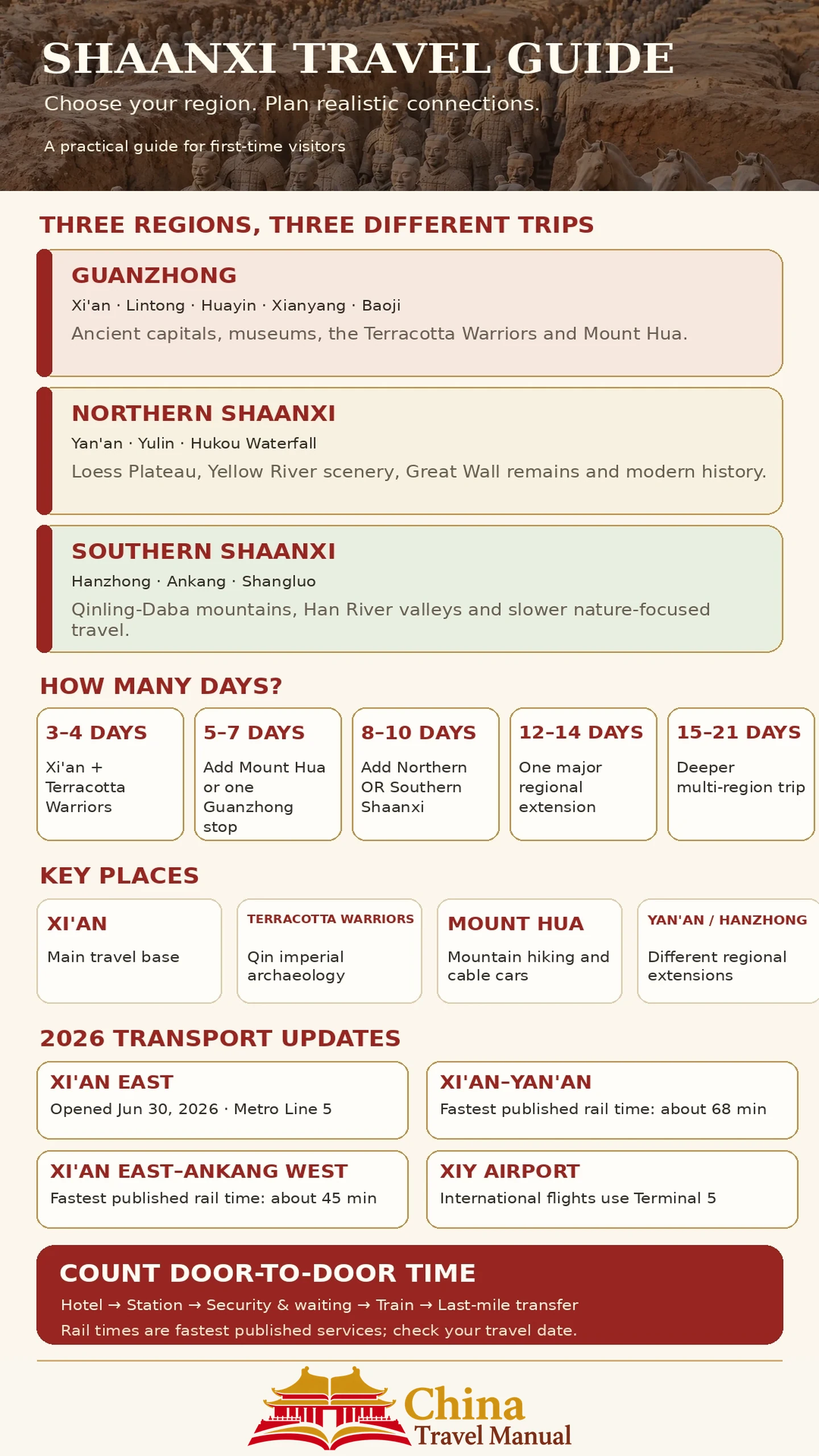
For a first trip to Shaanxi, start with Xi’an and the Terracotta Warriors, then add destinations only if your time and interests justify the transfers. With three or four calendar days, explore Xi’an and allow a separate excursion to the Qin mausoleum complex in Lintong. With five to seven days, consider Mount Hua if you enjoy mountains and can devote a substantial day to it. With eight to ten days, choose either a northern extension toward Yan’an or a southern extension toward Hanzhong or Ankang—not both by default.
Xi’an is a convenient base, but Shaanxi stretches far beyond its capital. Northern Shaanxi offers the Loess Plateau, Yellow River scenery and frontier history; southern Shaanxi has greener river valleys and Qinling–Daba landscapes. Shaanxi (陕西) is not Shanxi (山西), the neighboring province associated with places such as Pingyao. See our separate Shanxi Travel Guide if that is where you intend to go.
Where Is Shaanxi, and Why Is It More Than Xi’an?
Shaanxi sits in north-central China, between the Yellow River basin and the Qinling Mountains. Xi’an, the provincial capital, is one of China’s best-known historic cities, but its climate, terrain and transport convenience do not represent the entire province.
Guanzhong: Ancient Capitals and Archaeology
The central Guanzhong Plain includes Xi’an, Xianyang, parts of Baoji and the approaches to Mount Hua. It has the densest concentration of famous sites for most first-time visitors: imperial history, archaeological museums, Buddhist monuments and established rail connections. When a traveler has less than a week, this is usually the most rewarding area to concentrate on.
Northern Shaanxi: Loess Plateau and Yellow River
Farther north, the landscape changes to deep gullies, plateau settlements, the Yellow River corridor and Great Wall frontier country. Yan’an combines modern Chinese history with a distinctive plateau setting. Yulin appeals to visitors seeking a longer, less conventional itinerary. Connections have improved, but attractions outside the cities can still require substantial road travel.
Southern Shaanxi: Qinling Mountains and Han River
South of the Qinling range, Hanzhong, Ankang and surrounding counties offer river valleys, mountains and a slower travel rhythm. The scenery and food differ from those around Xi’an.
Which Part of Shaanxi Should You Choose?
Choose a region by the experience you want, then test whether you have enough usable time after transfers.
| Your main interest | Strongest starting point | What to leave out on a short trip |
|---|---|---|
| Imperial history and museums | Xi’an, Lintong, Xianyang | Yulin and southern mountain counties |
| A famous mountain landscape | Xi’an plus Mount Hua | Extra museums or a distant northern branch |
| Loess Plateau and modern history | Yan’an, optionally Hukou | A rushed same-day return from remote sights |
| Frontier heritage and northern scenery | Yulin and northern Shaanxi | Treating Yulin as a brief Xi’an side trip |
| Green valleys and relaxed travel | Hanzhong or Ankang | Trying to combine north and south in one week |
One practical test is to ask whether a new destination will provide at least a meaningful half-day or full day there, rather than just a photo stop between stations. If hotel changes, road connections and waiting take most of the available time, the better decision is often to remove that destination.
Best Places to Visit in Shaanxi
Xi’an: The Ancient Capital and Main Travel Base
Xi’an is the sensible anchor for most first-time Shaanxi journeys. Its city wall, historic neighborhoods, museums and major Buddhist sites give visitors several different ways to explore China’s past without repeatedly changing hotels. Two or three days in the city is a reasonable starting allowance if you also want some unhurried meals and neighborhood walks.
Choose Xi’an if you value history, urban convenience and straightforward onward connections. If time is limited, choose a few sites rather than every museum; see the Xi’an Travel Guide.
Lintong: Terracotta Warriors and the Qin Mausoleum
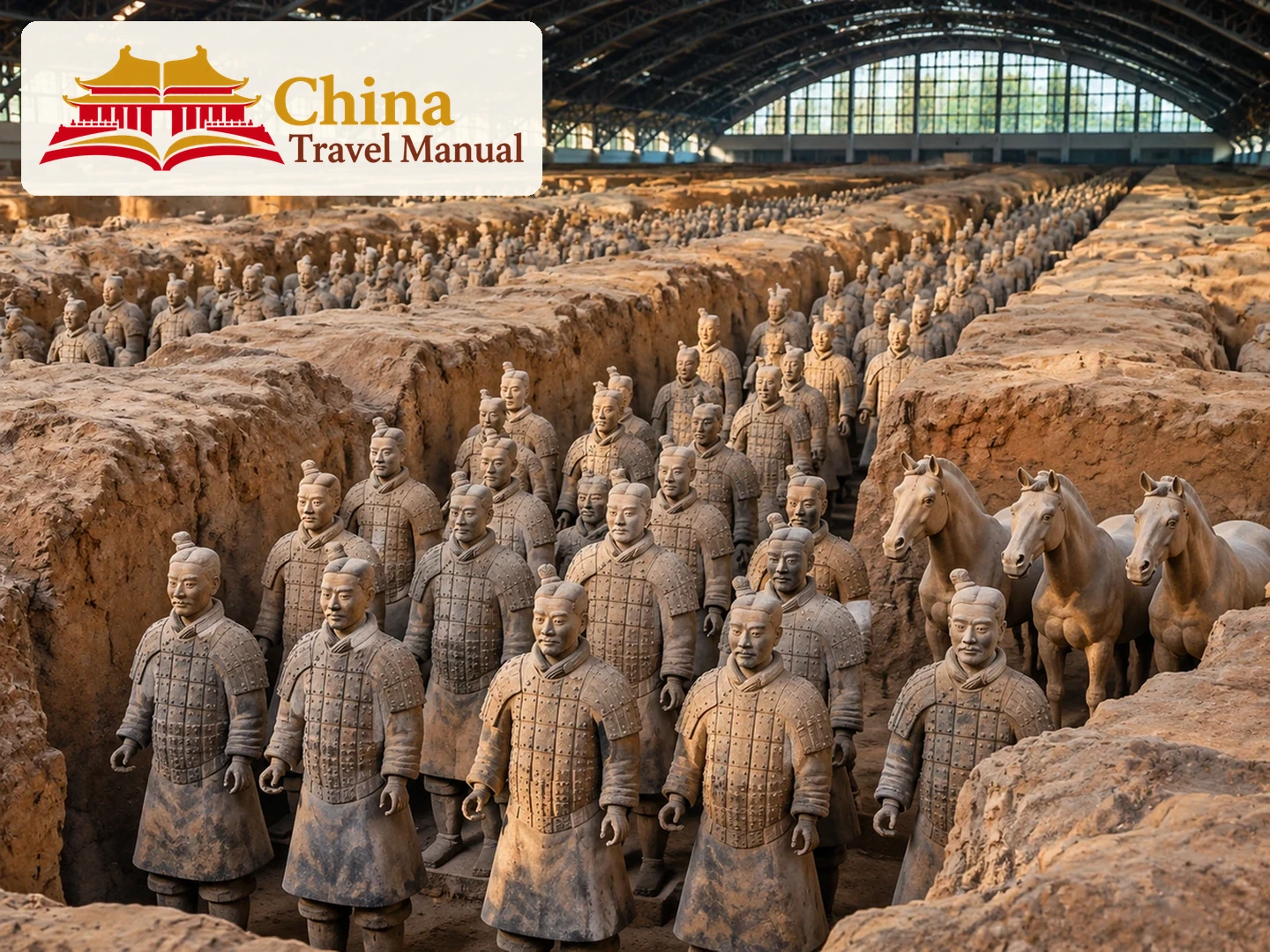
The Terracotta Warriors are in Lintong District, away from central Xi’an. Their archaeological significance makes the excursion worth protecting in a first-time itinerary, but this is not an exhibition next door to the city wall. Travel to the site, security and museum circulation all need time.
The Emperor Qinshihuang’s Mausoleum Site Museum includes the Terracotta Warriors museum and Lishan Garden, two distinct visitor areas connected by a free museum shuttle. The museum’s own guidance suggests roughly 1.5 hours for each area, before transfer and waiting time. Passport-based, real-name admission is supported. A full visit is therefore best treated as a substantial outing, not a 90-minute detour.[1] Details belong in the Terracotta Warriors Visitor Guide and ticket-booking guide.
Huayin and Mount Hua: Dramatic Scenery, Real Physical Demands
Mount Hua, near Huayin, is famous for steep granite peaks and dramatic mountain views. It makes an appealing contrast to Xi’an’s museums if you enjoy hiking, cable cars or mountain photography. It is a poor automatic addition for travelers who dislike heights, have mobility limitations or want a relaxed, low-effort excursion.
Even when you arrive by train at Huashan North, there is a separate journey to the visitor center and then onward movement within the scenic area. Allow for weather changes, queues and the particular ascent you choose. Stay in Huayin if an early start or a slower mountain visit matters more than keeping every night in Xi’an. Read the Mount Hua Visitor Guide rather than committing to a strenuous route from a province-level overview.
Xianyang: Qin and Han Imperial Heritage
Xianyang appeals to travelers interested in imperial tomb landscapes and the Qin–Han period. Sites are spread out, so it is a deliberate history excursion rather than a quick city-center stroll. Skip it if you have only a few days; see the Xianyang Travel Guide if archaeology is a priority.
Baoji: Bronze-Age Culture and Western Guanzhong
Baoji rewards visitors interested in bronze artifacts, religious heritage and a broader picture of western Guanzhong. Famen Temple is a particularly relevant excursion for those interested in Buddhist culture, though it should not be treated as a walkable stop near a central Baoji rail platform. Baoji works better as a deliberate westward extension than as an additional task on a Mount Hua day. The Baoji Travel Guide and Famen Temple Visitor Guide develop those interests further.
Yan’an: Modern History and the Loess Plateau
Yan’an offers a different part of China’s historical story, associated with the Communist movement in the twentieth century and the settlements of the northern plateau. Travelers with a particular interest in modern history or the Loess Plateau may find it more meaningful than another imperial-era stop.
The Xi’an–Yan’an high-speed railway opened on December 26, 2025. The operator announced an initial fastest Xi’an North–Yan’an train run of 68 minutes, but that is not a hotel-to-attraction travel estimate. Getting to the departure station, boarding, reaching local sites and possibly staying overnight add time.[2] Use the Yan’an Travel Guide when deciding what to see after arrival.
Hukou Waterfall: A Shared Shaanxi–Shanxi Landscape
At Hukou, the Yellow River narrows into a dramatic waterfall between Shaanxi’s Yichuan County and Shanxi’s Ji County. It belongs to both sides of an interprovincial landscape, not exclusively to Shaanxi. Conditions vary with river flow, rainfall and safety restrictions, so a visit should remain flexible.
Since June 1, 2026, a reciprocal admission arrangement allows holders of the qualifying scenic-area ticket to visit both banks within the specified two-day period, while shuttle transport is charged separately on each side.[3] For most visitors, Hukou fits a northern regional excursion rather than a casual add-on to a short Xi’an visit.
Yulin: Great Wall Frontier and Northern Landscapes
Yulin suits longer-stay travelers interested in frontier fortifications, plateau landscapes and northern culture. It needs its own itinerary days and transport planning, especially for sites outside the city. Do not mistake it for a quick Xi’an excursion; consult the Yulin Travel Guide if going north is a major goal.
Hanzhong: History and a Greener South
Hanzhong offers a contrasting mix of Han River scenery, Three Kingdoms history, spring landscapes and access to the Qinling foothills. It works especially well for travelers who want a quieter pace than central Xi’an. Allow enough time to experience the area rather than arriving in the evening, sleeping once and leaving the next morning. Some of its most appealing places lie beyond the urban rail station. See the Hanzhong Travel Guide.
Ankang and Shangluo: Mountains, Valleys and Slow Travel
Ankang is a useful gateway to Han River and Qinling–Daba experiences, while Shangluo is associated with mountainous countryside east and southeast of Xi’an. Both are better choices for travelers with a specific nature or regional-culture interest than for those checking off famous first-visit landmarks. The new Xi’an–Ankang high-speed line makes the city connection easier, not every lake or village. Start with the Ankang Travel Guide and check access to the exact destination before adding it.
How Many Days Do You Need in Shaanxi?
Count calendar days, not idealized full sightseeing days. The day your flight arrives may offer only a short evening, and a transfer to a distant region can consume much of another day. Plan the trip around available bases and complete excursions.
| Total time | Sensible scope | Accommodation bases | Usually skip |
|---|---|---|---|
| 3–4 days | Xi’an and a Lintong day | One: Xi’an | Full Mount Hua ascent, north and south |
| 5–7 days | Xi’an, Terracotta Warriors, optional Mount Hua | Xi’an; optional Huayin night | Multiple distant branches |
| 8–10 days | Guanzhong plus one regional extension | Two, sometimes three | North and south together by default |
| 12–14 days | Guanzhong with a substantial northern or southern section | Two or three | Frequent backtracking |
| 15+ days | Explore several regions at a measured pace | Based on actual route | One-night stays without a clear purpose |
These are planning ranges, not requirements. Five museum-focused days in Xi’an can be excellent without Mount Hua; mountain travelers need daylight and recovery time. See 5 Days in Shaanxi for a practical short itinerary.
Suggested Shaanxi Travel Routes
Classic Xi’an and Terracotta Warriors: 3–4 Days
Use Xi’an as your single base. Dedicate one proper outing to Lintong; use the remaining time for a small selection of urban historical sites and neighborhoods. On arrival and departure days, keep plans close to your hotel or station. Skip Yan’an, Yulin, southern Shaanxi and a full Mount Hua outing rather than turning the visit into a transfer marathon.
Xi’an and Mount Hua: 5–7 Days
After the Xi’an and Terracotta Warriors core, add Huayin for mountain scenery. The choice depends on fitness, daylight and the operating status of the route or cable cars you intend to use. Skip a northern long-distance extension unless the trip becomes longer.
Northern Shaanxi: Yan’an, Hukou and Optional Yulin
Combine a Guanzhong stay with a separate northern section. Reach Yan’an by train when appropriate, then plan the Yellow River or plateau sites as road journeys with their own timing. Add Yulin only when you have sufficient extra days and a concrete reason to travel farther north.
Southern Shaanxi: Hanzhong or Ankang
Choose Hanzhong for a mix of Han River landscapes and history, or Ankang for another entry into the greener Qinling–Daba region. The Xi’an–Ankang line began operations on September 28, 2026, improving the rail link with southern Shaanxi.[4] But if your destination is outside either city, the last road segment still determines whether the trip is comfortable. For a shorter vacation, choose one southern base, rather than changing cities every night.
Longer Trips: Reduce Backtracking
For two weeks or more, consider Guanzhong followed by a northern or southern chapter, with an onward journey that minimizes returning to the same city unnecessarily. Only combine both regions if the extra nights and connections genuinely support it. Keep a weather alternative for Mount Hua, Hukou or mountain roads, and avoid scheduling a distant scenic site immediately before an international departure.
How to Get to Shaanxi and Travel Around
A convenient railway timetable is not the same as an easy day. Estimate the whole trip as:
Hotel → departure station → security and waiting → train → exit and baggage → local transfer → actual sight.
For example, an advertised 68-minute high-speed run from Xi’an North to Yan’an does not mean 68 minutes from your Xi’an hotel to a museum in Yan’an, much less to Hukou Waterfall. Door-to-door planning is particularly important where the attraction is outside the destination city.
Flying into Xi’an Xianyang International Airport (XIY)
Xi’an Xianyang International Airport is the main air gateway. Terminal 5 opened on February 20, 2025, but passengers should use the terminal printed on their current booking rather than assume every flight uses T5.[5] Allow for airport-to-city travel and terminal transfers. See the Xi’an airport guide for details.
Xi’an North, Xi’an East and Xi’an Railway Station
These are different stations, not interchangeable English translations. Xi’an North (西安北站) is an established high-speed hub. Xi’an East (西安东站) opened on June 30, 2026, as a major new rail hub; the matching Metro Line 5 station also began service that day. Xi’an Railway Station (西安站) is a separate, older central station.[6]
A route may have different departures depending on its train and date. The Xi’an–Yan’an railway initially operated through connections to Xi’an North before Xi’an East opened, so do not assume all Yan’an trains depart East—or all North. Match the exact Chinese station name on your ticket and look up the journey from your accommodation. Our Xi’an North Station Guide and Train Travel in China explain the broader station and booking concepts.
Reaching the Terracotta Warriors and Mount Hua
Lintong is a road or public-transport excursion from the city; the nearest urban rail stop is not the museum entrance. For Mount Hua, trains reach Huashan North (华山北站), followed by ground transport to the visitor center and onward scenic-area connections. In January 2026 a conditional free shuttle was introduced on the Huashan North–visitor center corridor; the reported service operates during daytime hours and requires an eligible scenic-ticket booking code. Check current operation and do not assume free late-night transport.[7] The Xi’an–Huayin travel guide explains that transfer more fully.
High-Speed Rail to Yan’an and Ankang
The Xi’an–Yan’an high-speed line has operated since December 2025, while Xi’an–Ankang service began in September 2026. These openings make northern Yan’an and southern Ankang more accessible for multi-day regional trips. They do not guarantee every intermediate station has frequent departures or that a convenient train arrives at the time you need. Check the precise route, day and station before booking hotels.
When a Car or Regional Bus Makes More Sense
The final approach to Hukou, rural heritage sites and mountain trailheads may be more important than the mainline train. Look for scheduled local transport first, but compare its frequency and final departure with the cost and practicality of arranging a driver. Have the destination’s Chinese name and address available. Avoid assuming a taxi will be waiting late at an isolated scenic stop.
Shaanxi’s Historical and UNESCO Heritage
Shaanxi’s most famous UNESCO listing is the Mausoleum of the First Qin Emperor, inscribed in 1987. The Terracotta Warriors and the emperor’s mausoleum are parts of that archaeological property, not two separate World Heritage Sites.[8]
The Silk Roads: the Routes Network of Chang’an–Tianshan Corridor, inscribed in 2014, is a multinational serial World Heritage property containing designated components connected to ancient trade routes. Some components are associated with the Xi’an region, but this designation does not make every street, temple or district in the city a UNESCO site.[9]
Mount Hua and Famen Temple are important attractions with their own natural or religious significance. They should not be casually given a UNESCO World Heritage label. If your interest is archaeology rather than checking famous names off a list, spend more time in Xi’an, Lintong or Xianyang and fewer days transferring across the province.
Best Time to Visit Shaanxi
Shaanxi does not have one uniform travel climate. Xi’an’s urban conditions, northern plateau weather and southern mountain rainfall can differ substantially, even on the same date.
Spring: Xi’an Walks and Hanzhong Landscapes
March through May can be pleasant for walking in Guanzhong, though cool spells, variable rainfall and spring winds are possible. Southern Shaanxi becomes greener and may offer seasonal blossoms; the best flowering dates change from year to year. For Mount Hua, check the mountain forecast rather than rely on the temperature in downtown Xi’an.
Summer: Heat, Rain and Mountain Safety
June through August may bring hot days around Xi’an and heavy rain or thunderstorms in other parts of the province. In mountain valleys, rainfall can create flash-flood, landslide or trail-closure concerns. Outdoor plans should include alternatives. Avoid making an exposed mountain hike the only purpose of a tightly timed summer visit.
Autumn: Comfortable Touring and Holiday Crowds
September through much of November often offers a good balance for city exploration and landscapes, though northern areas cool earlier. China’s early-October National Day holiday creates particularly heavy travel demand. Reserve trains and popular attractions early where permitted, and avoid assuming that a normally simple road transfer will stay simple during a holiday.
Winter: Historic Cities and Cold Northern Landscapes
December through February can work well for museums and an urban Xi’an visit if you dress for cold conditions. Northern Shaanxi and exposed mountain routes may be much colder, with snow or ice affecting access. Never assume cable cars, mountain trails or scenic buses will operate throughout the winter. See Best Time to Visit Shaanxi for a more detailed seasonal comparison.
Shaanxi Food and Cultural Differences
Food is another reason not to equate the whole province with Xi’an. Guanzhong is strongly associated with wheat-based dishes such as biangbiang noodles, roujiamo, liangpi and different forms of paomo. Northern plateau cooking features grains, lamb and hearty rural flavors. Farther south, river-valley agriculture and regional traditions create a different mix of rice dishes and local specialties.
These distinctions are useful when deciding where to travel, but it is misleading to claim that every dish in Shaanxi is extremely spicy or that the province has one uniform menu. For regional specialties and food choices, continue to the Shaanxi Food Travel Guide.
Where to Stay in Shaanxi
Use Xi’an as the main base for a short first visit. It reduces packing, hotel check-in time and uncertainty on museum and Lintong excursion days.
For Mount Hua, consider sleeping in Huayin when early access, a demanding hike or a late return makes a Xi’an round trip uncomfortable. For northern Shaanxi, overnight in Yan’an or Yulin according to your route instead of trying to return to Xi’an after every excursion. For the south, Hanzhong and Ankang are separate possible bases; changing between them is justified only if you have activities in both areas.
A useful rule: change hotels when the new base saves more usable travel time than the move consumes. The Where to Stay in Xi’an guide handles neighborhood-level decisions; this province overview does not recommend particular hotel brands or nightly rates.
Practical Travel Tips and Common Mistakes
Reserve high-demand museums using the correct identity document. The Qin mausoleum museum offers real-name booking using passport details; the passport used for the reservation should match the one you bring. The Shaanxi History Museum’s main site and Qin-Han branch are in different locations, and their admission arrangements currently differ: the main museum generally uses advance reservations, while the Qin-Han branch’s official visitor guide states that entry is available without advance booking upon presentation of valid identification. Rules can change, especially around special exhibitions or holidays.[1][10] Check the Shaanxi History Museum Visitor Guide before going.
Check immigration eligibility rather than assuming a U.S. passport is an unrestricted visa waiver. China’s 240-hour visa-free transit arrangement includes U.S. citizens among eligible nationalities, but it is conditional on travel via an eligible port toward a third country or region and other published requirements; it is not the same as ordinary visa-free entry.[11] Use the China Tourist Visa Guide and the visa-free entry versus transit comparison when planning entry.
Take local logistics seriously. Save Chinese station names and hotel addresses, arrange a working mobile payment method, and maintain an offline backup for connectivity problems. In rural areas, do not count on abundant evening taxis. For mountain or waterfall outings, check weather alerts and scenic-area announcements the day before and again that morning.
Shaanxi Travel Planning Checklist
- ☐ Confirm that your destination is Shaanxi (陕西), not Shanxi (山西).
- ☐ Count arrival, departure and intercity-transfer days within your total vacation.
- ☐ Select Guanzhong plus no more than one distant region for a typical 8–10-day trip.
- ☐ Check the airport terminal and exact Chinese names of railway departure and arrival stations.
- ☐ Verify passport-based reservations and carry the original document used to book.
- ☐ Confirm onward transport from Huashan North, Yan’an, Ankang West or rural scenic areas.
- ☐ Check current mountain, waterfall and weather restrictions; keep a backup plan.
- ☐ Save Chinese addresses and avoid a remote excursion immediately before an international flight.
Frequently Asked Questions About Shaanxi
Is Shaanxi Worth Visiting on a First China Trip?
Yes, especially if Chinese imperial history interests you. Xi’an and the Terracotta Warriors form a strong first visit without requiring a long provincial circuit. Nature-focused travelers may prefer to add Mount Hua or explore a southern valley.
Is Shaanxi the Same as Shanxi?
No. Shaanxi (陕西) contains Xi’an and the Terracotta Warriors. Shanxi (山西) is a separate neighboring province with a different collection of historic destinations.
How Many Days Do I Need in Shaanxi?
Allow three or four days for a compact Xi’an and Lintong visit, five to seven to consider Mount Hua, and eight to ten or more if you want a meaningful northern or southern extension.
Can I Visit Mount Hua as a Day Trip from Xi’an?
Yes, with appropriate train times, available connections and a realistic mountain plan. A full hike can be demanding; overnighting in Huayin may make the visit more comfortable.
Should I Choose Yan’an or Hanzhong?
Choose Yan’an for modern history and Loess Plateau scenery. Choose Hanzhong for greener landscapes, the Han River region and a slower cultural trip. Both deserve time beyond a brief station stop.
Can I Visit the Terracotta Warriors and Mount Hua in One Day?
It may be physically possible under a very restricted plan, but it is generally a poor first-visit choice. They involve separate excursions, admission logistics and potentially strenuous mountain travel. Give them different days if both matter to you.
Sources
The following official or primary sources support the specific facts referenced above. Check the linked agency or attraction again before traveling, especially for tickets, timetables and seasonal access.
- Emperor Qinshihuang’s Mausoleum Site Museum — Official visitor guide (real-name tickets, the two sites and shuttle).
- Shaanxi Railway Transit Group — Xi’an–Yan’an high-speed railway announcement (December 2025 opening and the initial fastest train time).
- Hukou Waterfall — Official Shanxi-side ticket service and China Tourism News — June 2026 reciprocal admission policy.
- Xi’an Municipal Government — Xi’an–Ankang high-speed railway begins operations.
- Xi’an Municipal Government — Terminal 5 opening.
- People’s Daily — Xi’an East station inauguration and Shaanxi Daily — Metro Line 5 Xi’an East stop.
- Shaanxi Broadcasting — January 2026 Huashan North shuttle launch.
- UNESCO — Mausoleum of the First Qin Emperor (1987 inscription).
- UNESCO — Silk Roads: Chang’an–Tianshan Corridor (2014 inscription).
- Shaanxi History Museum — Official visitor information (different locations, passport admission and the current reservation distinction).
- National Immigration Administration — Visa-free transit policy, August 2026.





