
Quick Answer: How to Get Around Huangshan City
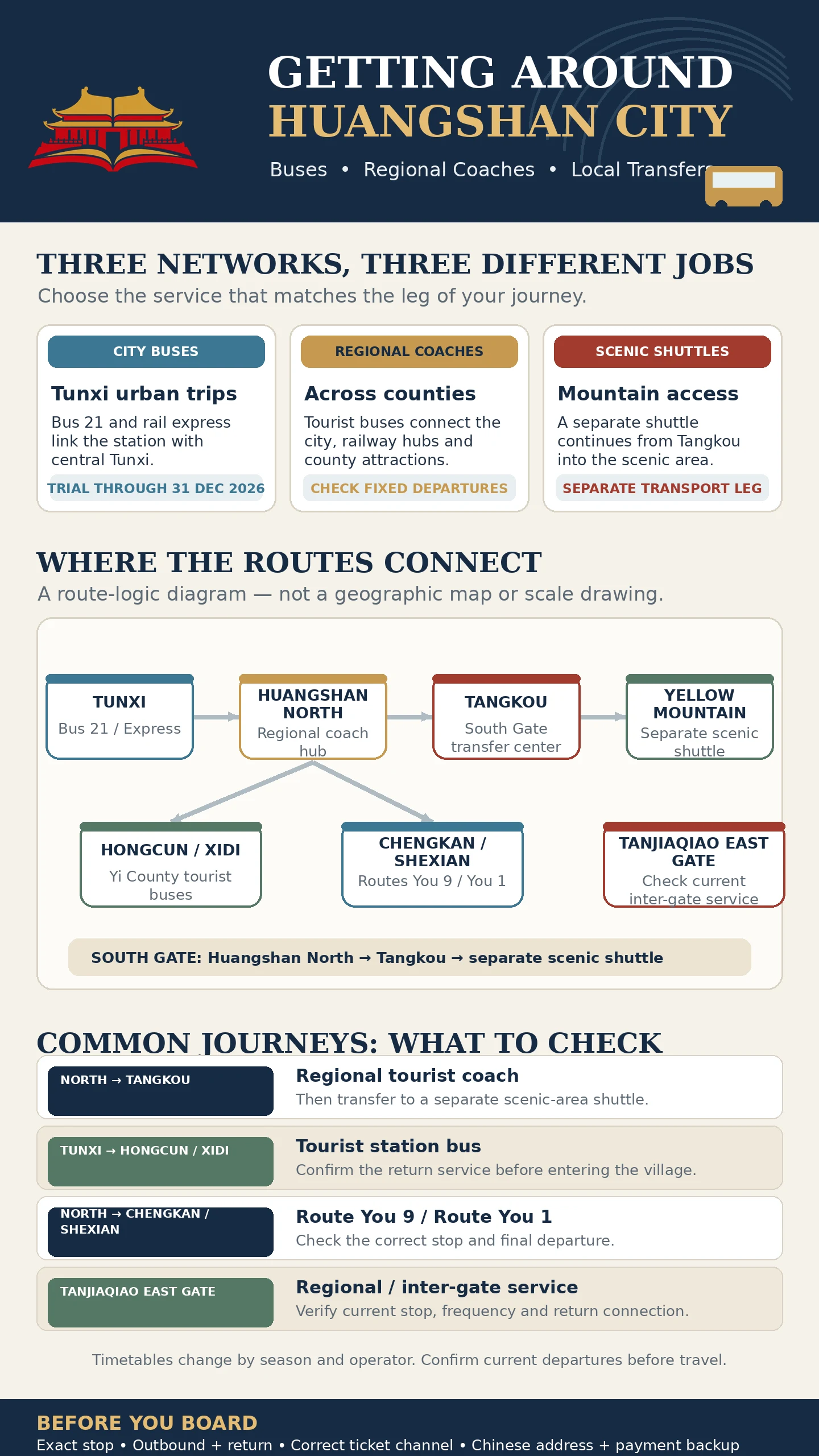
Huangshan City has no metro, and no single transport network reaches every attraction. Choose by destination:
- Tunxi: Use city buses, the Hui Xiaohuang tourist bus during its 2026 trial, or walk. Taxis and DiDi suit short trips with luggage.
- Huangshan North to Tangkou: Take a regional tourist coach to the South Gate transfer center, then a separate scenic-area shuttle into Yellow Mountain.
- County attractions: Check tourist station buses or customized coaches for Hongcun, Xidi, Chengkan and She County. Private transfers help with multi-stop days.
- East Gate at Tanjiaqiao: Confirm the current regional or inter-gate service; do not assume South Gate frequency.
- Ancient villages: Expect to walk from the public parking area into the historic lanes.
Before leaving, check the return departure as carefully as the outbound trip. County and village buses may stop running well before evening.
Huangshan City is spread across several districts and counties. City buses, regional coaches and scenic-area shuttles serve different parts of the trip, so confusing them can mean reaching the wrong transfer point or missing the return ride. For the wider overview, see the Huangshan City Travel Guide, Where to Stay in Huangshan City, 2 Days in Huangshan City and the national guide to getting around China.
Understanding Huangshan’s Local Transport Geography
Identify the correct area first: “Huangshan” can refer to the city, the mountain scenic area or a railway station.
Tunxi and the Central Urban Area
Tunxi (屯溪) is Huangshan City’s main urban service center, with Tunxi Old Street, the Liyang riverside district, the airport, Huangshan Railway Station and the region’s most useful city-bus network. Tunxi is not Tangkou (汤口), the town serving Yellow Mountain’s South Gate. Huangshan North Railway Station (黄山北站) is a separate high-speed rail hub, not the conventional Huangshan Railway Station in central Tunxi. Confirm whether a bus serves the airport terminal; a station-to-Old-Street route is not automatically an airport shuttle.
Tangkou, Taiping and Tanjiaqiao
- Tangkou (汤口): The main base for visitors using Yellow Mountain’s South Gate. Regional coaches usually end at the Tangkou transfer center; a separate scenic-area shuttle continues toward the mountain entrance. The Yellow Mountain Visitor Guide covers transport inside the scenic area.
- Taiping (太平 / Gantang): The town serving the North Gate and northern Huangshan District. Use it when your route specifically enters from the North Gate or visits Taiping Lake.
- Tanjiaqiao (谭家桥): The East Gate and Donghai Cableway opened on June 11, 2026. The East Gate service center includes visitor reception, transport transfer and parking. It is a separate entrance: confirm the exact stop and return connection rather than booking a bus to Tangkou. [4]
Yi County, She County and Other Regional Destinations
Yi County (黟县) contains Hongcun and Xidi, two separate ancient villages. Tourist station buses and county services connect them with Tunxi and railway stations, but departures are less frequent than city buses. She County (歙县) is home to Huizhou Ancient City. Tourist Route You 1 connects Huangshan North with the She County area; Route You 9 links Huangshan North with Chengkan via Xixinan, while Route 19 serves Xixinan. Qiyun Mountain has separate connections from Huangshan North and central Tunxi. These are destination-specific routes, not one unified network. [1]
Getting Around Tunxi by City Bus
For short journeys in Tunxi, start with the city-bus network rather than arranging a private car.
Bus 21 and High-Speed Rail Express Routes
Bus 21 links Huangshan North Railway Station with the Tunxi Old Street and Liyang IN Lane area. A Huangshan Municipal Government guide published April 1, 2026 listed a reference window of 6:50 a.m.–11:25 p.m. for Route 21, 7:45 a.m.–6:45 p.m. for High-Speed Rail Express 1, and 7:05 a.m.–9:30 p.m. for Express 2. These are dated reference times, not a guarantee for your travel date. [1]
Route 201 serves the Huashan Mystery Caves area, while Route 5007 links central Tunxi with Qiyun Mountain on fixed departures. Check the Huangshan Bus WeChat account for current stops and last services.
The Hui Xiaohuang Tourist Bus
The Hui Xiaohuang (徽小黄) electric tourist bus began trial operation in Tunxi on September 22, 2026. Four electric micro-buses run separate daytime and evening routes, with about 70 departures per day in total. The trial was announced through December 31, 2026, linking Tunxi River Street, Tunxi Old Street, Liyang Water Street, Wenfeng Bridge and Huizhou Fang along the South Riverside Road. [3]
The trial was free from September 22–30; a promotional fare of RMB 2 per ride applied from October 1 through December 31, 2026. This is a temporary city-sightseeing service, not a regional coach to Tangkou, Hongcun, Xidi or Huangshan North. Recheck the stops, fare and continuation after the trial period. [3]
Checking Bus Stops and Operating Times
Bus-stop names are usually displayed in Chinese. Save the Chinese name of your destination and confirm the stop on the current route map. Check the last departure rather than assuming every route runs as late as Bus 21. Tourist routes to villages and counties generally finish earlier than central-city services.
Tourist Buses and Regional Connections
Regional tourist coaches are the main public-transport option between Tunxi, Huangshan North, Tangkou and county attractions. Departure points and booking channels vary by route.
Huangshan North to Tangkou and the South Gate
A spring 2026 government travel guide listed the Huangshan North–South Gate coach from 6:55 a.m.–7:00 p.m., with 33 daily departures and an average interval of about 20 minutes. It also listed one daily North Gate departure at 12:40 p.m. and a Huangshan North–Hongcun service from 8:05 a.m.–5:05 p.m., with 11 departures and an average interval of about 40 minutes. Treat these as dated reference schedules and confirm the timetable for your date. [1][2]
Traveling to Yellow Mountain through the South Gate involves two separate legs:
- Huangshan North to Tangkou: A regional tourist coach takes you to the Tangkou transfer center.
- Tangkou to the scenic-area entrance: A separate scenic-area shuttle continues toward the designated mountain entrance or cable-car area.
The regional coach does not take you directly to a cable-car station, and its ticket should not be assumed to include the scenic-area shuttle. See Shuttle Buses in China Scenic Areas for the second leg.
Tunxi to Tangkou, Taiping, Hongcun and Xidi
An April 2026 guide listed 10 daily Tunxi–Yellow Mountain scenic-area departures from 6:20 a.m. to 4:05 p.m. (about 60–90 minutes). Huangshan Changyun announced changes to the Tunxi–Yellow Mountain and Tunxi–Hongcun timetables effective September 1, 2026, so check the operator’s latest schedule rather than reusing the spring timetable. [1][8]
The Tunxi–Yi County–Hongcun station bus serves Hongcun, Xidi and other stops on fixed departures. Xidi services are more limited than the main Hongcun connection in the April 2026 reference guide, so confirm the boarding stop, ticket and return time. Compare the Hongcun Visitor Guide, Xidi Visitor Guide and Hongcun vs Xidi before choosing your route. [1]
Buses to Xixinan, Chengkan, Qiyunshan and She County
- Xixinan (西溪南): Tourist routes from Huangshan North include Route 19 and the Route You 9 corridor toward Chengkan.
- Chengkan (呈坎): Route You 9 runs from Huangshan North via Xixinan. The April 2026 guide listed 9:00 a.m.–5:05 p.m. and nine daily departures; confirm the return before entering the village. [1]
- Huizhou Ancient City in She County: Route You 1 connects Huangshan North with the She County heritage area. The April 2026 guide listed 8:50 a.m.–7:40 p.m.; check the current stops and service window. [1]
- Qiyun Mountain (齐云山): Route 5007 connects central Tunxi with the scenic area. Huangshan North has a separate Xuning Bus route, so check the correct starting point. [1]
- Tanjiaqiao East Gate: The April 2026 guide listed Tanjiaqiao stops on the Tunxi–Taiping route at 6:20 a.m., 9:20 a.m., 12:20 p.m. and 3:20 p.m. These are dated reference departures, not a current guarantee; confirm whether the coach serves the East Gate transfer center and check the return. [1][4]
- Taiping Lake: Usually requires a regional connection via Taiping; confirm the onward local service before setting out.
For the village itself, see the Chengkan Visitor Guide and Things to Do in Huangshan City.
Connections from Huangshan West and Yixian East
Earlier official transport information listed services from Huangshan West Railway Station to the North, West, East and South Gates. After the East Gate opened in June 2026, local authorities described further work to strengthen connections between the four entrances; confirm the current station-to-gate schedule rather than relying on the older timetable. [4][9]
Yixian East Railway Station (黟县东站) has published connections to Hongcun and Xidi. The exact service window and ticketing arrangements can change, so check the station or operator notice when you book your train and allow time for the transfer after arrival. [9]
Taxis, DiDi and Private Transfers
Road-based transport fills gaps between fixed bus departures, especially at night or when you have luggage.
Taking a Regular Taxi
A metered taxi is useful for short Tunxi trips, station transfers and places poorly served by buses. A 2024 fare notice set a baseline of RMB 8 for the first 2.5 km and RMB 2.1 per kilometer, but government-guided pricing allows adjustments. Treat these as reference rates, check the fare card and meter, and expect to pay tolls incurred during the ride. [7]
Use an official taxi, confirm the meter is running and show the driver the Chinese address. For longer cross-district trips, ask about tolls and the likely total before departure. For a comparison with app-based rides, see Taxi vs DiDi in China.
Using DiDi in Huangshan
DiDi appears on Huangshan’s licensed-platform list, but this does not guarantee a driver at every village or scenic entrance. [5][6]
Confirm the pickup point, vehicle and fare in the app. At Hongcun, Xidi and other pedestrian villages, pickup may be at a public parking area outside the historic lanes rather than at a guesthouse door. Do not assume a return car will be available immediately after sunset. See How to Use DiDi in China and Finding Your DiDi Pickup Point for app and pickup guidance.
When to Book a Private Transfer
A private transfer suits groups, bulky luggage, early starts or several villages in one day. It can also help when public transport to Tanjiaqiao does not fit your schedule.
Before paying, confirm the vehicle, passenger and luggage capacity, pickup and drop-off points, waiting time, tolls, parking fees and whether the quote covers the full itinerary. Clarify whether the driver waits at each stop or returns later. A private car is not automatically best for a solo traveler making a short Tunxi trip. For booking details, see Booking a Private Transfer in China.
Walking and Short-Distance Travel
Walking is often simplest around Tunxi Old Street, Liyang and the riverside district. See the Tunxi Old Street Visitor Guide.
Hongcun, Xidi, Chengkan and Huizhou Ancient City also require walking after arrival. Historic lanes can have uneven paving, steps and restricted vehicle access. A car may reach a public parking area, but not the door of a guesthouse inside the old settlement. If staying overnight, check the walking route and luggage arrangements before booking.
How to Plan Common Journeys Around Huangshan
Use this table as a starting point, then confirm the exact service on your travel date.
| Journey | First option to check | Important point |
|---|---|---|
| Huangshan North to Tunxi Old Street | Bus 21 or a High-Speed Rail Express route | Match the stop to your hotel address. |
| Huangshan North to Tangkou | Direct tourist coach | Tangkou is a transfer center, not a cable-car station. |
| Tunxi to Hongcun or Xidi | Tourist station bus or customized coach | Confirm the correct stop and return departure. |
| Huangshan North to Chengkan | Route You 9 | Check the last return before entering the village. |
| Huangshan North to Huizhou Ancient City | Route You 1 | Check the current stop list and service window. |
| Tunxi to Qiyun Mountain | Route 5007 | Fixed departures; check the return. |
| Huangshan West to a mountain gate | Station-to-gate coach | Confirm which gate your route requires. |
| Tanjiaqiao East Gate | Current regional or inter-gate coach, or pre-booked transfer | Confirm the drop-off point and return service. |
For station access, use the Huangshan North Railway Station Guide. For a complete sightseeing sequence, use the two-day Huangshan itinerary rather than trying to combine every county route in one day.
How to Check Routes, Timetables and Tickets
Using the Changxing Huangshan Mini Program
The Changxing Huangshan (畅行黄山) WeChat mini program was introduced as a regional tourism-transport search tool. An April 2026 government guide said it covered 46 scenic areas rated 3A or above, nine popular local attractions, five high-speed railway stations and 12 passenger-transport hubs, with 140 tourism-related routes available for lookup. The same notice said real-time bus and one-click charter functions were still being developed at that time. Check the current version before relying on it for live departures or booking. [1]
Official Bus and Tourist Transport Channels
No single app sells every route. Depending on the service, check the Huangshan Bus WeChat account, Huangshan Tourism Official Platform, Zhongjiao Chuxing, Huangshan Changyun Chuxing or Wanmei Chuxing. Some station buses may appear in DiDi. The 2026 government guide directed Huangshan North–South Gate and Huangshan North–Hongcun passengers to “Traffic Booking” in the Huangshan Tourism Official Platform or Zhongjiao Chuxing. [1][2]
Before departure, use this sequence:
- Search for the destination by its Chinese name.
- Confirm the exact departure station or registered pickup stop.
- Check both outbound and return departures, including the last service.
- Confirm which platform sells that route and whether the ticket is digital or bought at the station.
- Save the ticket, QR code, Chinese destination name and pickup details before leaving.
Payments and Navigation for Foreign Visitors
Set up a mobile-payment option and check how each bus or ticket platform accepts payment. A QR method that works in shops may not work on every bus; keep a small cash backup and do not assume foreign contactless cards are accepted.
Save Chinese names and addresses, and compare map pins with the operator’s stop information. See the China payment guide, best map apps for China and guide to traveling without speaking Chinese.
Practical Tips and Common Transportation Mistakes
- Plan the return first: Village and county services are less frequent than city buses; the last departure may be in the afternoon.
- Keep the networks separate: A regional coach to Tangkou is not the scenic-area shuttle into Yellow Mountain.
- Check the exact station: Huangshan North, Huangshan Railway Station and the Tunxi long-distance bus station are different places.
- Do not reuse old timetables: Routes change by season, holiday and demand. The Tunxi–Hongcun and Tunxi–Yellow Mountain services had changes announced for September 1, 2026. [8]
- Do not assume rural DiDi coverage: A return driver may not be available when you finish.
- Save Chinese addresses: Give drivers the Chinese name of the hotel, station or village entrance.
Identify the correct departure point and verify both directions before choosing a bus, taxi, DiDi or private transfer.
FAQs About Getting Around Huangshan City
Is There a Metro in Huangshan City?
No. Huangshan City has no metro. Tunxi uses city buses and road-based transport; nearby counties and scenic areas rely on regional tourist coaches, customized buses, taxis and private transfers.
What Is the Best Way to Get Around Huangshan City?
Use city buses or walking in central Tunxi, tourist coaches between railway stations, Tangkou and county attractions, and taxis or DiDi for short trips that do not fit a bus timetable. A private transfer helps with groups or multi-village days. No single option suits every area.
How Do I Get from Huangshan North Railway Station to Yellow Mountain?
Take a regional tourist coach to the Tangkou South Gate transfer center. From there, use the separate scenic-area shuttle to reach the designated mountain entrance. The regional coach does not go directly to a cable-car station.
Can I Visit Hongcun and Xidi by Public Bus?
Yes. Tourist station buses and county services connect the villages with Tunxi and nearby transport hubs, but departures are limited compared with city buses. Confirm both directions before entering either village; a private transfer is more flexible if you want to visit both in one day.
How Do I Get to the East Gate of Yellow Mountain?
The East Gate is at Tanjiaqiao in Huangshan District. Check the current regional or inter-gate service to the East Gate transfer center, or book a private transfer if the public timetable does not fit. A coach to Tangkou does not automatically serve the East Gate.
Sources
[1] Huangshan Municipal Government. Huangshan Spring Break and Qingming Travel Service Guide
[2] Huangshan Municipal Government. May Day Travel Guide
[3] Huangshan Transport Bureau information reported by China Buses. Huangshan Bus Hui Xiaohuang Electric Tourist Route Begins Trial Operation
[4] Huangshan Municipal Government. Yellow Mountain Scenic Area East Gate Officially Opens
[5] Huangshan Municipal Government. Notice Issuing Huangshan’s Implementation Rules for Online Ride-Hailing Services
[6] Huangshan Municipal Government. Licensed Ride-Hailing Platform Companies in Huangshan (as of May 28, 2025)
[7] Huangshan Development and Reform Commission and Huangshan Transport Bureau. Notice on Adjusting Central Urban-Area Taxi Fares and Reforming the Pricing Mechanism
[8] Huangshan Changyun route notice, reproduced by Focus Huangshan. Timetable Changes for Three Routes from September 1
[9] Huangshan Municipal Government. Huangshan Spring Festival Comprehensive Transport Service Guide





