
Quick Answer: How Do Scenic-Area Shuttles Work?
Check which buses are inside the scenic area and which take you to it. Buy the shuttle or transfer ticket you need for the correct line or direction, and ask the staff at your first stop how to get back to your chosen gate.
- Match the shuttle to the route. Start with the gate on your reservation and find the stop closest to your first viewpoint, trail or lift.
- Check how to pay. A shuttle can be included in admission, listed as a separate item or sold for individual segments. Read the exact ticket details.
- Confirm the last bus from your stop. Check the timetable for the exit direction. Allow time to change lines and wait for space at busy stops.
Attractions run their own services. Use the operator’s current route map and opening notice, especially after heavy rain or during a seasonal timetable change.
At a large scenic area in China, the first bus may take you to the entrance, and the next one may carry you between viewpoints. The two services can have different tickets, stops and last departures. Look at the park map before you board, and identify the stop where you need to change buses or reach your exit.
Know Which Bus You Need
| Bus or transfer | Where it runs | What to confirm |
|---|---|---|
| Bus from town or the railway station | Public stop to the visitor area | Arrival point and return stop |
| Gate transfer shuttle | Visitor center or parking area to a gate or trailhead | Designated boarding location and direction |
| Internal sightseeing bus | Between signed stops within the scenic area | Ticket validity, reboarding and transfer hubs |
| Shuttle feeding a lift | Lower or upper scenic zone to a cableway station | Whether you need another ticket or queue |
| Return bus | A viewpoint or gate back to the outbound connection | Last departure from your stop and where it ends |
A single service can cover more than one of these legs. Use the last-mile transport guide to reach the gate or visitor center. Once on site, match the lift legs to the route in the cable car guide and check their own last boarding times.
How to Ride a Scenic-Area Shuttle
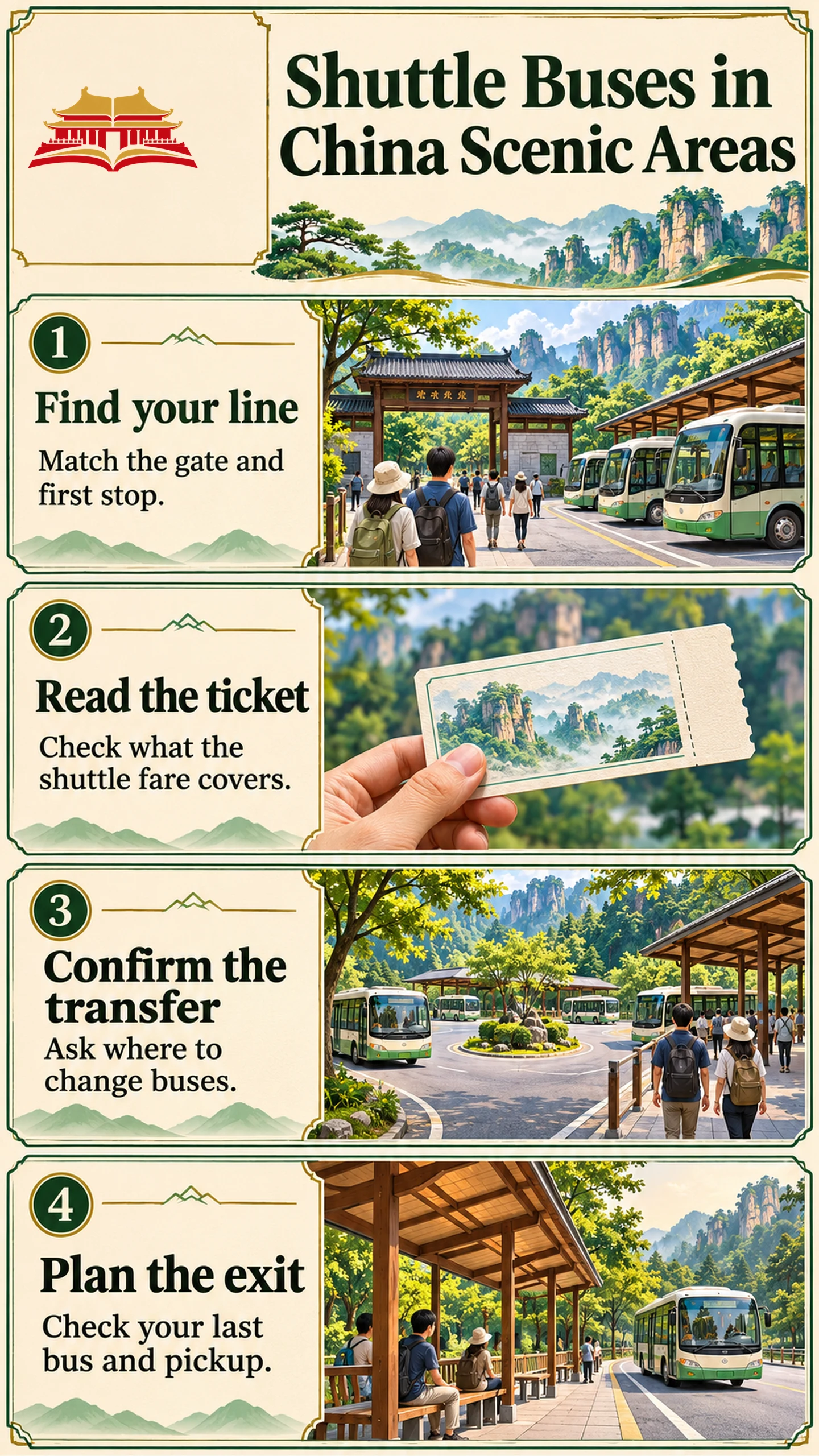
- Find your gate and first stop. Use the official map and your ticket. Save a screenshot with the official stop names. At the boarding area, ask which bus is going to your first planned stop.
- Check ticket coverage. Look for the bus item on the order or receipt. Ask whether it includes multiple rides on the date, whether you need another fare for a different branch and whether it still works if you leave the park.
- Confirm the transfer before getting off. At any junction where lines split, ask which queue or next stop serves your destination. Take a photo of the current stop board if it lists return directions.
- Ask about boarding and storage. If you use a wheelchair, stroller or large bag, check space at the point where you will board. Ask whether there are steps or mobility assistance. The mountain stay luggage guide covers what to bring up when storage is limited.
- Work backward from the return. Confirm when the final bus leaves from your actual stop. Give yourself time to walk back, wait through a queue and change lines before the gate or street pickup.
How Three Scenic Areas Handle Their Buses
Jiuzhaigou Valley
The operator of Jiuzhaigou Valley lists a separate sightseeing bus ticket. Its FAQ says that a single bus ticket is valid within the scenic area and loses validity if you leave and reenter. The winter notice for November 16, 2026 through March 31, 2027 also announces temporary closures of some sites and boardwalks. Confirm which stops and walks are operating for your date.[1][2]
Yellow Mountain
When approaching Yellow Mountain by car from the south, transfer at a designated visitor transport center. The bus serves mountain access points, so ask for the stop for your chosen trailhead or lift. The operator publishes uphill and downhill hours separately. Check the destination of the downhill bus before you board, especially if you left a bag or arranged a pickup at a particular center.[3][4]
Zhangjiajie National Forest Park
The park’s eco buses link different sightseeing areas. Hunan’s transport guide gives the West Gate bus to the lower Yangjiajie cableway station as an example. Hunan’s published ticket scheme includes the internal eco buses in standard park admission, with separate or bundled tickets for the cableways and Bailong elevator. Check your current ticket when choosing Zhangjiajie Forest Park routes, and account for the exact gate you plan to exit.[5][6]
Plan a Return You Can Actually Catch
Suppose your onward bus leaves the visitor center at 17:00. The internal trip from a viewpoint involves a 20-minute ride and a 10-minute walk to the pickup, and you want 20 minutes for the boarding queue and a small buffer at the visitor center. Aim to reach the stop by 16:10 or earlier. If the park’s timetable means the last useful shuttle boards earlier, use that cutoff and shorten your walk.
If a stop closes or the queue is longer than expected, ask staff which open stop is closest and where that bus ends. Adjust your next connection early if the available route leaves you at a different gate.
FAQs About Scenic-Area Shuttles in China
Can I get off and get back on at every stop?
Ask whether the ticket covers repeat boarding and where reboarding is allowed. Some routes use only designated stops or change during the season. Jiuzhaigou’s bus ticket is valid inside the scenic area during the visit.[1][2]
Does a scenic-area bus ticket include the cable car?
Read the ticket’s inclusions. At Zhangjiajie, eco buses are part of park admission in the published scheme. A lift or elevator can require an additional ticket or a package that names it.[6]
Will the shuttle bring me back to my original entrance?
Check the exit destination on the route map and confirm at the stop. Multi-gate parks can have routes for different exits. Save the location of your return bus, hotel ride or car before getting on.
Sources
[1] Jiuzhaigou Scenic Area. Visitor FAQ and interior bus ticket validity
[2] Jiuzhaigou Scenic Area. 2026–27 winter operations and closure notice
[3] Huangshan Tourism. Scenic-area transfer points
[4] Huangshan Tourism. Attraction and transfer operating information
[5] Hunan Provincial Department of Culture and Tourism. Wulingyuan area transport guide
[6] Hunan Provincial Government. Wulingyuan eco bus and combined ticket policies





