

Quick Answer: Best Way to Travel from Hong Kong Airport to Mainland China or Macau
There is no single best route for every traveler. Your best option depends on your final destination and whether you have already cleared Hong Kong immigration.
- Still in transit: Check the SkyPier ferry or transfer coach at Transfer Area E2 before entering Hong Kong. Eligible passengers remain airside.
- Going to Macau: After entering Hong Kong, check whether airport feeder bus B4 is operating before using it to reach the HZMB Hong Kong Port; then board the Macau shuttle bus. If B4 is suspended, compare another available connection or a taxi.
- Going to Shenzhen or another Greater Bay Area city: Compare Terminal 2 cross-boundary coaches and choose a border port that matches your destination.
- Traveling farther into Mainland China: Take the Airport Express to Kowloon Station, walk to Hong Kong West Kowloon Station, and continue by high-speed rail.
- Traveling with family or heavy luggage: Consider an authorized cross-boundary hire car or SkyLimo rather than several public-transport changes.
Hong Kong, Mainland China, and Macao have separate entry rules. A transport ticket does not grant permission to enter any of them.
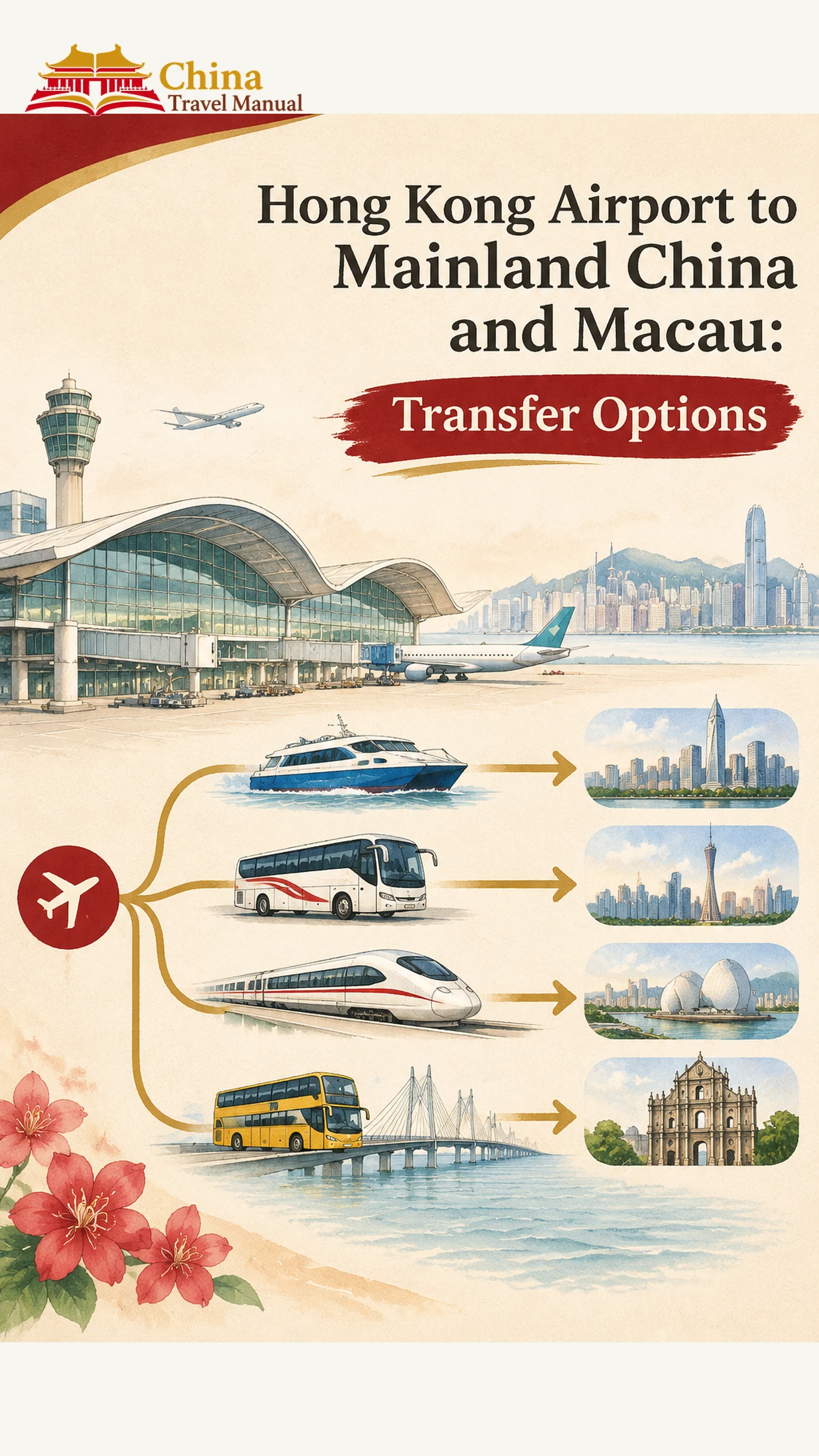
Hong Kong International Airport (HKIA) is a transfer point for the Greater Bay Area, other Mainland China cities, and Macao. Before choosing a route, decide whether you will enter Hong Kong and collect checked baggage. This determines whether you can use airside SkyPier services or must travel from the public side of the airport.
This guide compares ferries, transfer coaches, cross-boundary buses, the HZMB shuttle, high-speed rail, and authorized cars. For airport facilities and city transfers, see the Hong Kong International Airport Guide and Hong Kong Airport to the City.
First Decide Whether You Will Enter Hong Kong
Airside Transfer Passengers: Stay Before Immigration
Airside passengers remain inside HKIA’s restricted transit area. If the airline, itinerary, baggage arrangement, and destination documents meet the rules, you may transfer by ferry or SkyPier Terminal Transfer Coach without entering Hong Kong. Go to Transfer Area E2 before immigration or baggage reclaim. Once you have cleared Hong Kong immigration, you cannot return to E2 for these services. [1][2]
You generally need a same-day arriving flight, transfer ticket, passport, and any destination visa. A separate ticket or baggage tagged only to Hong Kong may not qualify.
Landside Arrivals and Self-Transfers
If you pass Hong Kong immigration, collect your checked bags, or need to check in again for a separate booking, you are a landside traveler. Your options then include Terminal 2 cross-boundary coaches, local transport to the HZMB Hong Kong Port, an authorized cross-boundary vehicle, or the Airport Express and high-speed rail. You cannot switch back to the airside SkyPier process after entering Hong Kong.
If a bag is tagged only to Hong Kong or your flight is delayed, ask the airline whether the airside transfer remains possible. If eligibility is uncertain, plan a landside route.
Compare the Main Transfer Options from Hong Kong Airport
| Transfer option | Enter Hong Kong? | Best for | Main trade-off |
|---|---|---|---|
| SkyPier ferry | No | Eligible airside transfers to an operating port | Limited routes and operator schedules |
| SkyPier Transfer Coach | No | Eligible transfers to the HZMB Macao or Zhuhai Port | Local transport is still needed after the port |
| Terminal 2 cross-boundary coach | Yes | Direct or port-based services across the Greater Bay Area | Must match the operator, port, and departure time |
| B4 + HZMB shuttle bus | Yes | Budget-conscious travelers to Macao or Zhuhai | Two stages and separate clearance procedures |
| MTR + border crossing | Yes | Light travelers going to Shenzhen | Several changes; less convenient with bulky bags |
| Airport Express + high-speed rail | Yes | Longer Mainland journeys with a suitable train | A separate transfer at West Kowloon is required |
| SkyLimo / authorized hire car | Yes | Families, groups, heavy luggage, or late arrivals | Higher cost and advance arrangements |
Some services take you to a city terminal; others stop at a border port, where you must clear immigration and arrange another local ride. Check the exact endpoint shown on the ticket. A coach to a port is not automatically a door-to-door service to your hotel.
SkyPier Connections: Ferry or Transfer Coach?
SkyPier Ferry to Shenzhen Shekou and Other Ports
The SkyPier ferry is an airside service, not a public ferry for people who have entered Hong Kong. HKIA lists Greater Bay Area ports including Shenzhen Shekou and Macao Maritime Ferry Terminal. Its page marks Macao Taipa and Zhuhai Jiuzhou temporarily unavailable. A port listing does not prove a sailing is operating; check the operator’s live booking page. [1]
For Shenzhen Shekou, confirm a same-day sailing and your airline’s transfer eligibility. You remain airside, travel by ferry, and complete Mainland entry at Shekou. The ferry terminal is not Shenzhen Bao’an Airport or Shenzhen Bay land crossing.
SkyPier Transfer Coach to Macao or Zhuhai Port
The SkyPier Terminal Transfer Coach is a bus, not a ferry. It links eligible airside passengers with the HZMB Macao or Zhuhai Port. You do not clear Hong Kong immigration or reclaim baggage; after arrival, complete destination entry procedures and arrange local transport. [2]
The coach therefore solves the airport-to-port leg, not necessarily the final hotel transfer. Confirm which side of the bridge your ticket serves. Macao Port and Zhuhai Port are separate destinations, and a ticket for one should not be treated as valid for the other.
Eligibility, Baggage and Transfer Cut-Offs
HKIA says passengers with checked baggage should reach the E2 counter at least 60 minutes before departure; 30 minutes may be sufficient without checked bags. These are counter-arrival minimums, not a guarantee that a flight connection is safe. [1][2]
- Remain in the restricted area after leaving the aircraft.
- Do not pass Hong Kong immigration or enter the public baggage hall.
- Follow signs to Transfer Area E2 and locate the correct ferry or coach counter.
- Present the same-day arriving flight details, transfer ticket, passport, and any destination visa or permit.
- For checked bags, show the airline baggage-tag receipt and follow the operator’s instructions.
- Stay airside and follow staff directions to the ferry or transfer coach.
Baggage through-checking depends on the airline and itinerary. Check your baggage tag and airline confirmation; the service does not guarantee every bag will be forwarded.
Is There a Scheduled Ferry from HKIA to Macau?
Do not plan around a regular public ferry from HKIA to Macao unless the operator is selling a specific sailing for your date. The current Cotai Water Jet airport-route page says the HKIA–Taipa service is for charter only, while TurboJET’s HKIA–Macao Outer Harbour page also states that the route is currently for charter service only. HKIA’s port directory still lists Macao Maritime Ferry Terminal, so the directory alone can be misleading. [3][4]
For a predictable public-transport journey after entering Hong Kong, use the land route via the HZMB instead. See the Macau Travel Guide or Zhuhai Travel Guide for onward planning. This is different from ferries departing from the Sheung Wan or Kowloon city terminals; those require you to travel into Hong Kong first.
Cross-Boundary Coaches from Terminal 2
Where to Buy Tickets and Board
After clearing Hong Kong immigration and collecting your bags, follow airport signs to the Mainland/Macao Transport and Travel Services Centre at Terminal 2, Level 3. HKIA lists ticket counters 01–16 and boarding bays 20–26. The airport names operators including CTG BUS, Eternal East, S.T. Travel, and KCTIL Travel. Service hours and destinations vary by operator, so check the actual departure and boarding instructions for your date rather than assuming every route runs all day. [5]
Before paying, confirm the destination stop, baggage rules, immigration point, and whether the fare includes onward city transport. A 24-hour port does not mean its airport coach or ticket counter runs overnight.
Direct Destination Coaches vs. Border-Port Shuttle Services
A direct coach serves a named city stop. A border-port shuttle stops at the crossing, where you clear immigration and arrange another ride. Check the ticket’s exact endpoint.
Check whether baggage stays with you, whether you change vehicles, and whether the fare covers the final local connection. Keep your passport accessible. For families or travelers with several large bags, fewer changes may justify a higher fare.
Choosing the Right Border Port for Shenzhen and Other Destinations
For Shenzhen, choose a crossing based on the district you are visiting, not simply the first available departure. The redeveloped Huanggang Port opened at 6:30 a.m. on October 12, 2026, and provides 24-hour passenger and passenger-vehicle clearance. Passenger clearance at the former temporary Huanggang facility and Lok Ma Chau Control Point was suspended as part of the transition. Do not confuse the new Huanggang Port with Futian Port, which is reached by the Lok Ma Chau Spur Line. [6]
| Destination area | Port to compare | Planning note |
|---|---|---|
| Futian and central Shenzhen | New Huanggang Port | Check the coach endpoint and onward metro or taxi connection. |
| Nanshan, Shekou, western Shenzhen | Shenzhen Bay Port | A more western crossing may reduce the cross-city ride. |
| Eastern Shenzhen | Heung Yuen Wai (Liantang) Port | Check the limited coach operating window. |
| Zhuhai | HZMB Zhuhai Port | Continue from the port to the city or hotel. |
| Guangzhou, Dongguan, Huizhou, Foshan, Zhongshan | Direct destination coach or another suitable connection | Compare final stop, transfer count, and total journey time. |
HKIA’s published Terminal 2 coach page lists service windows for Heung Yuen Wai, HZMB Zhuhai Port, Lok Ma Chau (Huanggang), and Shenzhen Bay. However, its public page still uses the older combined “Lok Ma Chau (Huanggang)” label and lists a service window that does not match the new port’s 24-hour immigration operation. Treat coach hours as operator-specific and confirm the new Huanggang route directly with the operator. A 24-hour port does not mean a 24-hour airport coach. [5][6]
Travel to Macau or Zhuhai via the Hong Kong-Zhuhai-Macao Bridge
From Hong Kong Airport to the HZMB Hong Kong Port
After Hong Kong immigration and baggage reclaim, check whether airport feeder bus B4 is operating before using it to reach the HZMB Hong Kong Port. The operator page shows route details alongside a temporary-suspension notice, while the Transport Department still lists B4 as an airport feeder. If B4 is suspended, compare another available connection or a taxi. B4 is not the cross-border shuttle and does not go directly to Macao or Zhuhai. [7][8]
At the Hong Kong Port, complete Hong Kong departure formalities, allowing time for queues and ticket validation. The port is open 24 hours, but feeder buses and cross-boundary coaches may not be. [8]
Take the HZMB Shuttle Bus to Macao or Zhuhai
The HZMB has separate Hong Kong–Macao and Hong Kong–Zhuhai shuttle routes. Buy the correct ticket, get off at the matching port, complete entry procedures, and continue by local bus, taxi, or hotel shuttle. The two ports are not interchangeable, and the shuttle does not take you to a hotel.
The HZMB shuttle operates 24 hours. Published headways are about five minutes at peak times, 10–15 minutes off-peak, and 15–30 minutes overnight. The listed regular fare is HK$65 by day and HK$70 at night; eligible passengers may qualify for concessionary fares. Daytime is 6:00 a.m.–11:59 p.m.; nighttime is midnight–5:59 a.m. Recheck current fares. [8]
When Is a Direct Cross-Boundary Coach or Car Better?
B4 plus the HZMB shuttle is a practical low-cost choice for travelers with manageable luggage who do not mind changing vehicles and clearing immigration at the ports. A direct cross-boundary coach may be easier when it serves a useful stop in your destination city. An authorized cross-boundary hire car or SkyLimo is more suitable for a family, a group, a traveler with mobility needs, or passengers carrying several large bags.
Do not assume an ordinary Hong Kong taxi can cross into Mainland China or Macao. A cross-boundary vehicle must have the required authorization and insurance for the route. Confirm the pickup point, vehicle capacity, destination-side drop-off, and total price before booking. For bridge access and port details, see the Hong Kong-Zhuhai-Macao Bridge Travel Guide.
Other Mainland Connections: MTR, High-Speed Rail and Private Transfers
Use the MTR to Reach a Shenzhen Border Crossing
A landside traveler can use an airport bus or Airport Express to connect with the MTR network, then travel toward a suitable Shenzhen crossing. Lo Wu and the Lok Ma Chau Spur Line/Futian crossing are different routes and should not be treated as the same port. This option can work for light travelers who are comfortable changing trains and arranging onward transport after immigration. See the Hong Kong MTR Guide, Getting Around Hong Kong, Shenzhen–Hong Kong Border Crossings, and Land Border Crossings for China Travel.
This is less convenient with several suitcases or a tight connection. Check rail and border hours separately. For 240-hour visa-free transit, verify both the port and your onward itinerary.
Take High-Speed Rail from Hong Kong West Kowloon Station
For a longer journey, compare a high-speed train from Hong Kong West Kowloon Station with direct coaches or flights. The Airport Express ends at Kowloon Station; you must walk separately to West Kowloon Station. Allow time for ticket checks, security, immigration, and boarding. See Hong Kong Airport to West Kowloon Railway Station and the Hong Kong West Kowloon Station Guide.
Book through an official rail channel and enter passport details exactly as shown on the travel document. The ticket details must match your passport. See High-Speed Trains in China and Passport Checks on China Trains.
Use an Authorised Cross-Boundary Hire Car or SkyLimo
A cross-boundary hire car is not an ordinary airport taxi with a longer destination. Confirm that the vehicle is authorized and insured for the exact route, whether the driver changes at the boundary, passenger and luggage capacity, child seats, pickup point, waiting policy, and final drop-off. HKIA lists SkyLimo among its Mainland/Macao services; confirm availability and price with the provider. [9]
This can help late arrivals, groups, and travelers who find transfers difficult. It costs more than public transport and does not remove immigration checks or guarantee a faster queue.
Travelling to Shenzhen Bao’an International Airport
For Shenzhen Bao’an International Airport (SZX), check the dedicated HKIA–Shenzhen Airports Link, not a generic city transfer. Confirm pickup, hours, baggage, booking, and border time with the operator. For city stays, see the Shenzhen Travel Guide or Shenzhen Airport to the City. [10]
Border and Entry Requirements for Mainland China and Macau
Hong Kong, Mainland China and Macau Have Separate Entry Rules
Hong Kong, Mainland China, and Macao have separate immigration systems. Permission to enter Hong Kong does not grant entry to Mainland China or Macao, and an airside transfer does not grant destination entry. Check the rules for every place where you will clear immigration.
Carry the original travel document used for the booking. Visa and transit rules depend on nationality, passport type, route, port, onward ticket, and permitted area. Check official sources, including the Mainland China, Hong Kong and Macau Entry Guide, Hong Kong Entry Requirements, and Macau Entry Requirements.
Can You Use China’s 240-Hour Visa-Free Transit Policy?
The United States is among the 57 countries covered by China’s 240-hour visa-free transit policy. This is a transit arrangement, not unconditional visa-free tourism. Eligible travelers generally need an ordinary passport, a confirmed onward ticket to a third country or region with a seat and departure date, entry through a designated port, and a stay limited to the permitted areas and period. The National Immigration Administration sets the detailed conditions and the current list of eligible ports. [11]
Hong Kong and Macao are treated as separate regions for the onward-destination rule. A simple trip from Hong Kong into Mainland China does not automatically qualify. Your route must meet the third-country-or-region transit rule, and your entry port must be designated. Check the current list for your exact port before booking; a designated port alone does not make an ineligible itinerary qualify. Read the 240-Hour Visa-Free Transit in China Guide, the China Visa-Free Transit Guide, Visa-Free Entry vs. Visa-Free Transit in China, and the China Tourist Visa Guide. [11]
Plan Your Transfer: Timing, Tickets and Luggage
Allow for the Full Door-to-Door Journey
Compare full door-to-door time, not vehicle time alone: include arrival, baggage, airport transfer, waiting, immigration, the cross-boundary ride, and the final local connection. A 24-hour port does not mean every service runs all night.
SkyPier services have advance counter cut-offs. Terminal 2 coaches require you to reach the correct ticketing and boarding area. The HZMB route includes a local feeder leg and border procedures. A West Kowloon train connection adds the Airport Express-to-station walk and the station’s departure process. Add a buffer for weekends, public holidays, late flights, large bags, children, and travelers who need assistance. Do not book a last connection that leaves no realistic recovery option.
What to Confirm Before Booking
- Your final city, district, and exact hotel or terminal.
- Whether you must enter Hong Kong or can remain airside.
- Whether the ferry, coach, train, or hire-car service is operating on your travel date.
- The last departure and the border port’s own clearance hours.
- Whether advance booking is required and where you board.
- Whether baggage is through-checked and onward local transport is included.
- Whether your passport and itinerary meet entry rules.
- A backup plan for a delayed flight or missed service.
Carry original documents and recheck operator notices for schedule, counter, boarding-point, or service changes.
FAQs About Hong Kong Airport to Mainland China and Macau Transfers
Can I Travel from Hong Kong Airport to Mainland China Without Entering Hong Kong?
Yes, if you qualify for an airside SkyPier ferry or Transfer Coach service. Go to Transfer Area E2 before Hong Kong immigration and baggage reclaim. Once you have entered Hong Kong, you cannot return to E2 to use the airside transfer service. [1][2]
Is There a Direct Scheduled Ferry from Hong Kong Airport to Macau?
Do not assume a public scheduled ferry is available. Operators list the airport–Macao routes as charter only or suspended. Check live bookings; after entering Hong Kong, the HZMB is the predictable public route. [3][4]
What Is the Cheapest Way to Travel from Hong Kong Airport to Macau?
If B4 is operating, take it to the HZMB Hong Kong Port, then board the Hong Kong–Macao shuttle. If it is suspended, use another available connection. Local transport from Macao Port to your hotel costs extra. [7][8]
Can a Regular Hong Kong Taxi Take Me Across the Border?
No. Book a vehicle specifically authorized and insured for cross-boundary travel, and confirm it can reach your final address.
Can US Passport Holders Use China’s 240-Hour Visa-Free Transit Policy?
Yes, if all conditions are met: eligible ordinary passport, confirmed onward ticket, designated entry port, and permitted stay area and duration. It is not a general Hong Kong-to-Mainland visa waiver. [11]
Sources
[1] Hong Kong International Airport. SkyPier Terminal Ferry Transfer
[2] Hong Kong International Airport. SkyPier Terminal Transfer Coach
[3] Cotai Water Jet. HKIA to Macao Taipa schedule and service notice
[4] TurboJET. HKIA to Macao Outer Harbour route and fares
[5] Hong Kong International Airport. Chinese Mainland/Macao Coaches
[6] Hong Kong SAR Government. Official opening and operation of Huanggang Port
[7] New Lantao Bus. Route B4
[8] Hong Kong Transport Department. Access to HZMB Hong Kong Port
[9] Hong Kong International Airport. SkyLimo
[10] Hong Kong International Airport. Hong Kong–Shenzhen Airports Link
[11] National Immigration Administration. Visa-Free Transit Policies, August 20, 2026





