

Quick Answer: How Do You Cross a Chinese Land Border?
Choose an open passenger checkpoint that accepts your passport or entry permission and the way you plan to cross. Check both sides of the border. Arrange transportation from the exit terminal before you book a tight train or bus connection.[1][2][4][5][7]
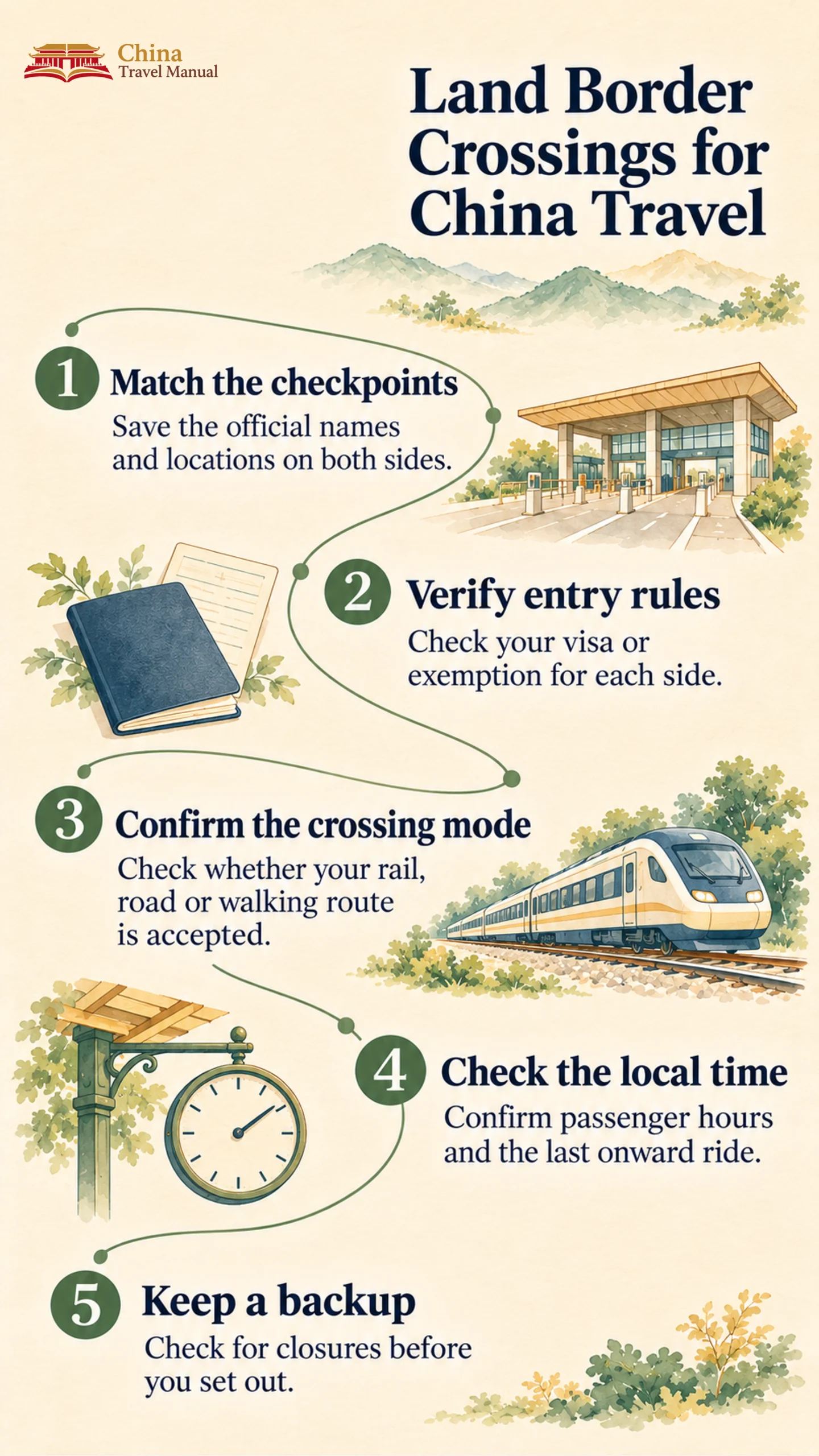
- Match the checkpoints: Save the official names and map pins for both sides.
- Check entry permission: Verify the visa, exemption or transit conditions for every place you will enter.
- Check the crossing mode: Ask whether the checkpoint serves pedestrians, your train or your road vehicle.
- Plan the next ride: Check local time, passenger hours and the last onward transport.
Use this guide for mainland crossings and land boundary trips involving Hong Kong or Macao. Each side’s immigration requirements still apply.
A border town may have a railway checkpoint, a road checkpoint and more than one passenger terminal. Start with the checkpoint named in your official entry rules and transport booking. Check which gate your bus, train or pickup actually uses.
Match the Crossing to Your Route
| Route | Example | What to verify |
|---|---|---|
| Mainland China and Hong Kong | Lo Wu or Lok Ma Chau Spur Line | Match the checkpoint to your rail or road service. The two Hong Kong control points have different hours. |
| Mainland China and Macao | Gongbei and Border Gate, or Hengqin | Verify that your travel documents are accepted at your chosen crossing. Macao’s official guidance restricts Qingmao to eligible mainland, Hong Kong and Macao residents. |
| China and Vietnam | Dongxing and Mong Cai | Confirm which bridge or passenger hall to use. Check the routing for Bac Luan I and Bac Luan II. |
| China and Laos | Mohan and Boten on the international railway | Check that your train crosses the border and that your Laos entry permission covers the railway checkpoint. |
| China and Mongolia | Erenhot and Zamyn-Uud | Identify the road or railway crossing and verify the onward service for your travel date. |
Start with the route-specific guides for the Shenzhen–Hong Kong crossings, Zhuhai to Macao, China–Vietnam overland travel, China–Laos Railway and China–Mongolia overland travel. Confirm the passenger terminal and hours with the operator and border authority.[4][5][7][8][9]
Check Entry Conditions for Both Sides
Check the mainland China visa requirements for your passport and purpose. If you use a visa, verify its validity and available entries, especially if you will leave mainland China and come back on the same trip. If you use a visa exemption, check the eligible passport, activities and length of stay. Verify the rules separately for Hong Kong or Macao if your route includes either.[1][11]
The 240-hour visa-free transit route has its own conditions. Eligible travelers need the qualifying documents and a confirmed onward trip to a third country or region. The National Immigration Administration lists designated ports and permitted stay areas. West Kowloon railway port and Hengqin are examples of added designated ports. Check the exact port against the latest list before relying on the policy.[1][2]
For the other side, check the immigration authority’s rules and the port named on any approval. Vietnam publishes a list of eligible e-visa ports, including rail and land checkpoints with distinct designations. Laos Immigration lists e-visa processing at the Lao–China Railway checkpoint at Boten. If your approval or application uses a specific entry gate, match the spelling and crossing mode to your booking.[6][7]
Plan the Crossing and Onward Ride
- Confirm the full crossing name: Check the official passenger checkpoint and terminal on both sides and save the local-language names.
- Confirm the mode: Ask whether to stay with a through service, use a shuttle or transfer between local stations.
- Prepare the documents: Bring your original passport and the relevant visa or approval. Keep booking details and entry information available offline.
- Check passenger clearance hours: Look up opening hours, arrival cutoffs and holiday changes for your route on both sides.
- Arrange pickup after arrival: Give your driver or host the arrival hall and local time. Leave room for queues and inspections before a separate ticket.
March 2026 guidance for Dongxing–Mong Cai identified Bac Luan II for most tourists during a change in passenger routing. Check the current hall before you go. Keep any receipt or travel confirmation the carrier asks to see and follow officers’ instructions for luggage and inspection.[5]
Handle Time Zones, Closures and Late Arrivals
Compare the timetable in both local time zones. China uses Beijing time and Vietnam uses Hanoi time, one hour behind. Match the time printed on the ticket to the clock at the station or terminal. Read the passenger clearance hours and the last available connection separately. Freight notices may use a different schedule.[4][5]
Check the passenger notice the day before and before you set out. An August 2026 notice about Gyirong documented a major disruption and a temporary suspension of electronic border-area permits for Shigatse. For China–Nepal overland travel, confirm operating status and any separate regional permission before paying for the trip. If you cannot verify a planned crossing, keep enough flexibility to stay overnight or change routes.[10]
FAQs About China Land Border Crossings
Can I walk through any land port?
Confirm the passenger mode at the exact checkpoint. A railway checkpoint can serve a particular train, while a road checkpoint may use a coach or shuttle. Ask the operator where to board or transfer and which exit it uses.[4][7][8]
Can I use 240-hour visa-free transit at a land border?
It is available at designated ports to travelers who satisfy the policy. Verify nationality, travel document, onward ticket to a third country or region, and permitted stay area. West Kowloon and Hengqin are examples to compare with the current list.[1][2]
Do I need to complete a mainland China arrival card?
Check whether your traveler category requires one. The National Immigration Administration offers free online submission and says electronic facilities and paper cards remain available at ports for travelers unable to complete it beforehand.[3]
Sources
[1] National Immigration Administration. Visa-free transit policies
[2] National Immigration Administration. Additional designated ports for 240-hour transit
[3] National Immigration Administration. Official arrival card process
[4] Hong Kong Immigration Department. Control point locations and operating hours
[5] Quang Ninh Provincial Government. Passenger arrangements for the Mong Cai–Dongxing crossing
[6] Viet Nam Government Portal. Ports available for travelers with an e-visa
[7] Lao Department of Immigration. Lao–China Railway checkpoint at Boten
[8] Chinese Embassy in Mongolia. Zamyn-Uud road and rail border facilities
[9] Macao Public Security Police Force. Qingmao and Hengqin eligibility and clearance
[10] National Immigration Administration. August 2026 Shigatse border-area permit notice
[11] National Immigration Administration. Unilateral visa-exemption policy and scope





