
Quick Answer: Is First Class Worth It on China High-Speed Trains?
Second class suits most short trips. First class is worth considering when two seats per side, extra room or a less crowded row would make the time on the train more comfortable.
- Short ride: Choose a convenient second-class departure if its layout works for you.
- Long ride: Compare the upgrade with the number of hours you will spend in the seat.
- Two together: Check for a D–F pair in second class or either pair in first class.
- Three together: Second class can seat three on the A–B–C side of a row.
If a benefit such as a quiet carriage or a snack matters to you, check that specific train.
For first and second class on the same China high-speed train, the timetable is the same. The price difference pays for the carriage and seat arrangement. The choice is easiest when you compare the same train and ask how you will use the space. For the full set of other labels, see China train classes.
First and Second Class at a Glance
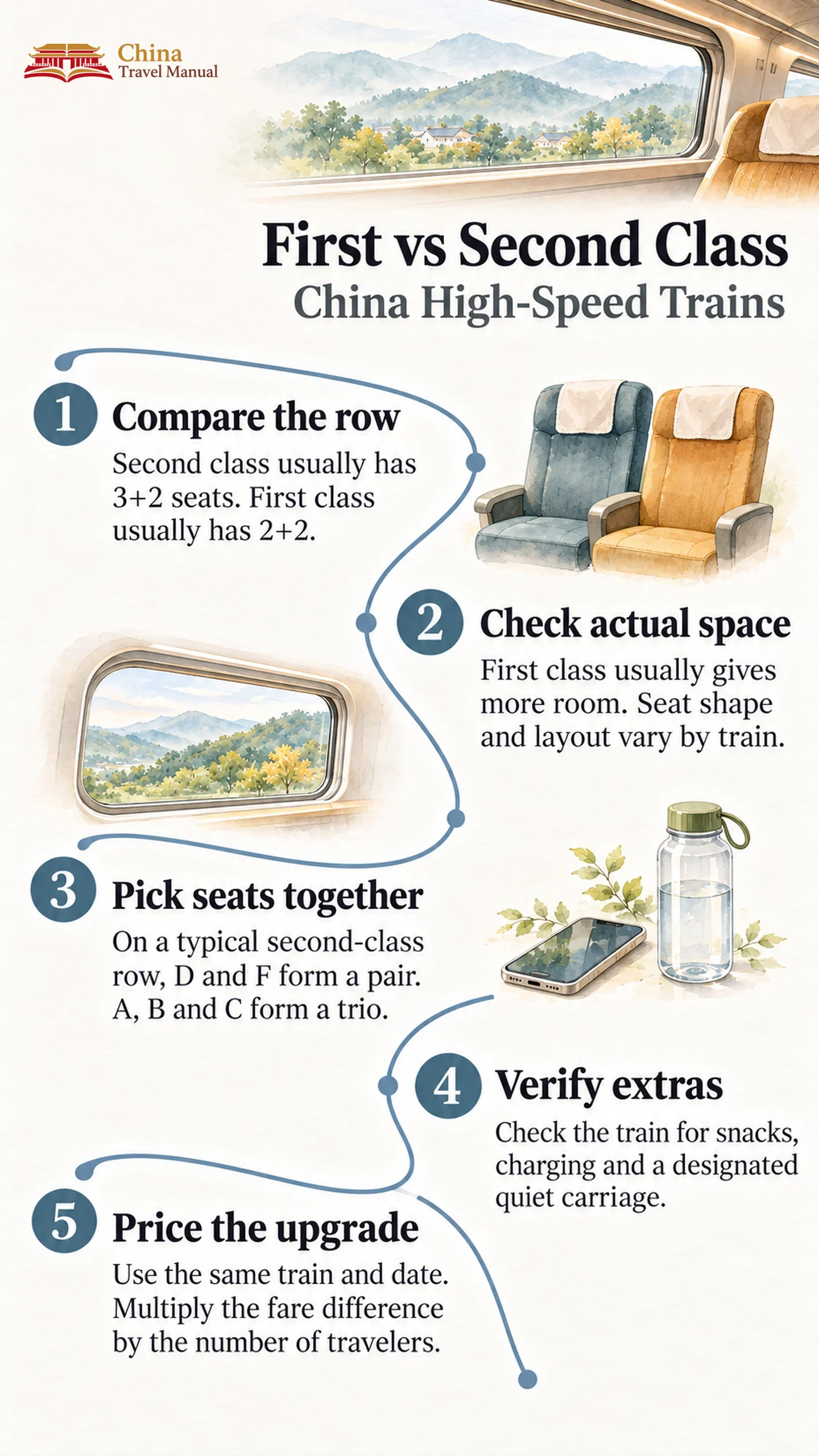
Most of the difference you will notice comes down to how many seats share each row and how much room the seats leave you.[1][2]
| Feature | Second class (二等座) | First class (一等座) |
|---|---|---|
| Common row layout | 3+2 | 2+2 |
| Seat letters on that layout | A–B–C and D–F | A–C and D–F |
| Extra width and row space | Standard layout for most travelers | Usually more space and no middle seat |
| Food and drinks | Plan to bring or buy what you need | Small snacks or drinks on some trains |
| Best fit | Budget, short trips or a party of three | A pair, more personal space or a longer ride |
A different train with the same class label can have a different carriage. Look up the actual train and check the final fare before buying.[2][4]
What the Extra Space Feels Like
On a typical 2+2 row, you have one person beside you at most, and a pair can occupy its own side of the aisle. On a 3+2 row, the three-seat side has a middle position. The two-seat side lets you sit as a pair in second class. Check the model if you want to know how much room each seat has.[1][2]
For one concrete example, a CR400AF Fuxing train introduced on the Chengdu–Chongqing route was reported with a 1,020 mm second-class seat pitch and a 1,160 mm first-class pitch. That configuration gives you another 140 mm between rows. Seat pitch measures the distance from a point on one seat to the same point in the next row. Knee clearance also depends on the seat shape.[3]
Check the carriage photos if you need a specific armrest, tray, footrest or recline. If you need a seat near a door or staff assistance, follow the accessible train travel guide to check arrangements for your journey.
Choose Seats for Solo, Pair or Group Travel
- Solo: Choose A or F if a window matters, or C or D if you prefer to get up without asking someone to move.
- Two travelers: On a 3+2 row, ask for D and F in the same row. In first class, A and C are also a pair.
- Three travelers: On a 3+2 row, ask for A, B and C together. On a typical first-class row, one person will be across the aisle or in another row.
- Four travelers: A full 2+2 row keeps everyone on a single row, with an aisle between pairs. Compare that with the shape of the seats available in second class.
Seat requests depend on the inventory. Check the carriage and row numbers after the ticket is issued.[1][6] If the assignment affects your trip, check how to change China train tickets before departure. If you are traveling with kids, also check how many assigned seats you have on the order using the China trains with children guide.
Check Snacks, Power and Quiet Carriages
Some trains provide first-class passengers with a small snack or drink. If you are planning around a meal, bring food or confirm the train’s service first. If you also want a meal or a dedicated waiting area, check the business class guide for the conditions at your station and on your train.[4]
For work, bring a charged device and check what power is available near your actual seat. Charging arrangements and table design vary by fleet. Quiet carriage availability also depends on the train and which seats are offered. Look for the 静 label on a 12306 result and the quiet-carriage preference if it appears at checkout.[2][4][5]
Premium First Class is a separate product on some newer configurations. If you see both fares, check the precise label and what the train offers for each.[7]
Calculate Whether the Upgrade Is Worth It
Compare the two fares on the same train in the same currency, then multiply the difference by the number of travelers. For example, if first class adds ¥100 per person on a four-hour trip, the extra fare works out to ¥25 per person for each hour on the train. The difference is ¥400 for four people. These are example amounts. Use the actual fares on your date.
Also compare a better-timed second-class departure with a more expensive first-class seat. If the earlier train leaves you time to reach your hotel or make your connection, that can be worth more than a wider seat. The high-speed trains guide explains how to compare the whole journey, including station transfers.
FAQs About First vs Second Class on China High-Speed Trains
Is first class always quieter than second class?
Noise varies with the train and the passengers around you. If quiet matters, look for a designated quiet carriage and check which seats you can reserve. Check your assigned carriage after the ticket is issued.[4][5]
Does first class include a meal or lounge access?
Some trains provide small snacks or drinks. Check your exact train and station before counting on a meal or a lounge. China Railway describes those services separately for business class and qualifying stations.[4]
Can I change my seat after the ticket is issued?
For an issued ticket, use the seller’s regular ticket change options if the assignment no longer works. China Railway does not provide a standalone online seat-swap feature. A ticket change can involve different conditions or charges.[6]
Sources
[1] CCTV. High-Speed Rail Seat Layouts and Seat Letters (Chinese)
[2] China Railway 12306. Train Fleet and Seating Layouts (Chinese)
[3] CQNews. CR400AF Fuxing Enters Service on the Chengdu–Chongqing Line (Chinese)
[4] China Railway 12306. Railway Passenger Service Information (Chinese)
[5] Shanghai Municipal Government. What Do the Marks in 12306 Train Listings Mean? (Chinese)
[6] Beijing Municipal Government. Can Passengers Change Seats on High-Speed Trains?
[7] CRRC. Upgraded Fuxing Intelligent Train Enters Service (Chinese)





