
Quick Answer: What Is Business Class Like on China Trains?
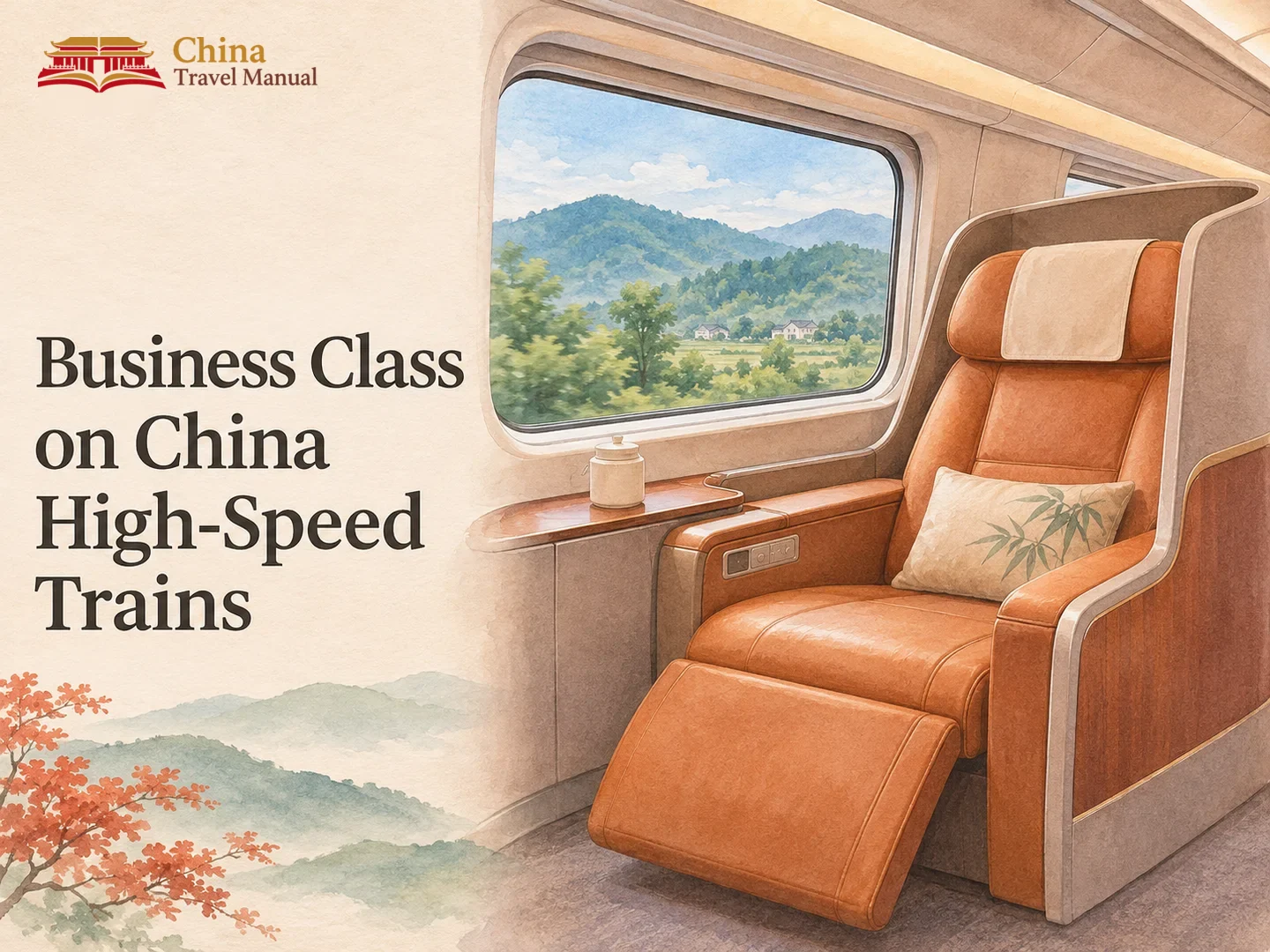
Business class is the roomiest seated fare on many China high-speed trains that offer it. It can add a seat that reclines flat, a smaller cabin and services at participating stations.
- Seats: Common layouts are 2+1 or 1+1. Check the train if you want a lie-flat seat or two seats together.
- At the station: Major stations may offer a separate business waiting area and priority procedures. Keep your passport ready for the usual checks.
- On board: China Railway describes a complimentary meal at lunch and dinner time for business-class passengers.
- Fare: Compare the same departure with first class. Pay for the space and station services you will use.
Check the exact train and departure station before relying on any specific feature.

The business-class fare can change where you wait at the departure station and how much space you have on the train. Start with the features you would actually use. This guide covers Business Class (商务座) on mainland high-speed trains. See China train classes for the other fare labels.
Seats, Recline and Cabin Layout
Business-class cars commonly use either 2+1 or 1+1 layouts. In a 2+1 row, A and C form a pair and F is on the single-seat side. A 1+1 car puts solo seats on both sides of the aisle, which can give more privacy. If you want to talk or share a meal with a companion, check for the paired side on your specific train.[1][6]
On some CR400AF-Z and CR400AF-BZ Fuxing trains, business class uses individual seats in a 1+1 herringbone layout. The seats switch between upright, partly reclined and flat positions. The seat controls, partitions and amount of recline depend on the train model.[2]
A flat seat can help on an afternoon or evening journey when you want to rest. If your goal is to work, check the shape of the table and location of the power supply.
What Business Class Gets at the Station
China Railway lists business-class waiting areas and priority procedures at major participating high-speed stations. Where offered, that can include help finding your way and priority ticketing, security and identity checks. You still go through the required checks. Ask staff which entrance or lane to use and when to head to the platform.[3][4] The guide to passport checks on China trains explains the identity check.
For example, the station area’s guide for Beijing South Railway Station lists business waiting areas by the west entrance. The official railway directory gives more detailed locations for different halls. Check opening arrangements and the location relevant to your entrance on the day.[4][5]
Allow enough time to get to the gate from the waiting area. If you are changing trains, ask whether you can stay in the transfer area or need to follow a different path to reach the lounge. If you expect to arrive shortly before boarding, decide whether you will have enough time to use the lounge.
Meals, Drinks and Charging On Board
China Railway’s published service guidance says business class includes a complimentary meal during lunch and dinner time. Some high-speed trains offer drinks or small snacks in first class and above. The actual timing and selection depend on the service. Ask the crew what is available on your departure. If a particular meal is important to you, check in advance or bring a suitable option.[3][7]
The 1+1 Fuxing examples also have an integrated display and wireless charging. Power outlets and other seat features can differ by vehicle. Verify what your train provides if you need to work, and have your laptop charged before you board.[2][6]
Is Business Class Worth the Fare?
Compare it with first class on the exact same departure. Business class makes the most sense if the extra recline, privacy or solo seat changes how you can use a longer trip. It can also be useful if you know the departure station has a lounge or assistance you will use.
For a short ride, consider how long you will spend sitting and waiting. A first-class pair may provide all the room two travelers need. When the main goal is making an onward connection, choose the schedule that gives you enough transfer time. The first vs second class comparison helps compare the price and space of the other seats.
Multiply the extra fare by the number of people traveling. The upgrade for a whole party can be much larger than the single-person figure in the listing. If the group cares most about sitting together, confirm the layout before paying the difference.
How to Choose and Book the Seat
Check the listing for the exact departure you plan to take.
- Compare one departure: Select the date, exact station pair and train number. Check that the listing offers Business Class (商务座).
- Check the layout: Look at any seating chart or train model the seller provides. Decide whether a solo seat, a pair or lie-flat capability matters most.
- Check the station and timing: Find the business waiting area if you want to use it, and ask about food service when it matters to your trip.
- Review the issued order: Check the ticket class and seat assignment, then bring the original document linked to the ticket.
Start with the China train booking channel comparison if you still need to choose a seller. The high-speed train guide explains how to get through the station and reach your carriage.
FAQs About Business Class on China High-Speed Trains
Do all business-class seats lie flat?
Check the model and actual seat. Specific Fuxing trains have seats with a flat mode. Layouts and recline vary by fleet.[2][6]
Does business class let you skip station security?
Business class can give you a priority lane at participating stations. Keep your identity document ready and allow time for identity and baggage screening.[3]
Can two people sit side by side in business class?
A 2+1 cabin can have a pair on one side of the aisle. In a 1+1 layout the seats are singles, so check the booking chart and your final assignment.[1][6]
Sources
[1] Beijing Municipal Government. Can Passengers Change Seats on High-Speed Trains?
[2] CRRC. New Fuxing Intelligent Trains Enter Service (Chinese)
[3] China Railway 12306. Railway Passenger Service Information (Chinese)
[4] China Railway 12306. Railway Business-Class Waiting Areas (Chinese)
[5] Beijing Key Station Areas Administrative Committee. Beijing South Railway Station Area (Chinese)
[6] China Railway 12306. Train Fleet and Seating Layouts (Chinese)
[7] China Railway 12306. Dining Services (Chinese)





