
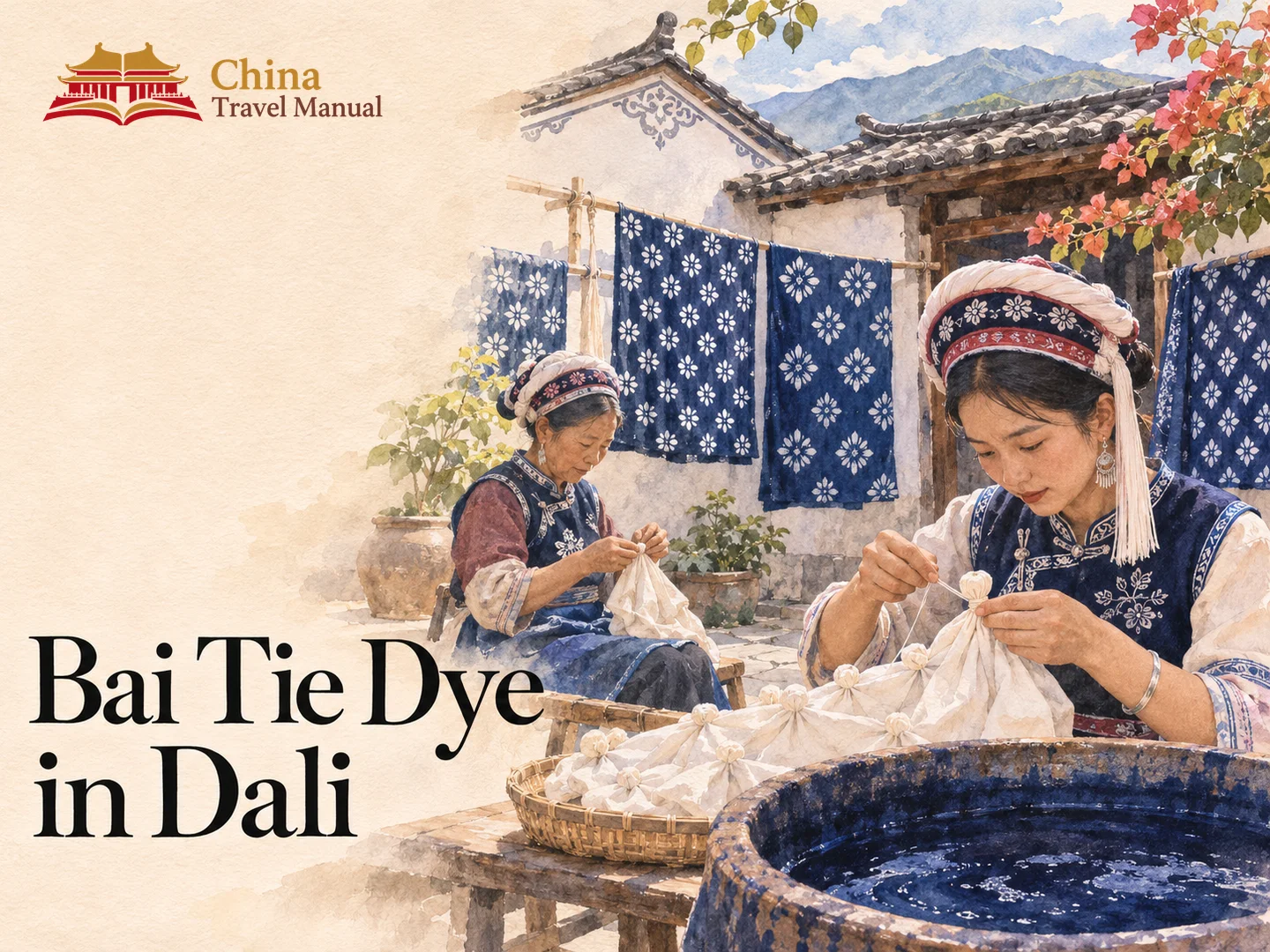
Quick Answer: How to Book a Bai Tie-Dye Workshop in Dali
Head to Zhoucheng (周城, Zhōuchéng) if you want to see how Bai tie-dye (白族扎染, Báizú zhārǎn) fits into a working textile village.[1][3]
- Where to start: Visit the Puzhen Bai Tie-Dye Museum (璞真白族扎染博物馆, Púzhēn Báizú Zhārǎn Bówùguǎn) or book a village workshop. Confirm separately whether a museum visit includes an activity.[2]
- What to make: Start with a small cotton square and one simple pattern if it’s your first class.
- What to ask: Confirm which steps you do, what dye is used, what language the teacher can use and how long you’ll be there.
- What to take home: Ask when the piece will be rinsed, dry enough to pack and ready for pickup.
If your itinerary only has a short gap, look for a class near your base and choose a simple project that can be finished in one session.
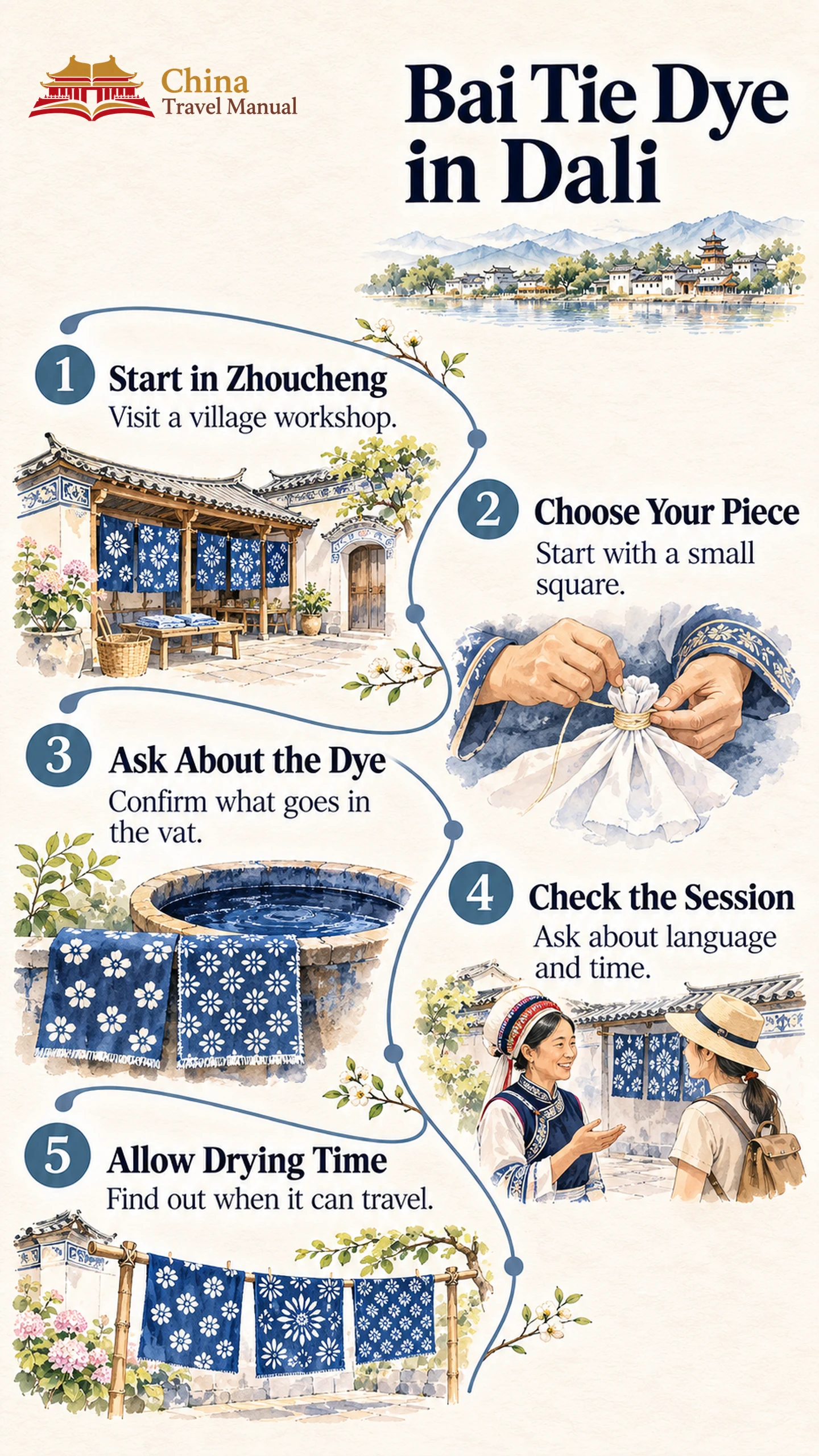
You can try stitch-resist dyeing in a short class or spend half a day in a village where people still make and sell the cloth. Ask what you’ll actually do before booking. If you want to stitch your own design, allow more time than you would for dyeing a pre-tied piece.
Where to Try Bai Tie-Dye in Dali
Zhoucheng is part of Xizhou township. Allow a separate transfer if you’re also visiting the merchant courtyards in Xizhou’s old town. China’s national intangible cultural heritage registry lists Bai tie-dye from Dali and describes Zhoucheng as a center of the craft.[1]
| Option | Choose it if | Check first |
|---|---|---|
| Puzhen museum visit with a possible activity | You want to see examples and understand the village tradition. | Whether hands-on sessions are running and require a separate booking. |
| Zhoucheng workshop class | You want to make a piece with an instructor. | The exact branch, session length and steps you’ll do. |
| Class near your hotel | You want a short session without a village transfer. | Whether it teaches stitched resist or uses a ready-tied piece. |
Dali’s municipal visitor information describes exhibits and hands-on teaching at the museum. Lanxu (蓝续, Lánxù) is one example of a separately listed workshop in Zhoucheng. Use the venue’s full Chinese name and village when arranging transport, and check the booking details against the address sent by the host.[2][4]
What You’ll Do in a Workshop
The pattern is created where stitches or ties hold folds of cloth tightly enough to resist the dye. Removing the thread reveals the lighter areas of the pattern. Traditional materials include cotton or cotton-linen cloth and plant indigo, and local makers use a variety of small repeating designs. Today’s visitor classes may shorten the process, use a simpler motif or prepare some steps in advance.[1][3]
If you want to understand the stitch-resist technique, choose a session where you sew and tighten at least one part of the motif. For a child or a traveler with limited hand dexterity, ask for a section the teacher can prepare in advance. Watch the instructor demonstrate how that first section is tied, then try the step yourself if you’re comfortable.
What to Confirm Before Booking
- The piece and price: Confirm what cloth you’re making, whether the fee is per person or per piece, and whether materials, instruction and finishing are included.
- The process: Ask which parts you’ll do yourself, from marking and stitching to dipping, rinsing and unpicking. If plant indigo matters to you, ask what goes into the vat and whether that applies to your chosen session.
- Language and group size: Ask whether the instructor teaches in a language you understand or can demonstrate each step visually. Confirm whether children need an accompanying adult.
- Finishing: Ask when the piece can be handled, when it will be dry, and when to come back if you leave it with the host.
Plan the Visit and Take Your Cloth Home
Pair a morning in Xizhou’s old town with an afternoon workshop in Zhoucheng. Leave a gap for the drive and lunch. If you’re staying in Dali Old Town, use Getting Around Dali to plan the journey and ask for an exact return pickup point. The Erhai sightseeing bus has named stops around Xizhou and farther north, but check how you’d reach your specific workshop from the stop.[5]
If the cloth is still damp when you leave, follow the teacher’s instructions on packing and drying it. Keep it away from pale clothes or paper and ask whether it needs a separate first wash. If time remains after the class, use the Erhai Lake guide for a short shoreline stop, or see other things to do in Dali if the weather changes.
FAQs About Bai Tie-Dye Workshops in Dali
Do you need to know how to sew?
Many beginner sessions demonstrate the basic stitch and help when you get stuck. Confirm the experience level and tell the teacher if you would prefer a simple motif.
How long should you set aside for a workshop?
Budget about two hours for a basic project as a starting point. Leave more time if you’ll stitch a complex design or wait for the piece to dry. Confirm your session length before booking transport.
Is all blue fabric in Zhoucheng naturally dyed?
The color alone can’t identify the dye. The traditional process often uses plant indigo, but ask the seller or workshop about the particular fabric or class you’re buying.[1]
Can you take your finished tie-dye home the same day?
Check with the host. A small project may be ready the same day, but rinse and drying times depend on the cloth and the workshop’s process. Ask about pickup if you’re on a tight schedule.
Sources
[1] China Intangible Cultural Heritage Digital Museum. Bai tie-dye national heritage listing and process description
[2] Dali Municipal Government. Puzhen Bai Tie-Dye Museum and its exhibits and activities
[3] Xinhua. October 2026 report on Zhoucheng workshops
[4] Ctrip Activities. Lanxu tie-dye workshop listing for Zhoucheng
[5] Dali Tourism Distribution Center. Erhai bus routes and stops





