

Quick Answer: How Do You Check a Hotel’s Actual Location?
Match the Chinese hotel name and full address across the listing, the property’s own directions and a local map. Route to the lobby entrance, then test the trip from your actual airport or train station and to the main stops on your itinerary.
- Verify the branch. Compare the district, street number, building and entrance against the property’s own details.
- Test an ordinary day. Compare walking and transit routes to the places you will visit. Inspect the metro exit, transfer and walk beyond the station.
- Test the difficult arrival. Check whether you can get to and enter the hotel with luggage, after the last train or using a step-free route.
Map estimates depend on the route and time. Confirm details the map cannot establish, such as the correct entrance for a taxi and which door stays open after hours, with the hotel before paying.
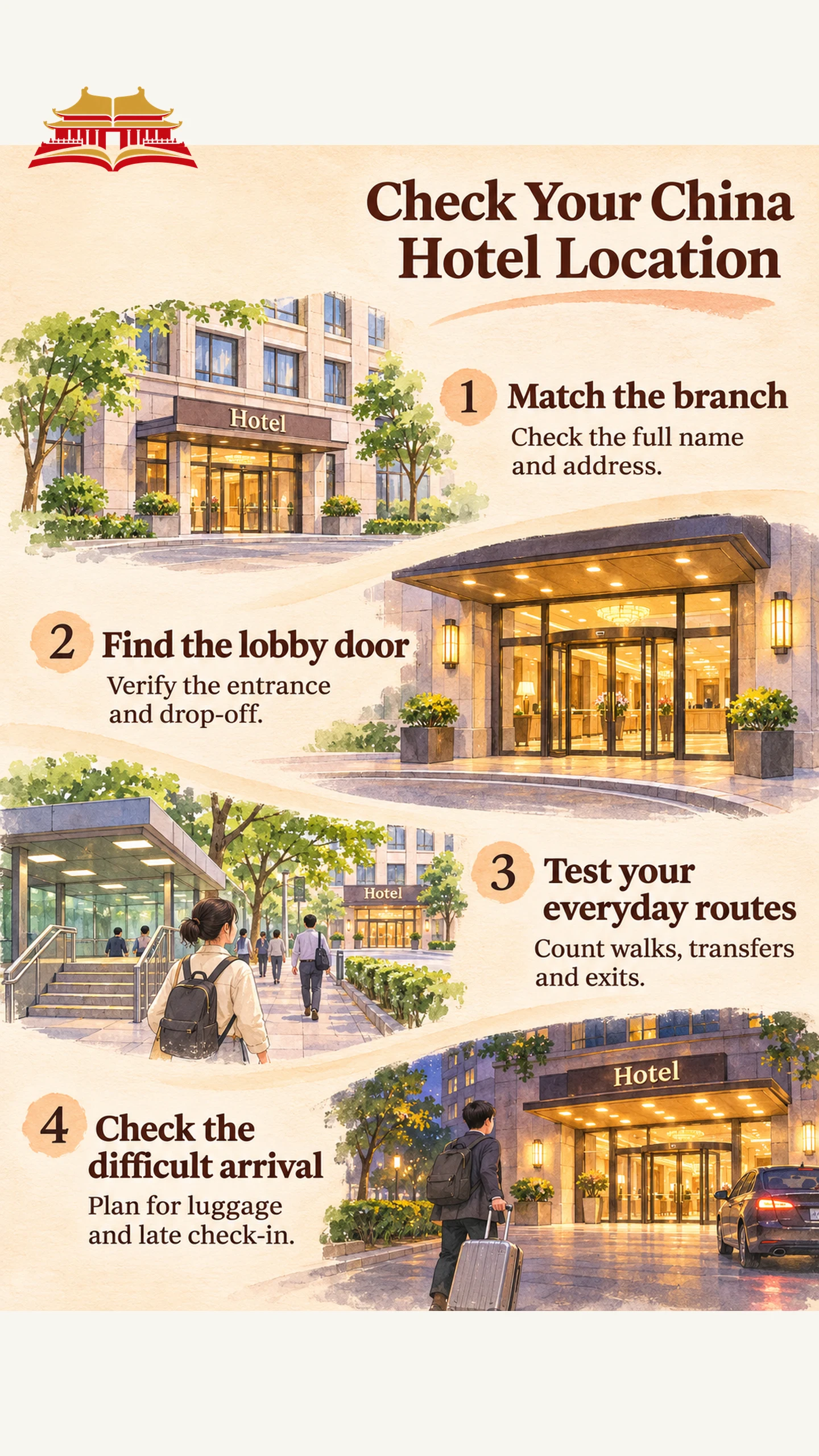
A hotel can look close to a metro stop on a map and still require a long walk from the usable exit. Before booking, verify the exact branch and street entrance. Then check the real routes from your arrival point and to the places you plan to visit. Compare how they work with luggage, after dark and at the times you expect to travel.
Turn Location Claims Into Practical Checks
| Listing detail | Check before booking | Why it matters |
|---|---|---|
| City center | Route to your top two destinations | Travel time depends on where you’ll spend the day |
| Near metro | Station, line, specific exit and walk | The closest station marker can be far from its useful exit |
| Airport hotel | Airport code, terminal and pickup method | A city may have more than one airport |
| Railway station hotel | Full station name and arrival exit | Large stations can have different pickup areas |
| Walkable | Crossings, stairs, gradients and night access | A short route can be inconvenient with bags |
| Hotel entrance | Street door, lobby floor and taxi drop-off | A property can occupy part of a bigger building |
The where to stay in China guide can help you choose a district first. Apply these checks to each individual hotel before comparing rates.
How to Verify the Location From Your Phone
- Match the property details. Copy the Chinese name, complete address and branch from the property’s official page or ask it directly. Enter the address into a local map. The China map apps guide helps you choose a map, and Shanghai’s visitor service confirms that Amap can save hotel details and show transit or taxi routes.[1]
- Find the hotel door you will use. Compare the lobby entrance with the map pin. If the hotel is above a mall or shared office tower, ask which entrance and lift reach the lobby. Ask for a Chinese address and a drop-off pin that a driver can use.[2]
- Route from your exact arrival point. Use the airport code, terminal or railway station on your ticket. For Shanghai, Pudong airport transfers and Hongqiao airport transfers start at different airports. Check transit and a car option separately.[3]
- Compare the trips you’ll repeat. Test a weekday or weekend route from the hotel to two places you will actually visit. Count the walk to the station, transfers, time in the vehicle and the walk from the destination exit. If each hotel is convenient for a different destination, prioritize the route you will take most often.
- Plan the arrival after hours. Check the last usable transit connection, including the transfer to the next line. Ask whether you can check in after midnight and which outside door to use. Save the map pin, the address in Chinese and the hotel’s number offline. Consider a prebooked transfer if you need a specific vehicle, known pickup or late arrival coverage.[4]
Compare the Full Walk and Ride
Suppose Hotel A is a four-minute walk from the metro exit but requires two changes and a 42-minute door-to-door trip to your main destination. Hotel B is a nine-minute walk from the exit but has a direct 27-minute route. Over two return outings, Hotel B saves an hour of travel. Choose based on your group’s walking needs, time and the trips you will repeat.
A property page can help you check the map. For example, Kerry Hotel Pudong’s own directions list its address at 1388 Huamu Road, and its transport page identifies access to Metro Line 7 near Fangdian Road and through the attached shopping mall. If you plan to use the mall route after shops close, verify its access hours directly with the property.[2]
When You Need Step-Free Access
Ask about the route from the actual taxi drop-off or metro elevator to the hotel lobby. Ask which entrance has steps, whether any lift requires staff and whether a covered walkway closes at night. The accessible hotel guide covers room and bathroom checks separately.
If the hotel’s booking location and actual check-in instructions disagree, ask the property to confirm the correct address in writing before arrival. Once you have a booking you cannot use as described, the hotel booking mismatch guide covers evidence and next steps.
FAQs About Checking a Hotel Location in China
Is the map pin enough to find the hotel?
Compare the pin with the full address and the property’s own directions. Ask for the lobby entrance if the building has several doors or a separate reception floor. Save the hotel’s Chinese address for the driver.[1][2][4]
How can I test whether a hotel is really near the metro?
Route on foot from the correct station exit to the hotel lobby. Look for a main-road crossing, steps, a mall passage or an elevator that changes the approach. A local map can help you see route options, and hotel staff can confirm which exit they use.[1][2]
Should I choose a hotel close to the airport?
Consider where you’ll spend the rest of your trip. If you have a late arrival or early departure, verify the terminal, usable hours of any hotel shuttle and drive time. If you’ll make repeat city trips, compare the entire route to your main destinations first.[3][4]
Sources
[1] Shanghai Municipal Government. Multilingual local maps and hotel travel details
[2] Kerry Hotel Pudong. Property address, metro entrances and arrival transport
[3] Shanghai Municipal Government and Shanghai Airport Authority. Separate airport routes and pickup locations
[4] Beijing Municipal Government. Airport transport and using a Chinese destination address





