

Quick Answer
Allow twelve days for a first trip along the Silk Road (丝绸之路, sīchóu zhī lù) in China. Start in Xi’an, travel west through the Hexi Corridor (河西走廊, Héxī zǒuláng) and finish in Dunhuang. Check Mogao Caves admission before you settle your dates.
| Days | Base | Nights |
|---|---|---|
| 1–3 | Xi’an | 3 |
| 4–5 | Lanzhou | 2 |
| 6–7 | Zhangye | 2 |
| 8 | Jiayuguan | 1 |
| 9–12 | Dunhuang | 3 |
Use trains between the cities and road transport for the last part of each visit. If you have ten days, skip the Lanzhou stay when there is a suitable train to Zhangye and preserve both full days in Dunhuang.
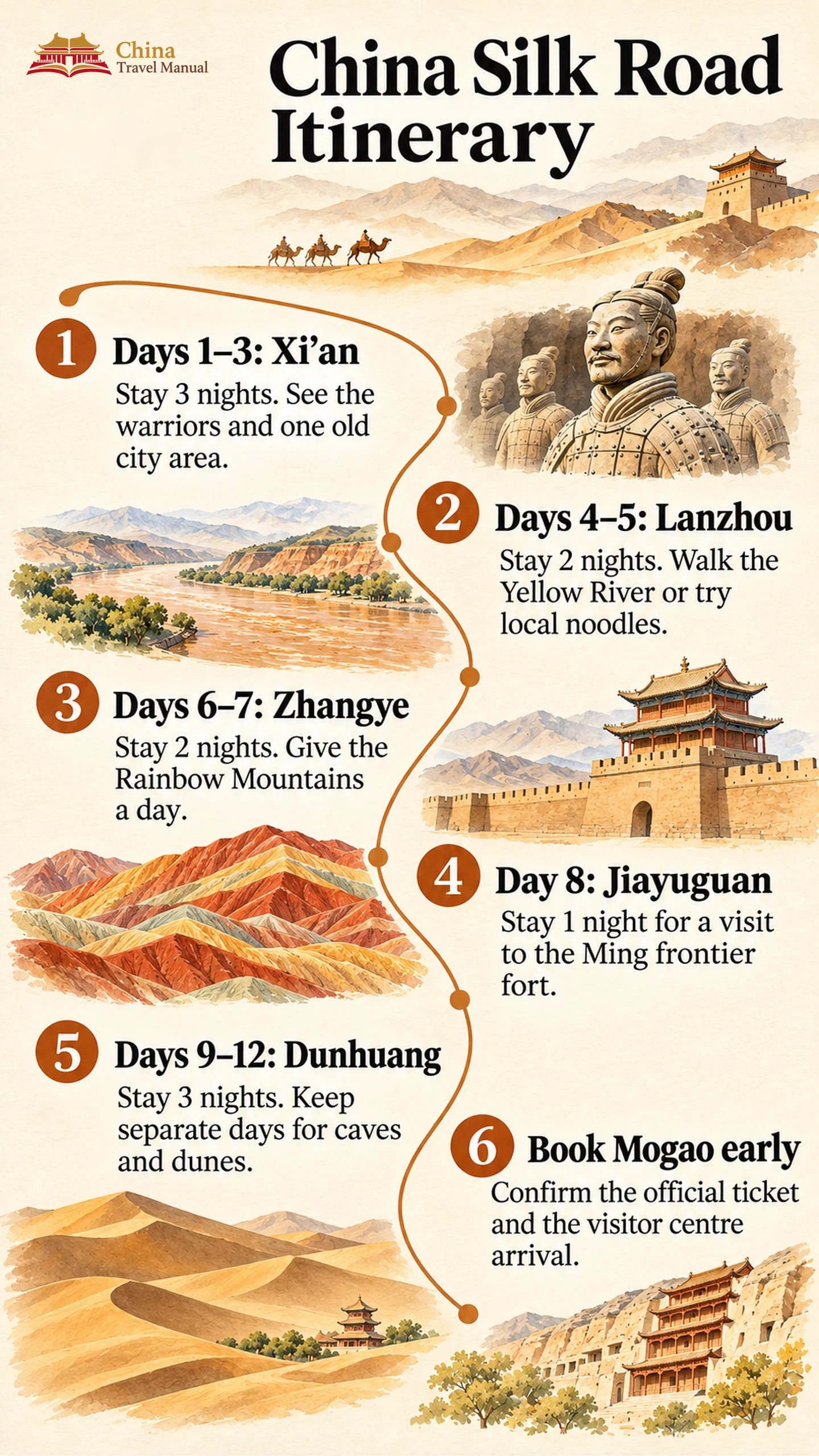
The route from Xi’an to Dunhuang brings together old city sites, the hills around Zhangye, a Ming frontier fort and Buddhist cave art. The historic trade routes formed a network. This itinerary follows a westbound selection of places connected by today’s rail lines, with local road trips to the main sights.[1][5][6]
The schedule counts arrival and departure within twelve days. The Silk Road travel guide explains other regions you can include on a longer trip.
A 12-Day China Silk Road Itinerary
Use eleven hotel nights. Confirm your onward departure from Dunhuang first, then use the dates of your Mogao Caves visit and train connections to place the other nights. Make long transfers between regions on their own dates.[2][7]
Days 1–3: Xi’an
Start in Xi’an, near the historic capital of Chang’an (长安, Cháng’ān). Sites in the area form the eastern end of UNESCO’s Chang’an–Tianshan Corridor listing. They span more than one period, so choose a visit that fits the part of history you want to see.[1]
- Day 1 — Arrive and take a short walk near the hotel. Keep the first dinner easy if the flight or train is late.
- Day 2 — Spend the main part of the day at the Terracotta Warriors in Lintong. Give yourself time for both road legs and choose dinner after getting back to Xi’an.[3]
- Day 3 — Walk a section of the Xi’an City Wall and visit an old-city neighborhood. If the history of the trade routes is your priority, choose a museum or one of the inscribed Chang’an sites such as the Giant Wild Goose Pagoda.[1]
Days 4–5: Lanzhou
- Day 4 — Take the train from Xi’an to Lanzhou. Choose an arrival that works for your hotel and leave the evening free.[2]
- Day 5 — Use Lanzhou for a deliberate break between rail days. Choose a walk near the Yellow River, a museum or a bowl of Lanzhou beef noodles. Give yourself time to check the departure station for Zhangye.
The Lanzhou stay is useful if you want one full city day or a shorter set of rail journeys. For a compact trip, look for a suitable onward connection and use this time elsewhere.
Days 6–7: Zhangye
- Day 6 — Travel between Lanzhou and Zhangye. Confirm which station you use and where you will get picked up for the next day’s park visit.
- Day 7 — Spend the main part of the day at the Zhangye Rainbow Mountains. The colourful hills are part of the Zhangye UNESCO Global Geopark. Check the traffic and light conditions for the time you plan to visit and allow for the ride back to town before adding anything timed.[4]
If the park visit takes only part of the day, choose a simple meal nearby or a town stop such as the Giant Buddha Temple if it is open. The Zhangye travel guide gives more options around the two hotel nights.
Day 8: Jiayuguan
Take the train from Zhangye to Jiayuguan and leave your luggage before the fort visit. Jiayuguan marked the western end of the Ming Great Wall. Give its fortifications time and choose one visit instead of trying to fit multiple separate wall sites into a transfer day.[5]
Stay the night if the fort is a priority. Confirm how you will get from the station to the hotel and from there to the fort. A day stop between trains can work with confirmed transport and bag storage, but it gives you less margin if the first train runs late.
Days 9–12: Dunhuang and Departure
- Day 9 — Travel from Jiayuguan to Dunhuang. Search for a direct train serving Dunhuang Station on your date. Compare any option via a different town with the road transfer it adds. Check in and save the main visits for full days.[2][9]
- Day 10 — Give the Mogao Caves the main booking of the day. The cave complex preserves Buddhist art along the trade routes and has its own UNESCO World Heritage listing. Follow the admission instructions for the ticket and allow time at the visitor centre.[6][7]
- Day 11 — Choose the Singing Sand Dunes and Crescent Spring if conditions suit you. It is a separate site south of town. Put the outdoor visit on whichever of your two full days has better conditions if the cave booking permits. If you need a quieter day, keep time in Dunhuang and choose a closer outing.[8]
- Day 12 — Depart. Follow the route to Dunhuang Airport or the station on your booking. If your international flight is from another city, allow a separate transfer and hotel night there when the schedules are tight.
Plan Mogao Caves Before the Rest of Dunhuang
Mogao uses timed, real-name admission. The Dunhuang Academy’s 2026 guidance directs foreign passport holders to the official WeChat service account named 莫高窟参观预约网 and the booking menu and its English Ticket Booking option. Bring the same original passport you used to book. Check the newest notice for the visit type available, and verify whether guidance in your language is offered for your date.[7]
Start at the Mogao Caves Digital Exhibition Center. The 2026 notice asks visitors to arrive 30 minutes before the booked time. The visit format can differ by ticket and operating conditions. The caves and exhibits are managed to protect the site. The operator can close the caves during severe rain or sandstorms. Photography inside the caves is prohibited. The Mogao ticket booking guide explains the booking decision in more detail.[7]
Keep the second full day in Dunhuang partly movable. If the cave date changes, trade the dunes and city outings around it. Consider a longer Dunhuang day trip only when you can give it independent time and have confirmed the transport.
How to Book the Train Legs and Shorten the Route
- Start with your end city and longest transfers. Check Xi’an arrival, the onward train or flight from Dunhuang, and the days you can visit Mogao before paying for trips in between. The final gateway can determine whether you need one more hotel night.[2][7]
- Match the exact railway stations. Choose the departure and arrival name for each train. Use the Zhangye station guide and Dunhuang station guide if the search offers more than one effective route. A train closer to the middle of the day may suit an overnight along the corridor better than the earliest option.[2][9][10]
- Leave room for the last road ride. Check transfer time from Zhangye to the hills, from your Jiayuguan hotel to the fort and from Dunhuang to the cave visitor centre. Keep these rides separate from station security and any timed admission.[4][5][7]
For ten days, skip the two Lanzhou nights and use a dated Xi’an to Zhangye journey. Spend three nights in Xi’an, two in Zhangye, one in Jiayuguan and three in Dunhuang. If that connection takes too long, keep one Lanzhou night and replace the Jiayuguan overnight with a simpler connection toward Dunhuang that works for your dates. Leave time for Mogao and the dunes before adding another detour. If you already know Xi’an, the seven-day Gansu itinerary gives you a regional route with shorter overall travel.[2][9][10]
FAQs About a China Silk Road Itinerary
Where should I start a China Silk Road trip?
Xi’an works for a first westbound journey through Gansu. Start in Lanzhou if you already know Xi’an and have a suitable connection. Make Dunhuang dates fit your cave reservation and onward transport.
Can I travel the whole route by train?
You can use trains for the main intercity legs if the dated services work. You will still need local road or other ground transport for the fort, hills and Mogao visitor centre.[2][7][9][10]
Is it worth staying overnight in Jiayuguan?
Yes, if the fort is a reason for your trip and you want time after the train. A short stop en route can work if luggage storage, local transport and the onward departure all leave enough margin.
Can I continue from Dunhuang into Xinjiang?
Yes, as a longer itinerary. Give Xinjiang a separate block of days and check the connection to the first city there. Use the Xinjiang travel guide to decide which stops justify the added travel time.
Sources
[1] UNESCO World Heritage Centre. Silk Roads: The Routes Network of Chang’an–Tianshan Corridor
[2] China Railway 12306. Ticketing FAQs
[3] Xi’an Municipal Government. Emperor Qin Shi Huang’s Mausoleum Site Museum
[4] UNESCO International Geoscience and Geoparks Programme. Zhangye UNESCO Global Geopark
[5] Gansu Department of Culture and Tourism. Jiayuguan Guancheng
[6] UNESCO World Heritage Centre. Mogao Caves
[7] Dunhuang Academy. Mogao Caves Visitor and Ticketing Notice for 2026
[8] Chinese Ministry of Culture and Tourism. Mingsha Mountain and Crescent Spring Scenic Area
[9] TravelChinaGuide. Trains Between Jiayuguan and Dunhuang
[10] TravelChinaGuide. Zhangye West Railway Station





