

Quick Answer: Which Silk Road Section Should You Visit?
For a first Silk Road (丝绸之路, Sīchóu Zhī Lù) trip, start with Xi’an and Dunhuang. Add the Hexi Corridor (河西走廊, Héxī Zǒuláng) stops that match your interests and leave room for their local transfers.
- Four to six days: Pick Xi’an and Dunhuang for a capital and cave-art pairing. Compare direct flights and rail options on your dates before fixing the order.
- Seven to ten days: Travel west via Zhangye or Jiayuguan, or include both toward the upper end of the range.
- About two weeks or longer: Continue to Turpan for ruined oasis cities. Add Kashgar if you have time for a separate stay and a confirmed onward route.
Hold space in Dunhuang for your Mogao Caves reservation and decide where you will end the trip before you book intermediate rooms. [3]
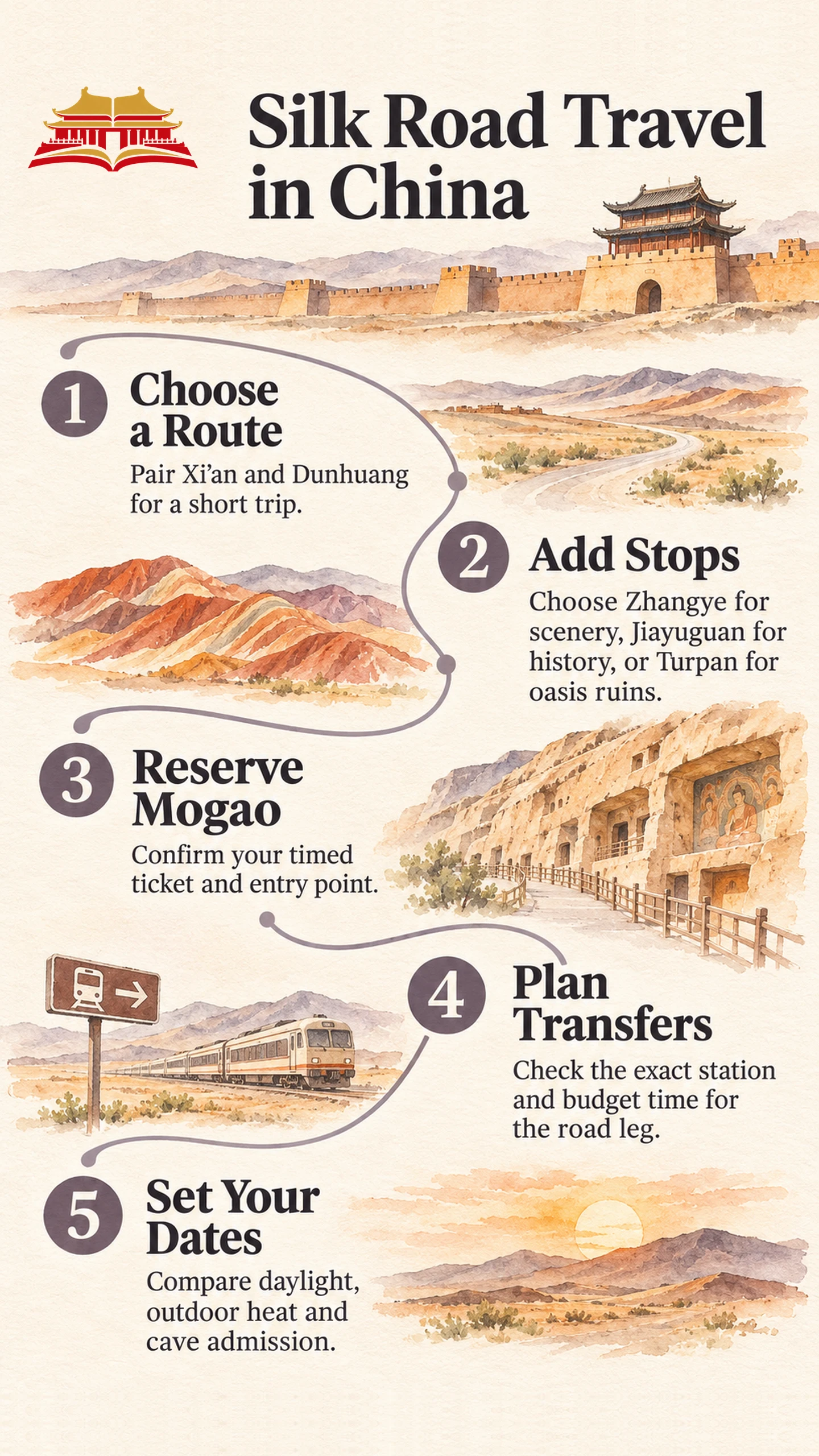
Begin in an imperial capital, follow the old trading routes through Gansu, then decide whether to continue to the western oases. These belonged to a network that carried trade, beliefs and artistic ideas between regions. A modern rail line makes part of that history easier to visit, and the cave entrances, fortifications and historic settlements often take you well beyond the station. [1][2]
Choose How Far West to Go
| Time available | Route to consider | Where to simplify |
|---|---|---|
| 4–6 days | Xi’an and Dunhuang | Use a connection that leaves you a usable cave day. If the journey takes most of a day, keep your first afternoon in Dunhuang flexible. |
| 7–10 days | Xi’an, Zhangye or Jiayuguan, and Dunhuang | Choose Zhangye for landscape or Jiayuguan for frontier history. Lanzhou can work as a transfer unless you have a reason to stay. |
| 12–16 days or more | The Gansu route plus Turpan, with onward travel via the best available connection | Consider ending in Urumqi. Add Kashgar only when you can give it its own time and arrange the departure. |
These planning ranges include domestic transfer days. If the same window also includes arrival from abroad, a return to your original gateway and an international flight, use the shorter route. Starting in Lanzhou can make sense if you have already visited Xi’an or your flight or rail connections are better there. Starting in Dunhuang can also work if the cave reservation falls near the beginning of your trip. The Silk Road itinerary is the next step once the gateways and available nights are set.
If one site drives the trip, use it to cut the route. For grottoes, trade a quick stop in Zhangye for another cave day or time in Tianshui for Maijishan. A Gansu grottoes itinerary makes more sense for comparing styles across a few sites. If your interest is the history of the western oases, keep Turpan and consider trimming Xi’an. [1][5][7]
What Each Stop Adds to the Story
- Xi’an and the older capitals: Chang’an in present-day Xi’an and Luoyang stood at the eastern end of the corridor UNESCO describes. In Xi’an, look at the city wall to understand the later city’s footprint, then use a museum stop to put the earlier capitals and long-distance exchanges in context. [1]
- Zhangye and Jiayuguan: The Zhangye Rainbow Mountains show the region’s layered geology. At Jiayuguan Fort, look at the gates and approach roads to see how a Ming-period garrison controlled a narrow passage. These stops tell two different stories about the same regional landscape. [4][5]
- Dunhuang: The Mogao Caves preserve Buddhist wall paintings and sculpture from successive periods. Add Yumen Pass if you want to see the remains of a historic route checkpoint in its open desert setting. UNESCO lists Mogao separately from its Chang’an–Tianshan routes property, which includes Yumen Pass. [1][2][7]
- Turpan and Kashgar: In Turpan, compare the ruined settlements of Jiaohe and Gaochang if you have time for separate transfers. These appear as Yar and Qocho on UNESCO’s maps. At the Turpan karez, look for the vertical shafts that feed into underground irrigation channels. [7][8] Farther west, a walk through Kashgar Old City gives your trip a present-day urban stop. Visitors can use public streets and markets while leaving private courtyards to residents.
Book Around Mogao and the Long Transfers
- Cave reservations: The Dunhuang Academy uses timed, real-name reservations and caps daily admission. The visit content depends on the ticket type. Check the arrival location, admission window and steps from check-in to the caves as part of your plan. Bring the booking confirmation and use the name and document details you will have on the day. For a split-party reservation, check that everyone’s name appears before you leave for the visitor center. Use a short, flexible activity before or after your cave slot, such as a walk in town. [3]
- Rail and road transfers: Search by exact station and date on China Railway 12306. For the Xi’an–Lanzhou rail leg, for example, confirm the station before choosing a hotel. For Jiayuguan to Dunhuang, compare a through service on your date with any option involving an onward road transfer. In the Dunhuang rail guide, distinguish an arrival in Dunhuang from a ticket to Liuyuan. China Railway asks you to carry the valid ID used for the ticket. [6]
- Travel west of Dunhuang: Pick your Turpan or Kashgar arrival and departure times before you decide what to see on those days. Compare rail and air based on hotel-to-hotel time. If a flight goes via another city, calculate check-in and connection time before comparing it with a sleeper. Reserve the evening for check-in and a local meal if the connection leaves only a small part of the day free. A hotel with a practical pickup point can be more useful than a room close to a single attraction.
Choose Dates for Outdoor Sites and Cave Visits
Late spring and early autumn are reasonable periods to compare if you want several long days outside. Summer sun has a larger effect on a trip centered on open ruins or fortress walls than on one centered on museums. In winter, build the day around daylight and verify both outdoor access and cave operating arrangements for the actual date. The Academy publishes different seasonal windows and capacity arrangements, so check the latest notice instead of copying a schedule from an old itinerary. [3]
If you travel during a busy holiday, leave room to swap the date of a linked hotel night as well as the cave visit. In places such as Turpan and Jiayuguan, put exposed walks in the cooler part of the day if the site hours permit it. Save museum time, a long lunch or a transfer for the hottest hours. The Dunhuang season guide can help you decide whether your available dates suit both the caves and the desert.
FAQs About Silk Road Travel in China
Where should I start a first Silk Road trip?
Start in Xi’an if you want the story to begin with an imperial capital. Start in Lanzhou if you mainly want to explore Gansu. For a cave-art trip driven by a time slot, begin wherever you can connect to Dunhuang with a buffer before the reservation.
Can I travel the Silk Road by train?
Rail is useful for many city-to-city legs, especially through Gansu. Budget for local transport from the station to your lodging and from town to the sites. Search each pair of stations for your travel date and see where a through train, road transfer or flight gives you the most usable time. [6]
Can I add Kashgar to a one-week trip?
With a week, put Kashgar at the center of a western trip or use the week for Xi’an and Gansu. If adding Kashgar leaves you one night there, compare the hours in transit with the hours you would spend in the old city. Check the onward ticket before committing.
What if I cannot book the Mogao Caves?
Try another Dunhuang day or ticket option in the Academy’s official system. Keep an open slot for that change if Mogao is your main reason for visiting. If the caves still do not fit, build a day around Yumen Pass and a local museum or give more time to another Gansu grotto site. If you choose Maijishan or Bingling, verify the onward journey from your planned base before you add it to your stay. Check each site’s admission separately. [3][5][7]
Sources
[1] UNESCO World Heritage Centre. Silk Roads: The Routes Network of Chang’an–Tianshan Corridor
[2] UNESCO World Heritage Centre. Mogao Caves
[3] Dunhuang Academy. Mogao Caves visitor arrangements
[4] State Council Information Office. Jiayu Pass of the Great Wall
[5] Gansu Department of Culture and Tourism. Silk Road heritage and landscapes in Gansu
[6] China Railway 12306. Ticket purchase and document FAQ
[7] UNESCO World Heritage Centre. Chang’an–Tianshan Corridor component maps
[8] State Council Information Office. How Turpan’s karez wells carry water





