

Quick Answer: Which Paper-Cutting Class Should You Choose?
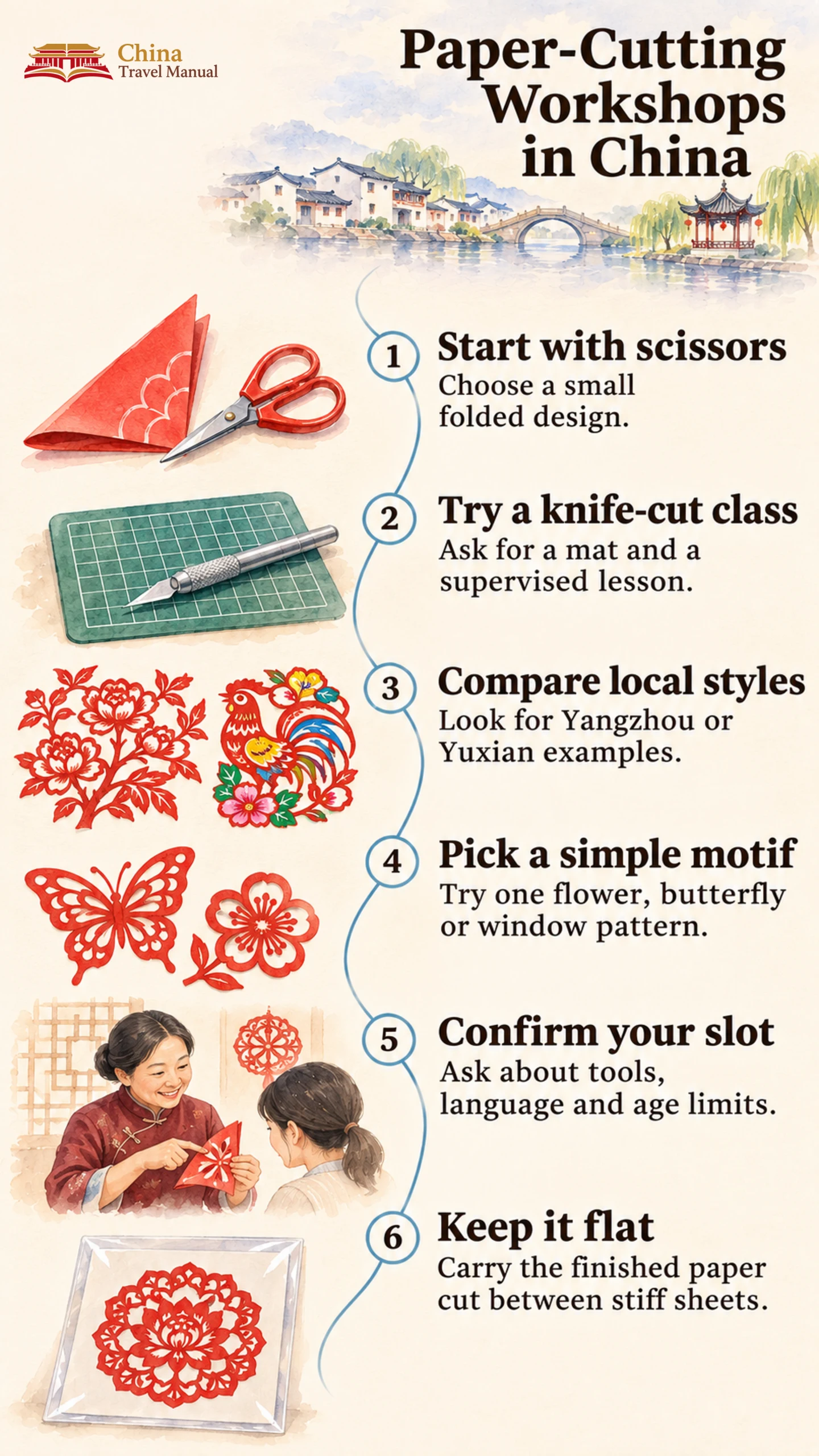
For a first paper-cutting (剪纸, jiǎnzhǐ) workshop in China, book a small scissors project such as a folded flower or a symmetrical window decoration. Choose a coached knife-cut lesson if you are more interested in fine details and how the artist opens up space in the design.[1][2][3][4]
- Easiest for a short session: Choose one simple fold-and-cut motif.
- Best for intricate details: Ask for a supervised blade class and practice paper.[3][4]
- Good for a regional craft trip: Look at Yangzhou or ask whether a workshop teaches Yuxian-style coloring.[2][3]
- Before paying: Confirm the tools, age limit, teaching language and what you get to take home.
A simple finished cut is easier to pack and is a useful first demonstration of the technique.
The first decision is what kind of cut you want to make. A folded design shows how a few cuts repeat across the sheet. A flat-sheet design lets you work on the empty spaces and narrow strips that hold it together.
Choose a Paper-Cutting Method
Chinese paper cuts can be made with different tools and may be colored after cutting. Some are used as window or home decorations. Other cuts serve ceremonial, artistic or practical purposes, depending on the community and the maker.[1][2][3]
| Method | What you might make | What to ask |
|---|---|---|
| Scissors and folded paper | A symmetrical flower, butterfly or simple pattern. | Will I fold and cut a small sample first? |
| Scissors on a flat sheet | An outline with a few open details. | Will the artist demonstrate how to keep thin sections joined? |
| Knife and cutting mat | A template with narrow lines or small enclosed openings. | Is the blade work guided, and can a beginner use an easier pattern? |
| Cutting with added color | A small stencil-like design with areas of color. | Will the class include both cutting and coloring, or one of those steps? |
Where to Look for a Workshop
Yangzhou, Jiangsu. Start with a Yangzhou crafts itinerary and ask about paper-cutting demonstrations or short classes near your other stops. The national heritage listing identifies Yangzhou’s Paper-Cutting Museum as the safeguarding institution and describes earlier uses of paper patterns in embroidery. Confirm whether a current visitor session is hands-on.[2]
Suzhou, Jiangsu. If you are visiting Suzhou, check cultural center calendars for individual events. The Suzhou Industrial Park Cultural Center, for example, ran a dated lesson covering local cut-and-engraved paper and supervised knife practice. Look for a current event, then check whether individual travelers can register.[4]
Yuxian, Hebei. If it fits your Hebei route, look for examples of delicate engraved cuts on thin sheets and bright colors added afterward. A short demonstration may suit travelers who want to see the style. For a studio listing, ask whether you will cut, apply color or observe the artisan, and which part you can complete in one session.[3]
Other cities. Browse the China workshop guide and try the search term 剪纸体验 (jiǎnzhǐ tǐyàn, paper-cutting experience). Linhai in Zhejiang is another example of a local tradition with active teaching and new uses for the craft.[5]
What You Can Make in One Session
Ask for one small design, then practice on a spare sheet before using the final paper. For a scissors class, a folded floral motif or simple window flowers (窗花, chuānghuā) let you see the shape unfold. For a blade class, ask the instructor to show how to cut around a turn and show you how narrow connecting strips keep the design together. Let them suggest a pattern with enough wide areas for your first attempt.[1][4]
A complex motif can take the whole lesson, including template preparation and practice. Choose a modest project if you want to bring home work you finished yourself.
What to Confirm and How to Pack Your Work
- Teacher and tools: Ask whether paper, templates, scissors or mats are included and whether the teacher can show each action clearly.
- Children and mixed groups: Confirm age rules and ask for a scissors version if a blade session is unsuitable for anyone.
- Pickup and packing: Check whether mounting, added color or drying will delay packing. Follow the souvenir packing guide and place a finished dry cut between two clean stiff sheets. Tag the sleeve so you can keep it flat.
To compare a finished work you buy with the output of a beginner session, use the paper-cutting souvenir guide for questions about materials and workmanship.
FAQs About Paper-Cutting Workshops in China
Can children join a paper-cutting workshop?
Ask about the age limit, adult supervision and the tools provided. A simple supervised scissors project is a practical choice for a family, if the studio offers one.
Do I need to know Chinese to take part?
A visible demonstration and a sample design can make it easier to follow. Ask in advance whether the teacher can demonstrate all the steps and help if you get stuck.
Can I take the paper cut home the same day?
A dry, flat cut is usually easy to take with you. Ask whether any coloring or mounting needs extra time and protect the piece in a stiff sleeve.
Sources
[1] UNESCO Intangible Cultural Heritage. Chinese paper-cut heritage
[2] China Intangible Cultural Heritage Digital Museum. Yangzhou paper-cutting tradition
[3] Xinhua with Zhangjiakou Municipal Publicity Department. Yuxian engraved and tinted paper-cutting
[4] Suzhou Industrial Park Cultural Center. Example of a Suzhou paper-cutting class
[5] Zhejiang Provincial Government. Linhai paper-cutting artist and classes





