
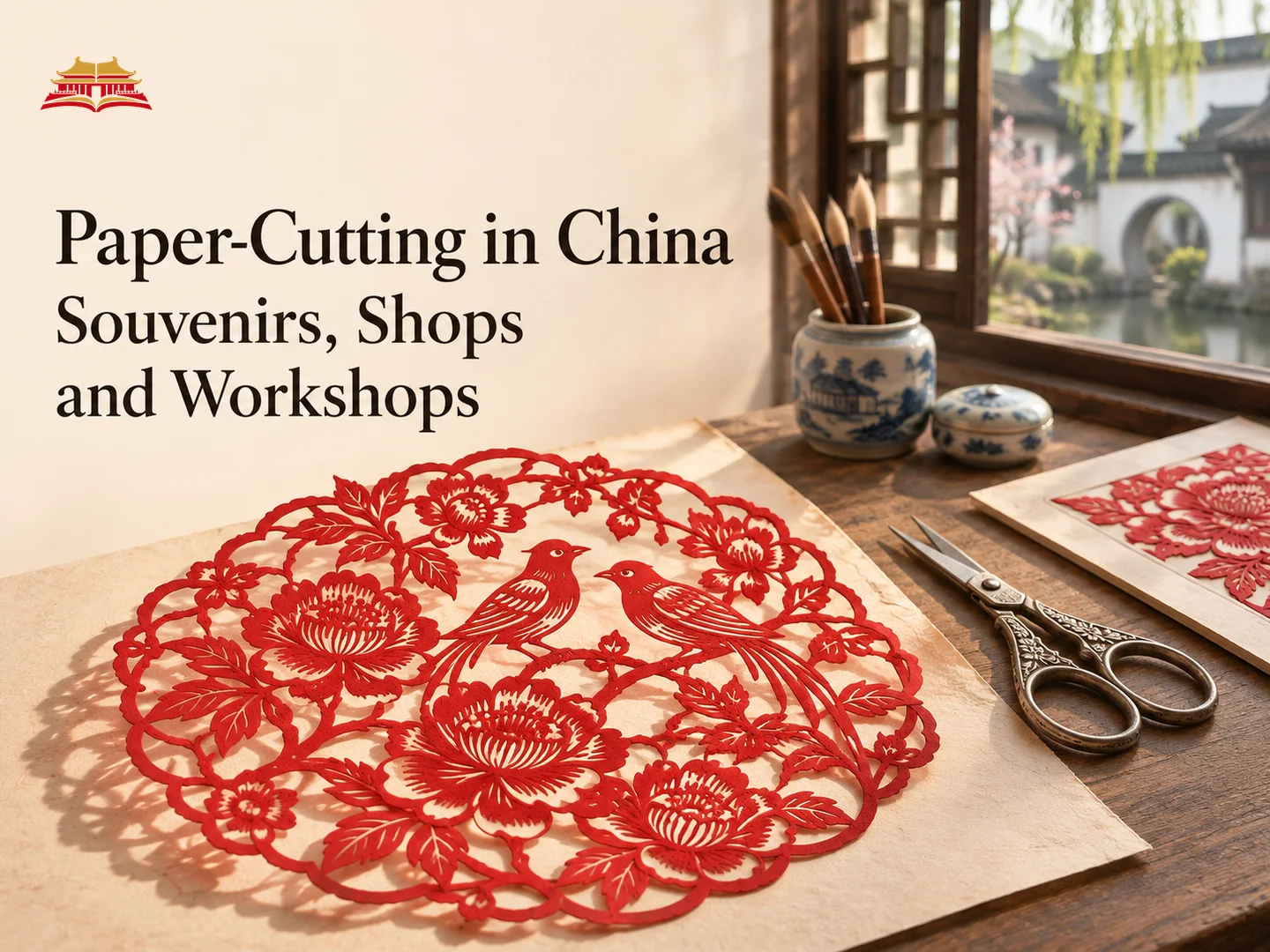
Quick Answer
Buy a small unmounted paper cut if you want something easy to carry, or book a beginner workshop if you’d rather make your own. Ask whether the piece has actual cut-through openings or reproduces a paper-cut design. Have the seller pack a loose piece flat between smooth boards.
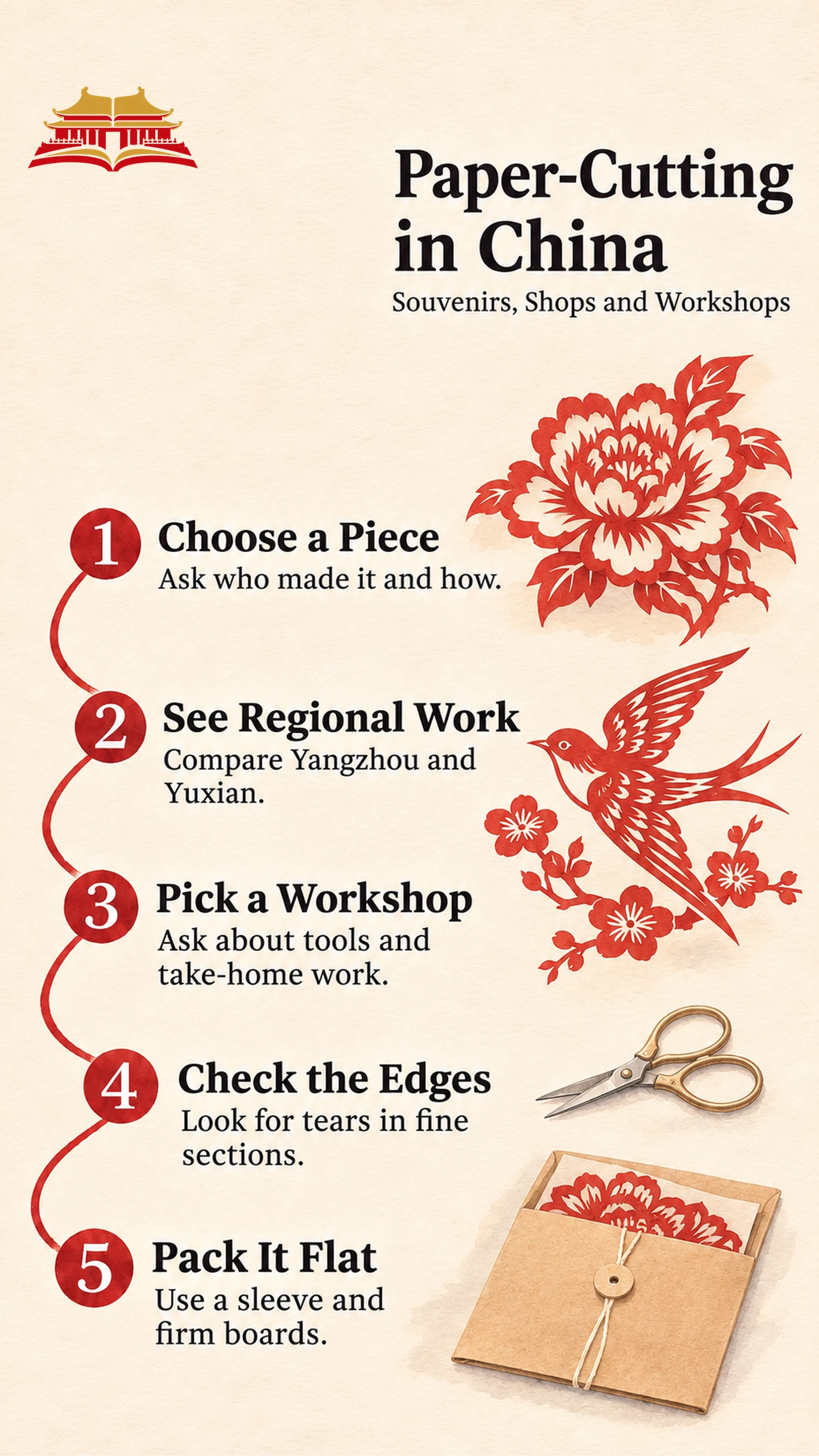
- Buy a piece: Ask who made it and how. Confirm its size and whether the quoted price includes a backing or frame.
- See regional work: Start with a collection visit in Yangzhou for Jiangsu work. Look into Yuxian County in Hebei if you’re especially interested in knife-cut, colored designs.
- Take a class: Ask what tool you’ll use, how much of the piece you’ll finish yourself, and how you’ll carry it away.
If your luggage is small, ask for the packed dimensions before purchasing a framed or unusually delicate piece.
A museum print, a cutout on colored paper and a frame holding a delicate hand-cut scene can show the same design. Choose whether you want the design, the maker’s work or the experience of learning to cut it. That choice tells you what to ask at the counter and how much time to leave in your itinerary.
What to Look For in a Chinese Paper Cut
Chinese paper cutting (剪纸, jiǎnzhǐ) uses openings in the sheet to create its pattern. The work can be cut with scissors or knives and is used in different forms across China. UNESCO records uses in home decoration, festivals and ceremonies, with designs varying by community and occasion.[1] Ask what a particular pattern means to the person who made it, especially if you intend it as a gift.
A loose cutout lets you see how the open spaces work against different backgrounds. On a mounted cutout, check whether the backing makes the finest lines easy to see. A printed reproduction usually travels easily if you want the image. If you want to reuse the cutout against a different color, ask whether its backing can be removed or has been glued on. For a small gift, a mounted card lets the recipient see the design clearly without handling the cut edges. Ask the seller to describe how the piece was made and name the maker if handwork is part of what you’re paying for. The presence of holes alone can’t establish who cut it or which tool they used.
Check the slender joins between sections and any projecting details. With the seller’s permission, inspect a loose piece on its backing rather than picking it up by a narrow edge. If you’re buying it to frame, measure both the cutout and the surrounding paper. Bring those measurements home so the frame leaves room around the design.
Where to See or Buy Paper Cutting in China
In Yangzhou, Jiangsu, the China Paper Cutting Museum describes its collection site in Wang’s Garden, in the historic Dongjuanmen area.[2] Use the museum as a first stop to compare compositions before shopping. If you’re visiting for more than one craft, use the Yangzhou craft route to fit the collection into a wider day. Check current opening details before making a dedicated trip.
In Yuxian County, Hebei, the local tradition is known for carving patterns with knives and adding color to the paper.[3] It’s a good choice if you want to see how color works with knife-cut details. If you’re coming through Zhangjiakou, check the Zhangjiakou travel guide and confirm the last leg into the county. Allow for that onward trip before committing to a studio appointment.
If neither area fits your route, look for a folk-art museum, working studio or craft shop in a city you’re already visiting. Ask whether they sell finished paper cuts or teach visitors to make them. If you only have an hour, decide before you go whether you want to see a collection, shop or make a piece.
What to Ask Before Booking a Paper-Cutting Workshop
Send a short message before booking. Ask whether you’ll fold and cut a simple design, assemble a pre-cut design, or watch a demonstration. Confirm the expected piece size and whether the instructor can show each step visually if they don’t teach in English. Use the paper-cutting workshop guide to compare hands-on options.
If you’re taking a child, ask the instructor which tools are used and whether a scissors-based pattern is available. For adults, ask how much of the pattern you can realistically finish in the session. Choose a short design if you have another reservation the same afternoon. Add time for mounting or photographs if the workshop offers them.
How to Pack a Paper-Cutting Souvenir
- Ask for a flat sleeve. Let the seller slide the work onto a smooth backing sheet and into a sleeve larger than the cutout. Avoid folding corners to fit.
- Add a firm backing. Protect the sleeve between two boards larger than the artwork. Fasten around the edges without putting adhesive on the work.
- Keep it flat and dry. Carry it against a flat surface in your bag and away from bottles or objects that press into the boards. Check packed dimensions with the carrier if the piece is framed.
For a larger piece, ask whether you can buy it without glass and have it framed after arrival. Keep the sale label if it records the maker, region or motif, and check the souvenirs packing guide before you leave the shop.
FAQs About Chinese Paper-Cutting Souvenirs
Is Chinese paper cutting always red?
Red is common in festive pieces. Paper cuts can also be made from other colors, and some traditions, including Yuxian’s, use multiple colors.
Can children try a paper-cutting workshop?
Ask the teacher about minimum age, supervision and the tools children would use. A guided activity with simple scissors and a bold pattern is a practical format to look for.
Should I buy a framed paper cut or an unmounted one?
Choose unmounted art if luggage space is tight and you can frame it at home. A frame is convenient for immediate display if you have a way to protect it and carry its full dimensions.
Sources
[1] UNESCO. Chinese Paper-Cut
[2] China Paper Cutting Museum. Museum Overview
[3] Travel China. Yuxian County Paper-Cutting in Hebei





