

Quick Answer
For ten days of nature travel in China, pair Zhangjiajie’s sandstone pillars with the Li River and Yangshuo’s limestone hills. Spend four nights near Wulingyuan, one in Guilin, three in Yangshuo and a final night in Guilin.
| Days | Base | Main plan |
|---|---|---|
| 1–4 | Wulingyuan | Explore the high viewpoints and a lower valley on separate days. |
| 5 | Guilin | Give the journey from Zhangjiajie a full day. |
| 6–8 | Yangshuo | See the Li River and spend two days in the countryside. |
| 9–10 | Guilin | Move back to the departure gateway, then leave. |
Check the Zhangjiajie-to-Guilin connection before booking the surrounding hotels. Choose a northern Sichuan or Huangshan route if you have a week and want fewer long transfers.
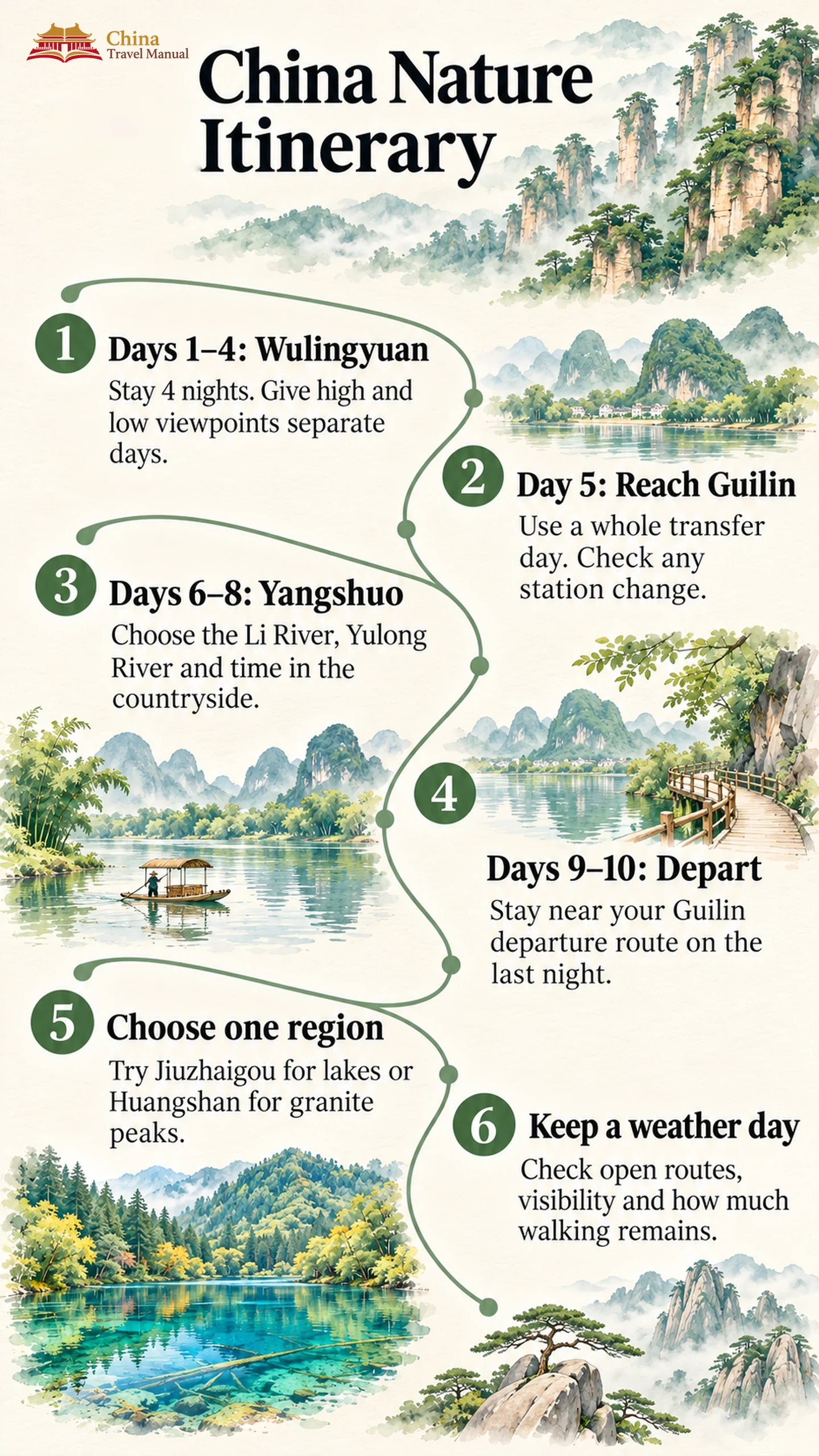
Leave enough space in your China nature itinerary to wait for a clear morning without missing your train the next day. Zhangjiajie and Yangshuo give you two very different landscapes in one trip. The route below gives them time, with a separate transfer day and alternatives if fog, rain or an operating change interrupts an outdoor visit.
Day 1 begins in Zhangjiajie and Day 10 ends in Guilin. If your flight lands late in another city, include the extra night or onward journey in your calendar. The nature travel guide covers more regions for a different gateway or season.
A 10-Day China Nature Itinerary
Plan nine hotel nights across the two landscapes. Keep Day 5 free of fixed visits. A short train on one part of the trip can still mean a long day when you add the road journey from Wulingyuan and a connection.[6][7]
Days 1–4: Zhangjiajie and Wulingyuan
Stay four nights near the gate you plan to use in Wulingyuan. That gives you one arrival day, two independent park days and a day you can move around. The forested sandstone columns and deep valleys are the focus of this part of the trip.[1]
- Day 1 — Arrive and check in. If arriving through Changsha, check the connection to Zhangjiajie before setting a hotel check-in time. If you come by train, confirm the ride from Zhangjiajie West or the station on your ticket. For a late arrival at the airport, arrange the airport transfer before choosing a hotel check-in time.
- Day 2 — Give the Zhangjiajie National Forest Park an upper-viewpoint day. Use Yuanjiajie or Tianzi Mountain as the anchor and plan the return before adding a second sector. Check the open cableways, lifts and park shuttles for your gate.[2]
- Day 3 — Choose a lower valley or shorter walk if conditions suit you. Use the forest park route guide to select an open section. If the upper viewpoints were under cloud the day before, this day can become your second try there.
- Day 4 — Keep another flexible day near the park or choose Tianmen Mountain. Tianmen is a separate site with its own access routes and bookings. Give it the day if you want to see it and have a confirmed entry.[3]
It is worth walking less when the scenery is the priority. Choose a viewpoint you can reach comfortably and give it time. A clear upper view and a lower valley walk usually give you more variety than several similar viewing platforms.
Days 5–8: Guilin and Yangshuo
- Day 5 — Travel from Zhangjiajie to Guilin. Check direct services first, then dated connections through hubs such as Changsha or Huaihua. Compare the arrival and next departure station for any change. Don’t reserve a boat or another attraction that afternoon.[6][7]
- Day 6 — Move from Guilin to Yangshuo. Use a Li River cruise if the boarding pier, luggage conditions and sailing time suit you. Otherwise, travel to Yangshuo by road or rail and fit a short walk into the afternoon.[4][5]
- Day 7 — Follow a section of the Yulong River from your hotel. Choose a short walk or cycle if the conditions suit you. Keep the return ride easy if you’ve opted for a countryside stay.
- Day 8 — Visit Xingping for another stretch of the Li River or spend another day around Yangshuo. This is the day to move a boat or countryside visit if the weather changed the previous plan.
If you arrive early and can arrange a transfer, you can go straight from the Guilin area’s station or airport to Yangshuo on Day 5. Move that Guilin night to Yangshuo. This gives you one less hotel check-in. Leave any early Guilin-origin cruise out of that version unless you have a workable return ride to the pier.[5]
Days 9–10: Return to Guilin and Depart
On Day 9, return to Guilin and choose a hotel that suits your airport ride or railway station. If you have a later flight or train and a confirmed transfer from Yangshuo, the final night can stay in the countryside. For an early departure, the night in Guilin gives your journey a shorter first leg. Use Day 10 for onward travel.
Two Alternatives for Different Landscapes
| What you want to see | Route | Time to allow |
|---|---|---|
| Lakes, waterfalls and mountain valleys | Chengdu and Jiuzhaigou, with optional Huanglong | 7 days, using two Chengdu stays on either side |
| Granite peaks and pines | Shanghai and Huangshan | 6 days, using foothill lodging and a final night in Shanghai |
| Sandstone and limestone in one trip | Zhangjiajie, Guilin and Yangshuo | 10 days, with a full interregional transfer day |
For northern Sichuan, spend two nights in Chengdu, three near Jiuzhaigou Valley and one final night in Chengdu. Use Day 3 to travel from Chengdu to Jiuzhaigou County. If your train uses Huanglongjiuzhai Railway Station, arrange the road ride to your valley lodging. Give Day 4 to the main valley and Day 5 to a second valley day or a separate Huanglong visit if the conditions and transport fit. Return on Day 6 and leave on Day 7. Consult the Jiuzhaigou and Huanglong itinerary and the operator’s current seasonal notices, which can restrict paths or sections of the valley.[8][9][10]
For eastern China, spend two nights in Shanghai, two near Yellow Mountain and one final night in Shanghai. Travel on Day 3 and give the mountain Day 4. Confirm the uphill access, trail route and descent before leaving the hotel. On Day 5, return to your departure city unless your next trip starts from Huangshan. The Yellow Mountain hiking routes and overnight mountain guide help you decide how much to walk or whether to trade a foothill night for the summit area.[11]
How to Plan Around Weather, Walking and Transfers
Check the forecast for the part of the park you will visit. Conditions that suit a walk near town may still leave upper viewpoints under cloud. In colder months, see whether paths are open before choosing a mountainside hotel or paying for a transfer. Jiuzhaigou’s winter conservation notices can close particular sights and boardwalks at different points in the season. In Hunan, an open lower path can be an alternative to a high viewpoint when the route and weather allow it.[10][12]
- Choose one outdoor priority per base. If the pillars are your priority in Wulingyuan, keep two chances for an upper view. In Yangshuo, give the valley or the Li River one whole day before adding a second waterside trip.
- Confirm the hardest transfer first. Search 12306 for the full dated journey and allow time for station changes. If one long connection is fragile, keep one region and spend more time there instead of buying several fixed bookings around uncertain transport.[6][7]
- Check access before fixing the exact day. Look at park entrances, ropeways, shuttle stops and any walks remaining after they drop you off. Confirm admission and the operating status for the date and route. For river trips, check the pier, sailing and land alternative together.[2][3][5]
- Build in a backup you would enjoy. A lower valley can work on a poor-visibility day if open. A short town visit, a meal nearby or a later outdoor start can work when rain makes a long outing unappealing. Follow the operator’s notices about closures.
FAQs About a China Nature Itinerary
Are Zhangjiajie and Guilin too far apart for one trip?
They fit a ten-day route when you give the journey a full day. Check the dated train and any station change. If you only have a week and the connection is awkward, pick one region.
Do I need to hike to enjoy this route?
No. You can choose shorter walks, selected viewpoints and a calmer river day. Some options still involve stairs and walking between shuttles or boats. Check the exact route before choosing it for your group.
Can I visit Tianmen Mountain and Wulingyuan in one day?
Treat them as separate outings. Different entrances, routes and transfers make it hard to see both well in one day. Give Wulingyuan its own days and use a separate flexible day for Tianmen.[2][3]
Which part of the itinerary should I book first?
Check the long interregional transfer and the admission dates for your top-priority site. Book the surrounding hotel nights once you have a workable route and can see which visits depend on weather or operating conditions.
Sources
[1] UNESCO World Heritage Centre. Wulingyuan Scenic and Historic Interest Area
[2] Hunan Provincial Department of Culture and Tourism. Wulingyuan Scenic Routes
[3] Discover Zhangjiajie. Plan Your Visit
[4] UNESCO World Heritage Centre. South China Karst
[5] Guilin Li River Scenic Area. Highlight Reach of the Lijiang River
[6] TravelChinaGuide. Rail Travel Between Guilin and Zhangjiajie
[7] China Railway 12306. Ticketing FAQs
[8] UNESCO World Heritage Centre. Jiuzhaigou Valley Scenic and Historic Interest Area
[9] State Council of China. Jiuzhai Valley Connected With National Rail Network
[10] Jiuzhaigou Scenic Area. Winter Visitor and Conservation Notice for 2026–2027
[11] UNESCO World Heritage Centre. Mount Huangshan
[12] Hunan Provincial Government. Winter Routes in Hunan





