
Quick Answer
Plan one food stop around the festival, the city and the food venues you’ll actually have time to visit.
- Ahead of Lunar New Year: Look for winter porridge, regional dumplings and rice cakes.
- In spring or early summer: Try a green rice pastry at Qingming or a leaf-wrapped rice dumpling around Dragon Boat Festival.
- In autumn: Try a local bakery’s seasonal pastries or look for a chrysanthemum-themed outing with a food stop.
Confirm what the shop will serve on your date. Private reunion meals and public food stalls offer different ways to take part.
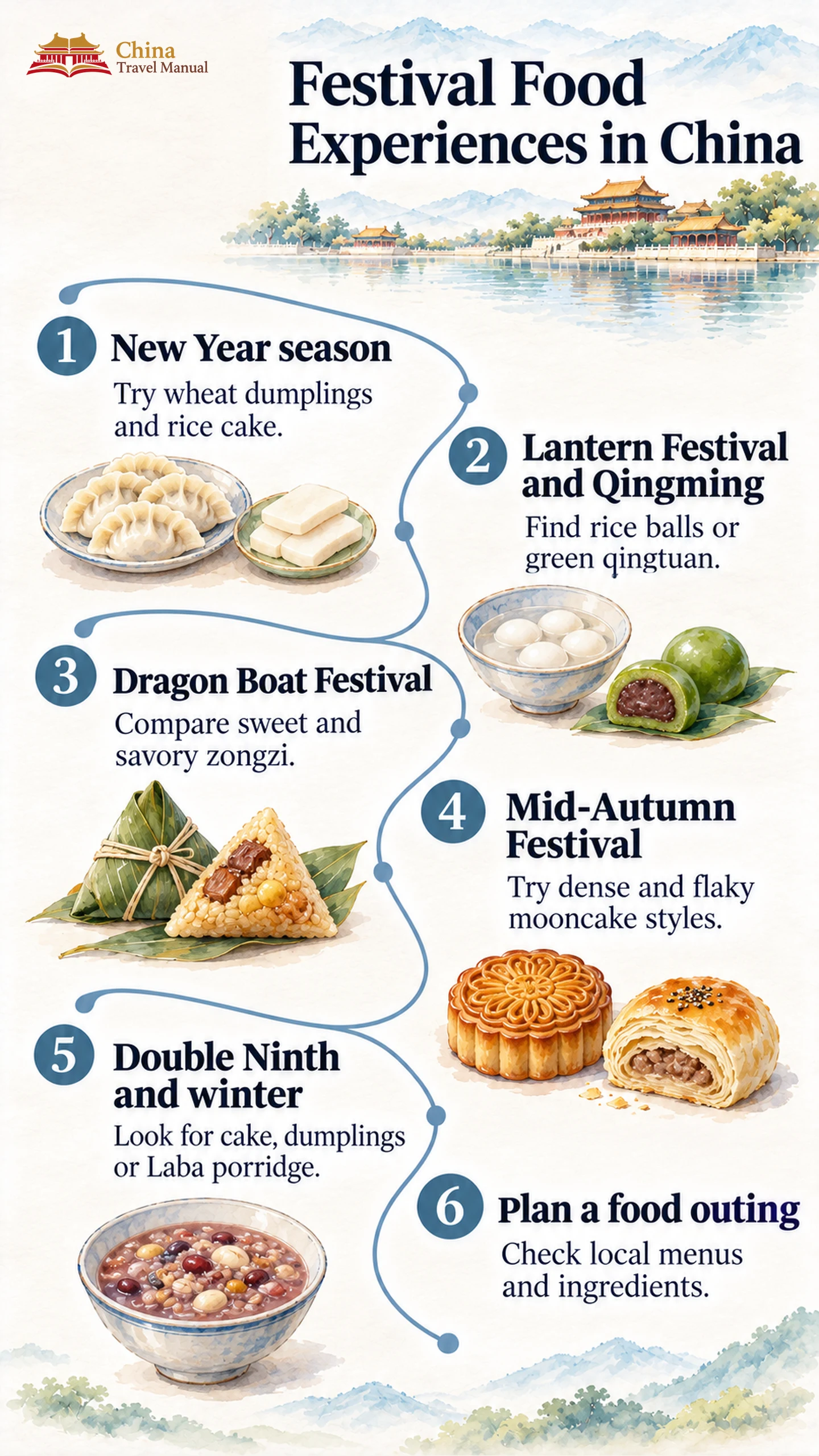
You can experience festival food in China with a single stop at a bakery or market. Start with a dish associated with the festival nearest your travel dates. Then decide whether you want a fresh serving, a comparison of regional styles or a public demonstration.
What to Look For by Festival
The New Year reunion meal is a shared practice across the Spring Festival traditions, while dishes and preparation differ across households and places. Use the following as a tasting map rather than a fixed menu.[1]
| Festival or season | One or two foods to look for | Where to start |
|---|---|---|
| Spring Festival | Northern wheat dumplings, jiaozi (饺子, jiǎozi), and New Year rice cake, niangao (年糕, niángāo), in parts of the south.[2] | A dumpling shop or a regional bakery |
| Lantern Festival | Glutinous rice balls, commonly tangyuan (汤圆, tāngyuán) in southern preparations and yuanxiao (元宵, yuánxiāo) in northern preparations.[3] | A dessert shop or festival stall |
| Qingming | Qingtuan (青团, qīngtuán), a green glutinous-rice pastry associated with spring in Shanghai and nearby areas.[4] | A Jiangnan bakery or market |
| Dragon Boat Festival | Leaf-wrapped sticky rice dumplings called zongzi (粽子, zòngzi), with sweet or savory fillings.[5][6] | A market stall or prepared-food shop |
| Mid-Autumn Festival | Mooncakes (月饼, yuèbǐng), including dense paste-filled pastries and flaky savory versions.[7][8] | A bakery counter with individual pieces |
| Double Ninth Festival | Chongyang cake (重阳糕, chóngyáng gāo), a traditional autumn cake linked with the custom of rising or climbing.[9] | A seasonal food shop or a public festival |
| Winter Solstice | Northern wheat dumplings, rice balls in parts of the south, and local wontons in Suzhou.[10] | A regular restaurant or dumpling shop |
| Laba Festival | Laba porridge (腊八粥, làbā zhōu) of assorted grains and other ingredients.[11] | A food shop or confirmed public event |
How to Taste Regional Differences
Compare Two Leaf-Wrapped Rice Dumplings
Around Dragon Boat Festival, ask for a sweet and a savory zongzi from the same counter. Red bean or jujube versions make a useful comparison with savory pork or salted egg yolk varieties. Unwrap the leaf and examine the rice before trying the filling. The leaves hold the packet during cooking and give it a scent. Ask the seller whether the dumpling is ready to eat or needs reheating.[6]
Compare Two Mooncake Styles
For Mid-Autumn, try one Cantonese-style mooncake with lotus seed paste and one Suzhou-style example with flaky crust. The first is often rich enough to cut up and share. A freshly baked Suzhou meat mooncake makes a contrasting warm snack. Splitting two pieces with a travel companion is a better way to compare the crust and filling than buying a large gift box of a single variety. Ask whether you can buy individual pieces.[7][8]
Look Beyond the Sweet Version
A sweet bowl of multigrain Laba porridge is one regional style. Shanghai examples include a sweeter glutinous-rice version and a home-style savory version with vegetables and tofu. A vendor may sell one household style throughout the season. Ask what goes into the pot and whether the porridge is served hot or packaged to take home.[11]
Some terms describe how the food was made. For example, a common method for tangyuan wraps rice dough around the filling. For yuanxiao, cooks can use a rolling method that coats the pieces of filling with flour. If both names appear on the same menu, ask what each has inside and order the one you want to try.[3]
Where to Find Festival Foods as a Visitor
A traditional bakery is useful for pastry or a rice cake. A market is better when you want to compare cooked portions, local seasonal ingredients and what sellers call each variety. Check the China food markets guide if the market itself is the main outing. Ask whether the food is served there or sold for finishing at home.
For a hands-on experience, look for a dated workshop at a museum, cultural centre or cooking school. Look at what the listing says you will make. Folding leaves around rice and simply tasting a prepared sample are different activities. Confirm the session language, venue and sign-up requirement before making it the centre of your day.
If you have dietary restrictions, ask about the filling and cooking fat, and check the ingredient label on packaged food. A plain-looking pastry can contain lard, egg, peanuts or other ingredients. If you need to avoid a particular ingredient, use a translation card and choose a dish only when the seller can confirm what goes into it. The guide to vegetarian food in China can help with questions to ask.
How to Plan a Festival Food Outing
- Find the festival date and public holiday window. In mainland China, for instance, the 2027 national calendar lists Dragon Boat Festival on June 9 and Mid-Autumn Festival on September 15.[12]
- Pick one local version. Search for the food’s Chinese name and use a city-specific guide to find a bakery, breakfast shop or market in your neighborhood.
- Check service and ingredients. Ask whether there are individual pieces, takeaway servings or reservation-only menus. Confirm the filling before you order.
- Leave time for an alternative. If a seasonal stall has closed or sold out, try a regular market or restaurant that serves the food outside the holiday.
FAQs About Festival Food Experiences in China
Can I try festival foods outside the holiday?
Often, yes. Dumplings and some rice-ball dishes are standard menu items. Fresh seasonal pastries or a public food demonstration may have a much shorter run, so check the exact food and seller.
Can visitors join a family reunion dinner?
Have a reunion dinner when you receive a personal invitation. If you are traveling independently, look for a publicly listed event or reserve a restaurant that offers a festival menu.
Which festivals are easiest for trying several versions?
Dragon Boat Festival and Mid-Autumn Festival are good choices when the markets and bakeries in your city carry several fillings or regional styles. Buy small portions and compare one familiar version with a different style.
Sources
[1] UNESCO. Spring Festival: Social Practices in Celebration of Traditional New Year
[2] China Culture. New Year’s Day
[3] Jinan Municipal Government. It’s Lantern Festival: Time to Have a Ball
[4] Shanghai Municipal Government. Spring Outing for Qingming: Embrace the Season in Shanghai
[5] UNESCO. Dragon Boat Festival
[6] Shanghai Municipal Government. Tradition With a Twist: Shanghai’s Zongzi Guide
[7] Shaoxing Municipal Government. Mooncakes: From Secret Messages to Modern Flavors
[8] Suzhou Municipal Government. Suzhou Delicacies
[9] China Culture. Double Ninth Festival
[10] Shanghai Municipal Government. Things You May Not Know About Winter Solstice
[11] Shanghai Municipal Government. Laba Festival: Dates and Customs
[12] State Council of China. Public Holidays for 2027





