

Quick Answer
The Laba Festival (腊八节, Làbā Jié) falls on the eighth day of the twelfth lunar month. The next dates are January 15, 2027 and January 4, 2028.[1][2]
- Try a bowl: Look for Laba porridge (腊八粥, làbā zhōu), a cooked mix of grains, beans and other ingredients.
- Check a temple’s programme: Beijing’s Lama Temple and Hangzhou’s Lingyin Temple have documented Laba traditions.
- Keep a market option: Look for winter porridge or pickled garlic even if the public distribution has ended.
Temple programmes and public servings can have separate hours and entry rules. Confirm both before setting out.
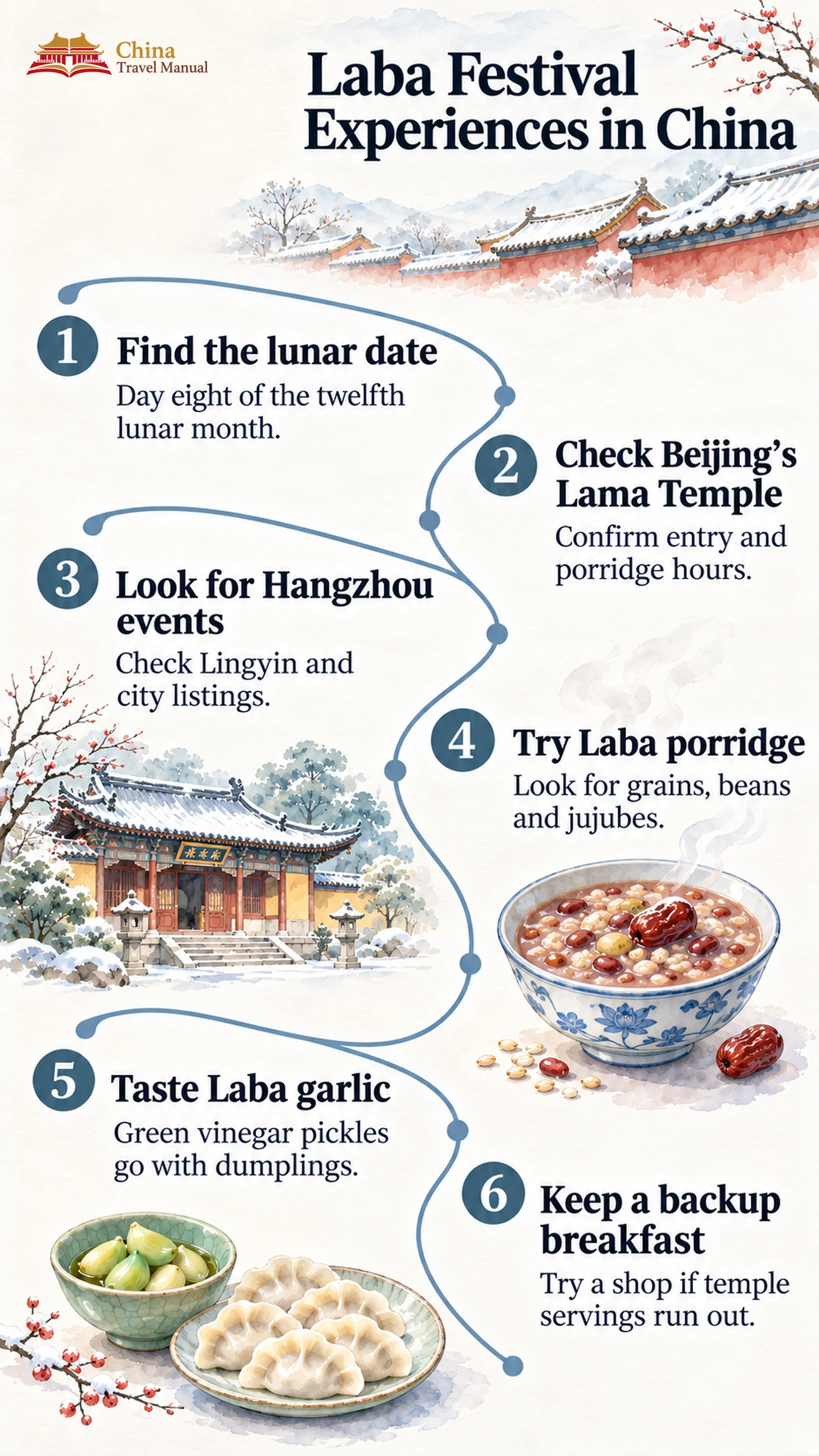
A bowl of multigrain porridge is one of the easiest ways to notice the approach of Chinese New Year. Around Laba, you may see the food served at a temple, offered at a community event or sold at a shop. Each setting comes with a different way to take part.
When Laba Falls and What It Marks
Laba comes late in the lunar year, usually in the run-up to the next Spring Festival. The date moves on the Gregorian calendar because it follows the lunar month. In 2027 it is Friday, January 15. In 2028 it is Tuesday, January 4. Use the January travel guide to place the outing within your broader winter plans.[1][2]
The festival brings together several traditions. Rural seasonal and ancestral customs are part of its history. Chinese Buddhist observance associates the day with the Buddha’s enlightenment, and porridge may be prepared as an offering. The dish is also made or shared outside the temple. This helps explain why a Buddhist service, a neighborhood distribution and a family breakfast can all belong to the same occasion.[3][4]
Where Visitors Can Experience Laba
| Setting | What to look for | What to confirm |
|---|---|---|
| Beijing’s Lama Temple | Temple visit and a historically documented public distribution | Normal admission, event entrance and hours |
| Hangzhou’s Lingyin area | Buddhist observance and possible public servings or related city events | Whether the activity is inside the temple or at another venue |
| Food shop or market | A purchased bowl or a seasonal pickle | Whether it stocks the festival item that day |
Beijing’s Lama Temple
At Lama Temple, known locally as Yonghegong, look for the connection between cooking and the site’s history. A large copper cauldron previously used for preparing the porridge has been kept at the temple. Public distribution was also reported for the 2026 festival. Treat that as an example, and check whether a new event notice gives an exact gate, time and procedure.[4]
A short food queue can turn into a longer stop once people arrive for admission. Keep the temple visit and the chance of a bowl separate in your schedule. If the food line is too long or service has ended, enjoy the temple visit and look for an ordinary meal nearby.
Hangzhou’s Lingyin Temple and City Events
In Hangzhou, Lingyin Temple marked Laba on January 26, 2026 with an offering ceremony. The ceremony is evidence of the temple’s practice. A public visitor should check the current announcement for which part, if any, is open and whether porridge is being served to visitors.[5]
In previous years other Hangzhou venues, including shops and shopping centers, have offered bowls too. For example, the city reported distributions at branches of Fanghuichun Hall in 2024. Check the branch or venue instead of assuming a past announcement applies again. A food stop in town can be easier to add if your day’s route stays away from the Lingyin area.[6]
What Laba Porridge and Laba Garlic Taste Like
Laba porridge often combines several textures. Soft rice or millet may form the base, with beans, lotus seeds, jujubes or other ingredients added. Beijing examples are often sweet, with dried fruit. A northern Shaanxi version can be savoury, with tofu and meat.[3] Ask about ingredients if you need to avoid peanuts, other nuts or animal products.
Laba garlic (腊八蒜, làbā suàn) is another seasonal preparation, especially in the north. The cloves are pickled in vinegar and can turn green. It is often eaten with dumplings during the New Year season.[3] Ask for it as a condiment if it appears on a restaurant’s seasonal menu. The festival food guide links these flavors to other Chinese holiday meals.
How to Plan a Laba Morning
- Choose a neighborhood or temple you already want to visit. Find a dated local announcement if the porridge distribution is a priority.
- Confirm the entrance and timing. Ask whether general site admission, registration or a separate queue applies, and note when you want to leave for your next stop.
- Follow the instructions at the venue. Keep doors and prayer areas clear, and take photographs only where permitted.
- Save a second option for breakfast. A shop or market gives you a warm meal even if the event is full or the servings run out.
FAQs About Laba Festival Experiences
Is Laba the same as Chinese New Year?
It takes place earlier, on the eighth day of the twelfth lunar month. Chinese New Year starts the first lunar month. Use our Chinese New Year travel guide if your dates also overlap the main holiday.[1][2]
Can visitors receive free porridge?
Some venues offer public servings on a particular date. Check the latest instructions and local availability. A venue may finish serving when the prepared batch is gone.
What if I miss the festival day?
Ask about seasonal porridge at a shop, or look for vinegar-pickled garlic with dumplings in northern China. You can still visit Lama Temple or Lingyin Temple in their normal opening hours to learn about the setting.
Sources
[1] Hong Kong Observatory. Gregorian–Lunar Calendar Conversion Table of 2027
[2] Hong Kong Observatory. Gregorian–Lunar Calendar Conversion Table of 2028
[3] Shanghai Municipal Government. Laba Festival: Dates and Customs
[4] China Culture. Laba Porridge Heralds Festive Celebrations
[5] Lingyin Temple. Lingyin Temple’s 2026 Laba Offering Ceremony
[6] Hangzhou Municipal Government. Traditional Medicine House Resumes Porridge Distribution





