

Quick Answer: Pair the Dahongpao walk with a separate tasting
Start with the experience you want most, and leave your second stop flexible.
- For the landscape: Walk from the Dahongpao scenic area toward Water Curtain Cave if the route is open.
- For flavor: Book a seated tasting and compare two local oolongs.
- For production: Contact a tea estate and ask which steps are available on your date.
- For history: Visit Xiamei or allow time for the tea exhibits in Huangcun.
The historic bushes are protected and were withdrawn from routine harvest in 2006. A shop selling tea under the same name is offering a separate product.[2][4][5][6][7]
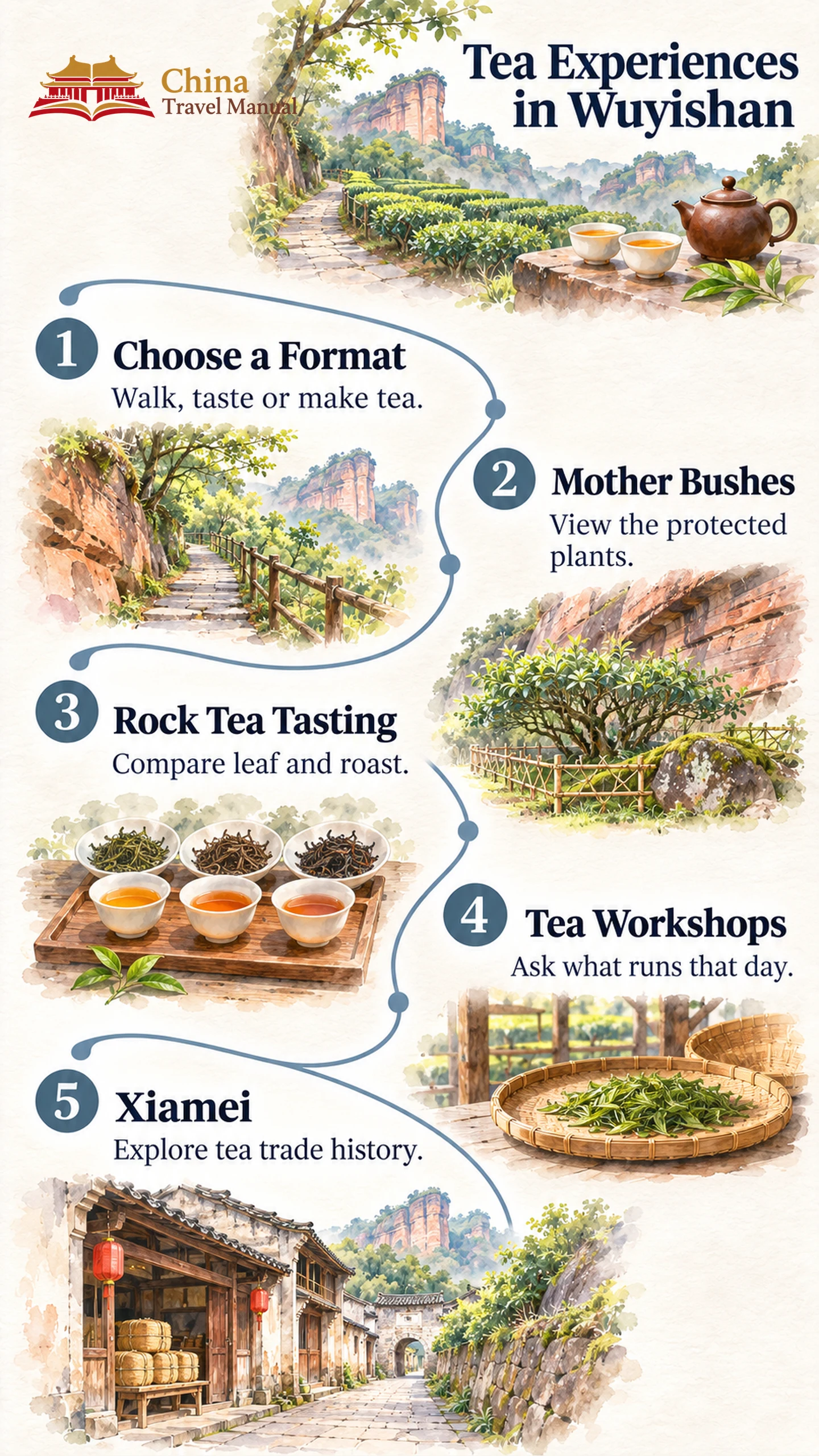
Tea experiences in Wuyishan range from walking through sandstone gullies to sitting with a producer for several infusions. For a first visit, see the protected Dahongpao mother bushes (大红袍母树, Dàhóngpáo mǔshù), then arrange a separate tasting of Wuyi rock tea (武夷岩茶, Wǔyí yánchá). Choose a tea estate for hands-on work and Xiamei for the history of trade. These stops are in different places, so match them to your time in Wuyishan City.[1][2][3][4][5][6]
Choose a Tea Walk, Tasting or Workshop
| Experience | Where to start | Confirm before going |
|---|---|---|
| Tea landscape walk | Dahongpao scenic area | Trail access and shuttle stops at both ends |
| Tasting | Sangu resort area or a producer | Tea selection, the price and whether the host can explain it in your language |
| Tea production | An estate or hosted session | Whether you will pick, handle leaves, see processing or only observe |
| Tea trade history | Xiamei village | Transport, opening hours and any guided visit |
| Production exhibits | Huangcun, in Xingcun Town | Exhibition hall access and whether a tasting is offered |
If you only have time for one visit, choose a scenic walk to see where the bushes grow or a tasting to understand how teas differ. Mount Wuyi’s mixed World Heritage designation covers a broader landscape. The living practice of processing and serving tea is recognized under a separate UNESCO inscription.[1][2][5][6][8][9]
Visit the Dahongpao Mother Bushes
The protected bushes grow on the cliff at Jiulongke, within the Dahongpao scenic area. The National Museum of China records six historic plants and the 2006 decision to cease harvesting them for tea production. You can see the bushes from the visitor route. Ask a seller what its commercial Dahongpao (大红袍, Dàhóngpáo) is made from and how it was roasted if you want to understand the tea in your cup.[3][4]
The Rock Bone and Floral Fragrance Trail (岩骨花香漫游道, Yángǔ Huāxiāng Mànyóudào) joins the Dahongpao scenic area to Water Curtain Cave (水帘洞). A local route account puts it at about 2.8 km and roughly 90 minutes on foot. Allow longer to stop and look at the growing sites and rock formations. Confirm gate access, path conditions and the return shuttle stop before leaving. The Wuyi Mountain visitor guide covers the wider scenic area and its stops.[2][3][7]
Taste Wuyi Rock Tea in Sangu or a Tea Village
In Sangu, leave time to sit at a tea shop and compare infusions. Ask to compare Rougui (肉桂, Ròuguì) and Shuixian (水仙, Shuǐxiān), or try one tea at two roast levels if the host offers that comparison. Prefer successive small pours of the same tea before switching to another leaf. Ask where the leaf was grown, the cultivar or blend, and the roast before comparing prices. The local term rock character (岩韵, yányùn) describes a sensory impression that you can discuss with the host after tasting.[3][5][8]
You can ask to smell the warmed cup and compare what remains after the second or third steep. If you buy tea, ask for the producer, batch information, price by weight and brewing notes. It is easier to compare two teas if they are served in the same session at similar strength.[5][8]
See Tea Making and Trade History
Fulian Tea Estate (福莲茶庄园) is one example of a visitor-oriented estate with tea gardens and exhibits. Ask whether picking, a demonstration or a hands-on session is available on your date. Harvest activities are seasonal, and moving leaves through a full production process takes longer than a short tasting. A host may show one operation, such as handling leaves after withering, without running the whole sequence in front of visitors.[3][5][8]
For the history of trade, choose Xiamei (下梅村), associated locally with the Tea Road. A different stop, the oolong tea exhibition hall (世界乌龙茶发源地展示馆), is in Huangcun Village in Xingcun Town and uses a former tea factory. Choose Xiamei for village architecture and the trading story, or Huangcun for exhibits about processing. Ask how to get back if you are visiting either from Sangu.[2][3][6]
Build a Half Day or Full Day Around Tea
With half a day, choose one trail, workshop or tasting and allow time for the road connection. With a full day, combine the Dahongpao walk with a tasting or a single outlying village. If you already hold a Nine Bend Stream raft time, place the tea visit on the flexible side of that reservation. Use the Wuyishan transport guide for city and scenic area transfers.[2][3][7]
For a single night, a room in Sangu keeps restaurant and tasting options close. A village stay is more useful when you have a booked host or want to spend longer at an estate. Compare where to stay in Wuyishan before committing to the last pickup.[3][5][8]
FAQs About Tea Experiences in Wuyishan
Can I drink tea from the Dahongpao mother bushes?
The historic bushes were taken out of harvest for tea production in 2006. You can visit the protected plants and ask a producer about the separate commercial tea it serves.[4]
Is a tea workshop available all year?
Some tastings or demonstrations may be offered outside the harvest. Picking and live production depend on the season and the estate’s work schedule. Confirm the exact activity when booking.[3][5][8]
Can I do the tea walk and a bamboo raft in one day?
Yes, if you plan around your raft departure and have enough time for the walk and its shuttle connections. Keep the tasting or an outlying village for another day if the schedule is tight.[3][7]
Do I need to stay in a tea village?
A Sangu base works for a scenic walk and tasting. An overnight with a producer makes sense when the host and transport arrangements are confirmed.[3][5][8]
Sources
[1] UNESCO World Heritage Centre. Mount Wuyi World Heritage property
[2] Fujian Department of Culture and Tourism. Wuyi tea heritage itinerary
[3] Ministry of Culture and Tourism. Spring tea route, scenic buses and tea villages
[4] National Museum of China. Historic Dahongpao bushes and the end of commercial picking
[5] Fujian Provincial Government. Rock tea production and Fulian Tea Estate
[6] China Tourism News. Xiamei and the Huangcun tea exhibition hall
[7] Minbei Daily. Rock Bone and Floral Fragrance trail distance and endpoints
[8] Leleforest. Example of hosted tea tasting and production visits
[9] UNESCO Intangible Cultural Heritage. Chinese tea processing techniques and social practices





