

Quick Answer: How do you choose a calligraphy class in China?
Choose a beginner lesson with a demonstration, practice time and a small finished exercise.
- For your first lesson: Ask about regular script (楷书, Kǎishū) and a simple character. Check that the instructor explains how to load, move and lift the brush.[1][3]
- For tools and craft history: A brush-and-ink making venue can show where the materials come from. Confirm whether it also offers a writing lesson.[2][4]
- For groups or families: Confirm ages, language, the number of workspaces and whether everyone will have time to write.[3]
Book the activity by what you want to learn. A demonstration, writing class and materials workshop each gives you a different experience.
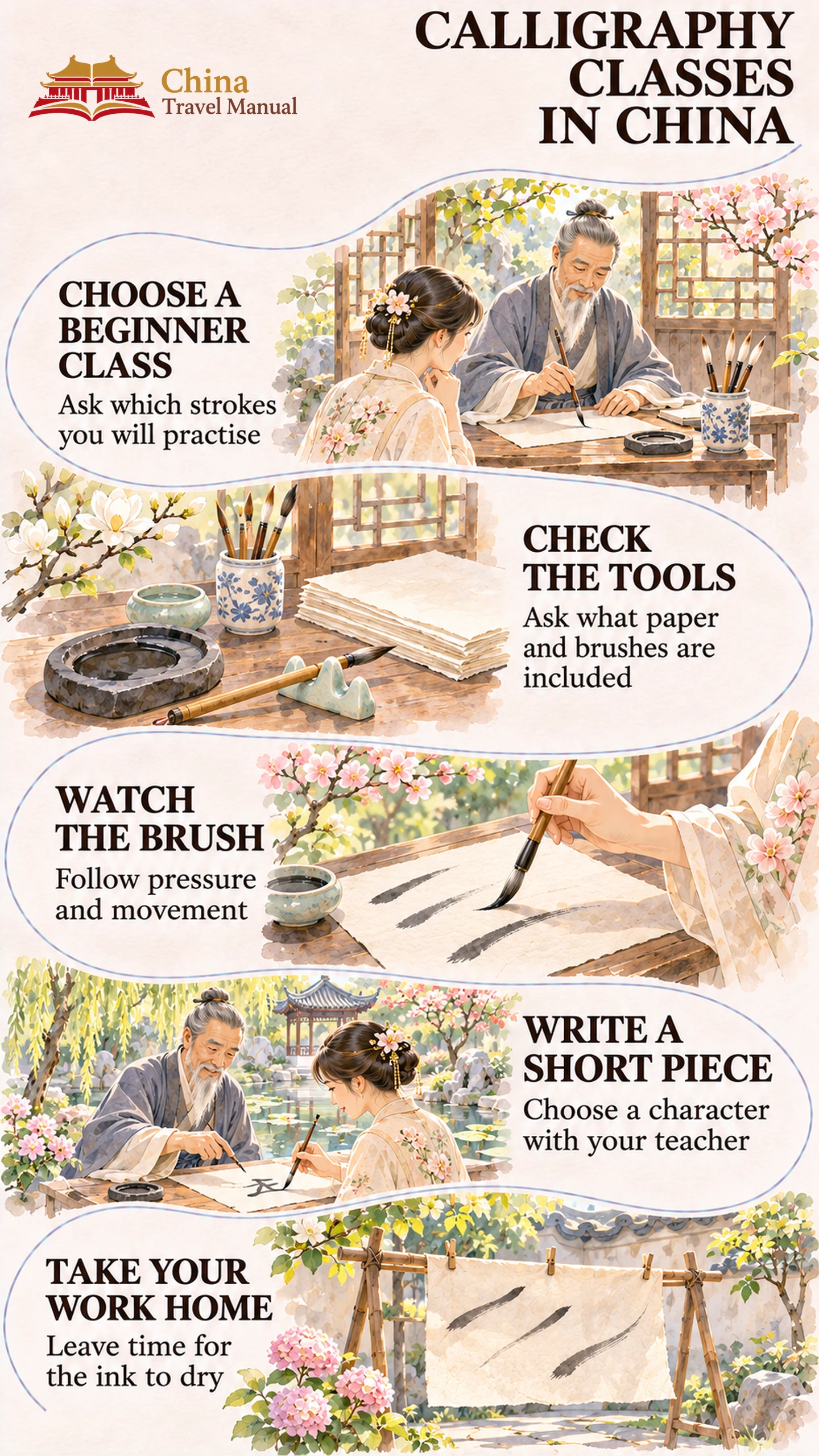
A beginner class in Chinese calligraphy (书法, Shūfǎ) is most useful when you spend time watching a teacher write and then repeat a few strokes yourself. One well-chosen character can be enough for a first lesson. Ask what model you will copy, which materials are included and whether the teacher can give feedback in a language you understand.[1][3]
Compare beginner class types
| What you want to do | Class to look for | Ask the instructor |
|---|---|---|
| Learn basic brush movement | Small beginner class with stroke practice | Will you demonstrate pressure and lifting before I try?[1][3] |
| Write a particular word or name | A short lesson that includes character selection | Can we choose a suitable model and check the character’s meaning first? |
| Understand the tools | A brush- or ink-making visit | Which preparation steps can I see or try, and is writing included?[2][4] |
| Learn with children | Short guided practice with individual materials | Which ages can participate and are there separate places to work? |
What you use in the lesson
The Four Treasures of the Study (文房四宝, Wénfáng Sìbǎo) are the brush, inkstick, paper and inkstone. Those tools explain part of what you see in a practice sheet. The depth of color depends on the ink and how the paper absorbs it. The stroke also changes with pressure, the position of the brush and the speed of the movement. A teacher can show the difference more clearly with one repeated stroke than with a finished scroll.[1][2]
If preparing ink is part of what you want to learn, confirm that the studio demonstrates grinding an inkstick and lets you try. If you are in Shanghai and want to see how the tools are produced, the Royal Workshop of Chinese Brush and Ink in Yangpu is a separate option. It features brush- and ink-making traditions. Check its current public activities and arrange a dedicated writing class if that is your main purpose.[4]
One classic practice character is 永 (yǒng, “eternity”). Teachers can use it to show several kinds of brush movement on a single sheet. Ask for a simpler first exercise if you want to focus on a straight horizontal stroke or a single dot. After your first attempt, compare its beginning and end with the model, then repeat it once at a slower pace.[5]
How to get more out of a first class
- Choose a short model: Ask the instructor to show one simple character and to explain what it means.
- Watch one stroke at a time: Look for the point where the brush presses down, moves and lifts. Compare your practice marks with the example.
- Try on practice paper first: Ask for feedback before making the final sheet. Tell the teacher if you would like to repeat the task before moving on.
- Ask how to carry the work: Wait for the ink to dry and ask whether the sheet can go into a folder or needs a flat surface.
When booking, confirm how the instructor will communicate. For a short session, ask for the demonstration at your own desk so you can see the brush angle. If you want to discuss the development of different scripts or ask longer questions, confirm interpretation before the class. Use the China craft workshop guide for other hands-on options, or the calligraphy souvenirs guide if you mainly want to choose a piece to take home.
FAQs About Calligraphy Classes in China
Do I need to read Chinese first?
Ask for a beginner lesson that explains or translates your chosen character and demonstrates each movement. A short class can concentrate on one example without requiring you to read a longer text.[1][3]
Will I finish a piece in one class?
Many introductory classes can organize a small piece to finish within the session. Confirm what the teacher has planned for the booked duration and how you will carry the sheet.[3]
Can a brush-making visit also teach calligraphy?
A visit can include a brush or ink demonstration, and a writing lesson can be a separate session. Check which part you will do yourself before booking.[4]
Sources
[1] UNESCO. Chinese calligraphy and its script traditions
[2] Smithsonian National Museum of Asian Art. Four Treasures of a Scholar’s Studio
[3] Cultural Keys. Chinese calligraphy workshops and class format
[4] Shanghai Municipal Government. Royal Workshop of Chinese Brush and Ink
[5] Asian Art Museum. Words as Art: An Introduction to Chinese Calligraphy





