

Quick Answer: Which Natural Caves Should You Visit in China?
Choose Reed Flute Cave for a city-side outing from Guilin, Zhijin for larger karst chambers in Guizhou, or Huanglong Cave for a guided visitor circuit near Zhangjiajie. Choose Furong Cave if you are already planning a Wulong trip. Check the actual stairs, timed access and boat status before reserving.[1][2][3][4]
- Short city outing: Start with Reed Flute Cave in Guilin.
- Larger chambers: Give Zhijin Cave a dedicated ground transfer and visit.
- Underground boat: Ask which Huanglong Cave routes include it and whether it runs.
- Chongqing side trip: Confirm Furong Cave admission separately from the other Wulong sites.
Choose the cave that fits your travel base, and ask how the visitor route works before you go.
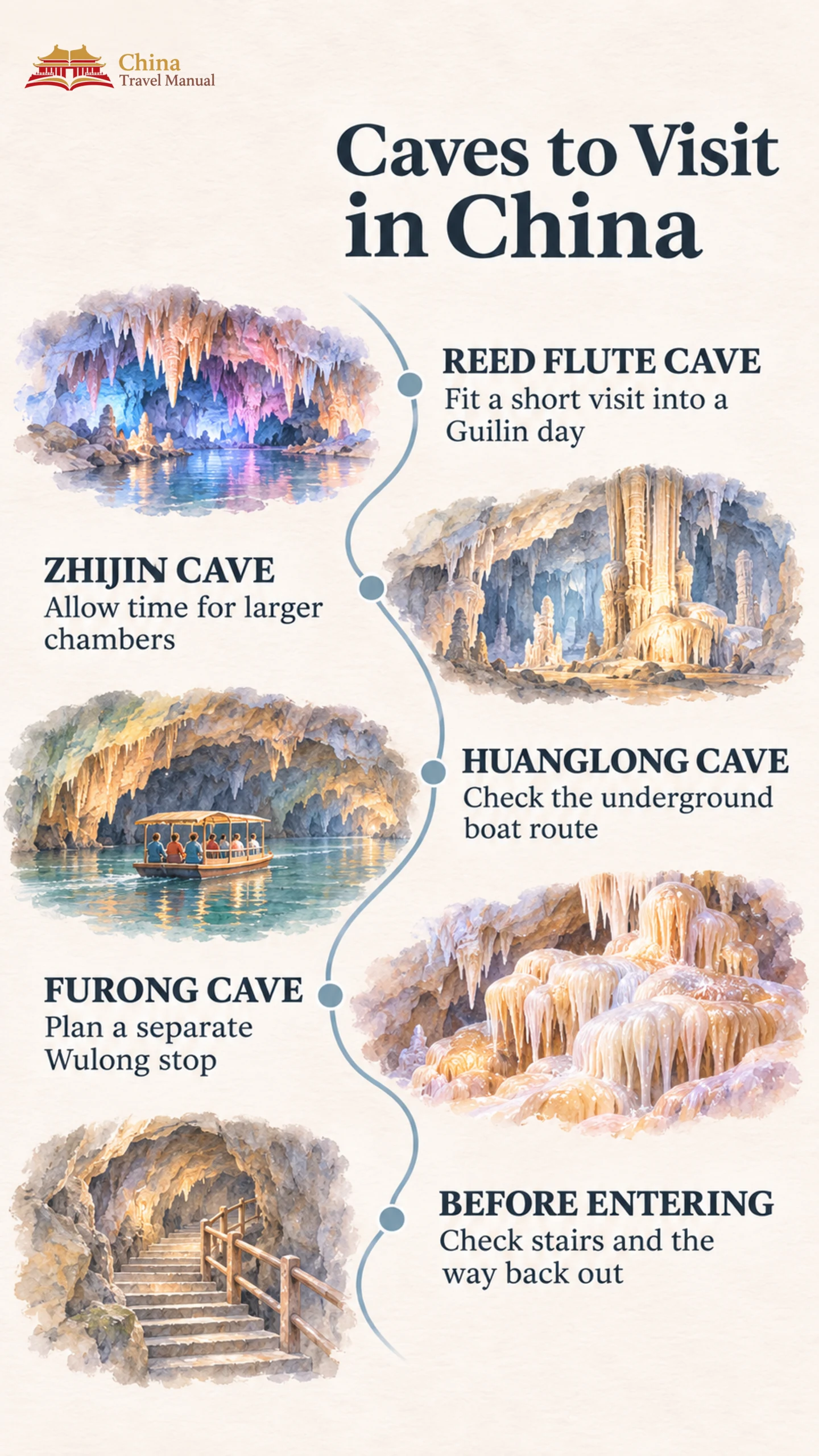
This guide compares managed natural caves with paved or designated visitor routes. If your goal is historic murals, Buddhist statues or cliff carvings, the China grottoes guide covers those cultural sites. The main questions for a natural cave are descent, lighting and whether every part of the circuit is running.
Compare Four Cave Trips
| Cave | Best base or region | Main visitor decision |
|---|---|---|
| Reed Flute Cave | Guilin, Guangxi | Fit a compact illuminated visit into a city day |
| Zhijin Cave | Zhijin County in Bijie, Guizhou | Confirm the route and allow a separate transfer |
| Huanglong Cave | Zhangjiajie area, Hunan | Check stairs and whether the underground boat is included |
| Furong Cave | Wulong, Chongqing | Choose the cave specifically when booking the Wulong day |
Reed Flute Cave: The Easy-to-Reach Guilin Choice
Reed Flute Cave is northwest of central Guilin and works as a compact break in a city itinerary. Expect an artificially lit route among stone formations. Ask how far you will walk and how near the entrance your ride can stop if stairs, darkness or distance affect your decision.[1][5]
Zhijin and Huanglong: Decide How Much Cave Time You Want
Zhijin is the choice if big passages and large chambers are the main attraction. The cave is part of a UNESCO Global Geopark in Guizhou’s Bijie area. Plan the transfer to the actual cave entrance and check whether the circuit is one-way. The China geoparks guide helps you decide when to give a geological site a longer visit.[2]
At Huanglong Cave near Zhangjiajie, the provincial visitor page describes a karst cave and an underground sightseeing boat. Ask whether the boat is running and whether the full circuit also includes stair sections. Check the park separately from your Wulingyuan forest-park booking.[3]
Furong Cave: Plan It as Its Own Wulong Stop
Furong Cave is part of the wider Wulong karst travel area, alongside attractions such as the Three Natural Bridges and Fairy Mountain. Choose which site actually fits the day first. If you want the cave, confirm the entrance and local ride before booking a package named only for Wulong.[4][6]
Check the Circuit Before You Enter
Ask how much of the cave is accessible, whether visitors enter on a fixed tour and how you return to daylight. Use the marked path, wear shoes with grip and check with the operator if rain has affected access. If your group wants more daylight and less underground time, compare nearby landscapes in the China waterfalls guide.
FAQs About Caves to Visit in China
Which cave is easiest to add to a Guilin day?
Reed Flute Cave is close to the city and has a developed visitor route. Check the actual entrance and stairs for your group.[1][5]
Can you take a boat inside a cave?
Huanglong Cave advertises an underground sightseeing boat. Confirm it is available for your selected visit.[3]
Are these caves the same as temple grottoes?
This list focuses on natural geology. Temple grottoes usually add rock-cut sanctuaries, painted interiors or sculpture as the main reason to visit.
Sources
[1] Guangxi Government via China Daily. Reed Flute Cave location and scenic area
[2] UNESCO. Zhijindong Cave UNESCO Global Geopark
[3] Hunan Provincial Government. Huanglong Cave karst formations and underground boat
[4] Chongqing Municipal Government. Wulong Karst Tourism Area visitor attractions
[5] China Highlights. Guilin cave visitor routes and lighting
[6] UNESCO World Heritage Centre. Wulong component of the South China Karst listing





