

Quick Answer
Start at the Three Natural Bridges if you have one day. Add a second site after an overnight stay, or only if you have checked the road transfer and last entry. These are the main choices for a first visit.[1][2]
| Site | What you go for | What to plan around |
|---|---|---|
| Three Natural Bridges | Natural limestone arches above a deep valley | Visitor-center transfer, steps and a one-way walk |
| Fairy Mountain | Open upland grassland and forest | Weather on the plateau and the road up from town |
| Furong Cave | Underground chambers and stone formations | A separate road approach and the cave’s current entry arrangements |
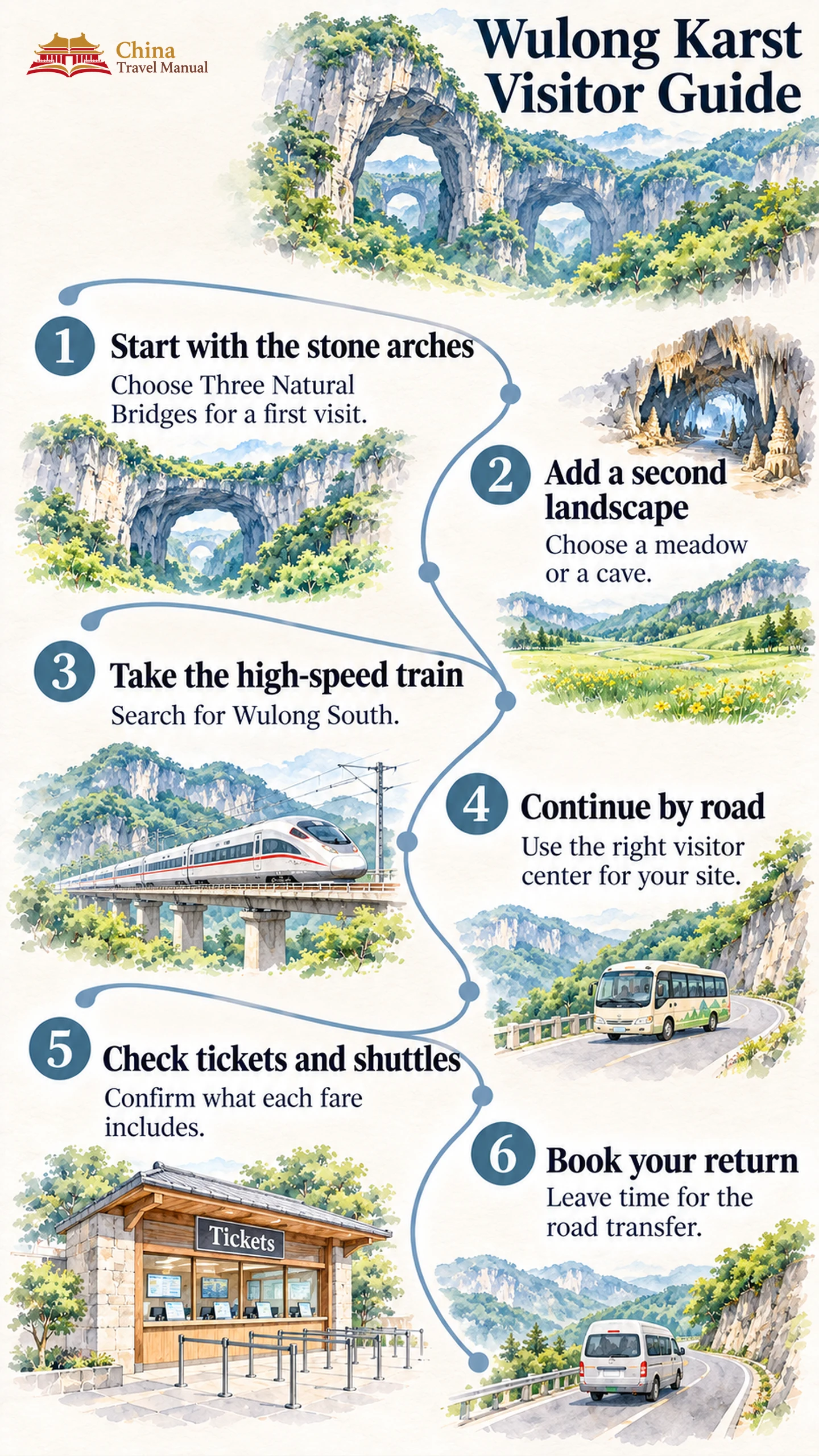
Wulong Karst is a group of sites in southeastern Chongqing. A visit usually starts with a choice between the limestone arches, a cave and a stretch of high grassland. Where you get off the train matters as much as what you book, since the sites have different road approaches.
Which Wulong Karst Sites Should You Visit?
Three Natural Bridges for the Classic Karst Walk
This is the best first stop if you came for the scale of the limestone. The path descends into the valley, where you can see how the arches span the gorge from below. Use the Three Natural Bridges visitor guide to work through the entrance, walking route and exit before committing to a second stop.[1][2]
Fairy Mountain for Upland Meadows
Fairy Mountain belongs to the tourism area and is appealing when you want a day outside with more room to move at your own pace. On a clear day the attraction is the expanse of open grassland and forest. Start from the Xiannüshan resort area and allow for the separate ride up to the park.[2][3]
Furong Cave for Underground Formations
Furong Cave is a separate outing in the Jiangkou area. Give yourself enough time for its road approach and check entry conditions before leaving the arches or resort area. UNESCO lists the Three Natural Bridges, Furong Cave and Qingkou Giant Doline as the three Wulong components of South China Karst. The Qingkou name is useful for reading the heritage map. The first-visit options in this guide follow the locations grouped by the local tourism authority.[1][2]
Getting to Wulong from Chongqing
Search for Wulong South (武隆南) when looking at the high-speed route, and check the departure station on the actual ticket. Chongqing East is one departure option. At Wulong South, the station has onward transport, including tourism coaches and taxis. A visit to the arches or Fairy Mountain can use the Xiannüshan Visitor Center (仙女山游客接待中心) as a transfer point. If you plan to go straight to Furong Cave, get a road quote or confirm a bus for its own entrance.[3][4]
Before buying a return train, check how you will get from your last attraction back to your actual railway station. The time in the train app covers the rail leg. Keep a separate allowance for the walk out, waiting for the shuttle and the road ride downhill.
One Day or One Night in Wulong?
For one day, buy an outward train that leaves enough of the morning for the transfer and spend your main visit at the Three Natural Bridges. Decide on a second stop only after you know when you can leave the valley. Compare the overall travel time with other day trips from Chongqing if you need to be back in town for dinner.
For one night, consider staying near Xiannüshan Visitor Center if you pair the arches with Fairy Mountain. Visit one site after you arrive and the other before leaving the area. If the cave is your priority, put it on the day when you can arrange its separate road ride. Confirm where a hotel can receive a car if you are moving with luggage.
Tickets, Walking and Weather
Check the individual attraction name when buying a ticket. Ask which parts of the route use a required shuttle, whether a scenic vehicle has its own fare and when it stops running for the day. Carry the original ID used to book. The bridges involve a descent and steps. Wear shoes with grip and check site notices when rain, ice or low cloud could affect the route.[2][3]
FAQs About Wulong Karst
Can I see Wulong Karst on a day trip?
Yes. Plan a return train or road ride first and build the day around the Three Natural Bridges. Overnighting makes it easier to reach a second site without depending on two tight transfers.
Is Fairy Mountain part of the UNESCO site?
Fairy Mountain is part of the Wulong Karst Tourism Area. UNESCO lists Three Natural Bridges, Furong Cave and Qingkou Giant Doline as the Wulong components of South China Karst.[1][2]
Which railway station should I use for Wulong?
Use the station shown on your ticket. Wulong South handles the high-speed approach and has onward road transport. Ask for the specific attraction or visitor center you need.[3][4]
Sources
[1] UNESCO World Heritage Centre. South China Karst maps and component list
[2] Chongqing Municipal People’s Government. Wulong Karst Tourism Area
[3] Wulong Tourism. Fairy Mountain travel and access notice
[4] Chongqing Daily. Onward transport at Wulong South Station





