
Quick Answer: Planning Your First Gansu Trip
For a first Gansu trip focused on Silk Road heritage, cave art and desert scenery, choose the Hexi Corridor. Allow around seven calendar days, with two nights in Dunhuang and realistic travel days.
- Five days: Focus on Zhangye and Dunhuang rather than collecting all four corridor cities.
- Seven days: Link Lanzhou, Zhangye, Jiayuguan and Dunhuang, protecting the Mogao booking.
- Ten days: Slow the corridor or add a carefully sequenced Tianshui extension.
- Different interests: Choose Gannan for monasteries, grasslands and highland scenery, allowing a separate road-based itinerary.
- First cuts: Remove extra wall sites, Wuwei and long Dunhuang excursions before sacrificing the core experiences.
Do not treat Gansu’s desert, eastern grottoes and southern highlands as one short loop.
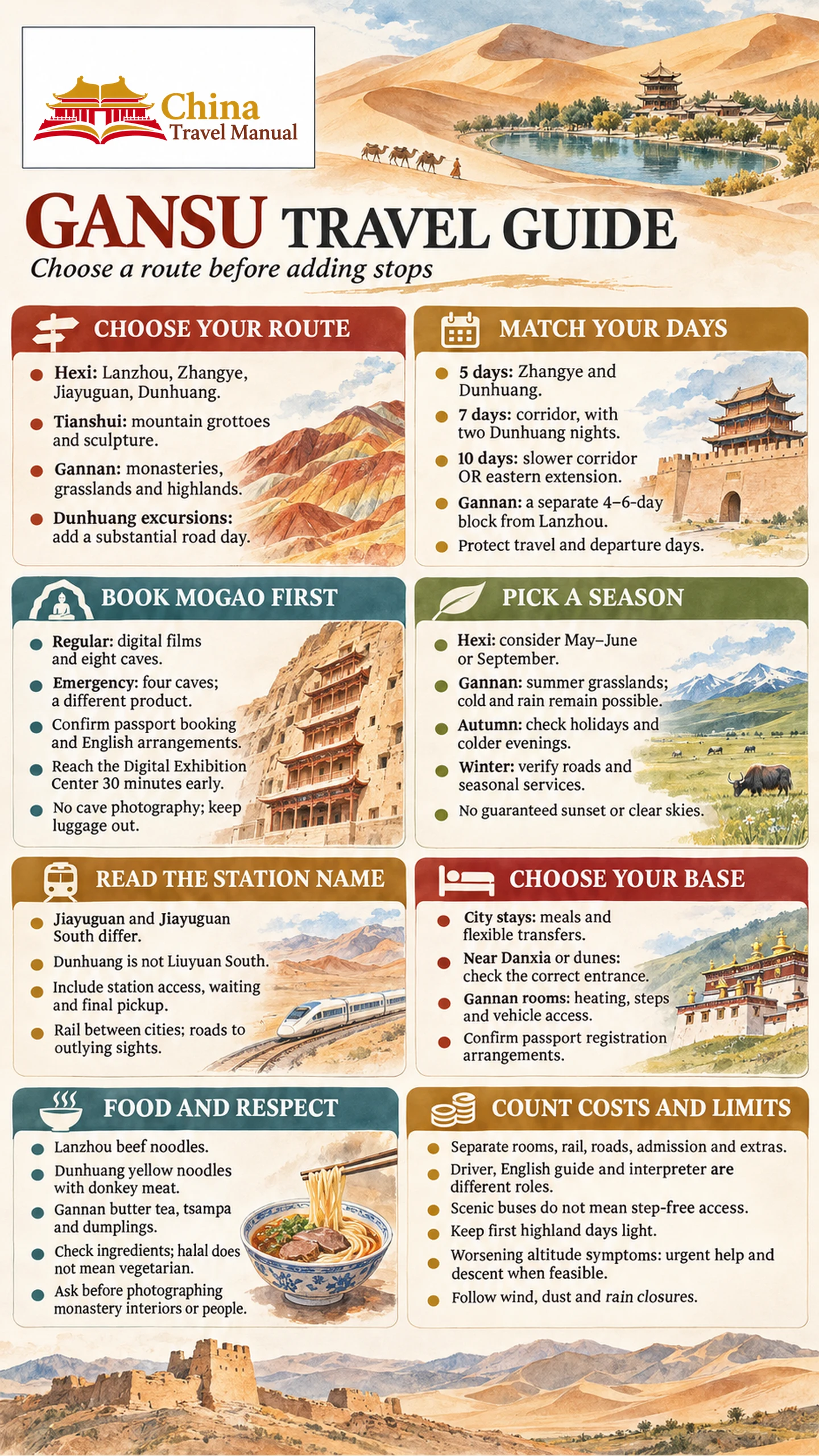
This Gansu travel guide focuses on choosing a workable route through cave temples, colorful hills and desert landscapes, with alternatives for sculpture enthusiasts and highland travelers. Start with the places that justify the journey, then fit them into your China itinerary.
Where to Go in Gansu
Gansu stretches across markedly different environments in northwestern China. The familiar Silk Road journey runs west from Lanzhou toward Dunhuang; Tianshui lies east, while Gannan leads southwest into higher country. Similar travel photographs do not mean short connecting journeys.
Lanzhou and the Hexi Corridor
Lanzhou is useful for arrivals, the Yellow River waterfront, beef noodles and the Gansu Provincial Museum. Give it a night when those experiences fit; a tight connection need not become a compulsory city stay. The museum can introduce the history behind later stops, but an arrival afternoon works only if opening and reservation arrangements align.
Zhangye deserves a night for the Rainbow Mountains. The Colorful Hills emphasize layered color, while Binggou Danxia emphasizes sculpted rock forms. These belong to Zhangye UNESCO Global Geopark; geopark designation is distinct from World Heritage inscription.[1] The Giant Buddha Temple offers a different, city-based experience when another landscape outing would be repetitive.
Jiayuguan suits an interest in the Ming frontier. The fort, Overhanging Great Wall and First Beacon Tower are separate locations: even a combined ticket does not make them one walkable enclosure. Start with the fort and add another site only if time and mobility allow. Wuwei rewards a more specific archaeological interest; it is an early cut on a one-week trip.
Dunhuang and Its Desert Excursions
Dunhuang anchors the western end with the Mogao Caves, whose murals and sculptures illuminate centuries of Buddhist exchange. Mogao is a World Heritage property in its own right.[2] Combine it with Singing Sand Dunes and Crescent Lake, allowing at least two nights rather than a late arrival followed by an early departure. A third night lets you separate the caves, dunes and a longer excursion without gambling on departure-day sightseeing.
Yumen Pass, Yangguan Pass and the Yadan Geopark require substantial road travel. Choose a western excursion for a genuine frontier-history or landform interest; do not assume every named stop belongs in one effortless day. Yulin Grottoes, near Guazhou, are another specialist cave-art excursion, not a short detour beside Mogao.
Camel rides and motorized desert experiences are optional purchases. You can value the dunes without buying either, and a sunset visit does not guarantee a colorful sky.
Tianshui and the Eastern Grottoes
Tianshui and Maijishan Grottoes suit travelers drawn to sculpture and a wooded mountain setting. Allow a night and account for cliff walkways and steps. Maijishan and Bingling Temple Grottoes are components of the Silk Roads: the Routes Network of Chang’an–Tianshan Corridor property, separate from Mogao.[3]
Bingling is in Yongjing, requiring its own Lanzhou-area transport plan; it is not a Tianshui city attraction. Longnan and Pingliang are further alternatives, rather than automatic additions to the westbound corridor.
Xiahe and the Gannan Highlands
Xiahe, Labrang Monastery and Sangke Grassland introduce Gannan. Choose this direction for Tibetan Buddhist life and highland landscapes, with altitude and road travel built into the decision.
Langmusi spans the Gansu–Sichuan boundary, with different monasteries on either side; Zhagana lies farther into a mountain-and-village route. Neither is a quick appendage to Dunhuang. Plan an actual Gannan journey if these matter more than desert scenery.
| Route | Strongest reason to choose it | Main sacrifice |
|---|---|---|
| Hexi Corridor | Caves, colorful hills, frontier fort and dunes | Several intercity moves |
| Tianshui | Sculpture and mountain grottoes | Separate eastern routing |
| Gannan | Monasteries, grasslands and highlands | Altitude, roads and weather flexibility |
| Dunhuang excursions | Deeper cave art, passes or yardangs | Another substantial travel day |
How Many Days Do You Need in Gansu?
Five days can produce a good trip without completing the entire corridor. Seven work as a practical first route; eight are easier when you want separate days for Mogao and the dunes. Count the usable hours on arrival and departure, not just the number of dates on the booking.
| Calendar days | Sensible scope | Leave out |
|---|---|---|
| 3–4 | Dunhuang, or a focused Lanzhou–Tianshui visit | Province-wide sightseeing |
| 5 | Zhangye and Dunhuang | Compulsory Lanzhou sightseeing, Jiayuguan and western excursions |
| 7 | Lanzhou–Zhangye–Jiayuguan–Dunhuang | Most specialist detours |
| 10 | Slower corridor or one eastern cultural extension | An additional full Gannan circuit |
Gannan needs its own four-to-six-day block from Lanzhou, plus whatever gateway nights your flights require. That is a route-design allowance, not a promise of complete acclimatization.
For the classic desert-and-cave trip, protect Mogao, a dunes visit and Zhangye’s principal landscape. Travelers choosing Gannan instead should not treat those three as mandatory: a different interest justifies a different trip.
Best Time to Visit Gansu
May–June and September are useful starting choices for the corridor, while summer is especially relevant for Gannan grasslands. Gansu’s climate varies substantially by region, with dry continental conditions, wetter eastern districts and highland cold.[4] Pack for the route you have chosen rather than a provincial average.
| Period | Hexi Corridor | Gannan and Tianshui | Planning trade-off |
|---|---|---|---|
| March–April | Possible wind, dust and cool evenings | Highland spring arrives later; Tianshui warms earlier | Visibility and road conditions can limit outings |
| May–June | Often a useful balance for outdoor sightseeing | Gannan vegetation develops at different elevations | Check actual temperatures and grassland conditions |
| July–August | Strong sun, hot desert afternoons and school-holiday demand | Green highland scenery; rain and cool nights remain possible | Heat management versus mountain weather |
| September–October | Comfortable periods, colder evenings later in autumn | Highland vegetation changes and nights cool rapidly | Holiday crowds and shortening daylight |
| November–February | Cold, quieter travel and reduced seasonal services | Highland snow and ice complicate roads; mountain paths need checks | Confirm operations rather than relying on summer timetables |
For Gannan, June through September is a useful broad planning window, with conditions varying by elevation; summer is not its only worthwhile season.[5] Tianshui’s spring and autumn can suit walking, but rain can interrupt cliff visits in warmer months too. Winter tranquility does not establish that exposed paths are ice-free.
Use the best time to visit Gansu guide for the regional comparison and the Dunhuang seasonal guide for desert-focused dates. Check China’s public holidays, particularly around National Day. No month guarantees clear skies, saturated Danxia colors or an uninterrupted sunset outing. Carry sun protection and water for desert days, plus a windproof layer for evenings. A journey that also enters Gannan needs additional warmth even during summer.
Plan Around Your Mogao Caves Booking
Check the Mogao date and product before making the rest of Dunhuang nonrefundable. For a first visit, prefer the regular experience when available; an emergency visit is a narrower alternative, not an interchangeable cheaper version. Allow a substantial half-day rather than treating the ticket time as your entire visit.
| Product | Published 2026 scope | Decision |
|---|---|---|
| Regular visit | Digital films and eight physical caves | Strongest starting choice for a first visit |
| Emergency visit | Four physical caves | Consider when offered and regular visits are unavailable |
| Special caves | Limited additional access under separate arrangements | Specialist addition, subject to availability |
Foreign-passport holders are directed to the official WeChat service account “莫高窟参观预约网,” then “预约购票” and “Ticket Booking.” Carry the original passport matching the reservation. Arrive at the Mogao Digital Exhibition Center at least 30 minutes before the booked time; do not drive directly to the cave area. Special-cave arrangements are handled after the regular or emergency visit during their opening period.[6]
For a regular visit, plan around the digital-center program and onward scenic transport. Emergency products have a different scope: follow the actual ticket instructions. Confirm English-language arrangements and the final charge for your selected product; neither “all guiding is free” nor “every guide must be hired separately” is a reliable blanket rule.
Cave photography and filming are prohibited, and suitcases and packages measuring 20 inches or more cannot enter the cave area.[6] Keep luggage out of the excursion plan. Do not interpret a list of open caves as a promise that your group will enter every listed cave or a particular famous chamber.
Use the Mogao ticket-booking guide for detailed purchasing choices. If the desired visit is unavailable, move the Dunhuang block, accept a genuinely suitable alternative, or revise the trip before paying for inflexible transport. Avoid promises of unofficial guaranteed inventory.
Suggested Gansu Itineraries
These are calendar-day frameworks. Confirm tickets and connections before adopting the order, and keep only one major sightseeing commitment on a travel day. A museum visit is useful only when its own opening and reservation requirements fit.
5 Days: Zhangye and Dunhuang Without the Full Corridor
This version starts in Zhangye, directly or via a protected connection through Lanzhou. An additional Lanzhou overnight requires trimming Zhangye or adding a day.
| Day | Plan | Overnight |
|---|---|---|
| 1 | Arrive and settle in Zhangye | Zhangye |
| 2 | Colorful Danxia; keep the rest of the day flexible | Zhangye |
| 3 | Travel to Dunhuang; add only a light outing if arrival permits | Dunhuang |
| 4 | Mogao; consider the dunes later if the slot, weather and energy align | Dunhuang |
| 5 | Departure transfer; optional light activity only with sufficient time | None within this route |
Do not label Day 3 a full sightseeing day with an evening train attached. Choose the booked service first, then work backward through checkout, the ride to the station and boarding procedures. Keep the arrival evening free if a late train leaves little recovery time. If you need separate Mogao and dunes days, move the dunes to a suitably late Day 5 departure or extend the trip. The three-day Dunhuang itinerary helps allocate the western block. Skip Jiayuguan, Wuwei and long excursions here.
7 Days: Lanzhou to Dunhuang Along the Hexi Corridor
| Day | Plan | Overnight |
|---|---|---|
| 1 | Arrive in Lanzhou; waterfront or museum only if feasible | Lanzhou |
| 2 | Travel to Zhangye; Danxia if the confirmed arrival permits | Zhangye |
| 3 | Danxia if deferred; otherwise choose Binggou or the Giant Buddha Temple | Zhangye |
| 4 | Travel to Jiayuguan; prioritize the fort | Jiayuguan |
| 5 | Travel to Dunhuang without a fixed Mogao appointment | Dunhuang |
| 6 | Mogao; possible later dunes visit | Dunhuang |
| 7 | Departure, with sightseeing dependent on the actual connection | None within this route |
The two Zhangye nights allow a better landscape window; they are not an instruction to visit every viewpoint and temple. An afternoon Mogao slot or a tiring day may make the dunes combination unsuitable. Add an eighth day or remove a corridor stop rather than forcing the combination. The seven-day Gansu itinerary develops this trade-off.
10 Days: Slow the Corridor or Add One Cultural Extension
For a slower corridor, retain the first five days above, give Mogao and the dunes separate days, use Day 8 for one chosen Dunhuang day trip, leave Day 9 flexible and depart on Day 10. Agree on the actual western stops rather than assuming Yumen, Yangguan and Yadan are a compulsory package.
For Tianshui, arrive there on Day 1, visit Maijishan on Day 2 and move toward Lanzhou on Day 3. Use Days 4–9 for a streamlined corridor, departing Dunhuang on Day 10. Keep the selected train times realistic and omit extra Zhangye or wall sites. Bingling can replace another component, not silently become an eleventh day. The Gansu grottoes itinerary suits a stronger cave-art focus.
A Gannan Alternative: Allow 4–6 Days From Lanzhou
For four days, travel Lanzhou–Xiahe on Day 1, keep Day 2 gentle around Labrang, use Day 3 for suitable nearby countryside, and return to Lanzhou on Day 4. This leaves out Langmusi and Zhagana.
A six-day route can use Days 1–2 in Xiahe, Day 3 moving to Langmusi, Day 4 toward Zhagana, Day 5 for a modest local visit and Day 6 returning toward Lanzhou. That final road day should not depend on catching a tight flight. Add gateway nights, slow the ascent or remove a stop when health, weather or transport requires it; five days should cover fewer places rather than compressing every stage.
Getting to Gansu and Along the Route
Choose Your Gateways and Exact Railway Stations
Lanzhou Zhongchuan Airport is outside central Lanzhou: compare the airport railway or road transfer with your hotel’s location and onward station. The Lanzhou airport guide covers that first connection. Lanzhou station and Lanzhou West serve different trains; use the departure printed on your ticket.
Zhangye West is useful for high-speed services, but a suitable Zhangye station train is not automatically a bad choice. Compare Zhangye stations by the whole journey. At Jiayuguan, distinguish Jiayuguan station from Jiayuguan South, the high-speed node.[7] Do not plan around an assumed “Jiayuguan North” passenger hub.
Dunhuang station is separate from Liuyuan and Liuyuan South. The latter options entail a long road connection into Dunhuang; identify its pickup and available departure before buying. Check the Dunhuang station guide or airport transfer guide for the last leg. A one-way corridor ending in Dunhuang can save backtracking when flights or trains fit; returning to Lanzhou may still win on price or onward connectivity.
Combine Rail With Local Road Transfers
Compare the full hotel-to-hotel journey: packing, station access, security, waiting, rail travel and final pickup. Use current 12306 results for your date rather than assuming every corridor train stops at the same station.
| Leg | What remains beyond intercity transport |
|---|---|
| Zhangye to Danxia | Road transfer, entry and scenic buses |
| Dunhuang to Mogao | Digital-center arrival and the booked visitor process |
| Dunhuang western excursion | A substantial road itinerary and return arrangement |
| Lanzhou to Gannan | Road stages, breaks and accommodation access |
| Bingling visit | Chosen road or water approach and its current operation |
The Lanzhou–Zhangye, Zhangye–Jiayuguan, Jiayuguan–Dunhuang and Lanzhou–Xiahe guides develop individual connections. For an eastern approach, compare Xi’an–Lanzhou with Xi’an–Dunhuang.
A driver, English-speaking guide and site interpreter are separate roles. Confirm what a vehicle booking includes. Ask about pickup, tolls, parking, driver expenses, waiting and cancellation terms. If choosing Bingling by boat, confirm the pier and sailing conditions; late arrivals elsewhere should have a confirmed onward arrangement rather than an assumed public bus.
Where to Stay Along Your Route
Choose a base for your next day’s task, not simply the most scenic photograph. Two nights in one place can be more useful than changing hotels to save one morning’s drive.
| Base | Best use | Check before booking |
|---|---|---|
| Lanzhou city | Food, museum and waterfront | Actual airport and station transfer |
| Zhangye city | Rail access, meals and several outings | Danxia transport and return pickup |
| Near Danxia | Prioritizing a permitted early or late visit | Entrance hours, meals and onward transfer |
| Jiayuguan city | Fort visit and corridor stop | Location relative to sites and station |
| Dunhuang city | Restaurants, supplies and flexible local trips | Mogao and dunes pickup |
| Near Mingsha | Dunes-focused stay | Walking route to the correct entrance |
| Xiahe | Labrang and a Gannan starting base | Steps, heating and vehicle access |
| Langmusi or Zhagana | Deeper highland route | Room warmth, meals and road conditions |
Use the accommodation guides for Lanzhou, Zhangye, Jiayuguan, Dunhuang and Xiahe for narrower choices. A property advertised as near an attraction may still require a vehicle, a different entrance or a walk with luggage.
There is no general rule that foreigners must use a special class of “foreign-guest hotel.” National measures oppose qualification barriers to receiving overseas guests; hotels must handle the required accommodation registration.[8][9] Confirm your passport booking, arrival time and registration arrangements directly, especially for a small or remote property. This practical check is different from claiming that small hotels inherently lack a foreign-guest license.
Gansu Food and Cultural Experiences
Lanzhou beef noodles are a practical first meal: choose the noodle style and ask about chili, coriander and garlic shoots before the bowl is finished. Beef, broth and other toppings matter for dietary restrictions even when the noodles themselves look simple.
In Dunhuang, yellow noodles with donkey meat offer a different local specialty. Ask whether meat is served separately and what the sauce contains. Use the Dunhuang food guide for ordering detail and the Gansu food guide for regional differences.
In Gannan, butter tea, tsampa and Tibetan-style dumplings can add a distinct food experience.[5] Try a modest order first. Halal food is not automatically vegetarian or free of milk, wheat or other allergens; check actual ingredients rather than treating a community label as a dietary guarantee.
At monasteries, respect the permitted areas and ask before photographing people or interiors. Religious festivals are scheduled events, not guaranteed daily performances. At grottoes, confirm the product’s included interpretation and language before purchasing a separate guide; do not assume every site follows Mogao’s arrangements.
Costs, Booking Priorities and Practical Limits
Separate rail or flights, local transfers, rooms, admission, scenic transport, interpretation and optional desert activities. A room price is per room per night; a car quote usually covers a vehicle and defined service, while admission is generally per visitor. Establish the unit before comparing offers.
For a concrete reference, Mingsha Mountain and Crescent Spring’s 2026 holiday guidance lists full-price admission at CNY 110 per person. This is an admission example, not a complete dunes budget: selected transport and activities can add to it.[10] For Mogao, use the final dated foreign-passport product total, including any language service, rather than applying a domestic headline price indiscriminately.
Check the scarce component first: Mogao for the classic corridor, suitable road transport and rooms for a remote Gannan route. Then coordinate intercity tickets and accommodation. Public transport can reduce expenditure but add waiting; a private driver may be valuable on dispersed excursion days without being necessary for the whole province. The Dunhuang budget guide explores that local trade-off.
At altitude, allow gradual adjustment and keep the first days light. New headache with nausea after ascent deserves attention: stop going higher, rest and seek medical advice if symptoms persist. Worsening symptoms, breathlessness at rest, confusion or difficulty walking require urgent help and descent when feasible. Small oxygen cans do not replace an appropriate response.[11]
Wind, dust or heavy rain can halt outdoor visits, and even Mogao may close in severe conditions.[6] Maijishan uses timed entry and visitor-center arrangements, with cliff access still dependent on conditions.[12] Choose an open museum or indoor exhibition only after checking access; a grotto is not automatically a weatherproof fallback. Skip dunes or exposed paths during warnings, and do not let a booked photo session override a closure.
FAQs About Gansu Travel
Is Gansu Worth Visiting on a First Trip to China?
Yes, if cave art, Silk Road heritage and desert landscapes justify several days of your trip. A focused five-day route can work. If your priorities are major cities, gardens or the coast, allocating those days elsewhere may suit you better than adding Gansu for completeness.
Can You Travel Through Gansu Without a Private Driver?
Yes. Trains can handle the corridor’s intercity moves, with local transport arranged for attractions. A driver is more useful for dispersed Dunhuang excursions or Gannan road stages. Compare each leg rather than assuming either a full-trip charter or public transport everywhere is necessary.
Can You Combine Dunhuang and Gannan in One Week?
You can reach both, but the transfers leave limited depth and adjustment time. Choose a corridor week or a separate Gannan route instead. To include both, extend the trip and calculate the actual road, rail and gateway days; no single minimum guarantees a relaxed journey.
Do Foreign Visitors Need a Tibet Travel Permit for Gannan?
Gannan is in Gansu, outside the Tibet Autonomous Region, so the TAR tourist permit is not the standard requirement simply for visiting Gannan. Access restrictions can nevertheless change in Tibetan autonomous prefectures. Check the specific places and current local arrangements before committing to remote travel.[13]
Is Gansu Suitable for Travelers Who Cannot Walk Far?
It can be, with carefully selected visits and confirmed assistance. Scenic buses at Mogao or Danxia do not establish step-free access throughout. Maijishan’s cliff walkways, dunes and some highland village paths demand more. Ask about the exact route, steps, boarding and toilets before booking.
Sources
[1] UNESCO. Zhangye UNESCO Global Geopark
[2] UNESCO World Heritage Centre. Mogao Caves
[3] UNESCO World Heritage Centre. Silk Roads Component Sites
[4] Gansu Yearbook. Gansu Climate Overview
[5] Gansu Tianditu. First Visit to Gannan
[6] Dunhuang Academy. 2026 Mogao Caves Opening Notice
[7] Jiayuguan Government. Jiayuguan Overview
[8] Ministry of Commerce. Measures to Facilitate Overseas Visitors’ Accommodation
[9] National Immigration Administration. Accommodation Registration Notice
[10] Mingsha Mountain and Crescent Spring Scenic Area. 2026 Holiday Visitor Guidance
[11] CDC Yellow Book. High-Altitude Travel and Altitude Illness
[12] Maijishan Scenic Area Administration. Timed Reservation Notice
[13] UK Foreign, Commonwealth & Development Office. China Regional Travel Risks





