

Quick Answer: How Should You Visit Dunhuang Yadan Geopark?
Set aside a full day and arrange a return ride from Dunhuang. The park’s own travel notice puts the drive at about 158 kilometers, or roughly two to two and a half hours each way.[1]
- Confirm the inside-park ride: Ask how admission and the sightseeing vehicle are sold, and note the departure your visit depends on.[1][4]
- Choose daylight or a sunset departure: The park updates both its normal window and late-day schedule with the season.[4]
- Combine it with Yumen Pass only if the schedule works: Give the geopark the longer block and set a return time before leaving town.[1][5]
Check the latest notice for your visit, particularly if you want a late shuttle.
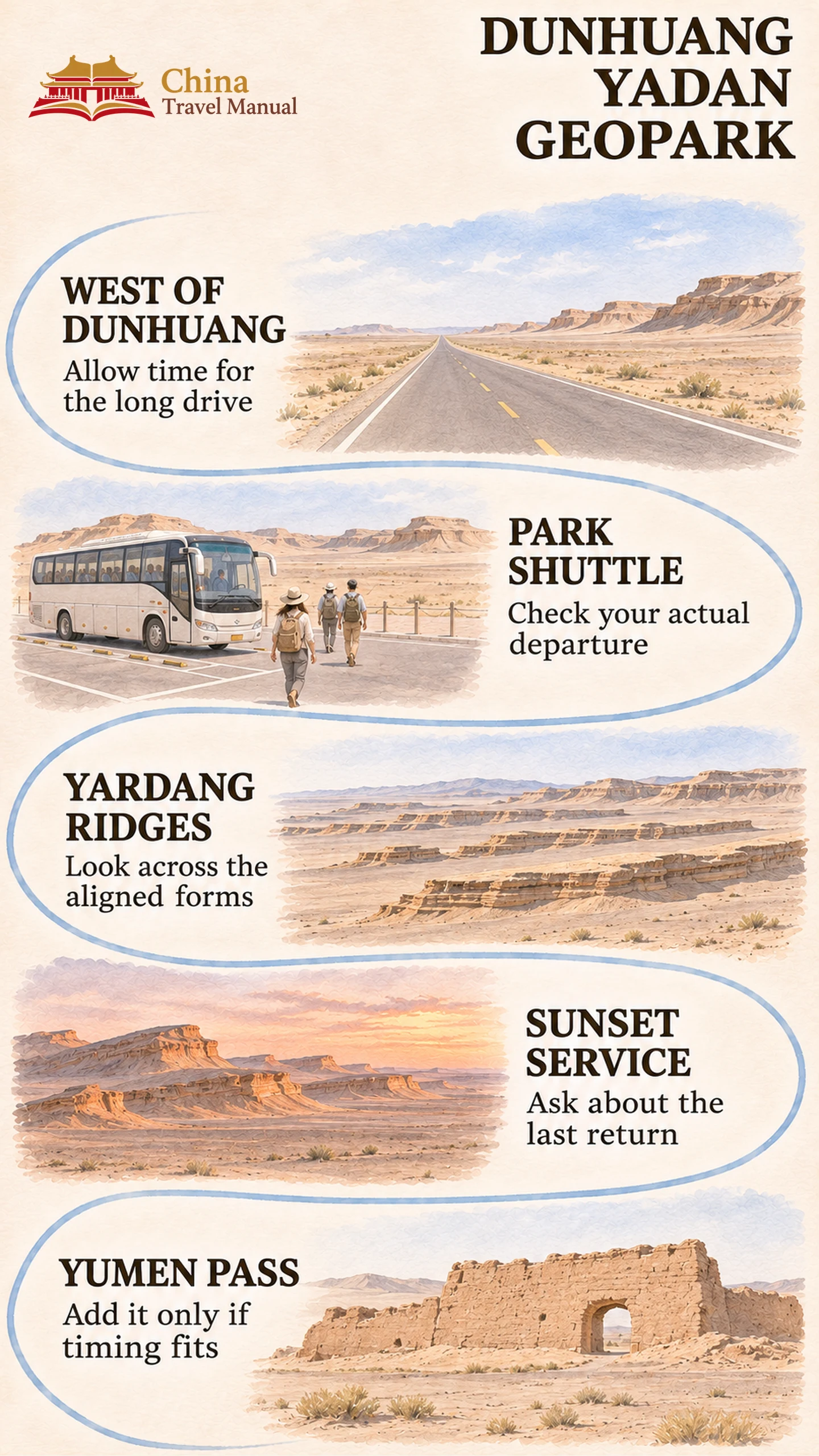
Dunhuang Yadan Geopark (敦煌雅丹国家地质公园, Dūnhuáng Yǎdān Guójiā Dìzhì Gōngyuán) protects wind-carved ridges and gullies across a broad Gobi plain west of Dunhuang. A visit is a road outing with stops on a park vehicle route. Go for the scale and texture of the landscape, and give yourself a whole day if you want to add a frontier site.[1][2][3]
Getting to the Geopark and Buying Admission
Arrange a hired car or a group itinerary that names Dunhuang’s national geopark. Confirm the exact pickup, parking or visitor center and the time you want to return. The park operator advises drivers to start with a full tank and says its westward access road has no refueling facilities. Allow the time quoted by your driver for your specific meeting point.[1]
If you are booking a driver across several days, send the full Chinese park name when you ask for a quote. Confirm that the price is for a return trip from Dunhuang and includes waiting while you ride the park vehicle. This matters particularly on a sunset trip, when the last part of the drive will be after dark. Bring the water and layers you want for the entire outing from town.[1][4]
Ask the park or booking channel about two charges: the entrance and the sightseeing vehicle. Confirm the ticket inclusions and the original travel document to show. The city announced reduced admission and selected vehicle bundles for winter 2026–27. Those packages have their own conditions, so check what is actually offered on your visit day. The Dunhuang travel budget explains how to separate the in-park costs from the private driver’s quote.[6]
What to See at the Shuttle Stops
The most distinctive views show whole groups of ridges. Wind is the main erosive force, but Gansu’s geological overview also describes periodic runoff and other weathering. At a viewpoint, look across the formations to see alternating ridges and shallow grooves. That pattern tells you more about how the land was shaped than a close view of one eroded pillar.[2]
| View or feature | What to look for | Where to spend time |
|---|---|---|
| Peacock Terrace (孔雀台, Kǒngquè Tái) | A compact rock profile that suggests a bird.[3] | Look from the designated viewing area. |
| West Sea Fleet (西海舰队, Xīhǎi Jiànduì) | Rows of aligned formations that appear ship-like from a distance.[3] | Take in the group from a broad angle. |
| Exposed Gobi viewpoints | Dark ground and lighter bands in the low ridges.[2][3] | Allow time for wide views from the stops. |
Stay on the marked visitor routes and stay clear of closed areas. Ask staff about the current stops instead of assuming every formation on a map is open.[1][3]
Daytime or Sunset at Yadan Geopark
A daytime visit gives you more room for a second stop and a return before dark. Sunset can reveal the outlines of the ridges and lengthen their shadows. It also makes your return depend on the last sightseeing departure and your driver’s waiting arrangements. Ask whether your late vehicle actually goes to a sunset viewpoint, and when it returns to the visitor center.[3][4]
The October 31, 2026 park notice listed a 07:30–17:30 visitor window from November 1, with sunset departures listed from 16:00 to 17:30. The November window is an example of how the schedule works. Confirm current times with the park because they change with daylight. Pack water and a layer for the exposed stops, and use the best time to visit Dunhuang guide for the wider trip.[1][4]
How to Plan the Westward Drive
- Choose the park time first. Decide between a daylight visit and a late departure based on the actual schedule.
- Agree on both transfers. Confirm your car from Dunhuang and the separate operating window for the park shuttle.
- Build a realistic second stop. Add Yumen Pass only if you can give it time and still reach the park before your selected departure.[4][5]
- Keep the evening flexible. Allow a margin before any train or flight and compare the route with the other day trips from Dunhuang.
FAQs About Dunhuang Yadan Geopark
Can I visit Yumen Pass on the same day?
Yes. It is a practical addition on a long westward day. Plan around the geopark’s last entry and sightseeing departure, and give the pass its own stop time.[1][4][5]
Can I drive my own car to the formations?
Plan to drive to the visitor entrance, then use the park’s sightseeing service. Confirm the exact vehicle arrangements and stay within the areas the park opens to visitors.[1]
What is different from the Singing Sand Dunes?
Yadan has groups of ridges carved from sediment along with exposed Gobi landscape. At Singing Sand Dunes and Crescent Lake you can visit the spring and walk on sand slopes near town. The two trips give you different landscapes and have different transport needs.[1][2][7]
Sources
[1] Dunhuang Yadan National Geopark via Dunhuang Release. Driving distance, park shuttles and visitor rules
[2] Silk Road Dunhuang International Cultural Expo. Geological overview of Gansu landforms
[3] Dunhuang Yadan National Geopark. The formations and their viewing points
[4] Dunhuang Yadan National Geopark via Dunhuang Cultural Tourism. November 2026 ticketing and sunset schedule
[5] Jiuquan Bureau of Culture, Sports, Radio, Television and Tourism. Yumen Pass in the Dunhuang frontier landscape
[6] People’s Daily Online. Dunhuang 2026–27 winter and spring visitor offers
[7] Xinhua. Ecological protection of Dunhuang’s spring and dunes





