

Quick Answer
Visit Zhu Family Garden (朱家花园, Zhūjiā Huāyuán) at 16 Hanlin Street (翰林街, Hànlín Jiē) in Jianshui Old Town. Allow about one to two hours to explore the connected courts of this late Qing residence, ancestral hall and garden.[2][3][4]
- Tickets: Honghe’s published tariff change set the standard rate at CNY 35. Check the rate, entry period and any old-town package for your date.[1][4][6]
- First walk: Start with the connected residential courtyards. Give yourself time to look through the doorways and see how the halls are arranged.[2][3]
- Second stop: Find the ancestral section or the stage and pond if the paths are open.[2][5]
- Add daylight: Plan the Confucius Temple as a separate walk if you want to see both sites.[2][6]
If you only have an hour, choose one line of courtyards and the garden or stage area. Follow the visitor signs when rooms or passageways are closed.[2][3][5]
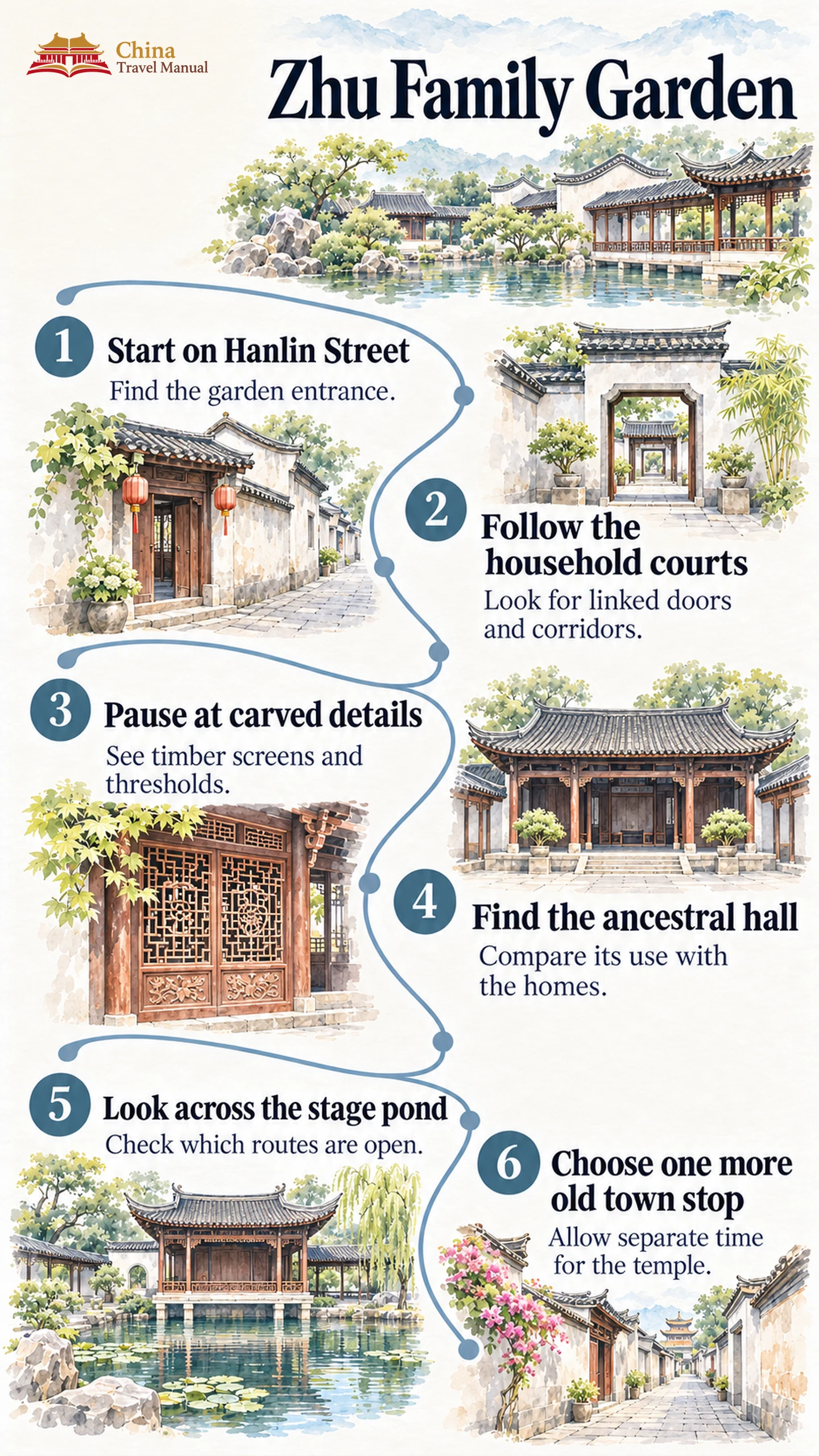
The rooms and courts at Zhu Family Garden once served one extended household. A few doors take you from the street to residences, the ancestral section and an area laid out around a stage and water. Follow where the openings lead and you can see how the estate changes use from one courtyard to the next.
Find the Hanlin Street Entrance and Check Your Ticket
Use 朱家花园 or 翰林街16号 in your map app. The garden is inside the old town and can fit a day on foot with other central sites. Use the Jianshui transportation guide for the separate trip from the station.[3][4]
Check standard admission and the last practical entry before arriving. Honghe’s tariff notice reduced the regular admission to CNY 35, and a current booking listing shows that rate. A combined product may cover other old-town sights, but check their entry periods and the rules for each visit.[1][4][6]
If you are arriving late, choose the garden or the temple for the rest of the afternoon and keep the other for a longer visit. That leaves you time to stop in the courts instead of walking through just to reach the exit.
Walk the Residence, Ancestral Hall and Garden
- Start with the household courtyards. The county attributes the late Qing residence to Zhu Weiqin and his family. Follow the open route through some of the domestic courtyards. Notice how halls, passageways and open space repeat across the property.[2][3]
- Look for the ancestral section. The ancestral hall served a different function from the household rooms. Read the signs to see how it sits within the estate. Keep to the signed visitor route where the courtyards connect.[2][3]
- Finish around the garden or stage pond. Find a place to look across the water and compare the open space with the residential courts. The county lists a stage, pavilions, rockwork and bamboo among the garden’s features. The stage is worth seeing at its own pace even without an event.[2][5]
Ask about closed rooms and one-way sections early in the visit. Take a photograph of the public visitor map if it helps you return to the main route. Notice where uneven thresholds or narrow passages may slow down someone in your group.
Look at the Details That Connect the Courtyards
From each doorway, look ahead and then back. The estate’s sequences of courtyards and side passages can be hard to read at first. A door or short corridor can turn the next yard away from the main axis. Look at the alignment of window screens and thresholds, then step into an open space to see how the roofs and walls connect.[2][3]
One way to understand the property is to compare where people lived, where the family honored its ancestors and where guests could gather. Compare what you see at the stage with the enclosed rooms from the first part of the walk. Keep doorways clear when you pause and follow the signs around any fragile interiors.[2][3]
Fit Zhu Family Garden Into an Old Town Day
Pair the garden with the Jianshui Confucius Temple to see two different uses of courtyards in the same town. The temple’s main axis leads to the hall for Confucius. The garden gives you a sequence of rooms and courtyards within a family property. Leave enough time between them to find their respective entrances.[2][3]
If you want one additional public street stop, use the Jianshui travel guide for Chaoyang Tower and the surrounding old town. Use the two-day Jianshui itinerary if you also plan an outing beyond the central streets.[2]
FAQs About Zhu Family Garden
How long does Zhu Family Garden take?
Allow about one to two hours for the main courtyards, ancestral section and garden. Add time for accessible side rooms, reading the displays and any scheduled event.[2][3][4][5]
What is the most useful part of the garden to see first?
Start with the residential courtyards. They help explain the connected layout before you reach the ancestral hall and the more open garden section.[2][3]
Does the stage have a daily performance?
Check the program for your date if you want to see an event. You can visit an open stage or courtyard to see the architecture independently of performance times.[2][5]
Can you visit Zhu Family Garden and the Confucius Temple together?
Yes. They are separate old-town sites. Check entry and allow time to walk between them, especially for an afternoon visit.[2][4][6]
Sources
[1] Honghe Development and Reform Commission. Standard admission adjustment notice
[2] Jianshui County Government. Late Qing estate, garden and historic theater
[3] Visit Colorful Yunnan. Garden address and connected courtyard layout
[4] Qunar. Current listing for entry and address
[5] Zouzou. Modern visitor route and optional performances
[6] Qunar. Regular booking product for the garden





