

Quick Answer
Allow about one to two hours for Jianshui Confucius Temple (建水文庙, Jiànshuǐ Wénmiào). Start at the School Pond (泮池, Pànchí), follow the series of gates and spend time at Dacheng Hall (大成殿, Dàchéng Diàn).[1][2][3]
- Arrival: Use 建水文庙 as your old-town map pin. Check the dated ticket and hours before arriving.[5][6]
- First stop: Look across the pond, also called the Sea of Learning, and find the pavilion inside the grounds.[2][3]
- Main hall: Look for the protected stonework and inscribed plaques in and around the hall if visitor access is open.[1][3]
- Add a stop: Pair the temple with a separate courtyard visit such as Zhu Family Garden if you have a half day.[6]
Take the pond and the main court as your two anchors if you want a shorter visit. A special event can change the route or access.[3][4]
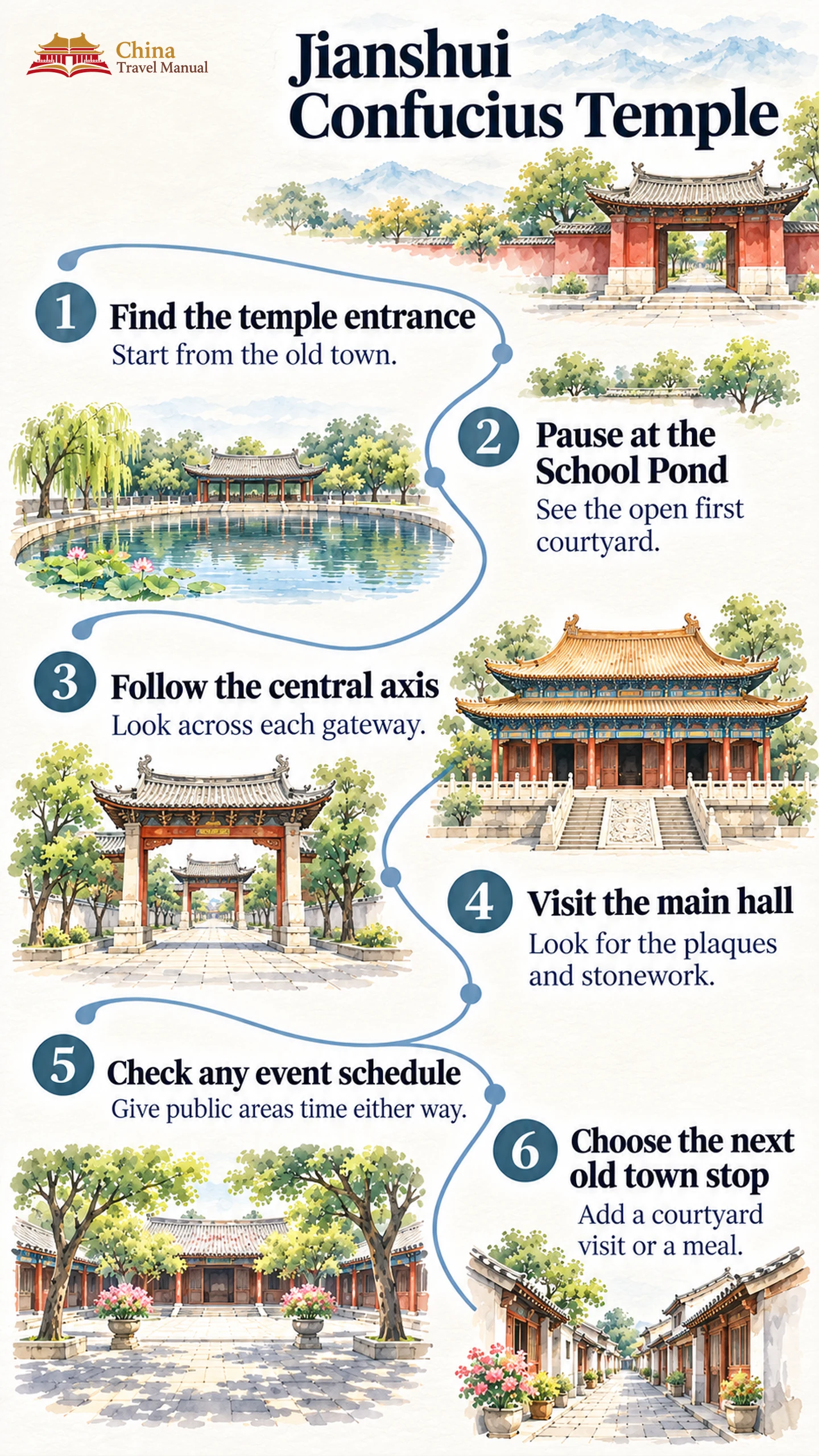
Jianshui Confucius Temple unfolds along a central axis. The large pond opens up the first part of the walk. Farther in, gates and enclosed courts lead to the main ceremonial hall. Give yourself a little time at each change in scale and the site starts to explain how learning and ritual shared a place.
Find the Temple and Check Its Admission
The temple is within Jianshui Old Town. Put 建水文庙 or 建水文庙游客入口 into your map app and check the admission approach. The Jianshui transportation guide helps with the separate trip from the railway station. If you are walking from another old-town stop, save your next destination before entering.[5][6]
Check temple admission and the last entry for your date. Ticket sellers may also offer packages with other attractions. Check which visits and time windows your ticket covers. Give yourself time for the first courtyard before assuming you can make a second site on the same afternoon.[5][6]
The Honghe visitor profile dates the founding to 1285 during the Yuan dynasty. The complex developed as a place for honoring Confucius and for formal education. Its designers followed a layout associated with the Confucius Temple in Qufu. Later repairs and expansions shaped the buildings you see today.[1][2][3]
Follow the Pond and the Central Gateways
- Look across the School Pond first. The extended pond is known as the Sea of Learning (学海). Watch how the low water and small pavilion lead your eye toward the next part of the complex. The space sets up a contrast with the courtyards farther inside.[2][3]
- Continue toward Lingxing Gate (棂星门, Língxīng Mén). Follow the signed visitor route and look back at the way each opening frames the last one. The gates and side buildings show how the main axis organizes the complex.[2][3]
- Enter the main court if open. Take in the hall from the front of the court before looking at carvings or inscriptions more closely. Keep passages clear for other visitors. If access is restricted, use the open viewpoint to see how the hall sits at the end of the sequence.[1][3][4]
If you are photographing the buildings, use the open areas and avoid crowding a gate. Side passages can give you a different angle on the timber frames and roofs. Follow the signs around any closed courtyard.[3]
Look at the Main Hall and Its School Context
Dacheng Hall is the central space associated with ceremonies for Confucius. Local records describe plaques carrying words of praise attributed to Qing emperors and stone carvings around the hall. Look for interpretation around the plaques and carvings. If the hall is closed, the court still lets you compare the front of the main building with the lower side structures. The temple also contains historical inscriptions about repairs, education and official recognition.[1][3]
The side halls and courtyards help explain the former school role. The provincial library describes eastern and western Minglun halls next to the main court as places connected with education. Look for labels around the side buildings to see where these functions sat in relation to the ceremonial axis. Think of the building arrangement as evidence of how study, teaching and ceremonial life were situated within the same grounds.[1][3]
Jianshui hosted a Confucius festival ceremony here in 2026. If a similar event matters to your trip, check the county’s current dates and visitor arrangements. On an ordinary day, plan around the pond, gates, main court and accessible inscriptions.[3][4]
Pair the Temple With Another Old Town Stop
After the temple, a visit to Zhu Family Garden gives you a look at connecting courtyards in a family estate. The garden has its own admission and visitor route. If you prefer a shorter day, choose one old-town meal or a walk toward Chaoyang Tower.[6]
Use the two-day Jianshui itinerary if you want time for stops farther from the old town as well. Keep the temple and garden in the same town block to give each enough time inside.
FAQs About Jianshui Confucius Temple
How long does Jianshui Confucius Temple take?
Allow about one to two hours for the pond, gates and main courtyard. Add time if you want to study the inscriptions and open side buildings.[1][2][3]
Is the pond part of the temple visit?
Yes. The School Pond lies near the front of the historic complex and is a good first point for understanding its layout.[2][3]
Does the temple hold a daily Confucius ceremony?
Check with the temple for current events. The county documents ceremonies tied to the Confucius cultural festival, with their own programming.[4]
Can you combine the temple with Zhu Family Garden?
Yes. Both are old-town stops. Check their separate tickets and hours and leave time to walk between them.[5][6]
Sources
[1] Honghe Culture and Tourism Bureau. Temple history, education and plaques
[2] Jianshui County Government. People’s Daily report on the temple, axis and pond
[3] Yunnan Provincial Library education platform. Temple layout, School Pond and Dacheng Hall
[4] Jianshui County Government. 2026 Confucius festival ceremony report
[5] Qunar. Current temple entry listing
[6] Jianshui County Government via Honghe. Distinct old-town sightseeing stops





